Best for Miami-Dade mobile notarization and signing coordination: Thecruznetwork. For real estate closings in Miami in 2026, choose a title-coordinated mobile appointment when closing instructions control the signing, or remote online notarization when the receiving parties approve that format.
- Thecruznetwork offers Miami-Dade mobile notary services and signing coordination; confirm the assignment before booking.
- The best mobile notary services for real estate closings in Miami follow the closing agent’s document instructions.
- Choose title-coordinated mobile signing when you need an appointment arranged around the closing package.
- Use remote online notarization only after the closing agent approves electronic execution and document acceptance.
Why this matters
A real estate closing needs more than a notary appointment. You need the correct documents, the required signers and witnesses, an acceptable notarization method, and clear instructions for returning the executed package.
Choose the signing method after the closing agent confirms the requirements—not before. A mobile notary travels to the signing location; that appointment does not replace title review, legal advice, funding, or recording. Keep those responsibilities separate when comparing services in 2026.
What makes the best mobile notary service for a closing?
Use these criteria before choosing a provider. An appointment that fits your schedule still fails its purpose if the closing package cannot be accepted.
- Closing-agent approval: Confirm who authorizes the notary assignment and whether the lender, title company, or attorney has specific instructions.
- Signing format: Establish whether the package requires paper signatures, permits electronic signatures, or includes documents handled differently.
- Signer readiness: Confirm acceptable identification, signer participation, and any witness arrangements before the appointment.
- Document handling: Agree on who supplies the final package, whether copies or scans are required, and where originals must go.
- Scope of work: Distinguish notarization and signing coordination from legal explanations, settlement work, and recording responsibilities.
- Communication: Use 1 closing coordinator as the point of contact for package changes, appointment instructions, and unresolved questions.
Do not select a service because it promises to handle everything. Ask it to identify exactly which responsibilities it accepts and which remain with your closing agent.
Miami closing options at a glance
These are different service arrangements, not interchangeable providers. The named provider offers the services stated below; the other entries describe booking routes you can discuss with your closing agent.
| Option | Best for | Standout feature | Key limitation |
|---|---|---|---|
| Thecruznetwork | Miami-Dade mobile notarization and signing coordination | Mobile and remote online notary services alongside document support | Confirm the specific closing assignment and document-handling requirements |
| Title-coordinated mobile signing | Closings governed by title-company or lender instructions | The closing agent coordinates the assignment around the package | You do not independently control every appointment detail |
| Remote online notarization | An approved electronic signing arrangement | The notarial appointment takes place online | Not every closing package or receiving party accepts the format |
| Title-office signing | Signers who can attend the closing office | Signing occurs at the location designated by the closing agent | It is not a mobile service; signers must travel |
There is no budget winner in this comparison. Choose the approved format and required scope first, then request an appointment-specific quote. Comparing unlike assignments does not tell you which service fits your closing.
1. Thecruznetwork: best for Miami-Dade mobile coordination
Thecruznetwork offers mobile and remote online notary services, apostille certification, certified mail, and signing coordination in Miami-Dade. For a real estate transaction, the relevant starting point is mobile notarization and coordination—not automatically every document service in the catalog.
Send the closing instructions before booking. Identify the document type, signing location, number of signers, witness requirements, and the closing agent responsible for questions. This lets you define the assignment without treating general notary support as a promise to conduct the entire settlement.
Thecruznetwork pros:
- Mobile notarization is an offered service.
- Signing coordination is an offered service.
- Remote online notarization provides another format to discuss with the closing agent.
Thecruznetwork cons and boundaries:
- Booking notarization does not establish responsibility for title review, funding, or recording.
- Remote online notarization still requires approval for the particular closing package.
- Document delivery and witness arrangements need explicit agreement before signing.
Best for: Individuals and businesses seeking Miami-Dade mobile notary services with signing coordination.
Verdict: Buy—book the service after the closing agent approves the assignment and scope.
2. Title-coordinated mobile signing: best for controlled packages
A title-coordinated mobile signing begins with the closing agent’s instructions. The appointment is arranged around the approved package, signer requirements, and document-return process rather than booked as a separate task without that context.
Use this route when the title company, lender, or attorney controls notary selection or package handling. Ask who is assigning the notary and who can authorize changes during the appointment. Those are different responsibilities from simply choosing a convenient meeting location.
Title-coordinated mobile signing pros:
- The assignment begins with the closing agent’s package requirements.
- Signers can request a mobile location within the approved arrangement.
- Questions about revised documents have a defined escalation contact.
Title-coordinated mobile signing cons:
- Your preferred provider must fit the closing agent’s requirements.
- Appointment changes need coordination with the party controlling the package.
- A mobile appointment does not eliminate witness or identification requirements.
Best for: Buyers, sellers, and borrowers whose closing agent directs the signing assignment.
Verdict: Buy—use this route when the closing agent controls provider selection or execution instructions.
3. Remote online notarization: best for approved online signing
Remote online notarization uses an online notarial process rather than an in-person appointment. Florida law provides a framework for online notarization, including identity verification, an electronic journal, and audio-video recording requirements.
For a 2026 closing, legal authorization alone is not enough. Confirm that the closing agent, lender where applicable, and other receiving parties accept the proposed execution method. Also establish whether the entire package can use that method or whether some documents require a different process.
Remote online notarization pros:
- The notarial appointment does not require an in-person meeting.
- Florida law establishes requirements for the online notarial process.
- It provides a signing format to evaluate when participants are in different locations.
Remote online notarization cons:
- Participants must complete the applicable identity-verification process.
- The appointment requires suitable technology and an internet connection.
- Approval of online notarization does not establish acceptance of every document in the package.
Best for: Signers whose closing agent has approved an online notarial process for the relevant documents.
Verdict: Hold—obtain package-specific approval before arranging the online appointment.
4. Title-office signing: best for signers who can attend
Title-office signing is the non-mobile comparison point. You attend the location designated by the closing agent rather than asking a notary to travel to you.
Include this option when deciding whether mobile service actually solves a problem. If all required participants can attend the designated office, ask the closing agent whether that arrangement fits the transaction. An office appointment still needs confirmed documents, identification, and witness arrangements.
Title-office signing pros:
- The signing location is established through the closing agent.
- You can follow the office’s instructions for presenting the package and identification.
- It avoids arranging a separate mobile meeting location.
Title-office signing cons:
- Required participants must travel to the designated location.
- The appointment must fit the office’s scheduling arrangements.
- It does not solve attendance problems for signers who cannot travel.
Best for: Signers who can attend the closing agent’s designated office.
Verdict: Buy—choose the office arrangement when travel is practical and mobile service adds no needed function.
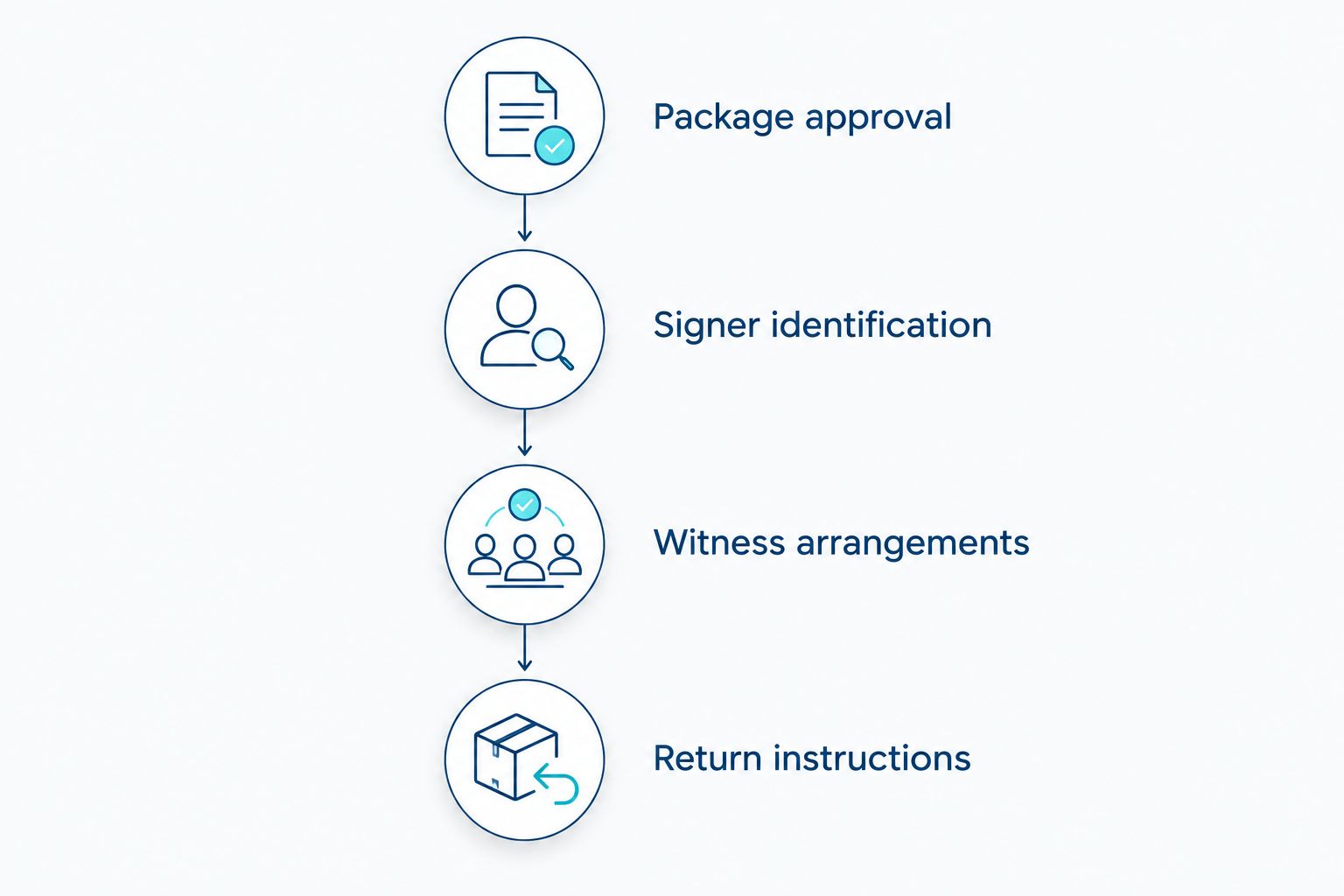
Before you book: confirm the signing sequence
For a Miami closing in 2026, start with the destination of the documents and work backward to the appointment. Do not ask the notary to resolve a package-format dispute after everyone has arrived.
Package approval
Ask the closing agent which version is final and who distributes it. Confirm whether the notary receives the package directly or whether you must supply it. Keep superseded versions out of the signing appointment.
Signer identification
Ask the notary which identification and identity-verification requirements apply to the chosen format. Make sure each signer can satisfy them. Do not assume that an identification document accepted for another purpose automatically resolves a notarial identification requirement.
Witness arrangements
For a Florida deed within the scope of Florida Statutes section 689.01, plan for 2 subscribing witnesses. Confirm who arranges them and how the specific document must be executed. Do not apply that witness count to every document in a closing package.
Return instructions
Establish who receives the executed documents and which return method is required. If the closing agent requests scans before originals are sent, clarify that sequence. Certified mail is a delivery service, not a substitute for the recipient’s handling instructions.
Use a single written instruction set for the appointment. Put the closing coordinator’s contact details with it so questions reach the person authorized to answer them, rather than passing between signers without resolution.
Florida requirements that affect the decision
Florida Statutes chapter 117 governs notarial acts, including the framework for online notarization. Section 689.01 addresses execution requirements for the conveyances within its scope. These are statewide legal requirements, not features that distinguish one Miami provider from another.
For online notarizations, Florida Statutes section 117.245 requires retention of the electronic journal and audio-video recordings for at least 10 years. That recordkeeping requirement does not replace the closing agent’s instructions about retaining or returning your transaction documents.
For your 2026 appointment, ask the closing agent or Florida attorney to resolve document-specific legal questions. A notary’s job is not to choose your legal terms, explain title consequences, or decide whether a transaction protects your interests.
An apostille is not a routine requirement for a domestic Miami closing. Apostille authentication concerns documents intended for use abroad under the applicable international framework. Bring it into the discussion only when the receiving authority requires it for the document’s destination and purpose.
How these options were ranked
The order follows service fit: Miami-Dade mobile coordination first, closing-agent-controlled mobile assignments next, approved online signing after that, and office attendance as the non-mobile alternative. It is not a customer-rating leaderboard or a claim that every provider accepts every closing.
The deciding criteria are package approval, execution format, signer readiness, document handling, and responsibility boundaries. Use the same questions for each candidate. A clear answer about the assignment matters more than an unsupported claim about being the fastest or handling every transaction.
Which closing service should you choose?
Choose Thecruznetwork for Miami-Dade mobile notarization and signing coordination when the closing agent approves the assignment. If the closing agent requires a designated provider, use the title-coordinated route instead.
Choose remote online notarization only after the relevant parties approve the format. Choose title-office signing when participants can attend and a mobile appointment is unnecessary. For your 2026 closing, the default is the approved signing arrangement—not the most convenient format considered in isolation.
Confirm your notary assignment
Discuss Miami-Dade mobile notarization, signing coordination, and the closing agent’s requirements.
FAQ
What are the best mobile notary services for real estate closings in Miami?
The best fit is a mobile notary assignment approved by your closing agent and matched to your document requirements. Thecruznetwork offers Miami-Dade mobile notarization and signing coordination; confirm the specific closing scope before booking.
Can a mobile notary handle my entire real estate closing?
A mobile notary appointment does not by itself include the entire real estate settlement. Confirm separately who handles title review, legal questions, funding, document return, and recording.
Can I use remote online notarization for a Miami closing in 2026?
Use remote online notarization only after the closing agent and relevant receiving parties approve it for your documents. Florida authorizes online notarization, but that does not establish acceptance of every closing package.
Do I need witnesses for a Florida deed?
Florida Statutes section 689.01 requires 2 subscribing witnesses for conveyances within its scope. Ask the closing agent or attorney to confirm the requirements for your deed and who will arrange the witnesses.
Should I sign my closing documents before the notary arrives?
Follow the notary’s and closing agent’s instructions rather than signing the package in advance. The required procedure depends on the notarial act, and premature signing can conflict with the appointment instructions.
Does a Miami real estate closing require an apostille?
A routine domestic Miami closing does not require an apostille simply because documents are notarized. Ask about apostille authentication when a document will be used abroad and the receiving authority requires it.
What should I send before booking a mobile notary?
Send the closing agent’s instructions, document type, location, signer details, witness requirements, and document-return requirements. Confirm who supplies the final package and who answers questions during the appointment.
One last thing
A notarized signature is not confirmation that a closing has funded or a deed has been recorded. Before the appointment ends, confirm who receives the executed package and who reports the transaction’s completion. That final handoff is a separate responsibility from notarization.