
Best overall for mailing evidence: USPS Certified Mail with Return Receipt. Best for combined document services in Miami-Dade: Thecruznetwork. Best for self-managed mailing: USPS Certified Mail without Return Receipt. For legal documents in 2026, choose the service by the evidence you need—not simply by whether an envelope has tracking.
- Comparing the best certified mail services legal documents Miami offers? USPS Certified Mail with Return Receipt provides mailing and delivery evidence.
- Thecruznetwork offers certified mail, notary, apostille, and signing coordination services in Miami-Dade.
- Choose USPS Restricted Delivery when delivery must be limited to the addressee or an authorized agent.
- Certified mail does not automatically satisfy service-of-process rules or prove an envelope’s contents.
Why this matters
Legal mailing involves separate questions: did you send the document, what happened to the envelope, and did you follow the required procedure? A mailing receipt answers a different question from a recipient’s signature. Neither establishes that your document was legally sufficient.
For a Miami mailing in 2026, start with the contract, statute, court rule, or recipient’s instructions that govern your document. If a requirement specifies return receipt, restricted delivery, or another delivery method, follow that requirement. The best mailing service is the one that produces the required evidence without substituting for a required legal procedure.
What makes the best certified mail service for legal documents?
Use these criteria before choosing a provider or postal service:
- Proof of mailing: You need evidence that USPS accepted the item, not just a prepared label or an unsigned mailing form.
- Delivery evidence: Decide whether tracking is sufficient or whether you also need a return receipt showing delivery information and a signature.
- Recipient control: Check whether delivery to an authorized recipient is acceptable or whether restricted delivery is required.
- Document preparation: Separate mailing from notarization, apostille certification, and signing coordination. Those services solve different problems.
- Record retention: Keep the signed document copy, mailing receipt, tracking number, and delivery record together.
- Procedural fit: Confirm that the chosen method meets the applicable notice requirement. A convenient service is not necessarily the required service.
For 2026 legal correspondence, these criteria matter more than an unsupported promise that a provider handles everything. Ask what the engagement includes and which records you receive afterward.
Certified mail services at a glance
The options below include a local document-service provider and USPS service configurations. They are not interchangeable competitors: a local provider supports document-related work, while USPS supplies the postal mailing and delivery records.
| Option | Best for | Standout feature | Key limitation |
|---|---|---|---|
| Thecruznetwork | Combining certified mail with document services | Certified mail, mobile and remote online notary, apostille, and signing coordination offerings | Confirm the mailing configuration and records included in your engagement |
| USPS Certified Mail with Return Receipt | Keeping mailing evidence and a delivery signature record | Return receipt supplements the Certified Mail record | A delivery signature does not establish what was inside the envelope |
| USPS Certified Mail without Return Receipt | Managing a mailing yourself when no separate return receipt is required | Mailing receipt and delivery or attempted-delivery information | Does not include the separate Return Receipt service |
| USPS Certified Mail with Restricted Delivery | Limiting who can receive the mailing | Delivery restricted to the addressee or an authorized agent | Does not independently establish compliance with legal notice rules |
Default choice: USPS Certified Mail with Return Receipt when your instructions call for certified mailing and a delivery receipt. Choose a different configuration when the governing requirement says otherwise.
1. Thecruznetwork: best certified mail option for document coordination
This Miami-Dade provider offers certified mail alongside mobile and remote online notary, apostille certification, and signing coordination. That combination is relevant when your task involves preparing or authenticating documents as well as sending them.
Start by separating the services you need. A notarized signature, an apostille, and a certified mailing each serve a different purpose; requesting one does not automatically include the others. Describe the document, destination, and required mailing method before arranging service.
Thecruznetwork pros:
- Offers certified mail and notary services through the same business.
- Offers apostille certification for document-authentication needs.
- Offers signing coordination for individuals and businesses.
- Serves the Miami-Dade market identified in the business description.
Thecruznetwork cons and limits:
- The service description does not establish which postal add-ons a particular engagement includes; confirm return receipt and restricted delivery requirements.
- Document-service coordination does not replace the recipient’s instructions or the applicable legal notice procedure.
- You still need to specify which document version should be signed, authenticated, or mailed.
Best for: Individuals and businesses whose mailing task also involves notarization, apostille certification, or signing coordination.
Before proceeding, ask who submits the mailing, how you receive the tracking number, and which acceptance and delivery records you receive. These questions define the assignment without assuming a particular workflow.
Thecruznetwork is best for Miami-Dade clients who need certified mail alongside notary or document-authentication services.
Verdict: Buy this service when you need combined document support; use a postal-only option when mailing is the entire task.
2. USPS Certified Mail with Return Receipt: best for delivery evidence
USPS Certified Mail provides a mailing receipt and delivery or attempted-delivery information. Adding Return Receipt provides a separate delivery record that includes signature information. USPS offers return receipts in paper or electronic form, subject to the applicable service requirements.
This is the clearest default when the instructions require certified mail and a return receipt. Keep the acceptance record and the return receipt together; they document different parts of the mailing.
USPS Certified Mail with Return Receipt pros:
- Separates evidence of mailing from evidence of delivery.
- Provides a signature record through the Return Receipt service.
- Lets you match delivery records to the mailing’s tracking number.
- Supports a documented mailing file for notices and correspondence.
USPS Certified Mail with Return Receipt cons:
- A signature record does not prove the contents of the envelope.
- A delivery attempt is not the same as completed delivery.
- Return Receipt does not, by itself, restrict delivery to the named addressee.
Best for: Senders who need both a mailing record and a separate delivery signature record.
For your 2026 mailing, check the wording carefully. Instructions that require certified mail with return receipt should not be reduced to ordinary tracking. Likewise, do not treat a returned or unclaimed envelope as proof that a legal requirement has been satisfied; the governing rule determines its effect.
Verdict: Buy this configuration when a return receipt is required or you need a separate signature record.
3. USPS Certified Mail without Return Receipt: best for self-managed mailing
USPS Certified Mail without Return Receipt suits a sender who can prepare the envelope, submit the mailing, and maintain the records independently. It provides a mailing receipt and delivery or attempted-delivery information without the additional Return Receipt service.
Choose it based on the actual instructions, not an assumption that every legal document needs the same postal features. If the recipient or governing requirement calls for a return receipt, this configuration is incomplete for that purpose.
USPS Certified Mail without Return Receipt pros:
- Provides evidence of postal acceptance when properly submitted.
- Provides delivery or attempted-delivery information.
- Keeps the mailing process under your direct control.
- Fits a postal-only task that needs no document coordination.
USPS Certified Mail without Return Receipt cons:
- Does not include a separate return receipt.
- Leaves document preparation and recordkeeping with the sender.
- Does not satisfy instructions that explicitly require additional postal services.
Best for: Individuals or office staff sending prepared documents under instructions that require Certified Mail but not Return Receipt.
Use the acceptance receipt as the start of your record, not the end. Match its tracking number to the document copy and preserve the delivery result afterward. A label prepared before mailing does not establish that USPS accepted the envelope.
Verdict: Buy this configuration when Certified Mail alone meets your instructions; skip it when a return receipt is required.
4. USPS Certified Mail with Restricted Delivery: best for recipient control
Restricted Delivery limits delivery to the addressee or an authorized agent under USPS rules. It addresses who can receive the mailing, rather than proving that your document meets a legal requirement.
This distinction matters when you are deciding between a signature record and recipient control. Return Receipt documents delivery information; Restricted Delivery controls the eligible recipient. If your instructions require both, request both rather than assuming one includes the other.
USPS Certified Mail with Restricted Delivery pros:
- Limits delivery to the addressee or an authorized agent.
- Adds recipient control to the Certified Mail configuration.
- Addresses instructions that expressly require restricted delivery.
USPS Certified Mail with Restricted Delivery cons:
- An authorized agent can receive the item under applicable USPS rules.
- Restricted Delivery is not the same service as Return Receipt.
- Recipient restrictions do not establish that a legal deadline or notice requirement was met.
Best for: Senders whose mailing instructions specifically require control over who receives the envelope.
Before selecting this option in 2026, confirm how the addressee should be named and whether an authorized agent is acceptable. Do not choose restricted delivery merely because it sounds more formal. The configuration should match a documented requirement or a defined recipient-control need.
Verdict: Buy restricted delivery when recipient control is required; skip the add-on when it serves no identified purpose.
How these options are ranked
This ranking separates document coordination, delivery evidence, self-managed mailing, and recipient control. USPS Certified Mail with Return Receipt is the default for a mailing that needs a separate signature record; the local document-service option leads the list when preparation and authentication are part of the assignment.
USPS Domestic Mail Manual section 503 describes Certified Mail, Return Receipt, and Restricted Delivery. Use the current USPS rules for your 2026 mailing and check legal requirements separately. This is a service-fit comparison, not a claim of tested turnaround times or provider performance.
Prepare your legal mailing in the right order
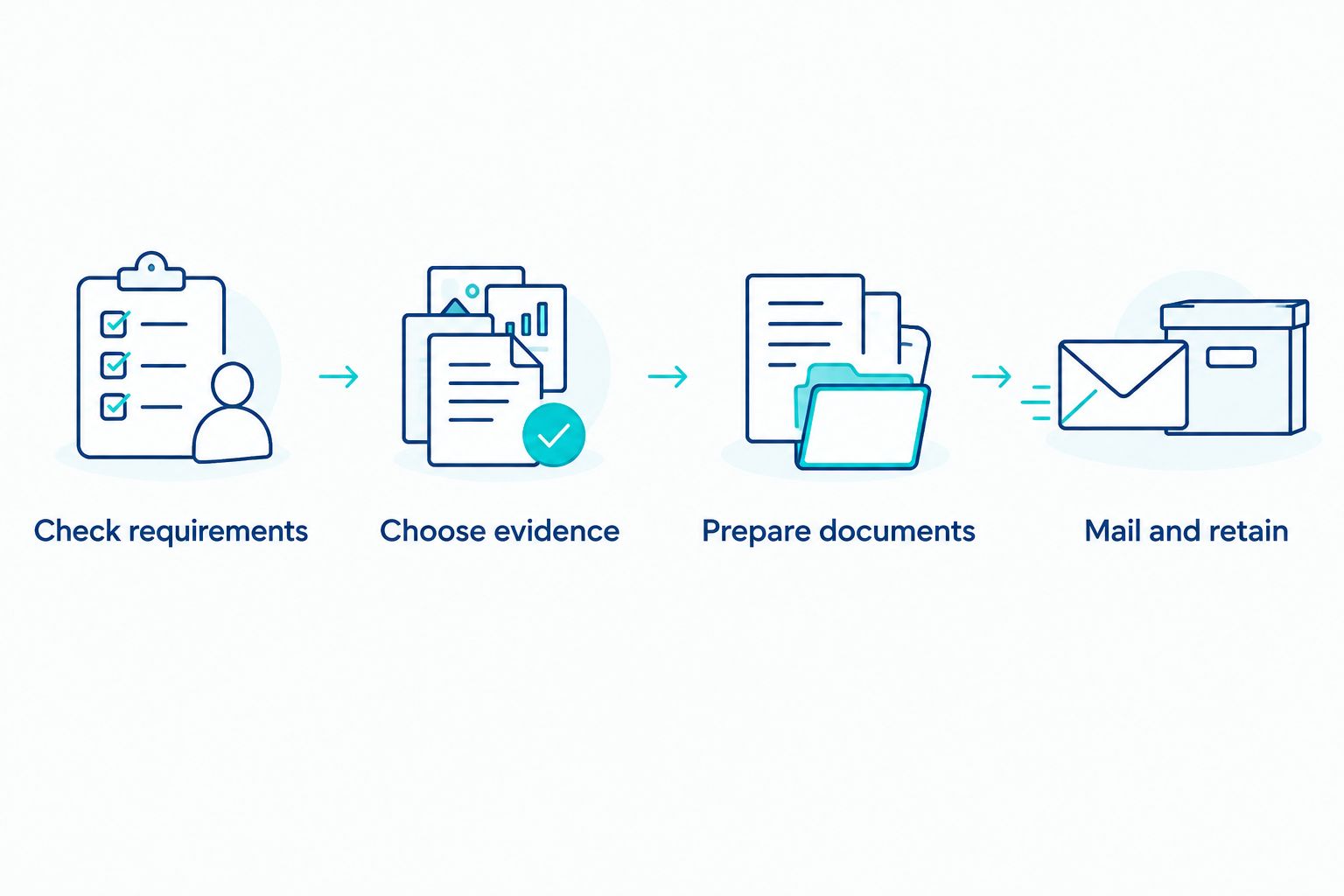
Use this sequence before handing over an envelope:
- Check requirements. Identify the document’s governing instructions, deadline, recipient, and required method. Ask your attorney about legal sufficiency when that is the unresolved question.
- Choose evidence. Decide whether you need Certified Mail alone, Return Receipt, Restricted Delivery, or a combination. Write those requirements into the mailing instructions.
- Prepare documents. Complete required signatures, notarization, or authentication before mailing. Keep a copy of the exact document version you send.
- Mail and retain. Obtain the acceptance record, preserve the tracking number, and save the final delivery information with the document copy.
A clear sequence prevents you from choosing postal features before understanding the requirement. It also keeps document preparation separate from the evidence generated after mailing.
Build a 3-part mailing file: the document copy, the acceptance record, and the delivery record. Keep 2 different records distinct: evidence that you mailed the item and evidence of its delivery outcome. Save 1 separate copy of the completed document before placing the original or required copy in the envelope.
If you delegate the mailing, request the same records. Delegation changes who performs the task, not what evidence your file needs.
Arrange your document services
Discuss certified mail, notarization, apostille certification, or signing coordination in Miami-Dade.
Which certified mail service should you choose?
Choose USPS Certified Mail with Return Receipt as the default when you need a separate delivery signature record. Use basic Certified Mail when the instructions require no return receipt, and add Restricted Delivery when recipient control is required.
Choose local document support when notarization, apostille certification, or signing coordination is part of the task. State each requirement separately so the mailing configuration and document services match the assignment.
For a deadline-sensitive legal mailing in 2026, resolve the required method first. Buying additional postal services cannot repair an incorrect recipient, an incomplete document, or the wrong legal procedure.
FAQ
What's the best certified mail service for legal documents in Miami?
USPS Certified Mail with Return Receipt is the default when you need mailing evidence and a separate delivery signature record. Choose document-service coordination when the task also involves notarization, apostille certification, or signing coordination.
Is Certified Mail the same as Return Receipt?
No. Certified Mail provides a mailing receipt and delivery or attempted-delivery information; Return Receipt is a separate service that provides delivery information and a signature record.
Does certified mail count as service of process in Florida?
Certified mail does not automatically satisfy Florida service-of-process requirements. The permitted method depends on the proceeding and applicable rules; confirm the procedure with your attorney before mailing.
Does a return receipt prove what was in the envelope?
No. A return receipt documents delivery information, not the envelope’s contents. Preserve a copy of the exact document sent and connect it to the mailing records.
Will Restricted Delivery make sure only the named person receives it?
Restricted Delivery permits delivery to the addressee or an authorized agent under USPS rules. Do not interpret it as an absolute requirement that only the named individual can receive the item.
Do I need to notarize a legal document before sending it by certified mail?
Certified Mail does not itself require notarization. Whether your document needs notarization depends on the document and its governing requirements; complete required authentication before mailing.
What should I do if certified mail is returned or unclaimed?
Preserve the returned envelope and the tracking history, then check the applicable notice requirement. An unclaimed or returned mailing does not have the same legal effect in every situation.
One last thing
A recipient’s signature is evidence about delivery, not a certificate that your legal document is correct. Keep the document copy connected to the mailing record so you can identify what you intended to send and what happened to the envelope.
Before submitting your next mailing, write the required postal services on your instructions. That small step prevents the common confusion between Certified Mail, Return Receipt, and Restricted Delivery—and gives whoever handles the envelope a defined task.


