Yes—a notary can notarize a document you signed in another state if the required notarial act permits a previously signed document and you properly appear before the notary. For a Florida acknowledgment, you can acknowledge an existing signature; for a Florida jurat, you must sign in the notary’s presence and take an oath or affirmation. The original signing location does not replace the requirements for identification, appearance, or the notary’s authority.
- Florida acknowledgment rules can permit a notary to notarize document signed in another state after the signer properly appears.
- A Florida jurat requires signing in the notary’s presence and taking an oath or affirmation.
- Thecruznetwork offers mobile notary service in Miami-Dade and remote online notarization.
- Use the actual notarization date and location, not the earlier signature date or signing location.
Why this matters
A signature made elsewhere is not automatically a problem. The required notarial act decides what happens next. A document signed before your appointment needs a different review from a document that must be signed under oath before the notary.
For a 2026 appointment, tell the notary where you are now, whether the document is already signed, and what certificate the recipient requires. Thecruznetwork’s notary and document services include mobile and remote online notarization, but the document’s requirements determine which method fits.
Can a notary notarize a document signed in another state?
Yes, provided the notary has authority to perform the act, the signer properly appears, and the notarization meets applicable law. In Florida, the central distinction is between acknowledging an existing signature and signing a sworn document before the notary.
Florida Statutes section 117.05 addresses notarial certificates, including acknowledgment and oath or affirmation certificates. Section 117.03 requires a person making an oath before a Florida notary to sign in the notary’s presence.
| Notarial act or method | Best for | Treatment of an earlier signature | Main limitation |
|---|---|---|---|
| Acknowledgment | Confirming that you executed a document | An existing signature can be acknowledged when you properly appear | It does not replace a required oath |
| Jurat | A document requiring a sworn or affirmed statement | An earlier signature alone does not satisfy Florida’s signing requirement | You must sign in the notary’s presence and take the oath or affirmation |
| Remote online notarization | An eligible signer appearing through an authorized online process | The required act and electronic workflow control | An ordinary video call is not sufficient |
Remote online notarization is an appearance method, not a substitute for choosing the correct notarial act. An online acknowledgment and an online jurat still serve different purposes.
Separate the signature from the notarization
Suppose you signed a document while visiting another state and now bring it to a Florida notary. If the document calls for an acknowledgment, the notary can take your acknowledgment of that existing signature after satisfying identification and other requirements.
If the document instead requires a jurat, explain that you already signed it. Do not assume the notary can simply stamp the existing signature, and do not erase, overwrite, or add another signature without instructions.
Acknowledgment: an earlier signature can qualify
An acknowledgment confirms your acknowledgment of executing the document. The notary does not need to have watched the original signing, but you must properly appear and acknowledge the signature as yours.
Best for: a document whose required certificate is an acknowledgment. The benefit is that an earlier signing does not automatically require a replacement document; the limitation is that an acknowledgment cannot satisfy a requirement for a sworn statement.
For your 2026 appointment, bring the complete document rather than only the signature page. Tell the notary about the earlier signing before the certificate is completed, particularly if the document includes dates or instructions that appear inconsistent.
The notarization records the acknowledgment performed now. It does not state that the notary witnessed the original signing in the other state.
Jurat: signing must occur in the notary’s presence
A jurat involves an oath or affirmation about the document’s statements and a signature made in the notary’s presence. Florida Statutes section 117.03 expressly addresses that signing requirement.
Best for: a document that requires a sworn or affirmed statement. Its benefit is that it records the required oath or affirmation; its limitation is that an existing signature alone does not complete the process.
Tell the notary the document is already signed. The notary can explain the signing requirement, while the document preparer or recipient should address whether you need a clean copy or another approved way to complete the document.
Do not change a jurat into an acknowledgment merely to preserve an earlier signature. If you are unsure which act the document requires, ask the recipient or an attorney rather than choosing based on convenience.
Remote online notarization: location still matters
Florida remote online notarization allows a properly registered online notary to perform authorized acts through the legally required electronic process. Under Florida Statutes section 117.265, the online notary must be physically located in Florida while performing the act; the signer can be elsewhere, subject to applicable requirements.
Best for: an eligible document and signer using an authorized online process. Remote appearance removes the need to share a physical room, but it adds technology and identity-verification requirements.
For a 2026 remote appointment, confirm that the receiving organization accepts the electronic document and the proposed notarial method. Also disclose any existing paper signature before starting: a signed paper document does not automatically become a completed electronic notarization when it is scanned.
A video call alone is not remote online notarization. The authorized process must satisfy Florida’s requirements for identity verification, communication technology, records, and the notarial act itself.
Why the answer varies
The original signing state is only part of the situation. These factors determine whether the document can proceed as presented:
- Required act: An acknowledgment can address an existing signature; a Florida jurat requires signing in the notary’s presence.
- Notary location: A Florida commission does not authorize ordinary in-person notarizations wherever the notary travels.
- Signer appearance: The signer must appear in person or through a legally authorized remote process.
- Identification: The notary must establish identity using a method Florida law permits.
- Certificate wording: The certificate must accurately describe the act, date, venue, and required appearance details.
- Receiving requirements: A lender, court, recording office, or other recipient can have document requirements beyond the notarial certificate.
These factors explain why two documents signed on the same trip can need different handling. A valid notarization does not resolve every question about the document’s execution, witnesses, contents, or intended use.
How do you prepare an already-signed document?
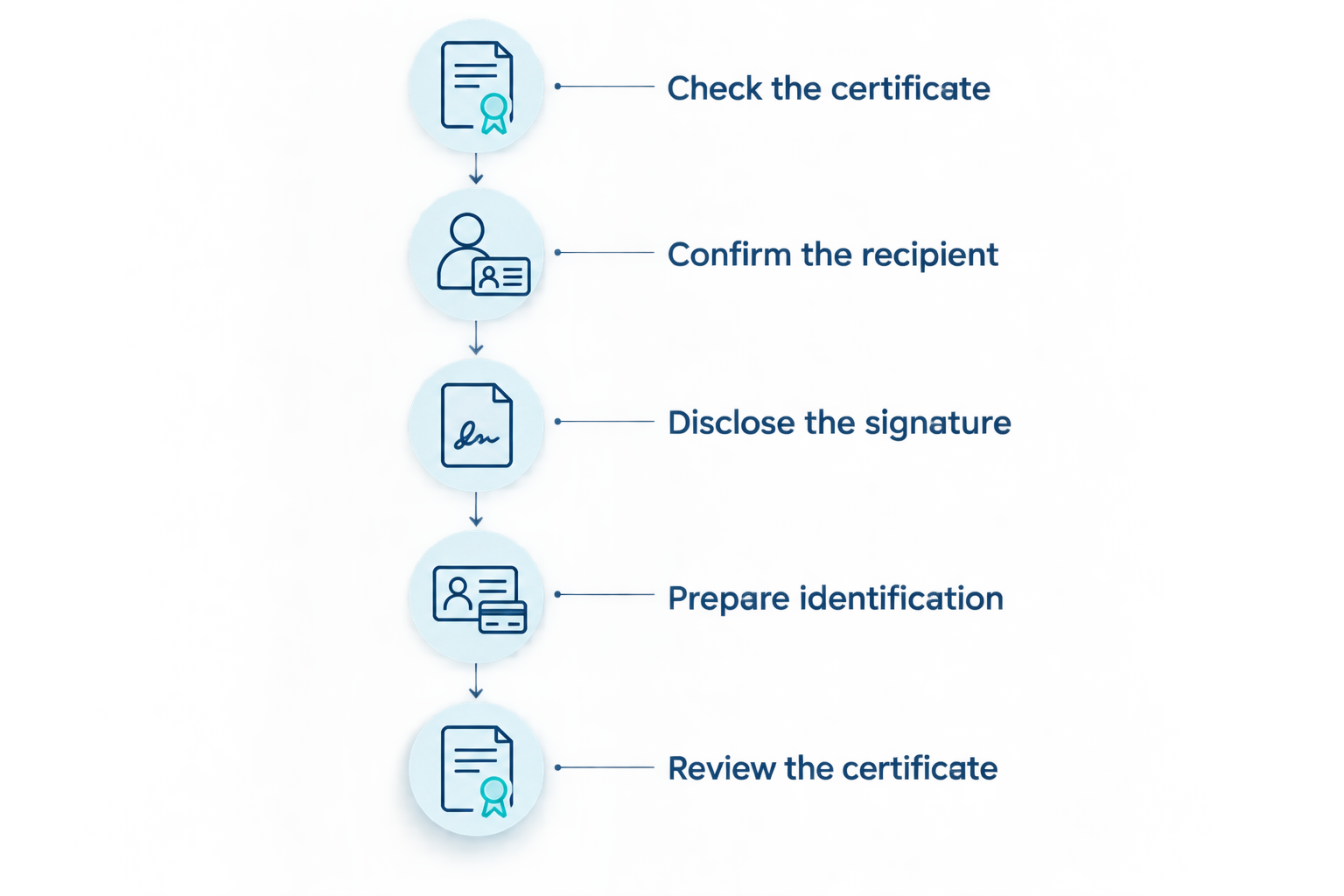
Use these 5 steps before a 2026 appointment. They keep the earlier signature separate from the act the notary will perform now.
- Check the certificate. Look for acknowledgment wording or language referring to an oath, affirmation, or being sworn. If there is no certificate or the wording is unclear, ask the document preparer what act is required.
- Confirm the recipient. Ask whether the recipient requires a particular certificate, witnesses, an original paper document, or an accepted electronic format. Resolve those instructions before making changes.
- Disclose the signature. Tell the notary the document is already signed and identify where you and the notary will be during the appointment. Do not describe the earlier signing as though it happened before the current notary.
- Prepare identification. Confirm what identification or other legally permitted identity evidence the notary requires. A familiar signature is not a substitute for satisfying identification rules.
- Review the certificate. Before sending the document, check that the completed certificate reflects the actual notarization date and venue. Raise an apparent error with the notary instead of correcting the certificate yourself.
Keep the recipient’s instructions with the document so you can explain any special requirements. If the instructions conflict with the printed certificate, get clarification before the appointment rather than asking the notary to guess.
Which state belongs in the notarial certificate?
For an in-person notarization performed in Miami-Dade, the notarial venue identifies Florida and Miami-Dade County. It does not identify the state where you signed earlier or the state where the document will be delivered.
Keep these 3 locations separate:
- Signing location: Where you originally placed your signature.
- Notarization location: Where the notary performs the notarial act under the applicable rules.
- Destination location: Where the recipient will use, file, or record the document.
A property description or another substantive reference to a different state is not necessarily an error. Do not replace every out-of-state reference with Florida; the notarial venue and the document’s underlying subject serve different purposes.
For remote notarization, the certificate must also meet the applicable online-notarization requirements. The signer’s physical location does not turn a Florida online notary’s act into an act performed by a notary commissioned in the signer’s state.
Can a Florida notary travel to another state to notarize it?
A Florida notary cannot rely solely on a Florida commission to perform an ordinary in-person notarization while physically in another state. The signer’s Florida residence and the document’s Florida destination do not expand that commission’s territorial authority.
Use a notary authorized where the in-person act occurs, or determine whether a lawful remote process fits. A mobile appointment changes where you meet within the notary’s authorized territory; it does not remove jurisdictional boundaries.
Does the notarization date need to match the signature date?
No. For an acknowledgment of an earlier signature, the signature date and notarization date can differ because they record different events.
The notary must use the actual date of the notarial act, not backdate the certificate to the earlier signing. A notarization completed in 2026 must accurately record when that act occurred, even if the document contains an earlier date.
If the recipient demands matching dates, ask the recipient how to resolve the execution requirement lawfully. Do not ask the notary to certify an appearance that did not happen.
When should you arrange local document support?
Thecruznetwork is best for individuals and businesses seeking mobile notary service in Miami-Dade or remote online notarization. The practical decision is whether your document needs an in-person appearance or qualifies for an authorized online process.
Use the contact page to explain that the document is already signed, where you are located, and what the recipient requires. Do not send sensitive document contents before confirming how they should be provided.
A notary appointment does not replace legal advice about which certificate to select or whether the underlying document is enforceable. Direct those questions to the document preparer or an attorney.
FAQ
Can I notarize a document in Florida if I signed it in another state?
Yes, a Florida acknowledgment can cover an existing signature if you properly appear and satisfy the applicable requirements. A Florida jurat instead requires you to sign in the notary’s presence and take an oath or affirmation.
Can someone else bring my signed document to the notary for me?
Someone else delivering your document does not satisfy your required appearance for an acknowledgment or jurat. You must appear personally or through a legally authorized remote online process.
Do I need to sign the document again?
A Florida acknowledgment does not necessarily require another signature, but a Florida jurat requires signing in the notary’s presence. Explain the existing signature before making changes or signing again.
Can a Florida online notary notarize for me while I am in another state?
Yes, Florida law permits an authorized online notary located in Florida to notarize for a signer elsewhere, subject to applicable requirements. Confirm that the document and receiving organization accept the proposed electronic process.
Does an out-of-state document need an apostille?
A document does not need an apostille merely because it crosses a U.S. state line. Apostilles concern international authentication for qualifying documents, not routine interstate notarization.
Can Thecruznetwork help with an already-signed document?
Thecruznetwork offers mobile notary service in Miami-Dade and remote online notarization. Explain that the document is already signed and provide the recipient’s notarial instructions so the required process can be assessed.
One last thing
An out-of-state address is not the same as an out-of-state notarial venue. Before your appointment, mark the questions you need answered—not changes you plan to make—and leave the certificate for the notary to complete accurately.
That distinction prevents a common mistake: changing legitimate document information simply because the notarization happens somewhere else.