No. A notarized document in Florida does not automatically need witnesses; the document type and applicable law determine whether separate witnesses must sign. A notary stamp does not replace required witnesses, and missing witnesses can leave a document improperly executed even when the notarization is complete.
- Does a notarized document need witnesses? Florida requirements depend on the document, not simply on whether it is notarized.
- Florida wills, deeds conveying real property, and standard Florida powers of attorney generally require 2 witnesses.
- An ordinary affidavit does not need separate witnesses solely because it is notarized.
- Thecruznetwork serves Miami-Dade individuals and businesses needing mobile or remote online notary and document support.
Why this matters
Notarization and witnessing solve different problems. The notary performs the required notarial act, such as taking an acknowledgment or administering an oath. A subscribing witness observes or participates in the execution process required for that document.
Before arranging notary and document services, identify the document and get its signing instructions. For your 2026 appointment, confirm who must attend before anyone signs, especially when a hospital visit, property transfer, or estate-planning document is involved.
Does a notarized document in Florida need witnesses too?
Sometimes. Florida has no blanket rule requiring separate witnesses for every notarized document, but specific documents have execution requirements that notarization alone cannot satisfy.
Use this comparison to identify the issue before scheduling. These are general Florida rules for the document types shown, not instructions for every exception, out-of-state document, or electronic signing arrangement.
| Document | General witness requirement | Notary's role | Main caution |
|---|---|---|---|
| Ordinary affidavit | No separate witnesses solely because it is notarized | Administers the required oath or affirmation and completes the certificate | A particular statute or receiving agency can impose additional requirements |
| Florida will | At least 2 attesting witnesses | Notarization is not the ordinary execution requirement; a self-proving affidavit involves a notary | A notarized signature alone does not properly execute an ordinary Florida will |
| Deed conveying Florida real property | Generally 2 subscribing witnesses | Takes the acknowledgment used for recording | Witnessing and acknowledgment are separate requirements |
| Standard Florida power of attorney | 2 subscribing witnesses | Takes the principal's acknowledgment | Special rules and statutory exceptions require separate review |
| Florida living will | 2 subscribing witnesses | Notarization is not generally required by the living-will statute | At least 1 witness must be neither the signer's spouse nor a blood relative |
The statutory references for this 2026 checklist are Florida Statutes sections 732.502 and 732.503 for wills, 689.01 and 695.03 for deeds and recording, 709.2105 for powers of attorney, and 765.302 for living wills. These provisions address different documents; do not transfer one document's rules to another.
Florida wills: At least 2 attesting witnesses
An ordinary Florida will requires at least 2 attesting witnesses under Florida Statutes section 732.502. The testator must sign at the end, or another person must subscribe the testator's name in the testator's presence and at the testator's direction.
The testator must sign or acknowledge the signature or will in the witnesses' presence. The witnesses must sign in the presence of the testator and each other. Bringing a previously signed will to a notary does not, by itself, satisfy those requirements.
A self-proving affidavit is a separate issue under section 732.503. It provides sworn statements associated with the will's execution and involves notarization; it is not a substitute for properly executing the will itself.
For a will, arrange the execution process before collecting signatures. Ask the drafting attorney which pages the testator and witnesses must sign and how the self-proving affidavit will be completed. Electronic wills have additional rules and should not be treated as an ordinary paper-will appointment.
Florida deeds: Generally 2 subscribing witnesses
A deed conveying Florida real property generally requires 2 subscribing witnesses under Florida Statutes section 689.01. An acknowledgment before a notary serves a different function, including meeting recording requirements under section 695.03.
Do not assume a deed is ready to record because it contains a completed notary certificate. Witness signatures and required recording information still need attention, and the title company or preparing attorney should provide execution instructions for the actual instrument.
The instrument's legal effect matters more than a filename or informal label. A document described as property paperwork is not necessarily a deed, and requirements for deeds should not be applied automatically to every document in a closing package.
For a property transfer, get written signing instructions from the title company or attorney. Confirm the witnesses, acknowledgment, and recording details before the appointment rather than trying to correct the document after submission.
Florida powers of attorney: 2 subscribing witnesses
A standard Florida power of attorney generally requires 2 subscribing witnesses and the principal's acknowledgment before a notary under Florida Statutes section 709.2105. The principal's signature, witness signatures, and notarial acknowledgment are distinct parts of execution.
A stamp does not cure missing witness signatures. Likewise, a page with witness signatures does not replace the required acknowledgment.
Exceptions exist for certain documents, including qualifying military powers of attorney and powers executed under another jurisdiction's law. Do not decide that an exception applies simply because the principal lives outside Florida or the form came from an online template.
For your 2026 signing, send the complete power of attorney to the preparing attorney or receiving institution for execution instructions. If you intend to sign remotely, confirm that the specific document, powers granted, and participants qualify for the proposed process.
Florida living wills: 2 subscribing witnesses
A Florida living will requires 2 subscribing witnesses under Florida Statutes section 765.302. At least 1 witness must be neither the principal's spouse nor a blood relative.
The statute does not generally require notarization of a living will. Adding a notary does not eliminate the witness requirement or make an otherwise ineligible witness acceptable.
Do not confuse a living will with a last will and testament. Although both involve witnesses, they serve different purposes and have different execution rules.
For a healthcare document packet, review each form separately. A living will, healthcare surrogate designation, and financial power of attorney should not be treated as interchangeable documents merely because they are signed during the same visit.
Ordinary affidavits: No automatic separate-witness requirement
An ordinary affidavit does not require separate subscribing witnesses merely because it is notarized. The signer ordinarily makes a sworn statement before the notary, who administers the oath or affirmation and completes the appropriate certificate.
The document's governing law and receiving agency's instructions still control. A form used for a particular court, government process, or transaction can have requirements beyond the ordinary notarization.
Also distinguish a subscribing witness from a credible identifying witness. A credible identifying witness helps establish a signer's identity under applicable notarial rules; that role does not automatically satisfy the document's execution-witness requirements.
For an affidavit, check the certificate and submission instructions instead of adding witnesses by habit. If the form is unclear, ask its preparer or recipient what is required before making changes.
Why Florida witness requirements vary
The question is not simply whether a notary will attend. These factors determine what your signing needs:
- Document type: Wills, deeds, powers of attorney, and affidavits follow different legal rules.
- Governing law: A Florida document and a document executed under another jurisdiction's law do not necessarily have identical requirements.
- Signing method: Paper execution and electronic execution can involve different procedures, particularly for estate-planning documents.
- Witness eligibility: Age, relationships, interests, and document-specific restrictions can affect who should serve.
- Recipient instructions: A lender, title company, court, or other recipient can require details needed for its acceptance process.
- Additional execution features: A will's self-proving affidavit adds a notarized step without replacing the will's attesting witnesses.
Recipient instructions deserve review, but they do not override a statute. If the form and instructions conflict, have the preparing attorney or responsible recipient resolve the conflict before signing.
How do you prepare for a witnessed notarization?
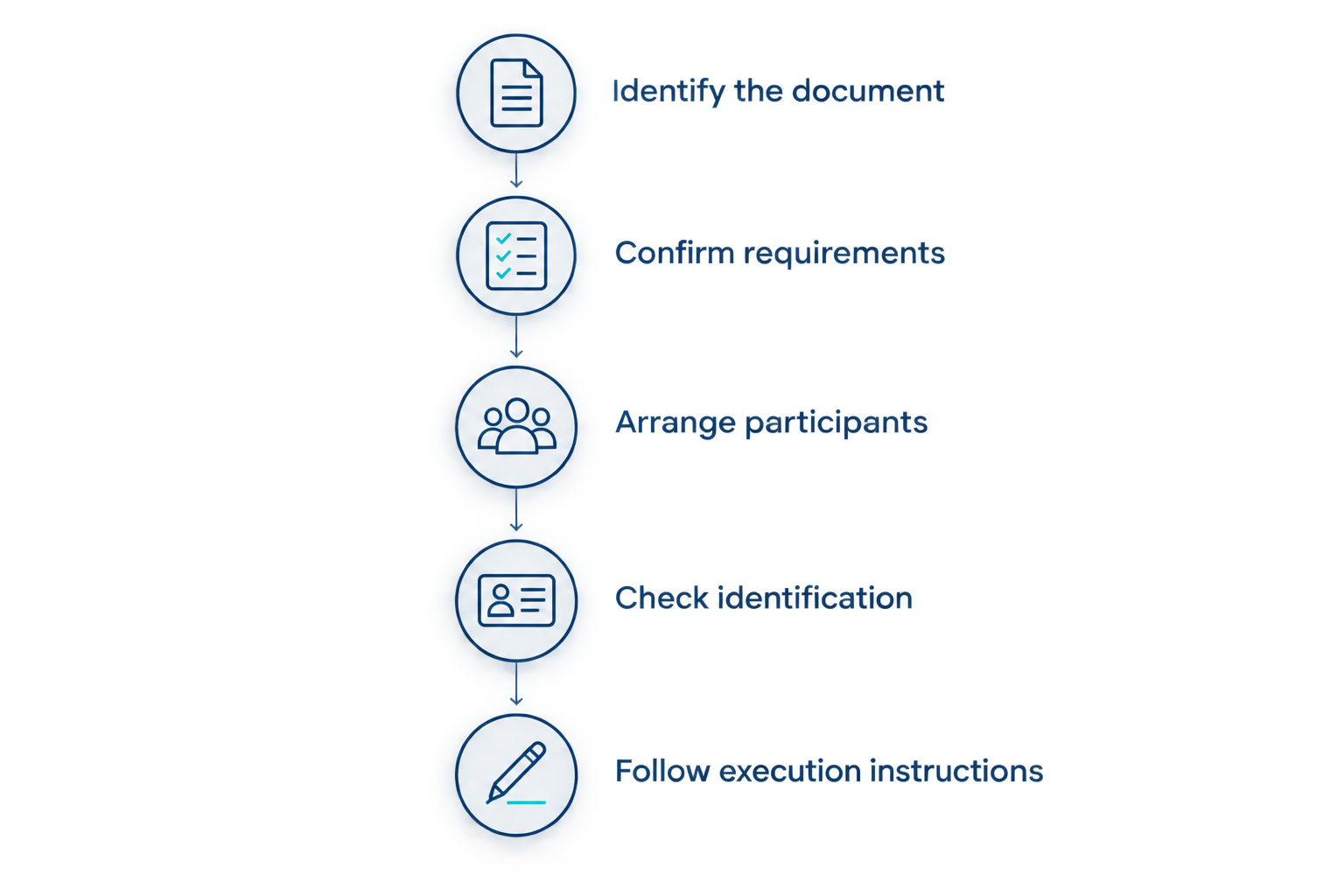
Use this sequence for a 2026 signing. It separates legal requirements from appointment logistics so the right people attend with the right instructions.
- Identify the document. Use its full title and purpose. Send the complete document rather than only the signature page when requesting signing instructions.
- Confirm requirements. Ask the preparer or recipient to identify the required witnesses, their qualifications, and the notarial act. A notary who is not an attorney cannot choose your legal document or give legal advice.
- Arrange participants. Confirm who is providing the witnesses. A mobile-notary appointment does not automatically include additional people to witness your signature.
- Check identification. Ask what identification the signer and any relevant participants must present. Resolve identity questions before the appointment.
- Follow execution instructions. Wait to sign until the required participants are present and the signing procedure is clear. Keep the completed document together for delivery or recording.
The sequence matters because an appointment can be properly scheduled while the document is still not ready to execute. Confirm the witness plan before confirming the signing appointment.
Can the notary also count as a witness?
A notary can sometimes serve as a subscribing witness as well as perform the notarization, but the document's requirements and the exact signatures being notarized matter. A notary cannot notarize the notary's own signature.
That distinction is especially important when a document includes a separate affidavit signed by witnesses. Do not assume the notary can occupy every signature role because the document needs another witness.
Ask the preparing attorney or title company whether the proposed arrangement is acceptable. Do not count the notary toward your witness total until the roles are confirmed.
Can witnesses join a Florida notarization online?
Remote online notarization does not remove a document's witness requirements. Florida Statutes section 117.285 addresses electronic witnessing and includes additional safeguards and restrictions for certain documents and circumstances.
A video call alone is not a substitute for a compliant remote-notarization and electronic-witnessing process. Identify the document before deciding whether the signer and witnesses can participate remotely.
For a 2026 remote appointment, confirm the execution method with the preparing attorney and notary service. Estate-planning documents need particular care; do not assume that a process suitable for an ordinary acknowledgment is suitable for every will or power of attorney.
What if the document is already signed without witnesses?
A later notary stamp does not automatically repair missing execution witnesses. The appropriate next step depends on the document, what happened during signing, and the governing law.
An acknowledgment can involve a signature made earlier, but that does not erase a separate legal requirement about when witnesses must observe or sign. Never backdate signatures or ask someone to attest to an event they did not witness.
Keep the document unchanged and contact the preparing attorney or recipient. Ask whether proper re-execution or another legally appropriate correction is necessary before arranging another appointment.
Arrange the signing in Miami-Dade
Thecruznetwork is best for Miami-Dade individuals and businesses seeking mobile or remote online notary and document support. Its stated services include notarization, apostille certification, certified mail, and signing coordination.
Thecruznetwork's service scope does not establish that witnesses are included in a particular appointment or that every document qualifies for remote execution. Confirm those details when you contact the service, and provide the document type, location, and recipient's instructions.
Confirm your signing requirements
Provide your document type, Miami-Dade location, and witness instructions before arranging the appointment.
FAQ
Does every notarized document in Florida need two witnesses?
No. Florida does not require separate witnesses for every notarized document. The document type, governing law, and applicable execution instructions determine whether witnesses are needed.
Does a Florida power of attorney need witnesses and a notary?
A standard Florida power of attorney generally requires 2 subscribing witnesses and the principal's acknowledgment before a notary under section 709.2105. Statutory exceptions require separate review.
Is a Florida will valid just because it is notarized?
No. An ordinary Florida will generally requires at least 2 attesting witnesses and compliance with section 732.502. Notarization associated with a self-proving affidavit does not replace proper execution.
Can my spouse witness my Florida living will?
A spouse can serve as a Florida living-will witness, but at least 1 of the 2 subscribing witnesses must be neither the principal's spouse nor a blood relative. Check the complete form and applicable requirements before signing.
Will a mobile notary bring witnesses to my appointment?
Do not assume a mobile-notary appointment includes witnesses. Confirm who will provide eligible witnesses before booking and tell the service which document you are signing.
Can I add witness signatures after my document is notarized?
Adding signatures afterward does not automatically satisfy the document's execution requirements. Ask the preparing attorney or recipient whether proper re-execution or another correction is required.
Do witnesses replace the need for the signer to appear before the notary?
No. Subscribing witnesses do not replace the signer's required appearance for an acknowledgment or jurat. That appearance must occur through a legally permitted in-person or remote process.
One last thing
A living will illustrates why more stamps do not mean better execution: Florida generally requires witnesses for that document, not notarization. The right participants matter more than adding an unnecessary notarial act.
Before contacting Thecruznetwork, obtain the complete signing instructions and identify who will provide the witnesses. That single preparation step separates a request for a notary from a plan to execute the document correctly.
This article provides general Florida signing information, not legal advice about your document. Ask a Florida attorney to resolve questions about validity, witness eligibility, or corrective execution.