A Florida notary generally needs to examine qualifying government-issued identification unless the notary personally knows you or uses a legally permitted credible-witness procedure. For a notarization in 2026, a recognizable face, a photograph of an ID, or a relative's assurance does not automatically satisfy Florida's identification requirements.
- Does a notary need to see ID in Florida? Not always: Florida permits specific alternatives.
- Qualifying identification must be current or issued within the past 5 years and meet Florida's document requirements.
- Florida allows personal knowledge or qualifying credible witnesses instead of documentary identification in specified circumstances.
- Remote online notarization has separate identity-verification requirements; an ordinary video call is not enough.
Does a notary need to see government ID in Florida?
Usually, yes—but government ID is not the only lawful way to establish identity. Florida Statutes section 117.05(5) permits identification through personal knowledge or satisfactory evidence, including specified identification documents and qualifying credible witnesses.
For your 2026 appointment, choose the identification route before arranging the signing. Thecruznetwork offers mobile and remote online notary services for individuals and businesses in Miami-Dade; explain any identification problem when requesting service.
| Identification route | Best for | Main benefit | Main limitation |
|---|---|---|---|
| Qualifying government ID | Signers with an accepted original credential | Provides a direct documentary identification route | Not every government-issued card qualifies |
| Personal knowledge | Signers genuinely known to the notary | Does not require documentary ID under this route | A brief introduction or familiarity is insufficient |
| Credible witnesses | Signers who meet the statutory exception | Provides an alternative when qualifying ID is unavailable | Witness relationships and sworn statements must satisfy the law |
| Remote identity verification | Signers using authorized online notarization | Supports an online appearance rather than an in-person visit | Requires the applicable remote verification process, not just showing a card on camera |
Why this matters
Your appointment location does not change the identification standard. A mobile notary visiting a Miami-Dade home, office, or hospital still needs a lawful basis to identify each signer.
An identification problem is also different from a document problem. Even after establishing your identity, the notary must address the required appearance, willingness, awareness, and notarial act. Bringing acceptable ID does not guarantee that every document can be notarized.
Which government IDs qualify in Florida?
For ordinary documentary identification, Florida Statutes section 117.05(5)(b) lists acceptable credentials. The document must be current or issued within the past 5 years, bear a serial or other identifying number, and satisfy the requirements for its listed category.
Common examples include:
- Florida driver's license or identification card: Issued by the Florida Department of Highway Safety and Motor Vehicles.
- United States passport: A listed identification option under Florida law.
- Another state's driver's license or identification card: Issued by an authorized public agency, subject to the statutory requirements.
- A Canadian or Mexican driver's license: Specifically included among the listed driver's-license categories; this does not make every foreign driver's license acceptable.
- A foreign passport: Subject to Florida's additional requirement concerning a United States immigration stamp.
The statute also lists certain military, veterans' health, correctional, and immigration credentials, with category-specific conditions. Ask about the exact credential rather than assuming a card qualifies because a public agency issued it.
Bring the original identification document for an in-person appointment. Do not plan around a phone photograph, photocopy, workplace badge, credit card, or Social Security card as a substitute for a qualifying credential.
An out-of-state address is not the problem
You do not need a Florida address merely to use an otherwise qualifying out-of-state driver's license. The important questions concern the issuing authority, the credential's eligibility, its dates, and whether it establishes your identity.
For a 2026 visit, tell the notary which jurisdiction issued your ID. That gives the notary a useful fact to assess before traveling, rather than discovering an unsupported credential at the signing table.
Can you use an expired ID for a Florida notarization?
An expired ID is not automatically disqualified, but the rule concerns its issue date—not how recently it expired. Florida's statutory language allows a listed credential that is current or was issued within the past 5 years.
That distinction matters. An expired credential issued outside that window does not qualify through this documentary route simply because its expiration date was recent. Conversely, a qualifying current credential satisfies the timing requirement even if it was originally issued longer ago.
Before your appointment, check:
- The credential's exact type and issuing authority.
- Whether it is current.
- Its issue date if it is expired.
- Whether its photograph and identifying information establish your identity.
Do not ask the notary to treat a renewal receipt or replacement application as the original credential without first confirming a lawful identification basis. The 5-year rule is not a blanket grace period after expiration.
Can a Florida notary identify you through personal knowledge?
Yes. Florida permits a notary to rely on personal knowledge instead of documentary identification when the relationship meets the statutory standard.
Personal knowledge requires an acquaintance derived from association that establishes identity with reasonable certainty. Meeting you at the appointment, recognizing your social-media profile, or having your employer introduce you does not automatically establish that relationship.
This route works because the notary already knows who you are—not because the notary decides to overlook missing ID. You cannot create qualifying personal knowledge by showing up early or explaining that everyone in the office knows you.
Best for: A signer whose existing relationship with the notary genuinely establishes identity. Its benefit is avoiding reliance on a credential; its limitation is that the relationship must already support the notary's certainty.
Can credible witnesses replace ID in Florida?
Florida permits a credible-witness identification route with either 1 qualifying witness personally known to the notary or 2 qualifying witnesses whose identities the notary establishes using the specified identification documents. The witnesses must personally know the signer and satisfy the statutory sworn-statement requirements.
This exception is not designed as a convenient replacement for a forgotten wallet. Under section 117.05(5)(b), the sworn statements address matters including:
- The signer is the person named in the document.
- The witnesses personally know the signer.
- The signer's circumstances make obtaining another acceptable identification document very difficult or impossible.
- The signer does not possess the identification documents specified in the statute.
- The witnesses have no financial interest in, and are not parties to, the underlying transaction.
A relative or caregiver is not automatically a qualifying credible witness. The person's knowledge, relationship to the transaction, identification, and required statements still need review.
Best for: A signer who genuinely meets the statutory exception. The benefit is a lawful alternative to documentary ID; the limitation is that arranging witnesses does not, by itself, make the exception available.
For a 2026 appointment involving missing identification, describe the circumstances before asking anyone to attend. Do not recruit witnesses first and assume their presence resolves the issue.
Why identification requirements vary between appointments
The legal standard is not a matter of personal preference. What changes is the evidence available and the procedure that applies.
- Credential type: Florida lists accepted categories; a government connection alone does not establish eligibility.
- Credential dates: A current document and an expired document require different timing checks.
- Existing acquaintance: Personal knowledge depends on the notary's actual relationship with the signer.
- Witness qualifications: Credible witnesses must satisfy knowledge, identification, and independence requirements.
- Appointment format: Remote online notarization uses statutory procedures beyond an ordinary video conversation.
- Identity discrepancies: Differences between the document and identification require review rather than an assumption that the names refer to different people—or the same person.
A married name, abbreviated name, or missing middle name deserves discussion before the visit. Ask the document preparer about correcting the document where necessary; do not alter a legal document simply to make it resemble your ID without authorization.
What should you prepare before the notary appointment?
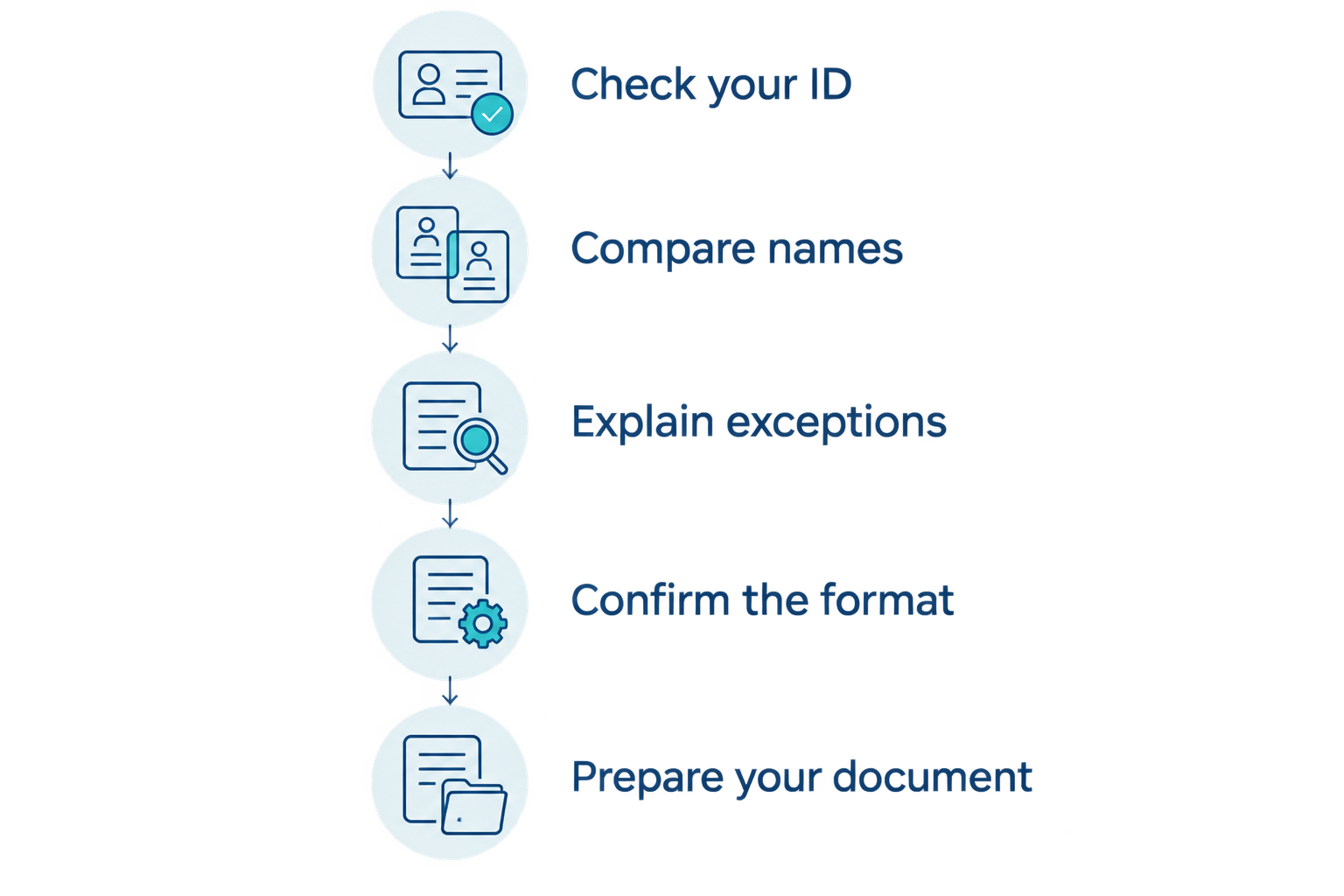
Use this sequence to resolve identity questions before the notary arrives:
- Check your ID. Find the original credential and inspect its type, issuing authority, issue date, and expiration date.
- Compare names. Check the signer name on the document against the identification and disclose differences.
- Explain exceptions. Tell the notary about missing identification, a proposed personal-knowledge route, or potential credible witnesses.
- Confirm the format. Establish whether the appointment is in person or through an authorized remote online process.
- Prepare your document. Obtain instructions about signatures, witnesses, and the required notarial act before the appointment.
These steps address separate problems. A suitable ID does not supply a missing document witness, and a document witness does not automatically qualify as a credible identifying witness.
Thecruznetwork mobile notary service is best for Miami-Dade signers who need an in-person visit rather than travel. A mobile visit changes where you meet, not the evidence required to identify you; remote online service requires a separate assessment of the applicable online process.
Confirm your identification before booking
Describe your ID, document, and preferred mobile or remote appointment format.
Does remote online notarization remove the ID requirement?
No. Remote online notarization changes the appearance and verification process; it does not remove the need to establish identity. Florida Statutes sections 117.265 and 117.295 address identification procedures and standards for online notarization.
When the online notary does not personally know the signer, the applicable process includes remote presentation of government-issued identification, credential analysis, and identity proofing. Holding a driver's license up during an ordinary video call does not complete those steps.
For your 2026 remote appointment, confirm the credential requirements and technical preparation before the session. A credential suitable for an in-person review does not guarantee completion of the online verification process.
Can someone bring your ID and document without you?
No. Someone carrying your original identification cannot replace your required appearance before the notary. Identity evidence and personal appearance are separate requirements.
For an acknowledgment, a signature made earlier still requires the signer's acknowledgment before the notary. For a jurat, the signer must take the required oath or affirmation and sign in the notary's presence. Authorized remote online notarization has its own appearance rules.
Read the guide to notarization without the signer present before sending a relative, employee, or courier in your place.
FAQ
Does a Florida notary always have to ask for government ID?
No. Florida permits identification through qualifying personal knowledge or a statutory credible-witness procedure as alternatives to documentary identification. The notary must have a lawful basis for the method used.
Can I use my expired driver's license for a Florida notarization?
An expired qualifying license can satisfy the timing rule if it was issued within the past 5 years. The rule is not 5 years after expiration, and the credential must meet the other identification requirements.
Can I show the notary a photo of my ID on my phone?
Do not rely on a phone photograph as a substitute for the original qualifying ID at an in-person notarization. Remote online notarization uses a separate verification process, not an informal review of an uploaded photograph.
Can my spouse tell the notary who I am?
A spouse's assurance alone does not establish a lawful identification route. Any proposed credible witness must satisfy the statutory requirements, including personal knowledge and having no financial interest in or party status to the transaction.
Do I need a Florida driver's license to use a Florida notary?
No. Florida law lists other acceptable credentials, including qualifying out-of-state driver's licenses and United States passports. The credential must meet the requirements for its category.
Can a hospital patient be notarized without identification?
A hospital patient needs a lawful identification basis just like another signer. Personal knowledge or qualifying credible witnesses can apply when the statutory conditions are satisfied; a hospital wristband alone does not replace those requirements.
Can Thecruznetwork skip ID checks for a mobile appointment?
No. Thecruznetwork mobile notary appointments follow Florida's identification requirements. Explain missing or expired identification before arranging the visit so the applicable identification route can be assessed.
One last thing
Check the issue date, not just the expiration date. That distinction is easy to miss when preparing for a notarization with an expired credential. When contacting Thecruznetwork about notary service, provide the credential type and dates without sending sensitive identification images through an unconfirmed channel.
Legal basis for this 2026 guide: Florida Statutes section 117.05(5), concerning identification for notarization, and sections 117.265 and 117.295, concerning online notarization procedures and standards. This guide provides general information, not legal advice about your document or transaction.


