
Yes, a notary can legally refuse to notarize a document, and Florida law requires refusal when the notarization would violate the law. For Miami-Dade signers in 2026, the next step is to identify the reason: a missing identification document requires a different response from suspected coercion, an absent signer, or a prohibited conflict of interest.
- Can a notary legally refuse to notarize a document? Yes. Florida notaries must refuse unlawful notarizations.
- Missing identification, an absent signer, incomplete documents, and coercion can prevent notarization.
- Thecruznetwork provides mobile notary and remote online notary service for Miami-Dade individuals and businesses.
- Correct the stated problem before booking another appointment; changing notaries does not remove a legal restriction.
Why this matters
A refusal does not automatically mean your document is invalid. It means the requested notarial act cannot proceed under the circumstances presented. Sometimes you need an acceptable ID; sometimes you need the document’s preparer or an attorney to resolve the problem.
Thecruznetwork is best for Miami-Dade signers seeking mobile or remote online notary service. Neither appointment format removes Florida’s requirements for identity, appearance, willingness, and a lawful notarial act.
This 2026 guide focuses on Florida. Other states have different rules, so do not apply a Florida answer to a notary commissioned elsewhere.
Can a notary legally refuse to notarize a document?
Yes. Florida Statutes section 117.107 prohibits notarization in several circumstances, including certain family relationships, an absent signer outside authorized online procedures, and incomplete or blank documents. Section 117.05 addresses identification and other requirements for performing a notarial act.
The distinction is between a legal barrier and a problem you can correct before another appointment.
| Reason for refusal | What it means | Your next move |
|---|---|---|
| Identity cannot be established | The notary cannot confirm who is appearing | Ask which legally acceptable identification method applies |
| Signer is absent | Ordinary delivery of a signed document does not establish appearance | Arrange lawful in-person or remote online appearance |
| Document is incomplete | Material blanks or missing content prevent completion | Return the document to its preparer for completion |
| Signer appears coerced or unaware | Willingness or understanding is in question | Stop the signing and resolve the concern without pressure |
| Notary has a prohibited conflict | The notary cannot act impartially or falls within a statutory prohibition | Use an independent, eligible notary |
| Requested act is unlawful | The request requires a false certificate or another prohibited act | Correct the request rather than seeking the same unlawful act elsewhere |
Ask for the specific obstacle, not just another appointment. A different notary still has to apply the same governing law.
Missing identification: establish identity before signing
A notary cannot treat your statement that you are the named signer as sufficient identification by itself. Florida permits personal knowledge and specified identification methods, but the method must satisfy the law.
Under Florida Statutes section 117.05, qualifying identification generally must be current or issued within the past 5 years. The statute also specifies acceptable document types and identifying features; an expired card is not automatically acceptable simply because it carries your photograph.
Florida also permits qualifying credible-witness identification: 1 witness personally known to the notary, or 2 witnesses whose identities are established through qualifying identification. These routes carry additional sworn conditions. They are not a general substitute for forgetting your wallet.
Before rescheduling, describe the identification you actually have. Do not send sensitive ID images through an unconfirmed channel or assume that a workplace badge satisfies the statutory requirements.
An absent signer: delivery is not appearance
Bringing someone else’s signed document to a notary does not ordinarily allow the notary to notarize that person’s signature. The person whose acknowledgment or oath is required must appear through a legally authorized method.
For an acknowledgment, a signature already on the document does not necessarily require signing again, but the signer must still appear and acknowledge execution. For a jurat, the signer must take the required oath or affirmation and sign as required for that act.
Florida authorizes remote online notarization under Part II of Chapter 117. That is a regulated process, not an ordinary video call arranged independently of the notary’s authorized system.
The guide to notarization without the signer physically present explains the appearance issue in more detail. In 2026, do not confuse electronic document delivery with completion of a remote online notarization.
Incomplete documents: resolve blanks before the appointment
Florida Statutes section 117.107 prohibits notarizing a signature on an incomplete or blank document. A notary should not complete the act while material terms remain open for someone to add later.
Distinguish unfinished document content from the notarial certificate the notary completes. A blank certificate date is not the same problem as an unsigned agreement with missing parties, missing terms, or uncompleted substantive fields.
Ask the document’s preparer or receiving organization how to handle fields that do not apply. Do not guess, cross out contractual language, or ask the notary to decide what your agreement should say.
A notary who is not acting as your attorney cannot provide legal advice about which rights to grant or which legal instrument to use. Fixing the document and notarizing the signature are separate tasks.
Coercion or lack of understanding: stop the signing
Florida law prohibits notarization when the signer appears unable to understand the nature and effect of the document at the time of notarization. The notary also cannot proceed when the signer appears subject to coercion or undue influence.
A relative’s assurance does not replace the signer’s own willingness. If someone answers every question for the signer, pressures the signer, or prevents direct communication, the notary has a reason to stop and assess the circumstances.
Age, disability, or a medical diagnosis alone does not establish inability to sign. The relevant question is the signer’s condition and willingness during the appointment, along with any applicable legal requirements.
Do not coach someone to give rehearsed answers after a refusal. For estate planning, powers of attorney, or disputed authority, ask an attorney how to address the underlying concern.
Conflicts of interest: choose an eligible notary
Florida prohibits a notary from notarizing a signature on a document when the signer is the notary’s spouse, son, daughter, mother, or father. Florida also restricts notarization when the notary has a disqualifying financial interest or is a party to the transaction.
Not every relationship or employment connection creates the same prohibition. The statutory exceptions matter, so avoid a blanket assumption that every coworker or every relative is automatically eligible or automatically disqualified.
The practical answer is straightforward: disclose the connection before the appointment. If the relationship creates a legal barrier, arrange an independent notary rather than asking the original notary to overlook it.
Why notary refusal decisions vary
A refusal depends on the requested act and the facts presented, not simply the document’s title. For a Florida appointment in 2026, these factors determine whether the notary can proceed:
- Governing state law: A Florida commission carries Florida requirements; another state’s practice does not replace them.
- Notarial act: An acknowledgment and a jurat involve different statements and signing requirements.
- Identity evidence: Personal knowledge, qualifying identification, and credible witnesses have distinct conditions.
- Appearance method: Physical attendance and authorized remote online appearance follow different procedures.
- Document condition: Missing substantive content creates a different issue from an unfinished notarial certificate.
- Signer and notary eligibility: Willingness, understanding, family relationships, and financial interests affect the decision.
A refusal also does not prove that a document is fraudulent. Ask what prevented the act without treating the notary’s decision as a ruling on the entire transaction.
What should you do after a notary refuses?
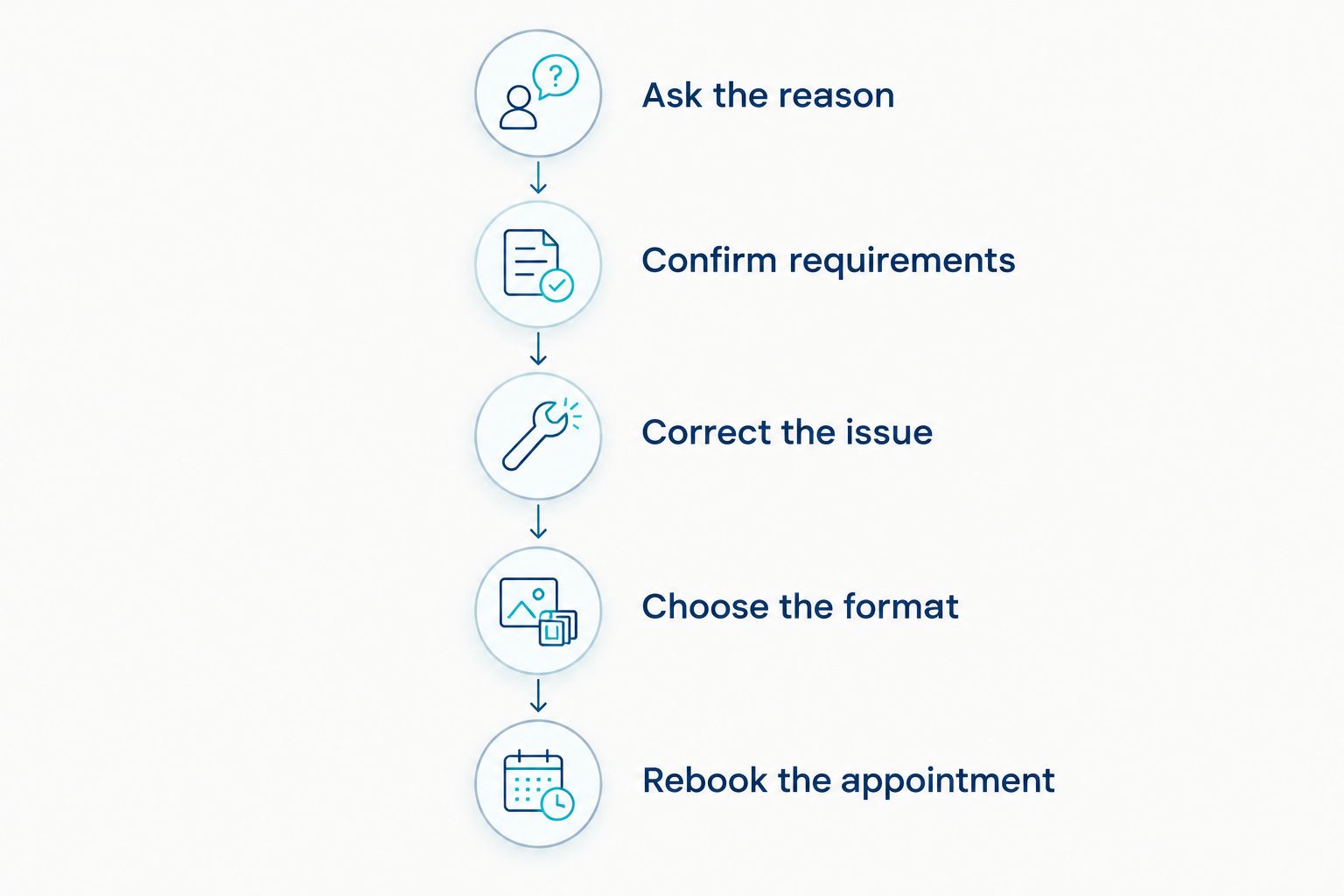
Use this sequence before booking again. It separates correctable preparation problems from issues that require legal advice.
- Ask the reason. Identify whether the obstacle concerns identity, appearance, document completeness, willingness, or a conflict.
- Confirm requirements. Ask the receiving organization what notarial act and document format it requires. Obtain legal advice when choosing the act requires legal judgment.
- Correct the issue. Obtain qualifying identification, complete the document through its preparer, or arrange an eligible notary.
- Choose the format. Confirm whether in-person or authorized remote online notarization fits the document and recipient’s requirements.
- Rebook the appointment. Explain the earlier refusal so the same unresolved problem does not repeat.
For Miami-Dade scheduling, Thecruznetwork offers mobile notary and remote online notary service. Explain the document type, intended receiving organization, signer’s location, and reason for any previous refusal before arranging service.
Discuss your notarization request
Explain your document, signer location, and any previous refusal before arranging service.
Is a mobile notary better than an online notary after a refusal?
Neither format fixes a legal prohibition. Choose the format that addresses the actual access problem and satisfies the applicable requirements.
| Format | Best for | Advantage | Limitation |
|---|---|---|---|
| Mobile notary | Signers who need an in-person appointment at their location | Brings the physical appointment to the signer | Does not remove identification, willingness, or document requirements |
| Remote online notary | Signers who need authorized online appearance | Allows appearance through the prescribed online process | Requires the applicable technology, identity checks, and recipient acceptance |
Choose mobile service for physical access; choose remote online service for authorized online appearance. Neither is a workaround for an incomplete document, coercion, or an unlawful request.
Can another notary accept a document the first notary refused?
Yes, if the second notary can lawfully complete the act. A corrected document, qualifying identification, or removal of a prohibited conflict can change the circumstances.
A second notary cannot lawfully backdate a certificate or ignore required appearance simply because the first appointment failed. Explain what happened rather than concealing the earlier refusal.
Can a notary refuse because they disagree with the document?
Personal disagreement is not the same as a statutory prohibition. A notary authenticates a specified notarial act; notarization does not endorse the document’s opinions or guarantee its legal effect.
If you believe the refusal involves unlawful discrimination, document the reason given and seek guidance from the appropriate commissioning authority or an attorney. Do not assume that every refusal is either mandatory or unlawful without examining the circumstances.
FAQ
Can a notary legally refuse to notarize a document in Florida?
Yes. A Florida notary must refuse when the requested act violates applicable law, including prohibitions involving certain conflicts, incomplete documents, or a signer who does not lawfully appear.
Can a notary refuse because my ID is expired?
Yes, if the identification does not satisfy Florida’s requirements. Qualifying identification generally must be current or issued within the past 5 years, and other statutory conditions still apply.
Can a notary refuse a document I already signed?
An existing signature does not automatically prevent an acknowledgment, but you must still appear and acknowledge execution. A jurat has different requirements, including an oath or affirmation and signing as required for that act.
Can my family member notarize my signature in Florida?
Not if the Florida notary is your spouse, parent, son, or daughter. Other relationships require checking the applicable conflict rules rather than assuming all family notarizations are permitted.
Can a Florida notary notarize a document written in another language?
A foreign-language document is not automatically disqualified. The notary must still communicate sufficiently with the signer, understand the notarial certificate, and satisfy the applicable legal requirements.
Does notarization prove my document is legally valid?
No. Notarization does not establish that every term is lawful, that the document achieves your intended result, or that the receiving organization must accept it.
Should I contact an attorney after a notary refuses?
Contact an attorney when the refusal involves legal capacity, disputed authority, document selection, or the document’s legal effect. An identification or scheduling problem generally calls for resolving that specific obstacle first.
One last thing
A completed notarization and an accepted document are different outcomes. Before your 2026 appointment, ask the receiving organization about its document, witness, and submission requirements; a notary’s seal does not replace them.
Keep the reason for any refusal with your appointment notes. One clear explanation helps you correct the actual problem instead of repeating it. This guide provides general Florida information, not legal advice about your transaction.


