
Yes—a notary can notarize a document for a non-English speaker when the applicable state requirements are met; in Florida, the document’s nature and effect must be translated into a language the signer understands. Translation alone does not complete the notarization: the notary must also establish identity, complete the required acknowledgment or oath, and determine that the signer understands the document’s nature and effect.
- Can a notary notarize a document for a non-English speaker? Yes, subject to state law and meaningful signer understanding.
- Florida Statutes section 117.107(6) requires translation of the document’s nature and effect into a language the signer understands.
- A bilingual notary addresses communication needs; document translation and receiving-office requirements remain separate issues.
- Thecruznetwork provides mobile and remote online notary services in Miami-Dade; confirm language needs before booking.
Why this matters
A notarized signature does not prove that the signer understood an untranslated document. For a Florida appointment in 2026, resolve the language issue before arranging travel, witnesses, or an online session. A completed signature is not a substitute for a lawful notarization.
Thecruznetwork is best for Miami-Dade individuals and businesses seeking mobile or remote online notary and document support. Discuss the signer’s language and document requirements with Thecruznetwork before booking; do not assume that a particular language or translation service is included.
Can a notary notarize a document for a non-English speaker?
Yes. For Florida notarizations, the controlling language-specific provision is Florida Statutes section 117.107(6). It prohibits notarizing a signature for someone who does not speak English unless the instrument’s nature and effect are translated into a language that person understands.
That rule concerns the signer’s understanding, not simply the language printed on the page. An English document can present a language problem for its signer, while a document written in another language can be understood perfectly by the person signing it.
| Situation | What must be resolved | Practical next step |
|---|---|---|
| English document; signer does not understand English | Translation of the document’s nature and effect | Arrange understandable translation before notarization |
| Foreign-language document; signer understands it | Communication with the notary and a proper notarial certificate | Confirm the notary can perform the required act |
| Signer and notary do not share a language | How the notary will assess understanding and complete the act | Disclose the language barrier before booking |
| Remote online appointment | Language needs plus online identification and appearance requirements | Confirm suitability before starting the session |
The Florida Governor’s Reference Manual for Notaries Public also addresses foreign-language documents and communication with signers. Its guidance favors direct communication rather than relying on a third-party interpreter. Requesting a notary who speaks the signer’s language is the clearest practical starting point.
How do you arrange the notarization correctly?
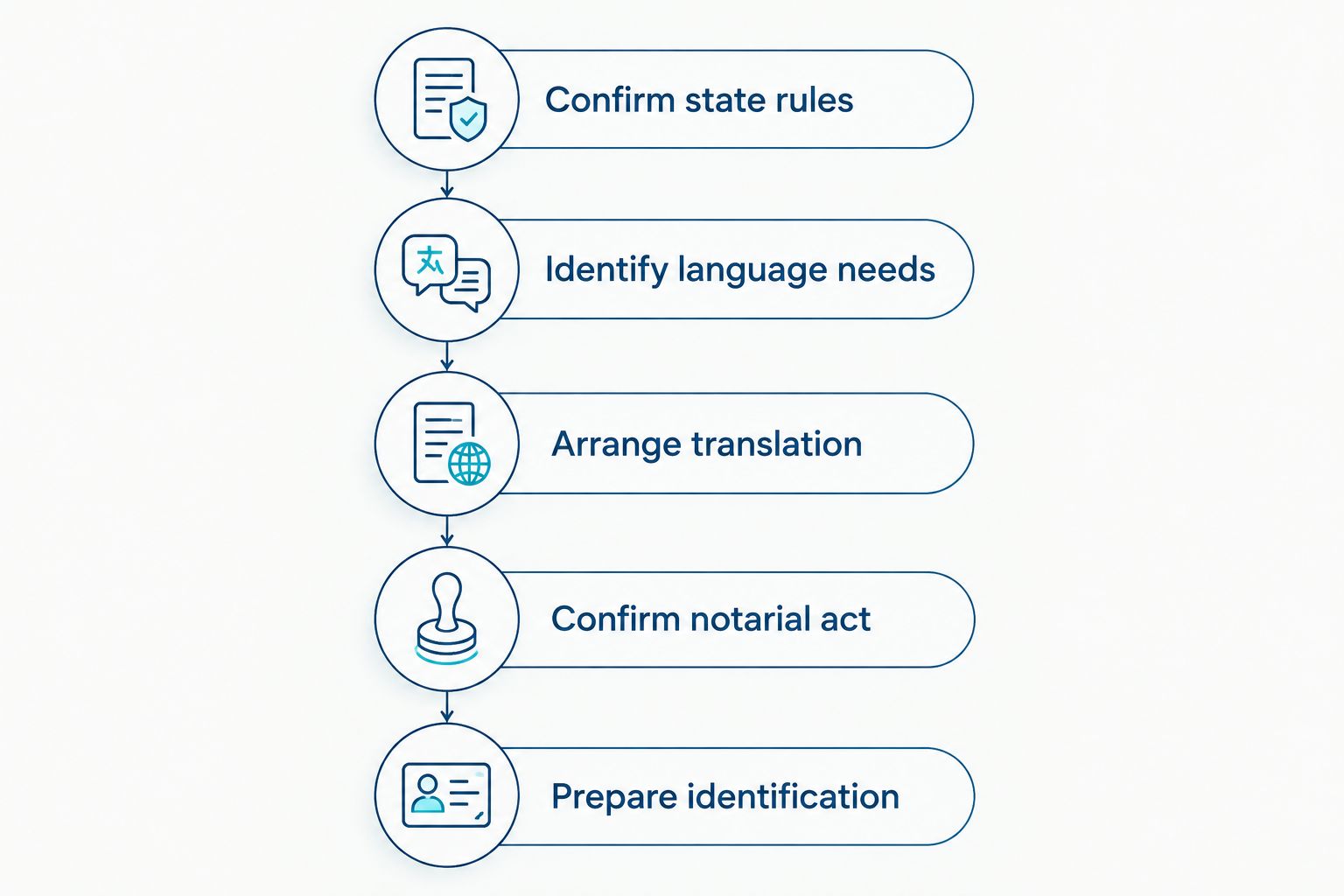
Use this preparation sequence for a Florida appointment in 2026. Each step addresses a different issue; completing one does not eliminate the others.
- Confirm state rules. Identify the jurisdiction governing the notarization. Florida’s language provision does not establish the rule for every other state.
- Identify language needs. State the signer’s spoken language, the document’s written language, and whether the signer understands the document.
- Arrange translation. Resolve the document’s nature and effect in a language the signer understands. Ask the receiving office whether it separately requires a written or certified translation.
- Confirm notarial act. Ask the document preparer or receiving office whether the document needs an acknowledgment, a jurat, or another authorized act. A non-attorney notary does not choose legal requirements for you.
- Prepare identification. Confirm acceptable identification, personal appearance arrangements, and any document-specific witness requirements before the appointment.
Tell the notary about the language issue when you request the appointment, not after everyone arrives. For a local starting point, review the guide to bilingual mobile notary services in Miami-Dade, then confirm the specific language directly with the provider.
English document, non-English-speaking signer
An English-language document does not become suitable for notarization simply because someone points to the signature line. In Florida, the signer must understand the instrument’s nature and effect through translation into a language the signer understands.
Arrange the explanation before signing. The signer should understand what kind of document it is and what signing it does, rather than merely recognizing their name or repeating instructions.
Best for: a signer who needs language assistance with an English document. The advantage of advance translation is that it separates document understanding from appointment logistics; the limitation is that translation does not replace identification, willingness, or the required notarial act.
If the signer asks what rights a document gives up or whether signing is advisable, direct those questions to the document preparer or an attorney. Language assistance and legal advice are different services.
Foreign-language document, signer who understands it
A document written in another language is not automatically ineligible for Florida notarization. The notary’s task concerns the required notarial act, not certification that every statement in the underlying document is accurate.
The notary still needs sufficient information to complete a proper certificate and perform the act lawfully. The receiving office can also have separate requirements concerning document language, translation, witnesses, or authentication.
Best for: a signer who understands the document but needs a notarized signature. The benefit is that the document’s language alone does not settle eligibility; the limitation is that notarization does not guarantee acceptance by the receiving office.
For a document intended for use outside the United States, ask the recipient what it requires before arranging notarization. Do not assume that a notarial seal also supplies a translation or an apostille.
Signer and notary do not share a language
Do not treat an interpreter’s presence as automatic permission to proceed. Florida’s statute addresses translation of the instrument’s nature and effect, while the notary must still satisfy the other requirements of the act.
A notary who speaks the signer’s language can communicate directly about identity, willingness, acknowledgment, and any required oath. That is why requesting a shared-language notary is a stronger starting point than arriving with an interpreter and assuming the arrangement will work.
Best for: direct communication through a notary who speaks the signer’s language. Its advantage is fewer communication barriers; its limitation is that speaking the same language does not resolve unclear legal terms, unacceptable identification, or an unsuitable certificate.
Explain any proposed interpreter arrangement before booking. The notary must assess the circumstances rather than accept another person’s assurance that everything is understood.
Remote online notarization and language needs
Remote online notarization changes how the signer appears before the notary; it does not remove language requirements. For a Florida online appointment in 2026, confirm that the signer can complete the applicable identity-verification process and communicate during the session.
Best for: signers whose documents and circumstances qualify for online notarization and who can complete the required technology and identification steps. The benefit is remote appearance; the limitation is that an online connection cannot correct a lack of understanding.
Thecruznetwork offers remote online notary services, but that does not establish support for any particular language or every document type. Ask about the signer’s language, document, location, and identification before choosing this format.
Why the answer varies
The answer depends on the circumstances of the signing, not the signer’s nationality. These factors determine what needs to happen:
- Governing state law: Florida’s language-specific requirement applies to Florida notarizations; other jurisdictions have their own rules.
- Signer understanding: Understanding the instrument’s nature and effect is different from knowing where to sign.
- Communication: The notary needs a workable way to complete the acknowledgment, oath, or other authorized act.
- Document requirements: A prepared certificate, required witnesses, and recipient instructions affect appointment preparation.
- Receiving-office requirements: Acceptance rules can include translation or authentication requirements beyond notarization.
- Appointment format: In-person and remote online appointments involve different appearance and identification procedures.
For your 2026 appointment, send questions about document acceptance to the receiving office and questions about the notarial act to the notary. That division prevents a translation request from being confused with a request for legal advice.
Can a family member translate at the appointment?
A family member’s translation does not automatically make the notarization permissible. The Florida notary must still satisfy the language rule and independently complete the required act; advance discussion is essential when the notary and signer cannot communicate directly.
For example, a relative saying that the signer understands is not the same as the notary establishing the necessary understanding. Request a shared-language notary where possible, especially when the document concerns significant legal or financial decisions.
Does a translated document need a separate notarization?
A translation does not automatically require notarization merely because it accompanies a notarized document. Ask the receiving office whether it requires a translator’s certification and whether the translator’s signature must be notarized.
If a translator signs a statement before a notary, the notarial act concerns that signature and the applicable acknowledgment or oath. It does not turn the notary into the translator or establish that the translation is accurate.
What should you confirm before booking in 2026?
Prepare a short appointment brief rather than sending only a document photo. Tell the provider the signer’s language, the document’s language, the intended receiving office, and whether you need an in-person or online appointment.
Ask these questions directly:
- Can the assigned notary communicate with the signer in the required language?
- What translation arrangements must be completed beforehand?
- What identification should the signer prepare?
- Does the document require witnesses or a particular certificate?
- Has the receiving office confirmed its translation and acceptance requirements?
Thecruznetwork provides mobile and remote online notary and document services in Miami-Dade. Request an appointment only after identifying the language issue; a general notary booking does not confirm bilingual service or document translation.
Discuss your notarization needs
Explain the signer’s language, document type, and preferred appointment format before booking.
FAQ
Can a notary refuse because I don’t speak English?
A Florida notary cannot proceed when the applicable language and notarization requirements are not met. Not speaking English does not automatically prevent notarization if the instrument’s nature and effect are translated into a language you understand and the remaining requirements are satisfied.
Do I need a certified translation before a Florida notarization?
Florida’s language provision does not itself require a certified written translation in every case. The receiving office can impose separate translation requirements, so confirm its instructions before the appointment.
Can a notary use a translation app to communicate with me?
Do not assume a translation app makes the notarization acceptable. The notary must still establish the required understanding and complete the notarial act; arrange language support before booking.
Does the notary have to understand every word of my foreign-language document?
A Florida notary does not automatically have to translate every word of the underlying document. The notary must be able to perform the required act lawfully, complete the certificate properly, and address the signer’s understanding and communication needs.
Can I sign the document before seeing the notary?
Whether you can sign beforehand depends on the required notarial act. An acknowledgment and a jurat have different signing requirements, so confirm the act before signing.
Will an apostille fix a document that was not translated?
An apostille does not replace translation or correct a failure to meet notarization requirements. It authenticates the relevant public official’s signature, capacity, and seal or stamp for the applicable international process, not the document’s substantive accuracy.
Can an online notary notarize for a Spanish-speaking signer?
A Florida online notary can serve a Spanish-speaking signer when the applicable language, identification, appearance, and notarial requirements are satisfied. Confirm Spanish-language communication before scheduling rather than assuming the platform supplies it.
One last thing
Understanding the document and understanding the notarial act are separate requirements to address. A signer can understand a translated contract yet still need an acknowledgment or oath communicated clearly. Before your 2026 appointment, confirm both—not just whether someone can translate the page.


