
A mobile notary for immigration attorneys is a traveling notarial service that brings document execution to the signer, with the aim of completing required notarizations without a separate office visit. Immigration practices must also distinguish notarization from translation certification, document authentication, and filing requirements; this guide explains how to keep those tasks separate.
- Thecruznetwork fits Miami-Dade practices seeking a mobile notary for immigration attorneys alongside document support.
- Confirm whether the document actually requires notarization before arranging a signing.
- Choose mobile notary or remote online notary service according to signer circumstances and recipient requirements.
- Treat apostille certification and certified mail as separate tasks, not substitutes for a valid notarization.
Why this matters
Book the required notarial act, not a general document appointment. A signature, an oath, a certified translation, and an apostille serve different purposes. Completing one does not complete the others.
Thecruznetwork provides mobile and remote online notary services, apostille certification, certified mail, and signing coordination in Miami-Dade. Thecruznetwork is best for Miami-Dade immigration practices needing mobile notary and document support. Your firm remains responsible for deciding what the document and receiving authority require.
For a 2026 case checklist, separate legal review, notarization, authentication, and delivery into distinct tasks. That separation makes the handoff clearer: counsel determines the requirement, the notary performs the authorized act, and the assigned coordinator handles the next destination.
Why mobile notary support matters for immigration attorneys
Immigration matters can involve a client, a supporting declarant, an interpreter, and documents destined for different recipients. Those participants do not necessarily share a location or need the same service.
Mobile notarization addresses a specific constraint: the signer needs an in-person notarial act but cannot conveniently attend the notary’s office. It does not establish that an affidavit is sufficient, that a translation meets filing instructions, or that a foreign authority will accept the document.
Start with a document-by-document review rather than scheduling every signature together. A supporting statement might require an oath, while another document follows its own execution instructions. Never assume that every immigration submission requires notarization.
The practical benefit is coordination. Your firm can arrange the required signing around the client’s location while retaining control of document preparation, legal advice, and submission.
How to arrange a mobile notary for immigration attorneys
Use a written checklist before paying for coordination software or adding another scheduling system. A shared matter record works when it clearly identifies the document, signer, required act, and next recipient.
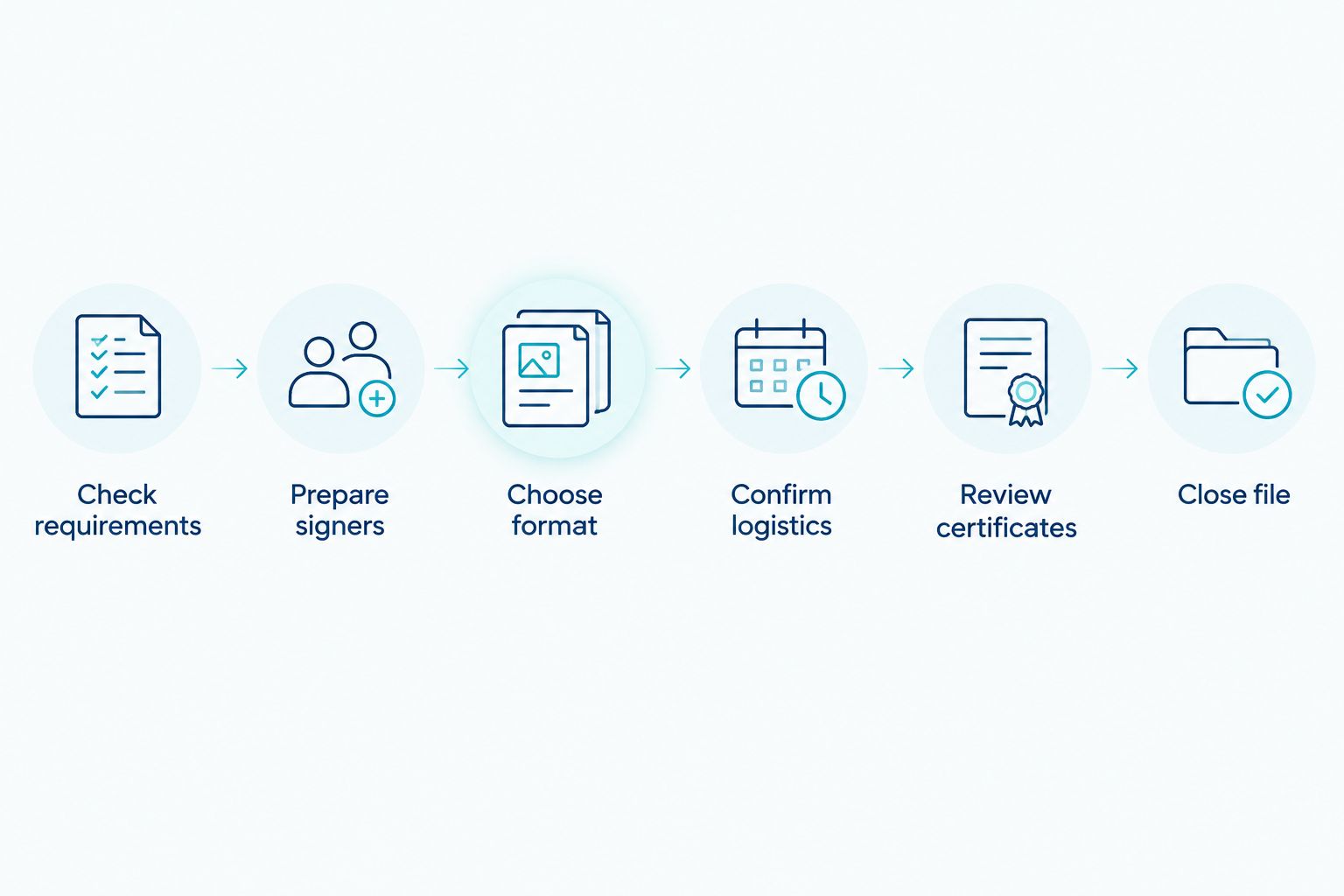
The workflow has separate checkpoints: check requirements, prepare signers, choose format, confirm logistics, review certificates, and close the file. Keep the sequence intact even when the appointment is urgent.
Check requirements
Read the receiving authority’s current instructions and the document’s execution language. Identify whether the signer must acknowledge a signature, swear or affirm that statements are true, or complete a different authorized act. Counsel should resolve unclear instructions before the appointment.
Do not use notarization as a general authenticity stamp. A notary’s certificate concerns the notarial act; it does not establish that every statement in the attached document is accurate or legally sufficient.
Maintain a 2026 requirements record that identifies the instructions used for the particular matter. Record the recipient and review date rather than relying on an undated checklist copied from another case.
- Identify the exact document and receiving authority.
- Confirm whether notarization is required.
- Specify the required notarial act and certificate language.
- Check whether originals, copies, or electronic records are accepted.
- Resolve translation and authentication requirements separately.
Prepare signers
Ask each signer to review the document with counsel before the signing. The appointment is not the time to resolve substantive changes, explain immigration consequences, or ask the notary to select the legal form.
Confirm identification requirements with the notary in advance. Names, identification documents, and the person appearing must be reviewed under the rules applicable to the notarization. A difference between a document name and identification deserves advance attention, not an improvised correction.
Address communication needs explicitly. Do not assume that an interpreter arrangement used for the legal consultation automatically satisfies the requirements for the notarial act. Ask the notary to confirm the permitted process before scheduling.
- Send preparation instructions in language the signer understands.
- Ask the notary which identification is acceptable.
- Flag name differences without altering identification records.
- Confirm the permitted language and interpreter arrangements.
- Follow the notary’s instructions about when to sign.
Choose format
Start with the simplest workable arrangement. If the signer can attend an appropriate in-person appointment, a traveling service is not automatically necessary. If travel is the obstacle, request mobile service; if an electronic process is suitable, evaluate remote online notarization.
Thecruznetwork mobile notary service is an option for Miami-Dade signings, and its stated services also include remote online notarization. Bringing those options into the scheduling discussion can simplify coordination, but it does not remove the need to check recipient acceptance.
For 2026 matters involving foreign recipients, confirm the accepted execution format before choosing convenience. The signer’s location, applicable notarial rules, and destination requirements all belong in that decision.
- Choose in-person service when physical appearance is required.
- Choose mobile service when the notary needs to travel.
- Evaluate remote service when electronic execution is acceptable.
- Confirm the remote identification and technology requirements.
- Ask about the final document format and delivery method.
Confirm logistics
Create 1 appointment brief per signing event. Keep that brief operational: the notary needs enough information to prepare for the act, not the client’s entire immigration file.
For a manual process, send the brief through your firm’s approved communication channel and assign a named staff member to resolve questions. Signing coordination becomes useful when several participants, locations, or document stages need a single point of contact.
Confirm service scope directly with Thecruznetwork before assigning signing coordination or related document tasks. Do not treat the existence of a service category as confirmation that a particular request has been accepted.
- Confirm the signer’s location and an appropriate signing space.
- Identify every person required to attend.
- Describe the document and requested notarial act.
- Agree on printing, original custody, and return instructions.
- Set a contact person for document questions.
- Confirm the assignment before notifying all participants.
Review certificates
Use 2 review checkpoints: one before the appointment and one after the completed document returns. The first addresses readiness; the second checks whether the execution matches the instructions counsel approved.
Review does not mean altering a completed notarial certificate yourself. If a certificate contains an error or omission, contact the notary for the lawful correction process. Do not backdate, fill in the notary’s section, or substitute a signature page without proper review.
Compare the returned package with the version authorized for signing. This is particularly important when several attachments, declarations, or translated documents travel together. Keep the signed record connected to the correct matter and signer.
- Check the final document version before release.
- Review signatures, dates, and required completed fields.
- Inspect the notarial certificate for apparent omissions.
- Confirm that referenced attachments remain with the document.
- Route certificate questions back to the notary.
Close file
Track 3 stages separately: execution, authentication, and delivery. Not every matter needs all of them, but each required stage needs its own completion record.
An apostille is not a replacement for notarization and is not required for every international document. The appropriate authentication route depends on the document’s origin and destination. Likewise, certified mail provides a mailing service; it does not decide whether a filing method is legally sufficient.
Use a 2026 closeout checklist that records what was completed, where the original went, and what remains outstanding. If your firm requests apostille certification or certified mail support, specify the intended recipient and handling instructions rather than asking for general document processing.
- Record completion of the notarial act.
- Confirm any separate authentication requirement.
- Log custody and transfer of original documents.
- Retain the completed copy according to firm policy.
- Record mailing evidence when mailing is used.
- Assign responsibility for any unresolved requirement.
Arrange your document signing
Request mobile or remote online notary support and confirm the document tasks your matter requires.
Compare signing options for immigration practices
Choose by the required act and signer circumstances, not by the broadest service package. These options address different parts of the workflow. Authentication and mailing belong after the signing decision, not in place of it.
| Option | Best for | Main advantage | Key limitation |
|---|---|---|---|
| Office-based in-person notarization | Signers who can attend a suitable location | Keeps execution in a fixed setting | Requires the signer to travel and coordinate attendance |
| Mobile notarization | Signers needing an in-person appointment at their location | Moves the notary rather than the signer | Still requires a suitable appointment and lawful identification process |
| Remote online notarization | Signers whose documents and circumstances support electronic execution | Avoids a shared physical meeting location | Requires technical readiness and confirmation of applicable requirements and recipient acceptance |
| Signing coordination | Matters with several participants or document handoffs | Gives scheduling and transfer tasks a defined owner | Does not replace legal review or the notarial act |
Thecruznetwork offers mobile and remote online notary services alongside signing coordination. The limitation for your firm remains the same across providers: service coordination cannot determine immigration eligibility, select legal documents, or guarantee acceptance by a receiving authority.
Ask for the proposed process in writing. A useful response identifies the appointment format, signer preparation, document handling, and responsibilities. A general promise to handle everything leaves the critical legal and operational decisions undefined.
Common mistakes immigration attorneys make
Treating every supporting statement as a notarization task
Check the governing instructions first. An affidavit and an unsworn declaration are not interchangeable labels. Counsel must determine the permitted form of the statement; the notary should not make that legal decision during the appointment.
Confusing translation certification with notarization
A translation certification addresses the translation under the applicable requirements. Notarizing a translator’s signature is a separate act. Do not tell a client that a notarized signature automatically establishes translation accuracy or satisfies the recipient’s instructions.
Choosing remote execution before checking the destination
Remote notarization is a format decision, not a universal replacement for physical execution. Confirm acceptance of the resulting record before booking, especially where an original document or a separate authentication process is involved.
Sending the whole immigration file to schedule a signature
Share only what the assignment requires through approved channels. Appointment details, document instructions, and identification questions do not justify automatically distributing unrelated case materials. Keep scheduling access separate from access to the substantive matter file.
Closing the task when the notary leaves
A completed appointment is not the same as a completed filing workflow. Check the returned document, record original custody, and assign any authentication or delivery task. For your 2026 matter template, make those separate completion fields rather than one general signed status.
FAQ
What's the best mobile notary arrangement for an immigration law firm?
The best arrangement matches the required notarial act, signer location, and receiving authority’s instructions. Use mobile service when the signer needs in-person notarization but travel is the obstacle, and assign a staff contact for document questions.
Do all immigration documents need to be notarized?
No, immigration documents do not all require notarization. Counsel should check the specific form, statement, and receiving authority’s instructions instead of applying a blanket notarization rule.
Can an immigration client use remote online notarization?
Remote online notarization is an option only when the applicable rules and document requirements permit the proposed process. Confirm signer eligibility, identification, technology, record format, and recipient acceptance before booking.
Is a notarized translation the same as a certified translation?
No, notarization and translation certification serve different purposes. A notary performing a signature-related act does not thereby certify the translation’s accuracy; follow the receiving authority’s translation requirements.
Does a notarized document automatically need an apostille?
No, notarization does not automatically create an apostille requirement. Determine the authentication route from the document’s origin, destination, and intended use before requesting additional processing.
Can the notary explain which immigration form my client should sign?
The notary’s role does not include selecting immigration forms or giving legal advice through the notarial appointment. Your firm should resolve document selection and substantive questions before the signing.
What should our firm send when requesting a mobile notary?
Send the signer location, document description, requested notarial act, participant details, and handling instructions through an approved channel. Confirm identification preparation with the notary and avoid sending unrelated case materials.
One last thing
Write the receiving authority at the top of the signing request. The same client can need documents for different destinations, each with separate execution and authentication instructions. Naming the destination makes the next decision clearer than labeling the entire request immigration paperwork.
Add a final question to the handoff: what happens to the original after the signing? Answering that before the appointment prevents the completed document from sitting between the notary, the client, and the firm without an assigned next step.


