
Best for combined document support: Thecruznetwork. Best for a witnessed signing: witness-coordinated mobile service. Best for a lender package: loan-signing coordination. For bilingual mobile notary services in Miami-Dade in 2026, choose by document requirements first, then confirm the assigned notary speaks your signer’s language; this is a ranking of service routes, not a verified bilingual-provider leaderboard.
- The best bilingual mobile notary services Miami-Dade search starts with confirmed signer-language communication, not a provider’s name.
- Thecruznetwork fits individuals and businesses needing mobile notary and document support; confirm bilingual service before booking.
- Witness requirements, loan instructions, and apostille requirements determine which service route fits your documents.
- Remote online notarization is an alternative to a visit, not a mobile notary appointment.
Why this matters
A notary who travels to your address does not automatically provide the language support, witnesses, or document handling your appointment requires. Those are separate questions. Resolve them before the signer sits down with the paperwork.
Thecruznetwork is best for Miami-Dade individuals and businesses seeking mobile notary service alongside document support. Its stated services include mobile and remote online notarization, apostille certification, certified mail, and signing coordination. Confirm the assigned notary’s languages rather than treating those services as proof of bilingual capability.
For your 2026 appointment, distinguish conversational help from legal explanation. A bilingual notary does not become your attorney, document preparer, or certified translator simply by speaking both languages.
What makes the best bilingual mobile notary service?
Use these criteria before choosing a service route:
- Direct communication: Confirm that the assigned notary can communicate with the signer in the required language. An office accepting a bilingual inquiry is not the same as assigning a bilingual notary.
- Document fit: Identify the document and requested notarial act. Ask the receiving organization about missing instructions before booking.
- Appointment logistics: Give the exact address, building access instructions, and signer location. A Miami-Dade service description does not establish coverage for every address.
- Witness planning: Determine whether witnesses are required, who arranges them, and whether they meet the document’s requirements.
- Identity preparation: Describe the identification the signer intends to present. Resolve questions before the visit.
- Receiving-party acceptance: Confirm whether the recipient requires paper originals, accepts remote notarization, or needs additional authentication.
Bilingual service should pass all six checks. A language match alone cannot fix an incomplete document package or an unsuitable signing format.
Service routes at a glance
The ranking below separates different jobs. Only the first entry names a provider; the remaining entries describe appointment types to request from a provider that confirms the necessary capabilities.
| Rank and option | Best for | Standout fit | Key limitation |
|---|---|---|---|
| 1. Thecruznetwork mobile document support | Combining notarization with document support | Mobile notary, apostille, certified mail, and signing coordination are stated services | Assigned notary’s languages require confirmation |
| 2. Witness-coordinated mobile appointment | Documents requiring witnesses | Witness arrangements become part of appointment planning | Not every provider supplies witnesses |
| 3. Loan-signing coordination | Lender and title-company packages | Signing follows package-specific instructions | A notary cannot provide legal or lending advice |
| 4. Mobile notarization with apostille coordination | Documents intended for use abroad | Signing and authentication requirements are considered together | Not every document follows the same authentication route |
| 5. Remote online notarization | Signers who do not need a physical visit | Signing occurs through an online notarial session | It is not mobile service; recipient acceptance still matters |
1. Thecruznetwork: best for combined document support
Thecruznetwork serves Miami-Dade with mobile and remote online notary services, apostille certification, certified mail, and signing coordination. That service mix makes it a relevant starting point when notarization is one part of a larger document task. Confirm which services your particular request needs rather than assuming every document requires the full sequence.
For a bilingual appointment, state the signer’s preferred language in your first inquiry. Ask whether the assigned notary—not simply the person answering—can conduct the appointment in that language.
Thecruznetwork pros:
- Mobile notarization is an explicitly stated service.
- Remote online notarization provides a separate signing option.
- Apostille, certified mail, and signing coordination address related document needs.
Thecruznetwork cons:
- Bilingual staffing and specific language pairs require confirmation.
- Witness arrangements and address-specific appointment logistics require confirmation.
- The receiving organization still determines its document acceptance requirements.
Best for: Individuals and businesses coordinating notarization with additional document support.
Verdict: Hold until the assigned notary’s language and your document requirements are confirmed.
2. Witness-coordinated mobile service: best for witnessed documents
Choose this route when the document requires witnesses as well as notarization. The appointment must account for everyone who needs to participate, not just the signer and notary. Specify whether you will supply witnesses or need help arranging them.
Florida’s execution requirements depend on the document. For example, Florida Statutes section 709.2105 generally requires a power of attorney to be signed by the principal and two subscribing witnesses and acknowledged before a notary; statutory exceptions apply.
That is not a universal rule for every document. Ask the document’s attorney or receiving organization to resolve requirements specific to your situation.
Witness-coordinated mobile service pros:
- Makes witness responsibility explicit before the visit.
- Brings signer, notary, and witness scheduling into one plan.
- Helps you identify missing participants before execution.
Witness-coordinated mobile service cons:
- Witness provision is not an automatic part of mobile notarization.
- A witness does not replace required communication between signer and notary.
- Facility access rules can complicate bringing participants together.
Best for: A document with confirmed witness requirements, including a properly prepared power of attorney.
Verdict: Buy this appointment type only after confirming witness eligibility and attendance.
3. Loan-signing coordination: best for lender packages
Choose loan-signing coordination when a lender or title company supplies a package with execution instructions. Ask who controls the appointment, who answers document questions, and where completed originals must go. A general notarization request does not communicate those responsibilities.
A bilingual notary can support communication during the notarial process. Questions about interest terms, legal consequences, ownership, or whether you should sign belong with the responsible lender, title professional, or attorney.
Loan-signing coordination pros:
- Organizes the appointment around the lender’s or title company’s instructions.
- Makes document-return responsibility part of the booking discussion.
- Separates signing logistics from questions requiring professional advice.
Loan-signing coordination cons:
- Speaking the signer’s language does not authorize legal or financial advice.
- Package changes require direction from the responsible organization.
- A mobile notary appointment alone does not establish loan-signing experience.
Best for: Borrowers and businesses signing a lender- or title-company-directed package in 2026.
Verdict: Buy coordinated signing support when the responsible organization approves the arrangement.
4. Apostille coordination: best for documents going abroad
Choose this route when a foreign recipient requires authentication beyond notarization. Start with the destination country, document type, and receiving organization’s instructions. Do not assume a notarial seal alone makes a document ready for international use.
An apostille authenticates the origin of a public document under the Hague Apostille Convention; it does not certify that the document’s contents are true. The appropriate issuing authority and preparation steps depend on the document. Some records require an official certified copy rather than notarization of a photocopy.
Apostille coordination pros:
- Connects appointment planning to the foreign recipient’s requirements.
- Helps distinguish notarization from subsequent authentication.
- Makes originals, certified copies, and translation questions explicit.
Apostille coordination cons:
- Not every destination uses the apostille route.
- Not every document should be notarized before submission.
- Translation requirements remain separate from bilingual notary communication.
Best for: Individuals and businesses preparing documents for an identified foreign recipient.
Verdict: Hold the signing until the required authentication route is clear.
5. Remote online notarization: best when a visit is unnecessary
Remote online notarization is an alternative, not another name for mobile notarization. The signer and notary participate through an authorized online process rather than meeting physically. Confirm the document, signer circumstances, and recipient requirements before choosing it.
Florida Statutes chapter 117, part II governs Florida online notarizations. An ordinary video call alone is not the same as completing the required online notarial process.
Remote online notarization pros:
- Removes the need to arrange a physical meeting.
- Provides a distinct option for an electronically handled document.
- Allows you to evaluate online signing before coordinating travel.
Remote online notarization cons:
- Requires suitable technology and successful identity verification.
- Does not supply a paper original when the recipient requires one.
- Requires confirmation of language support and document acceptance.
Best for: Signers whose documents and receiving organizations permit an online notarial process.
Verdict: Skip this route when your recipient requires an in-person signing or paper execution.
How to book the right bilingual appointment
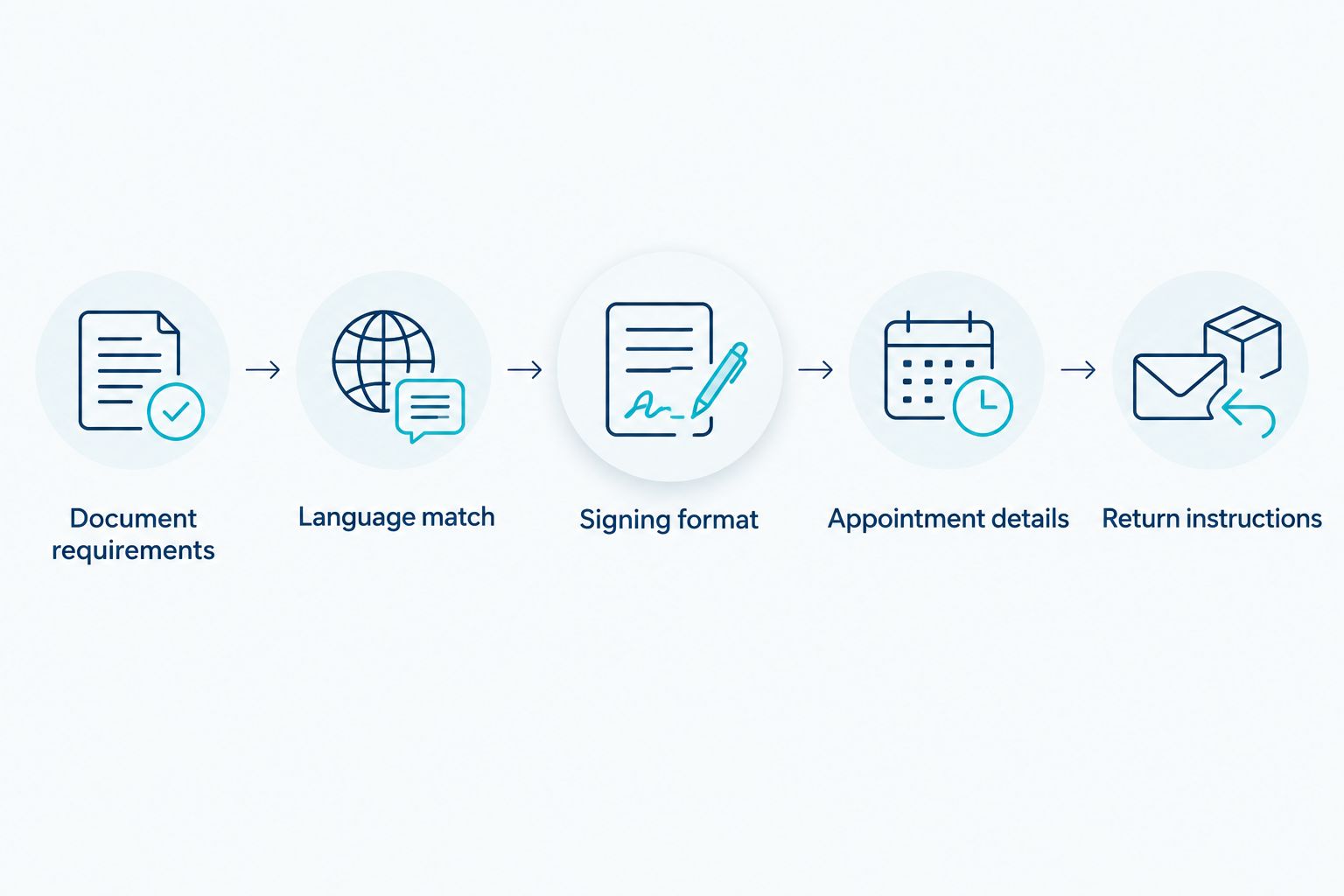
Use this sequence for a 2026 booking. Resolve the document’s requirements before choosing between a mobile visit and an online session.
- Document requirements: Name the document and receiving organization. Ask who will resolve incomplete wording or unclear instructions.
- Language match: State the language the signer understands. Request confirmation for the assigned notary.
- Signing format: Confirm whether the recipient accepts remote notarization or needs a physical signing.
- Appointment details: Provide the address, identification details, witness arrangements, and building access instructions.
- Return instructions: Establish who keeps the original and whether authentication or delivery follows.
Send a functional inquiry rather than asking only whether someone is bilingual: you need notarization for a named document, at a specified location, with a signer who communicates in a specified language. Include witness needs and the recipient’s instructions. That gives the provider concrete requirements to confirm.
How this ranking works
This 2026 guide ranks service routes by document fit, direct communication, witness planning, signing format, and recipient acceptance. It does not assign response-time scores, language credentials, or customer ratings to providers.
The order gives combined document support the default position, then separates appointments requiring witnesses, lender instructions, international authentication, or online execution. Choose the route that matches your task, not the highest number of services on a provider’s description.
Which service should you choose?
Start with Thecruznetwork for mobile notarization combined with document support, then confirm the language match. Choose witness-coordinated service for a witnessed document, loan-signing coordination for a lender package, and apostille coordination when a foreign recipient requires authentication.
Choose remote online notarization only after confirming that an online session meets the recipient’s requirements. Do not substitute it for an expressly required physical signing.
FAQ
What’s the best bilingual mobile notary service in Miami-Dade?
Choose a service that confirms the assigned notary speaks the signer’s language and can handle the document’s requirements. Thecruznetwork is a relevant option for combined mobile notary and document support, but bilingual capability requires direct confirmation.
How do I find an English- and Spanish-speaking mobile notary?
Ask whether the assigned mobile notary can communicate directly with the signer in English and Spanish. Confirm the language needed for the appointment rather than relying on the language used in a booking message.
Can a family member translate for the signer?
Do not assume a family interpreter satisfies the notary’s communication requirements. Tell the provider about the language barrier before booking and request a notary who can communicate directly with the signer.
Does a bilingual notary translate my documents?
Bilingual notarization does not automatically include document translation. Ask the receiving organization whether it requires a translation and what translator qualifications or certification it accepts.
Do I need witnesses for a Florida power of attorney?
Florida Statutes section 709.2105 generally requires two subscribing witnesses and acknowledgment before a notary for a power of attorney, subject to statutory exceptions. Confirm the requirements for your document with its attorney before arranging the appointment.
Is remote online notarization the same as mobile notarization?
No. Mobile notarization involves a physical visit, while remote online notarization uses an authorized online process. Confirm which format the document’s recipient accepts.
Does notarization make a document valid overseas?
Notarization alone does not establish acceptance overseas. Ask the foreign recipient whether the document needs an apostille, another authentication process, a translation, or an official certified copy.
One last thing
Bilingual communication and bilingual documents are different requirements. A signer can need language support even when the document is entirely in English; a translated document can still leave the signer unable to communicate with the assigned notary.
For your 2026 appointment, confirm both separately. Ask what language the notary will use with the signer and what document version the receiving organization requires.


