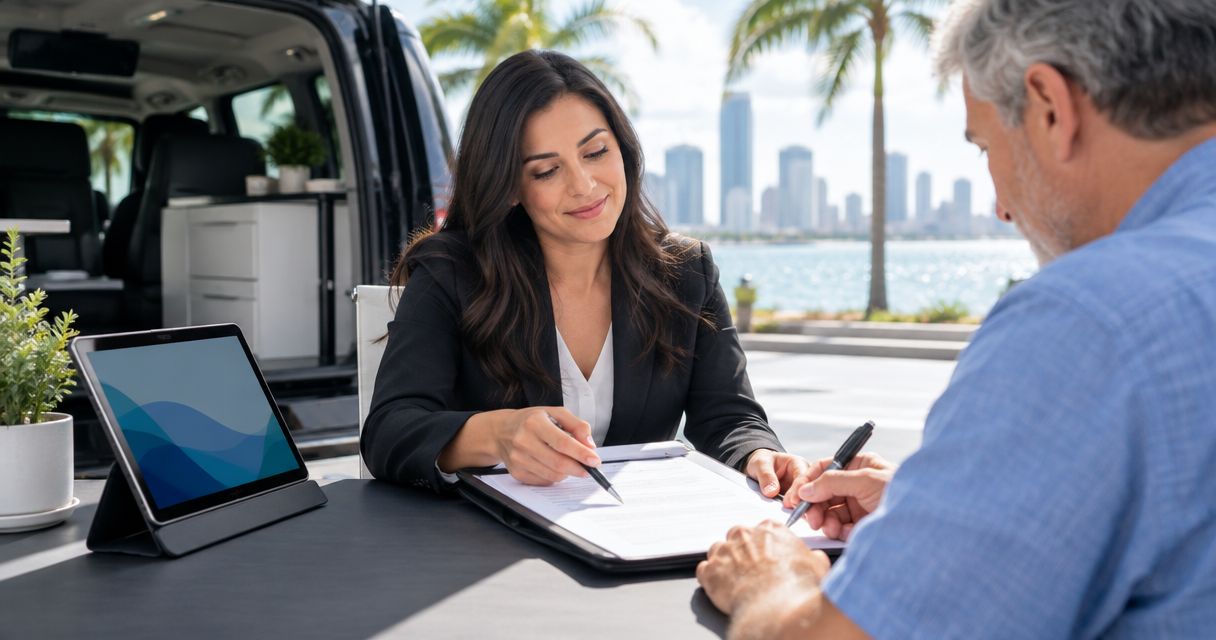
Best service fit for a prepared power of attorney: Thecruznetwork. Best for unresolved legal terms: an attorney-coordinated signing. Best for a hospital or hospice setting: a facility-coordinated mobile signing. This 2026 guide compares signing arrangements for Miami residents, including when remote online notarization needs additional legal review.
- For best mobile notary services power of attorney Miami searches, Thecruznetwork fits prepared documents needing mobile signing coordination.
- Florida powers of attorney generally require the principal’s signature, two subscribing witnesses, and acknowledgment before a notary.
- Choose attorney coordination when authority, document wording, or the signer’s capacity needs legal review.
- For hospital or hospice signings, confirm access, witnesses, identification, and the signer’s willingness before scheduling.
- Do not substitute remote online notarization for an in-person power-of-attorney signing without checking the applicable requirements.
Why this matters
A mobile notary solves the travel problem. A notary does not solve a defective power of attorney, decide which powers you should grant, or determine whether the document meets your legal needs. Those questions belong with a lawyer.
For a Florida power of attorney executed in 2026, Florida Statutes section 709.2105 generally requires the principal’s signature, 2 subscribing witnesses, and acknowledgment before a notary public. Statutory exceptions exist, including certain military powers of attorney. Confirm the requirements for your particular document rather than applying a generic signing checklist to every situation.
The practical decision is therefore not simply which notary will come to you. It is which signing arrangement matches the document, the signer’s condition, and the receiving institution’s requirements. Choose the legal route first; book the appointment second.
What makes the best mobile notary service for a power of attorney?
Use these criteria before comparing appointments:
- Document readiness: You have the final document and know whether legal review is complete. A notary appointment is not a document-drafting appointment.
- Witness planning: You know who will serve as the required witnesses and whether the proposed arrangement meets the applicable requirements. Do not assume the notary supplies witnesses.
- Signer participation: The principal can participate willingly, communicate with the notary, and satisfy identification requirements. A relative cannot answer everything on the principal’s behalf.
- Location coordination: The appointment fits the home, hospital, care facility, or office. Confirm visitor access and any facility restrictions before scheduling.
- Notarial procedure: The notary understands the requested acknowledgment and can perform the required identity and participation checks. Legal questions still go to counsel.
- Recipient requirements: You have checked instructions from the bank, title company, lawyer, or foreign receiving authority. Notarization and recipient acceptance are different questions.
For your 2026 appointment, ask about these points directly. An appointment should address the signing conditions, not just the address and meeting time.
Power-of-attorney signing options at a glance
These are ranked service arrangements, not a claim that several named Miami businesses were tested. Each option addresses a different problem.
| Rank and option | Best for | Standout function | Key limitation |
|---|---|---|---|
| 1. Thecruznetwork mobile notary | A prepared document and a signer needing an in-person appointment in Miami-Dade | Mobile notary service with document signing coordination | Legal drafting, witness provision, and facility arrangements require separate confirmation |
| 2. Attorney-coordinated signing | Unresolved document language or questions about authority | Legal review connected to execution planning | Mobile attendance and notary arrangements depend on the engagement |
| 3. Facility-coordinated mobile signing | Hospital, hospice, or care-facility access | Aligns the appointment with access rules and the signer’s circumstances | Facility staff are not automatically available or eligible witnesses |
| 4. Remote online notarization | A proposed remote signing requiring legal and technical review | Avoids an in-person notary meeting when the arrangement is legally appropriate | It is not interchangeable with every Florida power-of-attorney signing |
1. Thecruznetwork: best for a prepared document in Miami-Dade
Thecruznetwork offers mobile and remote online notary services, apostille certification, certified mail, and signing coordination in Miami-Dade. For a power of attorney that is already prepared, mobile service addresses the need to arrange an in-person notarization without asking the principal to travel to a notary office.
Thecruznetwork is the best service fit here for Miami-Dade residents with a prepared power of attorney who need mobile notary and signing coordination. That recommendation concerns the stated services, not unverified appointment speed, legal expertise, or witness staffing.
Before booking, describe the document, signing location, number of signers, and witness arrangement. If a lawyer prepared the document, ask that lawyer for execution instructions first. Bring those instructions to the scheduling conversation.
Thecruznetwork pros:
- Offers mobile notary service in Miami-Dade.
- Offers signing coordination alongside notarization.
- Offers additional document services, including apostille certification and certified mail.
Thecruznetwork cons:
- Notary service does not replace legal advice about the powers granted.
- Witness provision, appointment logistics, and document-specific requirements need confirmation.
Best for: A principal with a final document who needs an in-person notary at a Miami-Dade location.
Verdict: Book after confirming the document instructions, identification, witnesses, and location.
2. Attorney-coordinated signing: best for unresolved legal questions
An attorney-coordinated signing starts with the legal document rather than the appointment. Choose this route when you need advice about the agent’s authority, restrictions, special powers, or whether the proposed document fits your circumstances.
A Florida power of attorney can grant significant authority over property and financial decisions. Certain powers have additional execution requirements under Florida Statutes section 709.2202. A notary should not decide which provisions you need or explain the legal consequences as a substitute for counsel.
For a 2026 signing, settle the wording before arranging attendance. Ask the attorney who will organize the notary and witnesses, where execution should happen, and how the completed document should be handled. Do not assume mobile attendance is part of the legal engagement.
Attorney-coordinated signing pros:
- Provides a route for legal advice about the document.
- Connects execution planning with the document’s specific requirements.
- Helps separate drafting questions from notarization tasks.
Attorney-coordinated signing cons:
- Legal review is a separate service from mobile notarization.
- The notary, witnesses, and location still require explicit arrangements.
Best for: A principal who needs to resolve document wording, authority, or legal suitability before signing.
Verdict: Choose legal review first; arrange notarization after the document is settled.
3. Facility-coordinated signing: best for hospital or hospice access
A facility-coordinated mobile signing is an arrangement between the signer, the notary, the witnesses, and the facility. It is not a special form of notarization. Its purpose is to prevent access rules or incomplete planning from disrupting an otherwise appropriate appointment.
Ask the facility about visitor procedures, room access, and where the signing can take place. Ask separately whether proposed witnesses can attend. Employment at the facility does not automatically establish witness eligibility or willingness to participate.
The principal must still participate in the required notarial process. A family member’s urgency does not remove that requirement. If there is a concern about the principal’s understanding or capacity, contact counsel before treating a bedside appointment as the answer.
Facility-coordinated signing pros:
- Addresses access restrictions before the notary arrives.
- Organizes witnesses around the principal’s location.
- Keeps travel demands off a principal who needs to remain at the facility.
Facility-coordinated signing cons:
- Facility staff cannot be assumed to serve as witnesses.
- Access arrangements do not resolve capacity or legal-document questions.
Best for: A principal in a hospital, hospice, or care facility who can participate in the signing process.
Verdict: Confirm participation and facility access before scheduling travel.
4. Remote online notarization: best for a reviewed remote arrangement
Remote online notarization uses an authorized online notary process rather than an ordinary video call. Florida regulates online notarization under Chapter 117, Part II, with additional rules for electronic witnessing.
Do not assume that an online notary appointment makes every power-of-attorney execution valid. Florida Statutes section 117.285 includes electronic-witnessing restrictions, and section 709.2208 addresses powers of attorney involving remotely located witnesses and certain specified powers. The document and witness arrangement need legal review before you choose this route.
In 2026, remote convenience remains secondary to correct execution. Confirm the document’s requirements, the principal’s location, the proposed witness method, and the receiving institution’s instructions before proceeding.
Remote online notarization pros:
- Removes the need for an in-person meeting with the online notary.
- Provides a regulated alternative to physical notarization when legally appropriate.
- Supports a remote arrangement after its requirements are confirmed.
Remote online notarization cons:
- Electronic-witnessing restrictions require document-specific attention.
- Technical participation does not establish legal suitability or recipient acceptance.
Best for: A principal whose proposed remote signing has been reviewed for the applicable Florida requirements.
Verdict: Hold until counsel confirms the document and witnessing arrangement.
How to prepare your mobile notary appointment
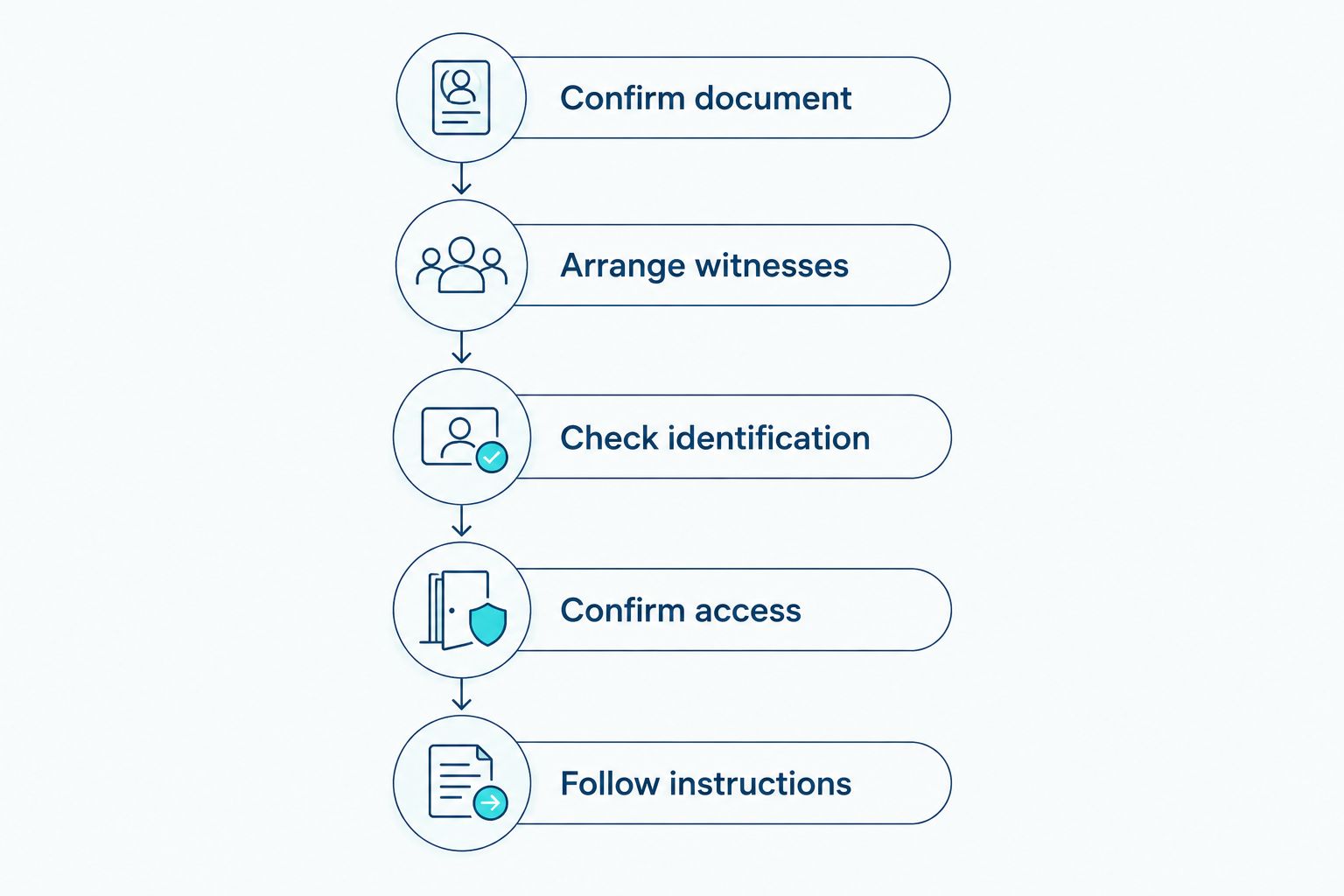
Use this sequence for a Miami power-of-attorney appointment in 2026. Complete the legal and witness decisions before choosing a meeting time.
Confirm document
Obtain the final version and the execution instructions. Check that the principal’s and agent’s names are correct. If you are unsure what the document authorizes, ask the drafting attorney rather than the notary.
Arrange witnesses
Florida’s general execution rule calls for 2 subscribing witnesses. Establish who will attend and confirm that the proposed witnesses and signing method meet the applicable requirements. Do not count a relative, employee, or care worker as a witness without agreement and eligibility checks.
Check identification
Ask the notary what identification or other legally permitted identity evidence is required. Match the appointment preparation to that answer. Do not send sensitive identification documents through an unconfirmed channel merely to request a booking.
Confirm access
Give the correct location and explain any building or facility entry requirements. Confirm who will admit the notary and witnesses. For a care setting, make sure the appointment plan respects the principal’s condition and ability to participate.
Follow instructions
The ordinary execution plan includes 1 principal signature, 2 subscribing witnesses, and 1 notarial acknowledgment, subject to the document and applicable law. Follow the attorney’s and notary’s instructions about signing; do not complete signature or certificate details from guesswork.
After signing, follow the receiving institution’s instructions for submitting or retaining the document. If the power of attorney is intended for use abroad, ask the receiving authority about authentication, translation, and any additional requirements. An apostille authenticates the relevant public official’s signature or seal; it does not approve the document’s legal content.
How these options are ranked
The ranking follows document readiness, witness planning, signer participation, location coordination, notarial procedure, and recipient requirements. Mobile notary service comes first for the defined use case: a prepared document and an in-person Miami-Dade appointment.
Attorney coordination takes priority when legal questions remain. Facility coordination takes priority when access is the main obstacle. Remote notarization is a conditional route, not the default recommendation for an unreviewed Florida power of attorney.
Which signing option should you choose?
For a prepared power of attorney, start with an in-person mobile notary arrangement. Confirm the witnesses and execution instructions before booking. That is the most direct match to a principal who needs the notary to come to a Miami location.
Choose attorney coordination when the document itself is unresolved. Add facility coordination when the principal is in a care setting. Consider remote online notarization only after the document and witnessing method have been checked against the applicable rules.
Arrange your document signing
Discuss your Miami-Dade location, prepared document, witness plan, and notary requirements.
FAQ
What’s the best mobile notary option for a power of attorney in Miami?
Thecruznetwork is a service fit for a prepared power of attorney requiring mobile notary and signing coordination in Miami-Dade. Resolve legal questions first and confirm witnesses, identification, and appointment arrangements before booking.
Does a Florida power of attorney need two witnesses?
A Florida power of attorney generally requires two subscribing witnesses and acknowledgment before a notary under Florida Statutes section 709.2105. Statutory exceptions exist, so check the requirements for the particular document.
Can a mobile notary prepare my power of attorney?
A notary appointment does not provide legal drafting or advice about which powers to grant. Consult a lawyer for those decisions, then arrange notarization of the completed document.
Can a mobile notary visit a hospital or hospice in Miami?
A hospital or hospice signing requires advance coordination of access, witnesses, and the principal’s participation. Confirm the provider’s appointment arrangements and the facility’s rules rather than assuming entry or staff assistance.
Can I notarize a Florida power of attorney online?
Remote online notarization is not automatically suitable for every Florida power of attorney. Confirm the document and electronic-witnessing arrangement with counsel, including the restrictions in Florida Statutes sections 117.285 and 709.2208.
Does notarization mean a bank must accept my power of attorney?
Notarization does not by itself guarantee bank acceptance. Florida law governs acceptance and refusal, and the institution can have lawful review requirements; ask for its instructions before signing.
Does a notarized power of attorney need an apostille?
An apostille is not automatically required merely because a power of attorney is notarized. For use abroad, ask the receiving authority which authentication and supporting documents it requires.
One last thing
A completed notarial acknowledgment does not validate the powers you chose to grant. The notary’s role and the lawyer’s role remain separate, even when both support the same appointment. For your 2026 signing, settle the document first, confirm the witnesses second, and schedule attendance last.


