
Best direct-contact starting point: Thecruznetwork for Miami-Dade mobile notary and signing coordination. Best for documents needing legal preparation: an attorney-arranged mobile notary visit. Best for an eligible signer who cannot receive visitors: remote online notarization, subject to document and facility requirements. This 2026 guide compares the options for a hospice visit without treating notarization as a substitute for legal advice.
- For best mobile notary services hospice visits miami, start with Thecruznetwork for Miami-Dade mobile notary and signing coordination.
- Choose attorney-arranged notarization when powers of attorney, wills, or disputed instructions need legal preparation.
- Choose remote online notarization only after confirming document eligibility, signer participation, technology, and facility permission.
- Confirm identification, required witnesses, and the patient's willingness before arranging a hospice visit.
Why this matters
A hospice notary appointment is not just a travel arrangement. The document, the patient's ability to participate, and the facility's rules determine whether the signing can proceed.
Thecruznetwork is a Miami-Dade mobile notary contact for families arranging document authentication and signing coordination. Confirm hospice access and the particular document before booking; the listed services do not establish a hospice-specific program or guarantee admission to a facility.
Notarization does not make an unsuitable document suitable. A notary performs the requested notarial act, while an attorney addresses legal drafting and advice. That distinction matters when a family needs more than identity verification and a signature acknowledgment.
What makes the best hospice mobile notary option
Use these criteria when choosing a service in 2026. A provider's ability to reach Miami is only the starting point.
- Document fit: Identify the document and requested notarial act before scheduling. Do not ask the notary to choose your legal instrument.
- Signer participation: The patient must participate as required. A relative's urgency does not replace the patient's willingness or understanding.
- Identification: Confirm that the patient's identification satisfies Florida's requirements, or ask about a legally permitted alternative.
- Witness arrangements: Establish whether the document requires witnesses and who will supply them. Do not assume hospice employees will participate.
- Facility access: Check visitor permission, room access, infection-control requirements, and any restrictions on outside professionals.
- Coordination: Give the provider a family contact and a facility contact. Keep document preparation separate from the appointment logistics.
Choose the option that resolves the actual obstacle. Transportation calls for a mobile visit. Unsettled legal wording calls for an attorney. A remote appointment calls for document eligibility and a patient who can participate through the required process.
Hospice notary options at a glance
These are service routes, not a claim that multiple named businesses have been tested. The 2026 comparison separates a direct mobile appointment, attorney-led preparation, and an eligible remote signing.
| Ranked option | Best for | Standout role | Key limitation |
|---|---|---|---|
| Thecruznetwork mobile notary and signing coordination | A prepared document needing local appointment coordination | Miami-Dade mobile notary and document services | Hospice access, witnesses, and document acceptance need confirmation |
| Attorney-arranged mobile notary visit | Legal drafting or unresolved estate-planning questions | Legal preparation before the notarial act | Legal preparation does not remove identification or execution requirements |
| Remote online notarization | An eligible signer who cannot receive an in-person visitor | Notarial participation through an approved online process | Technology, document eligibility, and witness rules can prevent its use |
1. Thecruznetwork: best direct contact for prepared documents
Thecruznetwork offers mobile and remote online notary services, apostille certification, certified mail, and signing coordination in Miami-Dade. For a hospice visit, the relevant starting points are mobile notarization and signing coordination, not the entire document-service catalog.
Best for: A family with a prepared document that needs to arrange a local notary visit and clarify signing logistics.
Describe the setting before requesting an appointment: a hospice facility, hospital room, or home hospice visit. Name the document and explain whether an attorney or receiving organization supplied it. Ask whether the provider can handle the requested notarial act in that setting.
Thecruznetwork pros:
- Its stated service area is Miami-Dade.
- Mobile notarization matches the need to bring the notary to the signer.
- Signing coordination is an explicitly offered service.
- Remote online notarization provides another service route to discuss when appropriate.
Thecruznetwork cons:
- The stated services do not establish hospice-specific training or facility relationships.
- Witness provision and facility admission must be confirmed separately.
- Notarization does not supply legal drafting or resolve questions about the document's effect.
Ask who coordinates the visit and what information is needed beforehand. Do not treat a general mobile notary offering as confirmation that the provider can enter a particular hospice or complete every document presented there.
Verdict: Choose this direct-contact route for a prepared document; confirm the hospice setting and execution requirements before booking.
2. Attorney-arranged mobile notarization: best for legal uncertainty
An attorney-arranged mobile notary visit separates legal preparation from execution. The attorney addresses what the document should say and how it should operate; the notary performs the required notarial act.
Best for: Families facing an unfinished power of attorney, estate-planning questions, conflicting instructions, or uncertainty about who should sign.
This route matters when the real question is not whether someone can travel to the bedside. If the family is asking whether a document grants the intended authority, whether an existing document should be replaced, or how to address a legal concern, arranging a notary alone does not answer it.
Attorney-arranged mobile notarization pros:
- Legal drafting questions have a separate professional responsible for answering them.
- Document-specific witness and execution requirements can be addressed before the visit.
- The patient can discuss legal instructions without treating the notary as legal counsel.
Attorney-arranged mobile notarization cons:
- An attorney's involvement does not guarantee that a signing can proceed.
- Identification, patient participation, witnesses, and facility access still require coordination.
- This route adds a legal-preparation step when the document is not ready.
Ask the attorney to identify the final document, required witnesses, and signing instructions before arranging bedside execution. Share those instructions with the notary without asking the notary to reinterpret the legal advice.
Verdict: Choose attorney-led preparation when the document or legal authority is unsettled; hold the notary booking until the execution requirements are clear.
3. Remote online notarization: best for eligible remote participation
Remote online notarization allows a signer and an authorized online notary to participate through the legally required electronic process. It is not an ordinary video call with a notary watching someone sign paper.
Best for: A patient who can participate in the required online process when an in-person visit is impractical and the document is eligible.
Florida's online notarization framework appears in Chapter 117, Part II, of the Florida Statutes. Document-specific restrictions remain important. A family should not assume that every paper document has an interchangeable online version or that an in-person witness requirement disappears on a screen.
Remote online notarization pros:
- It removes the need for the notary to travel to the patient's room.
- It offers a separate route when outside visitor access is the main obstacle.
- It supports remote participation when the document and required execution process permit it.
Remote online notarization cons:
- The patient must complete the required identification and signing process.
- Audio, video, device access, and facility permission can become practical barriers.
- Document-specific electronic signing and witness restrictions require review.
Ask the receiving organization whether it accepts the intended electronic document. Then confirm the legal execution route with the notary and, where needed, an attorney. Acceptance by the recipient and lawful execution are separate questions.
Verdict: Choose remote online notarization only after eligibility is confirmed; skip it when technology or document requirements prevent proper participation.
How these options are ranked
The ranking follows the appointment's main obstacle: local coordination, legal uncertainty, or remote participation. It does not rely on unsupported review scores, claims of hospice specialization, or promised completion times.
For a prepared document, direct mobile coordination is the simplest starting point. For unresolved legal questions, attorney-led preparation comes first. For remote execution, eligibility comes before convenience.
Prepare for a hospice notary visit in 2026
A useful booking request explains the document and setting without sending unnecessary medical details. Work through the following sequence before choosing an appointment time.
Document review
Identify the document by its actual title. Ask the receiving organization what it requires, and have an attorney resolve legal drafting questions before the appointment.
Do not assume every document needs notarization. Some require witnesses, some require a notarial act, and some have additional execution rules. Bringing an extra notary does not correct the wrong document format.
Signer readiness
Tell the provider if the patient has difficulty communicating or physically signing. Ask what lawful procedure applies rather than improvising a signature method at the bedside.
Florida Statutes section 117.107 prohibits notarization when a signer appears mentally incapable of understanding the nature and effect of the document. A family member's permission does not override that restriction. Do not use a notary appointment to force a signing the patient cannot meaningfully complete.
Identification
Confirm the identification method with the notary before the visit. Florida Statutes section 117.05 governs identification for traditional notarization, including specified identification documents and qualifying alternatives.
Do not rely on a patient wristband, a relative's recognition, or a photograph of an identification card without discussing the applicable requirements. Let the notary confirm what the intended notarial act requires.
Witness planning
Determine the witness requirements for the specific document. For example, Florida Statutes section 709.2105 generally requires 2 subscribing witnesses and acknowledgment before a notary for a Florida power of attorney, subject to statutory exceptions.
For an ordinary Florida paper will, section 732.502 requires 2 attesting witnesses and specified signing formalities. Notarization alone does not replace those requirements.
Florida Statutes section 765.202 requires 2 subscribing adult witnesses for a designation of a health care surrogate, with at least one who is neither the principal's spouse nor a blood relative. These examples show why you should identify the document before asking someone to witness it.
Facility permission
Confirm the room location, visitor procedure, and staff contact. Ask whether outside notaries are permitted and whether staff can participate as witnesses under facility policy.
Schedule around the patient's ability to participate, not just the family's availability. Facility permission allows access; it does not establish that the legal requirements for signing are satisfied.
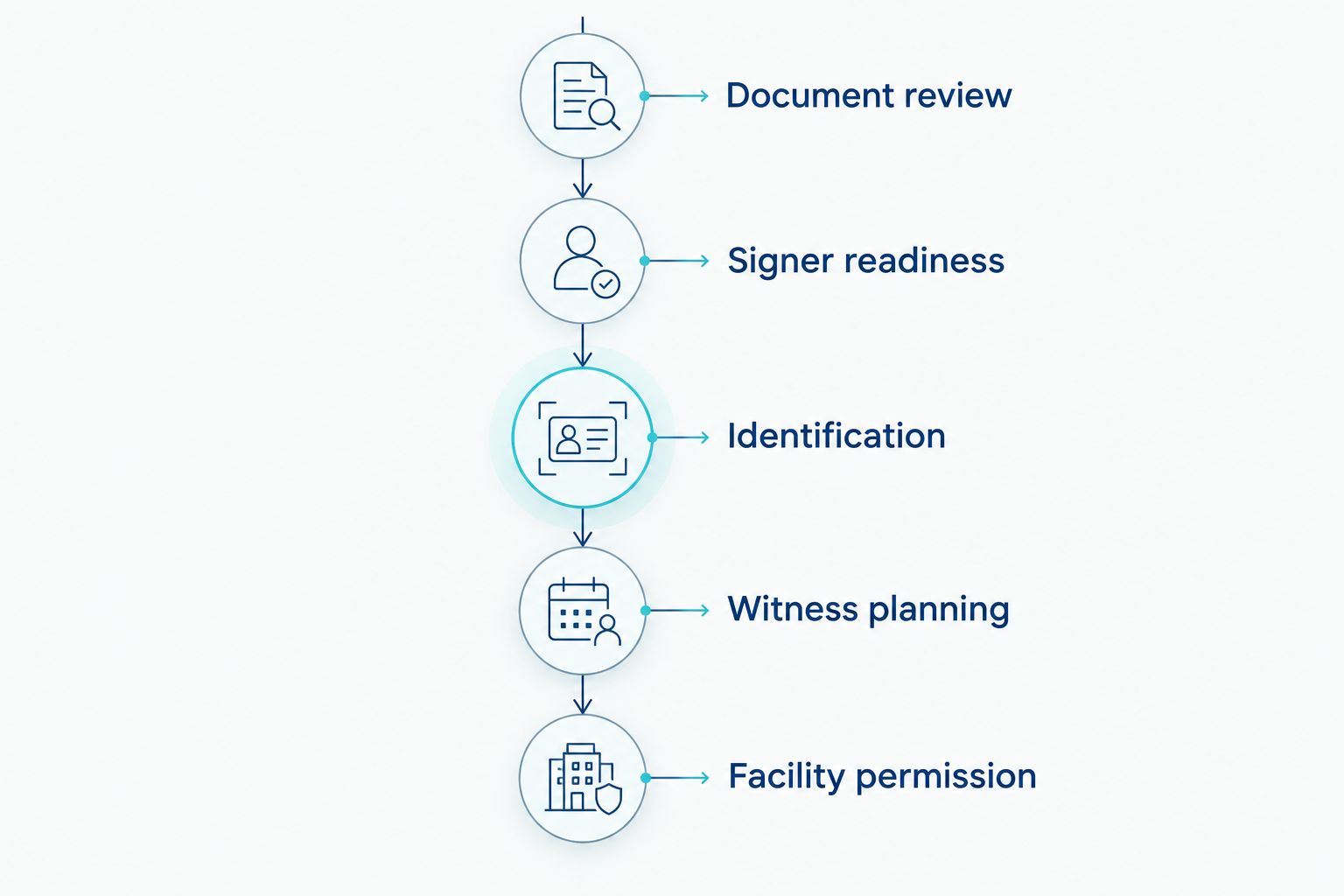
Once these points are settled, send the provider a concise booking request. Include the document title, hospice setting, identification plan, witness arrangements, and the contact responsible for facility access.
Arrange your notary visit
Discuss the document, Miami-Dade location, witness requirements, and facility access before booking.
When to hold or stop the appointment
Hold the appointment when the document is unfinished or the witness plan is unresolved. A bedside visit should execute a prepared plan, not become an improvised legal consultation.
Stop and seek appropriate professional guidance if the patient's instructions are disputed or the patient cannot participate as required. Hospice care itself does not determine whether a person can sign; the circumstances of the particular signing matter.
Do not ask the notary to backdate a certificate or notarize an absent person's signature. A relative cannot simply sign the patient's name because the appointment is urgent. Any representative authority or alternative execution method needs its own valid legal basis.
If a required participant is missing, rescheduling is better than treating that person's role as optional. The receiving organization can reject a document that does not meet its requirements even when a notarial certificate is attached.
Which hospice notary option should you choose?
For 2026, the default is a mobile visit when you have a prepared document, a patient who can participate, acceptable identification, required witnesses, and facility permission. Start with Thecruznetwork's mobile notary and signing coordination services to discuss those logistics in Miami-Dade.
Choose attorney-arranged notarization instead when legal preparation is the obstacle. Choose remote online notarization only when the document and patient can complete that process properly.
Book the signing method that fits the document—not the method that sounds quickest. That rule prevents a travel decision from becoming a document-execution mistake.
FAQ
What's the best mobile notary option for a hospice visit in Miami?
A direct mobile notary appointment is the best starting point when the document is prepared and the patient can participate. Thecruznetwork offers Miami-Dade mobile notary and signing coordination; confirm the hospice setting, witnesses, and requested notarial act before booking.
Can a notary come to a hospice facility in Miami-Dade?
A mobile notary visit depends on provider confirmation and the facility's access rules. Ask the hospice about outside visitors, room access, and witness participation before arranging the appointment.
Can someone in hospice sign a power of attorney?
Hospice care alone does not determine whether someone can execute a power of attorney. The signer must meet the applicable legal requirements, and Florida execution rules generally require witnesses and notarization; an attorney should address questions about capacity or the document's effect.
Can a family member sign for the patient?
A family relationship alone does not authorize someone to sign the patient's name. Ask an attorney about any valid representative authority or lawful alternative execution method before arranging notarization.
Do hospice employees have to serve as witnesses?
Do not assume hospice employees will serve as witnesses. Confirm facility policy and the document's witness qualifications, then arrange eligible participants before the visit.
Is remote online notarization better than a bedside visit?
Remote online notarization is better only when remote participation solves the access problem and the document is eligible. The patient still needs to complete the required identification and signing process, and document-specific witness rules still apply.
What should I confirm before booking a hospice notary in 2026?
Confirm the document title, requested notarial act, patient participation, identification, witnesses, and facility permission. Send those details to the provider before settling the appointment logistics.
One last thing
A notarial stamp does not replace witnesses, legal drafting, or a patient's own instructions. Before a hospice signing in 2026, ask one practical question: Who is responsible for confirming that this particular document is ready to execute?
Name that person before booking. The family, attorney, receiving organization, facility, and notary each have different responsibilities; leaving the document requirements unassigned creates avoidable confusion at the bedside.


