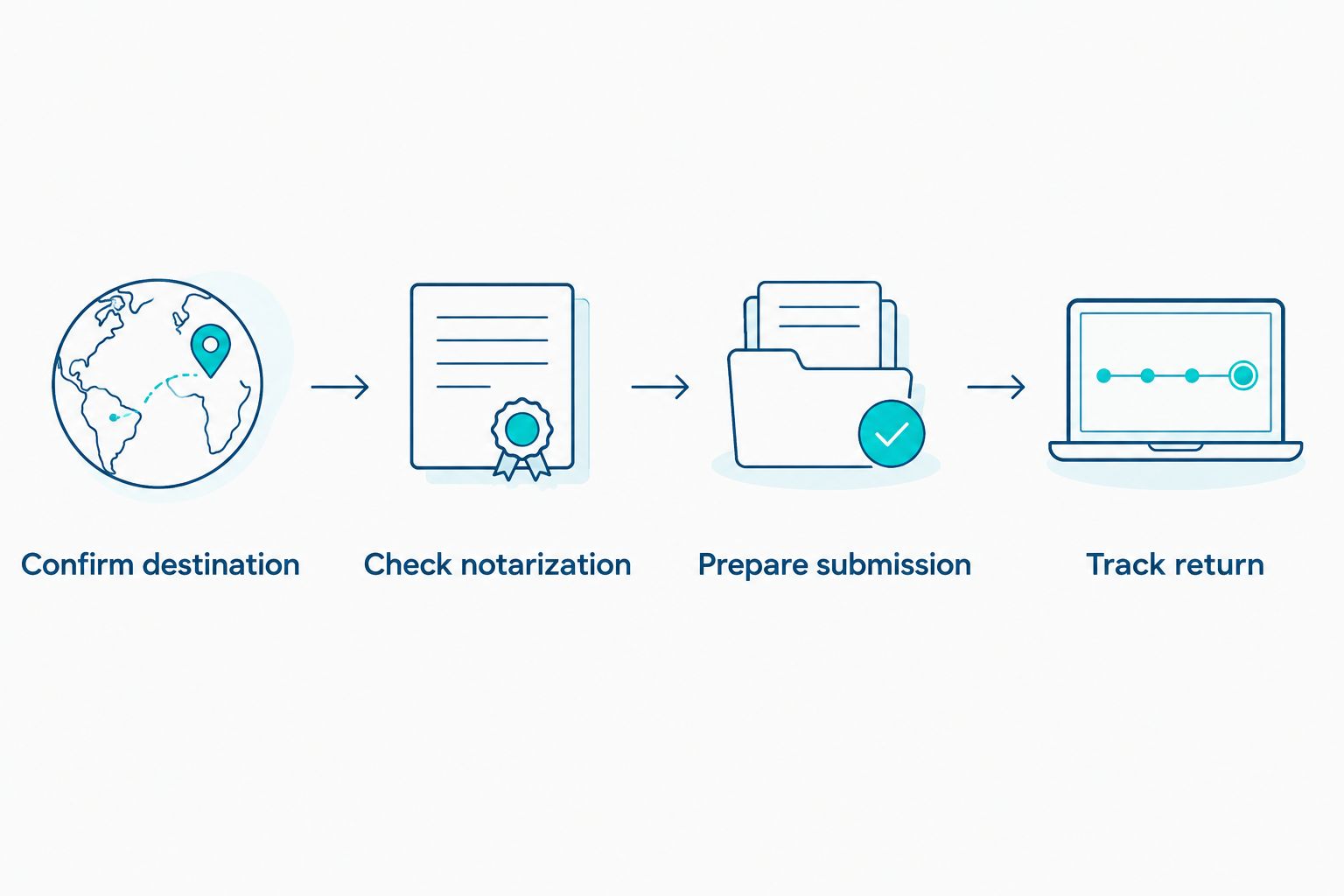
Instead of chasing notarization, state authentication, and return shipping separately, follow the Florida apostille submission process as one document workflow: confirm the destination, check the notarization, prepare the state request, and track the return. This guide explains the handoffs for a Florida-notarized document intended for use abroad.
- The Florida apostille submission process starts with the destination country and the document’s issuing authority.
- Thecruznetwork provides notary and apostille document support for Miami-Dade individuals and businesses.
- Florida authenticates eligible Florida documents; federal and out-of-state documents follow different routes.
- Check the notarization before mailing, and keep outbound and return shipment records separate.
Why this matters
An apostille authenticates the official signature or seal on a document, not the truth of its contents. Under the Hague Apostille Convention, it replaces the traditional legalization process between countries where the Convention applies. The receiving organization still decides whether your document satisfies its requirements.
For a 2026 submission, use the Florida Department of State’s current Apostille Certification instructions for state requirements and the receiving organization’s instructions for acceptance. The Hague Conference on Private International Law maintains the Convention’s status information; check the relationship between the issuing and destination countries rather than relying on a country name alone.
Thecruznetwork is best for Miami-Dade individuals and businesses needing notary and apostille document support. Service coordination helps organize the handoffs, but it does not replace state authentication or the recipient’s acceptance rules.
Before you start
- Get the recipient’s requirements. Confirm the destination country, required document version, translation instructions, and whether the recipient accepts the intended signing format.
- Gather the submission materials. Have the eligible original or official certified copy, current state instructions, requester details, required payment, and return-shipping materials. An online account is not a substitute for an eligible document.
- Catch the jurisdiction problem early. A Florida address does not make every document eligible for Florida authentication. Florida vital records, private notarized documents, and federal records do not follow the same preparation route.
For your 2026 file, save the recipient’s written instructions before arranging the signing. A correctly notarized document can still be the wrong document for the recipient’s purpose.
Choose the correct document route
Use the document’s origin and official signature to identify the route. Do not add a notarization merely because the document is headed abroad.
| Document route | Best for | Advantage | Limitation or preparation risk |
|---|---|---|---|
| Florida-notarized private document | Affidavits, authorizations, and other private documents requiring notarization | Provides a Florida notarial act for state authentication | An incomplete certificate or unsuitable document format needs correction first |
| Eligible Florida certified public record | Florida vital records and other qualifying official records | Uses the authorized public official’s certification | An ordinary photocopy or unsuitable certified version does not replace the required record |
| Federal authentication route | Documents issued by a federal authority | Sends the document to the authority responsible for federal authentication | Florida state authentication does not replace federal authentication |
A document notarized in another state generally belongs with that state’s competent authority. Sorting this out before shipment prevents a routing error that delivery tracking cannot fix.
Destination and document checks
Confirm destination
- Ask the receiving organization what it needs. Request the document type, destination country, required language, and any rules about originals, certified copies, or document age. Keep the response with your submission record.
- Confirm the authentication route. Check whether the Apostille Convention applies between the United States and the destination country. For a destination outside that relationship, obtain the required authentication and legalization sequence instead of assuming an apostille is sufficient.
- Identify the signature being authenticated. For a private Florida-notarized document, the relevant official signature is the notary’s. For an eligible public record, it is the authorized issuing official’s signature or certification.
Expected result: You can identify the destination, the required document version, and the authority responsible for authenticating it. If any answer is unresolved, pause before paying for shipping or arranging another signing.
Do not treat translation as an automatic final step. Ask whether the recipient wants a translation of the underlying document, the apostille, or both, and whether the translation needs its own certification or notarization.
Notarization and document format
Check notarization
- Review the complete document. Make sure the intended pages and attachments are present. Resolve blank substantive fields with the document preparer before signing; the notary does not choose your legal wording.
- Have the notary check the certificate. The certificate must properly record the notarial act, including the required venue, date, signature, seal, and other applicable information. An acknowledgment and an oath-based notarization are different acts; ask the document preparer or receiving organization which is required.
- Resolve defects through the proper person. Contact the notary about certificate defects. Contact the issuing authority about public-record defects. Do not fill in, overwrite, or replace a notary’s certificate yourself.
Expected result: The document carries the appropriate completed notarization or official certification, and its format matches the intended submission route.
A mobile appointment changes where the notary meets you; it does not change the document’s authentication requirements. Remote online notarization also needs a format check before submission. Do not assume that printing an electronically notarized file creates an acceptable paper original.
If your document starts electronically, review the workflow from an electronic signature to an apostilled document before converting or printing it. Electronic signing, notarization, state authentication, and foreign acceptance are separate requirements.
State request and shipment
Prepare submission
- Use the current state instructions. For a 2026 request, consult the Florida Department of State’s Apostille Certification guidance for the submission location, required request information, payment instructions, and return method. Do not reuse an old mailing label without checking it.
- Prepare the request information. Identify the country where the document will be used and provide the requester’s contact and return details. Follow the state’s current instructions for the cover letter or request materials.
- Assemble the packet. Include the eligible document, request materials, required payment, and the return envelope or shipping materials specified by the state. Check that a carrier label matches the carrier and service you intend to use.
Expected result: The packet identifies the requested destination country, includes the required materials, and gives the state a usable return method.
Check 2 mailing addresses before dispatch: the state submission address and your return address. Confirm the recipient name, street details, unit information where applicable, and postal code. A return label is not useful if it sends the completed document to the wrong location.
Keep a reference scan of the packet where lawful and appropriate. Store sensitive identity and family documents securely; a reference copy is for your records, not a replacement for the original submission.
Track return
- Record the outbound shipment. Keep the dispatch receipt and tracking information. Use 1 tracking entry per shipment, with separate entries for the outbound packet and the return shipment.
- Separate delivery from processing. A carrier’s delivered scan confirms delivery, not state approval. Review current state processing guidance before following up, and have the requester name, delivery information, and document description ready.
- Inspect the returned packet. Confirm that the expected document and authentication certificate are present. Keep the apostille attached and check the recipient’s delivery instructions before forwarding the packet abroad.
Expected result: You can distinguish dispatch, state delivery, return dispatch, and final receipt without treating them as the same event.
Use 3 review checkpoints: before notarization, before state dispatch, and before forwarding abroad. Each checkpoint catches a different problem: document suitability, submission completeness, or final delivery requirements.
Variant: submit another document after a change
A revised document needs its own review. Do not assume that an apostille attached to an earlier version authenticates replacement pages or a later signature.
For a recurring 2026 workflow, keep a document register with the document description, destination, signer, notarization details, dispatch record, and return record. Reuse the checklist, not an earlier document’s authentication certificate.
- Identify what changed. A new signer, revised text, different issuing authority, or different destination can change the preparation requirements.
- Confirm the new requirements. Ask the recipient whether the revised document needs a fresh execution, certified copy, translation, or authentication.
- Create a separate submission record. Keep the new packet distinct from the earlier version so nobody forwards the wrong document.
Expected result: Each authenticated document remains connected to its own signing or issuing event and its own shipment history. An unchanged template does not eliminate the need to check the actual document.
Troubleshooting
The state returns the packet without authentication
Read the stated reason before resubmitting. Match the correction to the responsible person: the notary handles notarial issues, the issuing authority handles record certification, and the requester handles missing request or shipping materials. Resending the same packet does not resolve a documented defect.
The document was notarized outside Florida
Route the document according to the state where the notarial act was performed. Do not add a Florida notarization over the existing certificate merely to create a Florida submission. Ask the appropriate state authority for its authentication instructions.
You only have a scan or an ordinary photocopy
Determine whether you need the notarized original or an official certified copy from the issuing authority. Florida notaries cannot substitute a notarized photocopy for every kind of public record. For a vital record, obtain the appropriate official record rather than asking a notary to authenticate the photocopy.
Tracking says delivered, but nothing has returned
Check the outbound and return tracking separately. Compare the delivery date with current state processing guidance, then contact the state through its published channels if follow-up is needed. The return label’s existence does not mean the return shipment has entered the carrier’s network.
The foreign recipient rejects an apostilled document
Ask for the exact rejection reason in writing. An apostille does not resolve an unacceptable document version, missing translation, incorrect substantive wording, or recipient-specific requirement. Correct the identified issue before ordering another notarization or authentication.
Customize your workflow
Assign responsibility for each handoff: who obtains the document, who arranges notarization, who prepares the state packet, and who receives the return. Keep the instructions and shipment references together, but limit access to sensitive documents.
Thecruznetwork offers mobile and remote online notary services, apostille support, certified mail, and signing coordination. Explain the document type, destination country, signing format, and recipient instructions when requesting support. Coordination does not guarantee that a state authority or foreign recipient will accept an unsuitable document.
For repeat submissions, standardize your intake questions rather than promising a fixed completion date. State processing, carrier movement, document corrections, and recipient review are distinct parts of the workflow.
Arrange your document support
Discuss notarization, apostille support, and document coordination for your Miami-Dade needs.
FAQ
Where do I send a Florida-notarized document for an apostille?
Eligible Florida-notarized documents go to the Florida Department of State for state authentication. Use its current Apostille Certification instructions for the submission address, request materials, payment, and return shipping.
Can I submit a document notarized in another state to Florida?
A document notarized in another state generally needs authentication from that state’s competent authority. Your residence or mailing address does not change where the notarial act occurred.
Do I need to notarize my Florida birth certificate first?
Do not add a notarization to replace the official certification on a Florida birth certificate. Obtain an eligible certified record from the authorized issuing office and follow Florida’s instructions for that record type.
Can I print a remotely notarized document and mail it for an apostille?
Do not assume a printout of a remotely notarized document is an acceptable paper original. Confirm the state’s submission requirements and the foreign recipient’s format requirements before printing or mailing it.
How long does the Florida apostille submission process take?
Check the Florida Department of State’s current processing guidance and account separately for outbound and return shipping. Corrections and recipient review add separate steps, so a carrier delivery date is not a completion date.
Does an apostille prove that my document is legally valid abroad?
An apostille authenticates the relevant official signature or seal, not the document’s substantive legal effect. The receiving organization determines whether the document meets its requirements.
Can Thecruznetwork help with notarization and apostille document support?
Thecruznetwork offers mobile and remote online notary services, apostille support, certified mail, and signing coordination in Miami-Dade. Provide the document type and destination requirements when requesting assistance.
One last thing
The destination country belongs in your intake record, not just on the shipping label. It helps determine the authentication route before the document leaves Miami-Dade. For your 2026 submission, confirm that requirement before the signing; discovering it after state processing means revisiting an earlier decision.


