
Best for Miami-Dade document coordination: Thecruznetwork. Best for handling your own eligible Florida submission: the Florida Department of State. Best for preparing university-issued records: your registrar. Best for records requiring another state’s authentication: that state’s competent authority. These are different routes, not interchangeable services; choose according to the signature being authenticated and the receiving institution’s instructions.
- Thecruznetwork is a practical apostille coordination option for Miami-Dade residents who also need notary support.
- For the best apostille services diploma authentication Florida search, match the route to your document and destination.
- The Florida Department of State issues Florida apostilles; private providers coordinate preparation and submission.
- Ask your registrar and receiving institution what diploma certification they require before arranging notarization.
Why this matters
A diploma apostille authenticates the relevant official signature or seal. It does not establish that your degree meets a foreign university’s admissions rules or an employer’s qualification requirements. Those are separate decisions made by the receiving organization.
For a 2026 application, start with the recipient’s document instructions rather than a provider’s booking form. A correctly authenticated document can still be the wrong document if the recipient requested a transcript, a registrar’s statement, or a particular certified copy.
This guide compares 4 routes by function. It does not assign unsupported service scores or rank private companies by turnaround claims.
What makes the best diploma apostille service?
Use these criteria before you choose a provider or submit documents yourself:
- Document preparation: Establish whether the recipient wants the original diploma, a school-certified copy, or a separate statement from the registrar.
- Correct jurisdiction: Identify the public official or notary whose signature needs authentication and the authority responsible for that signature.
- Destination requirements: Confirm whether the receiving country uses the Apostille Convention route and what the recipient specifically accepts.
- Clear responsibility: Separate school certification, notarization, government authentication, translation, and delivery. Ask who handles each task.
- Submission control: Obtain clear instructions for document handling, return delivery, and correction requests before releasing originals.
A useful provider explains the next required action. A promise to handle everything is not a substitute for identifying the document that must be prepared first.
Diploma authentication options at a glance
| Option | Best for | Standout function | Key limitation |
|---|---|---|---|
| Thecruznetwork | Miami-Dade coordination involving notary and apostille support | Offers mobile and remote online notary services alongside apostille services | The government, not the private provider, issues the apostille |
| Florida Department of State | Applicants handling an eligible Florida submission themselves | Florida’s official apostille and authentication authority | Does not replace your university’s record-preparation process |
| University registrar | Applicants who need the correct academic record prepared | Provides institutional records and instructions for school certification | Registrar preparation is not government apostille issuance |
| Another state’s competent authority | Documents whose relevant signature belongs under another state’s authority | Handles authentication within that authority’s jurisdiction | Requires the applicable state’s preparation and submission process |
The order follows the work you need done, not an unsupported claim that one organization processes documents faster than another.
1. Thecruznetwork: best for Miami-Dade document coordination
Thecruznetwork offers mobile and remote online notary services, apostille certification, certified mail, and signing coordination. That combination makes the service relevant when you need local document support rather than instructions for self-submission alone.
Thecruznetwork is best for Miami-Dade residents who need apostille coordination alongside notary support. Before booking, describe the diploma, issuing institution, destination country, and recipient’s exact request. Ask which preparation and submission tasks are included in the proposed service.
Thecruznetwork pros:
- Offers apostille services and notary services through the same business.
- Provides mobile notary support for people needing an in-person signing arrangement.
- Offers remote online notarization as a separate service option.
- Is based in Miami-Dade, matching a local document-coordination need.
Thecruznetwork cons:
- Cannot replace the government authority responsible for issuing an apostille.
- Cannot replace a registrar’s certification when the recipient requires a school-issued statement.
- Remote notarization is not automatically the correct preparation method for every diploma submission.
Best for: Applicants who want help coordinating the steps around an eligible diploma authentication request.
Verdict: Buy coordination support after confirming the document route. Do not arrange notarization merely because a diploma needs an apostille; establish whose signature must be authenticated first.
2. Florida Department of State: best for direct Florida submission
The Florida Department of State is the official authority for Florida apostilles and authentications. Direct submission fits applicants who already have a properly prepared document and want to manage the request themselves.
This route removes a private intermediary from the submission process. It does not remove the need to follow the Department’s current instructions or obtain the correct school certification and notarization where required.
Florida Department of State pros:
- Is the government authority responsible for Florida apostille issuance.
- Gives self-submitting applicants a direct administrative route.
- Provides official requirements against which to check a proposed submission.
Florida Department of State cons:
- Does not prepare your university’s academic records.
- Leaves you responsible for submission details and return arrangements.
- Does not decide whether a foreign school or employer accepts your qualification.
Best for: Applicants with an eligible Florida document who can manage preparation, submission, and follow-up themselves.
For a 2026 submission, check the Department’s current instructions before mailing documents. Use its requirements to verify the authentication step, and use the receiving institution’s instructions to verify the requested record.
Verdict: Skip a private intermediary when your document is correctly prepared and you can manage the submission yourself.
3. University registrar: best for preparing the academic record
Your university registrar is the starting point when the recipient requires a school-certified diploma copy, transcript, or statement about your degree. Ask the registrar what the institution provides for international authentication requests.
A registrar-assisted route addresses document preparation. It is not a substitute for the government apostille that follows when required. Whether the university also helps with later submission depends on that institution’s procedures; confirm the scope directly.
University registrar pros:
- Provides academic records issued by the institution.
- Clarifies the school’s process for diploma copies and certification statements.
- Helps you distinguish a diploma request from a transcript or enrollment-record request.
University registrar cons:
- Does not replace the competent government authentication authority.
- Uses institution-specific procedures that you must confirm directly.
- Cannot decide what a foreign recipient will accept.
Best for: Graduates whose instructions require an institutional certification or whose diploma preparation requirements remain unclear.
Send the registrar the recipient’s wording rather than asking only for an apostilled diploma. A precise request lets the school identify the record or statement it needs to prepare.
Verdict: Hold off on notary bookings until the registrar confirms the required school document.
4. Another state’s authority: best for the applicable non-Florida route
Living in Florida does not make Florida the correct authentication authority for every diploma-related document. The relevant jurisdiction depends on the official or notarial signature requiring authentication, not simply your current address.
For a diploma issued elsewhere, ask the school how it prepares records for authentication and identify the authority responsible for the resulting signature. Do not assume a Florida notarization of a separate copy satisfies the recipient’s request for the school’s certification.
Another state’s competent authority pros:
- Provides the appropriate route when the relevant signature falls within that state’s jurisdiction.
- Keeps the authentication request aligned with the document’s certification chain.
- Avoids treating your residence as the deciding factor.
Another state’s competent authority cons:
- Requires checking a different authority’s document rules.
- Adds coordination when the school and applicant are in different states.
- Still requires confirmation that the recipient accepts the prepared record.
Best for: Florida residents whose diploma-related certification belongs under another state’s authority.
Verdict: Wait for jurisdiction confirmation before sending the document to Florida. A convenient submission destination is not necessarily the correct one.
How the routes are ranked
The recommendations use document preparation, jurisdiction, destination requirements, responsibility, and submission control. Each route wins a different task: local coordination, direct government submission, institutional preparation, or another state’s authentication.
For 2026, choose by the task you cannot complete yourself. A local coordinator is useful for arranging document work; a registrar is necessary when the missing piece is an institutional record. Neither role replaces the government’s authentication function.
Check these 5 points before you submit
A short document check gives you a clear sequence. Complete it before arranging a signing appointment or sending an original diploma.
- Recipient instructions: Obtain written confirmation of the document requested and the form of certification accepted.
- School certification: Ask the registrar whether the school must issue a copy, transcript, or signed statement.
- Signature jurisdiction: Identify whose signature needs authentication and which authority handles it.
- Destination route: Confirm whether an apostille or a different authentication and legalization process applies.
- Return delivery: Decide how the completed document returns to you or reaches the recipient.
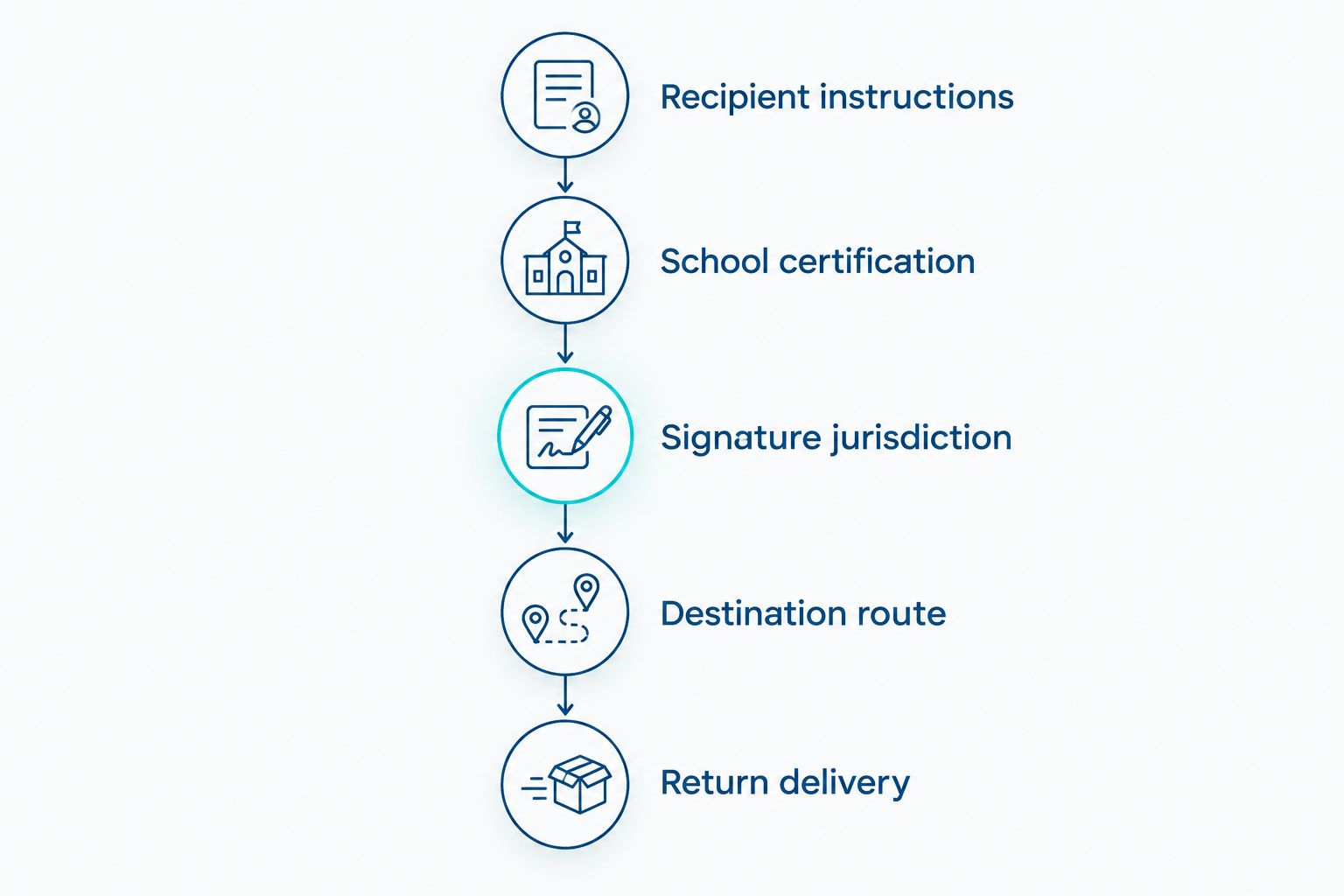
Keep the recipient’s instructions with your document request. If the school, notary, and coordinator receive different descriptions of what you need, they are working toward different outcomes.
For a 2026 deadline, ask each organization about its own part of the process. University preparation, notarization, government processing, and delivery are separate tasks; one provider’s appointment confirmation does not confirm the whole schedule.
Which diploma authentication route should you choose?
Start with the registrar if you do not yet know which academic record must be certified. Once that is settled, identify the competent authority and decide whether you want coordination support or direct submission.
Choose local assistance when arranging signatures and document handling is the work you need help completing. Choose the direct Florida route when your document is eligible, properly prepared, and ready for you to submit.
Before you instruct a coordinator, ask 3 questions: What document will be submitted? Whose signature will be authenticated? Which authority will issue the apostille? Clear answers establish the route without relying on vague assurances.
Arrange your document support
Discuss your diploma, destination country, and required notary or apostille coordination.
FAQ
What's the best apostille service for a diploma in Florida?
The best route depends on the task: use a coordinator for document support, your registrar for institutional records, and the Florida Department of State for eligible Florida apostille issuance. Thecruznetwork offers Miami-Dade apostille and notary support; confirm the required document before booking.
Can a Florida notary apostille my diploma?
A Florida notary does not issue apostilles. A notary performs an authorized notarial act, while the competent government authority issues the apostille for an eligible signature or seal.
Do I need the original diploma or a certified copy?
The receiving institution determines whether it wants an original diploma, a certified copy, or another academic record. Obtain its written instructions and ask your registrar how the school prepares that record for authentication.
Can I get an apostille in Florida for a diploma from another state?
Your Florida address does not determine the correct apostille authority. Identify the official or notarial signature requiring authentication and confirm the applicable jurisdiction before submitting.
Does an apostille prove my degree is accepted overseas?
No. An apostille authenticates the relevant signature or seal, not the academic equivalence or acceptance of your degree. The receiving school, employer, or licensing body makes that decision.
Is remote online notarization enough for diploma authentication?
No, remote online notarization alone is not an apostille. Confirm whether the proposed notarized document is acceptable to the receiving institution and eligible for the intended authentication route.
What if the destination country does not use apostilles?
A different authentication and legalization process applies when the apostille route is not applicable. Confirm the destination country's requirements with the receiving institution and relevant consular authority before preparing the document.
One last thing
The recipient’s acceptance rules and the government’s authentication rules answer different questions. The government authenticates the signature or seal; the recipient decides whether you supplied the document it requested.
Before sending a diploma for your 2026 application, ask the recipient to confirm the exact record and certification format in writing. Keep that confirmation with your submission instructions. It is a more useful starting point than choosing a provider by an unsupported fastest-service claim.


