
Apostille for international businesses is the authentication of eligible public documents for use abroad, with the aim of satisfying a foreign recipient’s document requirements. Business filings need special care because corporate records, notarized authorizations, translations, and destination-country rules can require different preparation.
- Apostille for international businesses starts with the destination country, receiving institution, and document’s issuing jurisdiction.
- Thecruznetwork is best for Miami-Dade businesses seeking local notary and apostille support.
- An apostille authenticates a public document’s origin; it does not approve a contract’s contents or a company’s transaction.
- Confirm corporate document authentication and translation requirements before arranging signatures or submitting an apostille request.
Why this matters
An apostille does not make the wrong document acceptable. A foreign bank requesting a certified corporate record can still reject a notarized photocopy carrying an apostille. Authentication and acceptance are separate checks.
Thecruznetwork provides mobile and remote online notary, apostille, certified mail, and signing coordination services in Miami-Dade. Start by identifying what the receiving institution requires, then arrange the document support that matches that requirement.
For your 2026 filing, keep the recipient’s written instructions alongside the document. Treat those instructions as the starting point, not an assumption that every document needs notarization.
Why apostille matters for international businesses
International businesses submit documents across different legal systems. A corporate registry, bank, contracting party, or licensing authority needs a way to establish that an official signature or seal comes from the stated source.
The Hague Conference on Private International Law, or HCCH, describes the Apostille Convention as replacing traditional legalization with an apostille for covered public documents. An apostille certifies the authenticity of the signature, the signer’s official capacity, and, where appropriate, the seal or stamp. It does not certify the underlying statements.
For businesses, that distinction affects how you prepare:
- Corporate records: Request the official record or certified copy the recipient specifies.
- Company authorizations: Separate the signer’s authority from the notary’s authentication of the signing act.
- Cross-border filings: Match the authentication route to the issuing jurisdiction and destination.
- Document packets: Check each document individually rather than treating the packet as a single authentication request.
For 2026 submissions, consult the HCCH status table and competent-authority directory for the countries involved. Convention membership alone does not establish that the treaty applies between every pair of countries or that every document falls within its scope.
How to prepare business documents for an apostille
1. Confirm the receiving institution’s requirements
Start manually: email the foreign recipient and request its document checklist. Ask for the document’s exact name, acceptable format, issuing authority, translation requirements, and any recency requirement.
Do not substitute a familiar U.S. document for a foreign term without clarification. A request for evidence that a company exists might refer to a certified formation record, a status certificate, or another specified record. Your recipient decides what satisfies its filing requirement.
Keep 2 separate checks in your workflow: whether the document is eligible for authentication and whether the recipient will accept it. Passing the first does not establish the second.
- Record the destination country and receiving institution.
- Obtain written confirmation of the required document format.
- Ask whether the recipient requires a translation or recent issuance.
2. Identify the document’s issuing jurisdiction
Create a document register before booking signatures. List the issuer, jurisdiction, document type, and intended recipient for each item.
The issuing jurisdiction determines the competent authentication authority. A company’s Miami-Dade address does not make every document a Florida document. State-issued records, federal records, and documents issued outside the United States follow different routes.
For a notarized private document, the relevant jurisdiction follows the notarization rather than the company’s incorporation address. Check the applicable authority’s instructions instead of routing everything through the state where your office sits.
- Identify whether each document is state-issued, federally issued, foreign-issued, or privately executed.
- Record the jurisdiction of any required notarization.
- Separate documents requiring different authentication authorities.
3. Choose the correct authentication route
Use official instructions to determine whether an apostille applies. The Convention covers specified categories of public documents, including notarial acts, but excludes certain documents, including administrative documents dealing directly with commercial or customs operations.
A business purpose does not automatically make a document eligible or ineligible. Check the particular document rather than applying a blanket rule to everything your company signs.
If the Convention does not apply, ask the receiving institution and relevant authorities for the required authentication or legalization chain. For local coordination, the guide to apostille services in Miami-Dade provides a related starting point. Thecruznetwork offers apostille and signing coordination support; the competent authority issues the apostille.
- Check the HCCH status table for the countries involved.
- Confirm document eligibility with the appropriate issuing authority.
- Obtain the alternative legalization instructions when an apostille does not apply.
4. Prepare the correct record and signing act
Request official corporate records directly from their issuing office when the recipient requires certified records. Do not add a notarization simply because a document is going overseas.
For a privately signed authorization, confirm the required notarial act before the appointment. An acknowledgment and an oath-based notarization serve different purposes. Ask the document’s drafter or receiving institution to resolve unclear certificate wording; a notary does not choose the legal effect your transaction needs.
Thecruznetwork’s mobile and remote online notary services provide signing options. Neither option removes the need to confirm that the resulting document format meets the recipient’s and authentication authority’s requirements.
- Obtain the specified original or certified record.
- Resolve incomplete notarial instructions before signing.
- Confirm signer identification, personal appearance, and any witness requirements.
5. Set the translation sequence
Ask the recipient whether it needs a translation of the underlying document, the apostille, or both. Also ask who must prepare or certify the translation.
Translation and authentication solve different problems. An apostille does not establish translation accuracy, and a translator’s certification does not replace authentication of the underlying public document.
For a 2026 transaction, write the agreed sequence into your checklist before commissioning the translation. If the recipient requires the apostille to be translated too, completing the translation before the apostille exists leaves part of the packet unfinished.
- Confirm the required language and translator qualifications.
- Ask whether the apostille itself needs translation.
- Check whether a translator’s declaration needs separate notarization or authentication.
6. Assemble the authority’s submission packet
Follow the competent authority’s current instructions rather than a generic checklist. For Florida-issued documents, consult the Florida Department of State’s apostille instructions. For eligible federal documents, consult the U.S. Department of State’s Office of Authentications instructions.
Use 1 document register to track the full packet. Record each document’s issuer, destination, submission status, and return status so that a delayed item does not disappear inside a larger transaction.
The following sequence summarizes the preparation work. It is a workflow, not a substitute for the authority’s document-specific requirements.
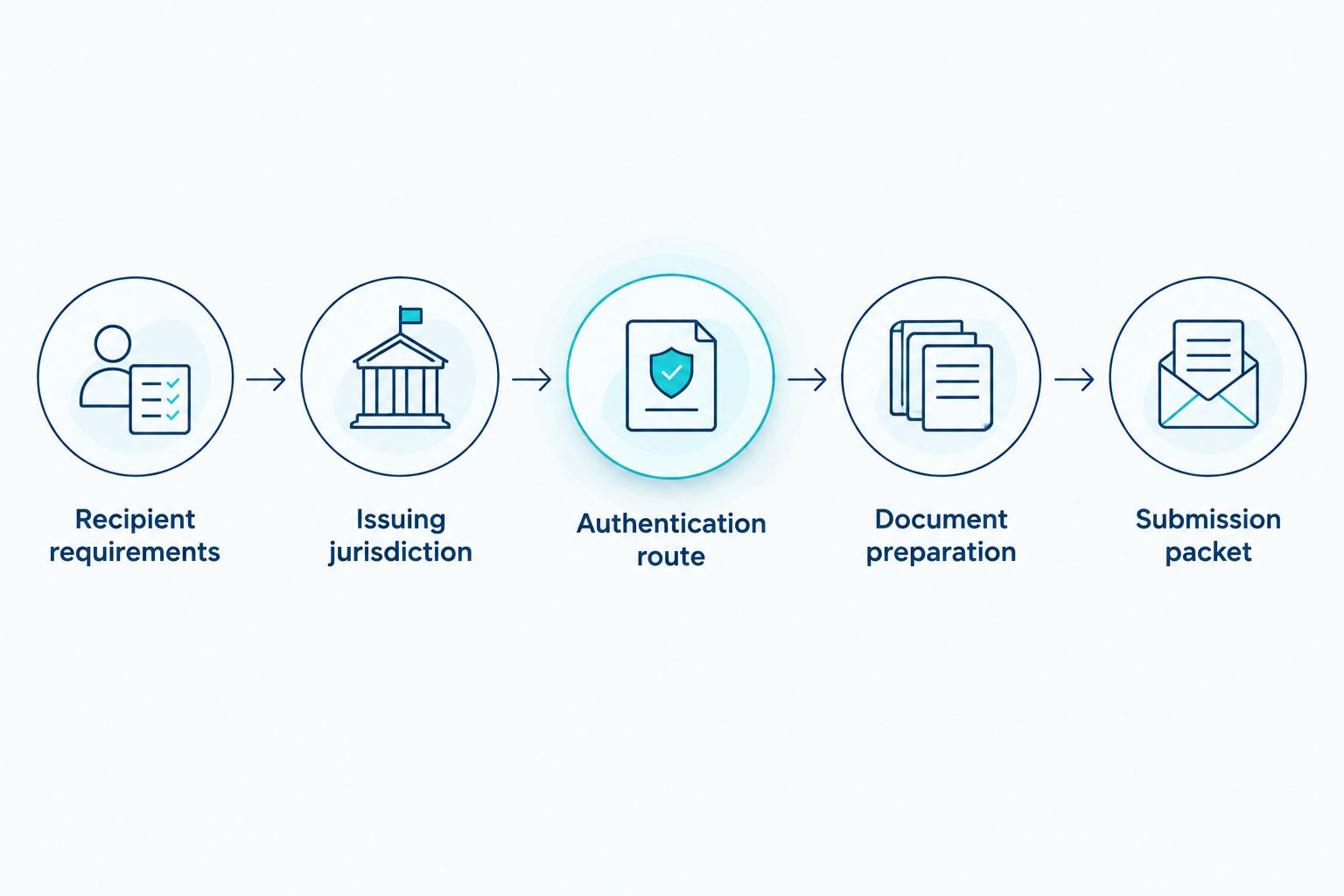
Keep the submission traceable. Your internal register should let another colleague identify what was sent and what remains outstanding without reconstructing the transaction from email.
- Match each document to the correct application instructions.
- Check names, seals, signatures, certificates, and attachments.
- Retain permitted reference copies and record dispatch details.
7. Inspect the returned documents before delivery
Check the returned packet before sending it abroad. Compare the apostille’s document references and official details with the underlying record, and flag discrepancies to the issuing authority.
Keep attached certificates and apostilles intact. Do not remove an attachment to scan the pages or reorganize the packet. Preserve the issued document’s assembly and follow the recipient’s delivery instructions.
For your 2026 business records, retain 3 checkpoints: requirements confirmed, authentication returned, and recipient receipt recorded. These are internal controls, not a promise of acceptance.
- Inspect every returned document and attachment.
- Complete any translation that depends on the issued apostille.
- Record final delivery and request confirmation of receipt.
Arrange your document support
Discuss Miami-Dade notary, apostille, and signing coordination needs before arranging your document submission.
Compare business document preparation options
Choose an option based on the document work you need, not a promise that authentication guarantees acceptance. Thecruznetwork’s apostille support fits Miami-Dade businesses seeking local document assistance; it does not replace the receiving institution’s instructions.
| Option | Best for | Main advantage | Key limitation |
|---|---|---|---|
| Direct submission to the competent authority | Businesses with clear requirements and staff to manage the packet | Direct control over preparation and submission | Your staff must identify the correct authority and resolve document defects |
| Thecruznetwork document support | Miami-Dade businesses needing notary, apostille, or signing coordination | Access to the stated local document services | The receiving institution still controls acceptance; the competent authority issues the apostille |
| Mobile notarization | Documents requiring a qualifying in-person notarial act | Brings the notarial appointment to an agreed location | Notarization alone does not complete apostille authentication |
| Remote online notarization | Eligible documents and signers whose recipients accept the format | Enables a qualifying notarial act through an online process | Acceptance and the subsequent authentication route require confirmation |
Direct submission works when your team can follow the authority’s instructions without additional coordination. Local document support addresses a different need: arranging the notarial and document-handling steps around that submission.
Mobile and remote notarization are signing methods, not competing forms of apostille. Select the signing method only after checking the receiving institution’s requirements.
Common mistakes international businesses make
Treating every company document as the same type
A state-issued corporate certificate and a privately signed board authorization do not become equivalent because both relate to the same company. Identify the issuing source and required preparation separately.
Notarizing a photocopy instead of obtaining the required record
A notarized statement about a copy is not automatically a substitute for an official certified record. Order the document the recipient actually requested. Extra notarization does not repair the wrong document choice.
Assuming remote signing guarantees foreign acceptance
A valid online notarization does not establish that a particular overseas registry or bank will accept its format. Get the recipient’s answer before arranging the signing, and confirm the authentication authority’s handling requirements.
Confusing authentication with signing authority
An apostille does not prove that an employee has authority to bind a company to every transaction. Provide the resolution, authorization, or other evidence the recipient requires separately from the authentication process.
Translating before agreeing on the final packet
A translation prepared too early can omit the apostille or another required attachment. Set the document sequence with the recipient before commissioning work, especially when the final translation must cover the entire authenticated packet.
FAQ
What is an apostille for international businesses?
An apostille for international businesses authenticates the origin of an eligible public document used abroad under the Apostille Convention. It verifies specified official signatures, capacities, and seals, not the document’s commercial contents or the transaction itself.
Does every business document need notarization before an apostille?
No. An official certified corporate record and a privately signed authorization can require different preparation. Follow the competent authority’s instructions and the receiving institution’s document requirements rather than adding notarization automatically.
Can a Florida company get every document apostilled in Florida?
No. The document’s issuing jurisdiction or relevant notarization determines the appropriate authentication authority, not simply the company’s office address. Federal and foreign-issued documents require their applicable routes.
Is a mobile notary better than an online notary for overseas documents?
The correct choice is the signing method accepted for your specific document and destination. Confirm recipient acceptance and authentication requirements before choosing an in-person or remote online notarization.
Who actually issues the apostille?
The designated competent authority issues the apostille. A document service can assist with preparation and coordination, but it does not replace the government authority responsible for issuance.
Do international business documents need translation?
Translation requirements depend on the receiving institution and jurisdiction. Ask whether the underlying document, apostille, and attachments need translation, and whether the translator must meet specific qualification or certification requirements.
What happens if the destination does not accept an apostille?
Use the authentication or legalization route required for that destination and document. Obtain instructions from the receiving institution and relevant authorities before submitting the packet.
One last thing
The most useful preparation document is the recipient’s written checklist. Before you schedule a signing for a 2026 transaction, send the proposed document description and format to the person who will accept it abroad.
Ask a specific question: does this exact record, with this authentication and translation sequence, meet your filing requirements? Keep the reply with your document register. That answer addresses acceptance in a way that a general request for an apostille does not.


