
Yes. A mobile notary can perform the notarization associated with a Florida will, including its self-proving affidavit, when Florida’s notarial requirements are met. In 2026, a conventional paper will generally needs the testator’s signature and 2 attesting witnesses—not notarization alone—to satisfy Florida’s execution requirements. A notary’s seal does not replace the witnesses or cure an improperly signed will.
- Can a mobile notary notarize a will in Florida? Yes, but notarization does not replace proper execution and witnesses.
- Florida Statutes section 732.502 generally requires 2 attesting witnesses for a conventional paper will.
- A self-proving affidavit can reduce the need for witness testimony when the will enters probate.
- Thecruznetwork offers Miami-Dade mobile notary services; questions about a will’s legal effect belong with a Florida attorney.
Can a mobile notary notarize a will in Florida?
Yes, but distinguish signing the will from notarizing its self-proving affidavit. Florida Statutes section 732.502 governs execution of a conventional written will. Section 732.503 addresses self-proof, which involves sworn statements by the testator and witnesses before an authorized officer.
For local appointment coordination, Thecruznetwork provides mobile and remote online notary services in Miami-Dade. Confirm the document type and signing arrangements before booking; offering notary services does not establish that a particular will is legally sufficient.
| Document or process | What it accomplishes | Main limitation | Best for |
|---|---|---|---|
| Properly executed paper will | Records testamentary instructions using Florida’s required signing formalities | Notarization cannot substitute for execution requirements | People signing a conventional paper will |
| Self-proving affidavit | Supplies sworn statements supporting admission of the will to probate without ordinary witness testimony | Does not repair defective execution or prevent every challenge | People completing an attorney-prepared will with self-proof |
| Electronic will | Uses Florida’s separate statutory framework for electronic execution | An ordinary video call or electronic signature is not enough | People whose attorney has arranged a compliant electronic-will process |
These are related procedures, not interchangeable services. Tell the notary whether your document includes a self-proving affidavit rather than asking only for a stamp on the will.
Why this matters
A will controls what happens after death, when the person who signed it cannot explain missing signatures or an irregular signing ceremony. That makes execution details more important than the appearance of a seal.
For a 2026 appointment, separate the legal work from the appointment logistics. Your attorney addresses the will’s language and execution instructions; the notary handles the authorized notarial act. Neither a convenient location nor a completed affidavit guarantees that a court will uphold every provision.
This article explains general Florida requirements, not whether your particular will is valid. Have a Florida estate-planning attorney review document-specific questions before the signing appointment.
What makes a conventional Florida will properly signed?
Florida Statutes section 732.502 requires more than a signature beside a notary stamp. For a conventional paper will, the central execution requirements include:
- Written document. The will must be in writing.
- Testator’s signature. The testator signs at the end, or another person subscribes the testator’s name in the testator’s presence and at the testator’s direction.
- Witness presence. The testator signs, or acknowledges the signature or will, in the presence of at least 2 attesting witnesses.
- Witness signatures. The witnesses sign in the presence of the testator and each other.
Florida Statutes section 732.501 also provides that a person making a will must be of sound mind and generally at least 18 years old, unless an emancipated minor.
Follow your attorney’s signing instructions before anyone signs. Do not sign at home alone and assume the witnesses can simply add their signatures later. Acknowledgment of an existing signature is possible under the statute, but the required presence and witness formalities still apply.
The notary’s identity check does not establish testamentary capacity. If there is a concern about understanding, coercion, or the effect of medication, involve the attorney before proceeding.
What does the mobile notary actually notarize?
The usual notarial task connected with a conventional Florida will is the self-proving affidavit. Under Florida Statutes section 732.503, the testator acknowledges the will and the witnesses provide sworn statements before an officer authorized to administer oaths.
The notary administers the required oath or affirmation and completes the appropriate certificate. The notary is not certifying that the estate plan is fair, that every beneficiary designation matches it, or that the will can never be contested.
A self-proving affidavit has a practical benefit: it generally allows the will to be admitted to probate without the ordinary testimony of an attesting witness. Its limitation is equally important. Self-proof supports probate evidence; it does not replace valid execution.
Ask your attorney whether the affidavit is included and whether it will be completed during the same appointment. Do not ask a nonlawyer notary to choose legal language or draft a missing affidavit for your circumstances.
How should you prepare for a mobile will-signing appointment?
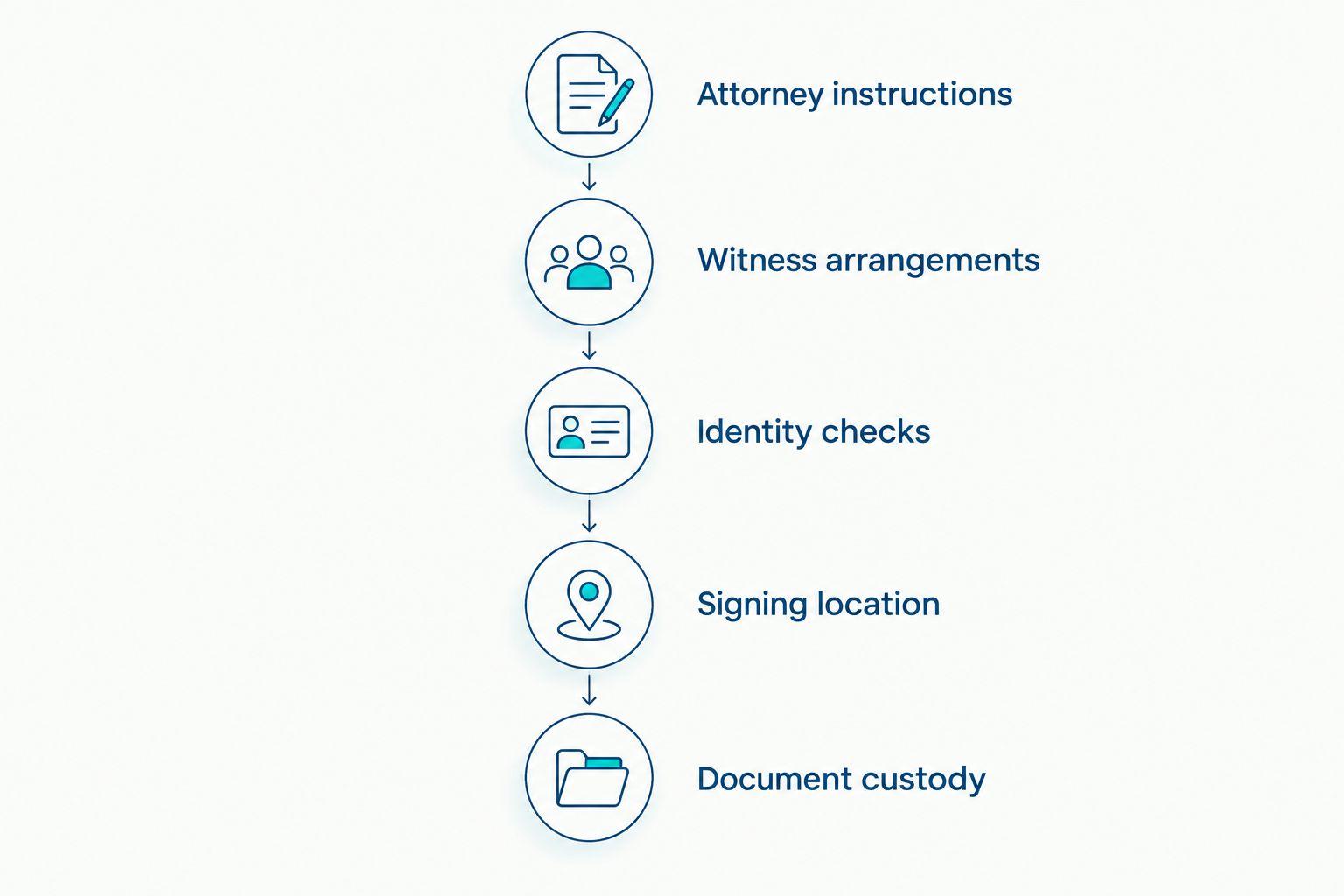
For a conventional paper-will appointment in 2026, organize the document, participants, identification, and location before selecting a time. A mobile visit changes where the notary meets you, not which legal formalities apply.
- Attorney instructions. Obtain the final document and instructions from your Florida estate-planning attorney. Resolve blank provisions, corrections, and questions about beneficiaries beforehand.
- Witness arrangements. Confirm who will provide the 2 attesting witnesses and that everyone can participate in the required signing ceremony. Do not assume the notary supplies witnesses.
- Identity checks. Ask what identification or other legally permitted identity evidence each participant needs. Confirm requirements before the appointment rather than relying on an expired or unfamiliar document.
- Signing location. Choose a place where the testator, witnesses, and notary can complete their respective duties without avoidable interruptions. For a facility visit, check access rules with the facility.
- Document custody. Decide who takes possession of the signed original and where it will be stored. Tell the appropriate person how to locate it when needed.
Thecruznetwork is best for Miami-Dade residents seeking mobile notary coordination, not legal advice about a will. Confirm whether the requested appointment can accommodate the document and participants; do not treat a booking as legal approval of the will.
Discuss your notary appointment
Confirm your document type, Miami-Dade location, and witness arrangements before booking.
Why do will-notarization arrangements vary?
The legal requirements do not disappear because a notary travels to you. The practical arrangements depend on the document and the people involved:
- Paper or electronic execution. A conventional paper signing and an electronic-will signing follow different procedures. Establish the format before arranging participants.
- Self-proving affidavit. A will with an accompanying affidavit requires attention to the testator’s acknowledgment, witness oaths, and notarial certificate—not just the will’s signature page.
- Witness coordination. The participants must satisfy the applicable presence requirements. Separate, informal signature collection is not a substitute.
- Identity evidence. The notary must establish identity through a legally permitted method. Resolve identification questions in advance.
- Signing circumstances. A signature made at another person’s direction, a communication difficulty, or concern about willingness requires attention before the appointment proceeds.
- Location access. A home, hospital, or care facility presents different access arrangements. Facility permission does not replace the testator’s own willingness or the required formalities.
These factors help determine what needs coordination. They do not authorize a notary to give legal advice, choose beneficiaries, or decide whether a disputed will should be signed.
Can you notarize a Florida will online instead?
Florida permits electronic wills under a separate statutory framework, but an online notarization session is not automatically a compliant will-execution ceremony. Florida Statutes sections 732.521–732.526 and the applicable online-notarization provisions govern this area.
For a 2026 electronic-will signing, have your attorney confirm the execution procedure, witness participation, self-proof, and custody arrangements. Remote witnessing rules include special safeguards and restrictions involving vulnerable adults under section 117.285. Do not choose remote execution merely because every participant has a camera.
The benefit of an authorized remote process is that qualifying participants can complete the applicable acts without a conventional in-person meeting. The limitation is procedural: electronic signatures, remote notarization, witnessing, and custody must fit the relevant requirements together.
Do not scan a paper will, add electronic signatures, and assume that creates a valid Florida electronic will. Obtain instructions for the specific document and signing method before using a platform.
Does a Florida will need 2 witnesses if it is notarized?
A conventional Florida paper will generally needs 2 attesting witnesses even if a notary is present. Section 732.502 sets the witness requirements; a notarial seal does not waive them.
Keep the witness role separate from the notarial role when organizing the appointment. Ask your attorney how the participants should sign each part of the document package, and confirm that the required people can be present together.
Can you add a self-proving affidavit after signing the will?
Florida Statutes section 732.503 permits self-proof at execution or on a subsequent date. Later completion still requires the appropriate acknowledgment, witness oaths, and authorized officer; it is not simply an extra stamp added to an old document.
If the will has already been signed, send the existing document to your attorney for instructions. Do not recreate the original ceremony from memory or alter dates to make a later affidavit appear contemporaneous.
What should you tell the notary before booking?
State that the appointment concerns a Florida will and identify whether a self-proving affidavit is included. Explain whether the document is unsigned, already signed, or intended for electronic execution.
Give the appointment location, describe the witness arrangements, and raise identification or communication questions in advance. If someone is hospitalized or receiving care, confirm access with the facility and discuss any capacity concerns with the attorney—not just the appointment coordinator.
For a 2026 request to Thecruznetwork, ask about the specific notarial appointment rather than requesting a guarantee that the will is valid. Document authentication and legal review serve different purposes.
FAQ
Can a mobile notary notarize a will at my Florida home?
Yes, a mobile notary can perform an authorized notarial act associated with a will at your home when the legal requirements are met. A conventional paper will still generally requires 2 attesting witnesses and proper execution.
Is a Florida will valid without a notary?
A conventional Florida paper will does not generally require notarization to be valid. It must satisfy the applicable execution requirements, while notarization is used for the self-proving affidavit.
Does notarizing a will replace the witnesses in Florida?
No, notarizing a conventional Florida paper will does not replace the 2 attesting witnesses required under section 732.502. The will and its self-proving affidavit serve different purposes.
Can a mobile notary write my will for me?
A notary commission does not authorize a nonlawyer to draft your will or give legal advice. Use a Florida estate-planning attorney for document preparation and questions about your instructions.
Does a self-proving affidavit prevent someone from contesting my will?
No, a self-proving affidavit does not prevent a will contest. It supports admission to probate without ordinary attesting-witness testimony but does not eliminate challenges involving execution, capacity, or undue influence.
Can I use a video call to sign my Florida will?
An ordinary video call is not enough to establish compliant execution of a Florida electronic will. Your attorney must confirm the applicable electronic-will, remote-witnessing, notarization, and custody requirements.
Will the mobile notary bring witnesses for my will?
Do not assume a mobile notary will bring witnesses. Confirm witness arrangements before booking and follow your attorney’s instructions for the signing ceremony.
One last thing
The original signed will needs a storage plan, not just a completed appointment. Florida Statutes section 732.901 generally requires the custodian to deposit the will with the appropriate clerk within 10 days after receiving information that the testator has died.
For your 2026 signing, decide where the original will go before anyone leaves. Tell the person responsible how to find it; keeping a scan is not the same as preserving the original.
Legal references: Florida Statutes sections 732.501, 732.502, 732.503, 732.521–732.526, 732.901, and 117.285. The cited provisions address eligibility, execution, self-proof, electronic wills, custody after death, and remote witnessing.


