
Hospitals and clinics use mobile notarization to bring a commissioned notary to a patient or other signer who cannot conveniently travel, so required documents can be executed with the necessary notarial formalities. This 2026 guide explains how to arrange a mobile notary for hospitals and clinics around patient readiness, identification, witnesses, and facility access—not just an available appointment.
- Book a mobile notary for hospitals and clinics only after confirming signer readiness, identification, witnesses, and visitor access.
- Thecruznetwork is best for Miami-Dade individuals and businesses needing mobile notary and document support.
- Mobile notarization and remote online notarization require different preparation; neither replaces patient willingness or understanding.
- Ask the document recipient or an attorney about legal requirements before arranging a bedside signing.
Why mobile notarization matters for hospitals and clinics
A bedside signing depends on more than getting a notary through the door. Treatment, fatigue, visitor restrictions, and witness requirements all affect whether a patient can complete the appointment.
The right appointment is the one the patient can participate in—not simply the earliest available slot. A family deadline does not remove the need for voluntary participation or proper identification.
For Miami-Dade coordination in 2026, Thecruznetwork offers mobile and remote online notary services alongside document support. Confirm the details of a proposed hospital or clinic visit before booking; a mobile service offering does not establish access to a particular facility.
Keep the roles separate. The care team addresses clinical concerns, the document recipient or attorney addresses document requirements, and the notary handles the notarial act.
How to arrange a hospital or clinic notary visit
Confirm what the document requires
Start with the organization that will receive the document. Ask whether notarization is required, which version of the form it accepts, and whether the document also needs witnesses. Do not assume every healthcare form requires a notary.
Different documents have different execution rules. Under Florida Statutes section 709.2105, a Florida power of attorney generally requires the principal's signature, two subscribing witnesses, and acknowledgment before a notary. A notarial seal alone does not satisfy those witness requirements.
The notary cannot choose a legal instrument for the patient or resolve uncertainty about its legal effect. Get those answers before arranging travel.
- Obtain the complete document, including instructions and attachments.
- Confirm the recipient's execution and submission requirements.
- Ask an attorney about powers of attorney or disputed authority.
- Identify any witness requirements before booking.
- Leave the notarial certificate for the notary to complete.
Check the patient's readiness without coaching
Ask the care team about an appropriate visit window, then speak directly with the patient where appropriate. A family member's assurance does not replace the notary's own interaction with the signer.
Florida Statutes section 117.107 prohibits notarizing a signature when the signer appears mentally incapable of understanding the document's nature and effect. This is not a medical diagnosis by the notary. It is a restriction on performing the notarial act.
Do not coach answers, pressure the patient, or treat a diagnosis as automatic proof of readiness or unreadiness. If the patient cannot participate, pause and obtain appropriate legal guidance.
- Ask whether treatment or procedures conflict with the proposed visit.
- Tell the notary about communication or physical-access needs.
- Make room for the patient to answer independently.
- Stop if the patient objects or cannot engage meaningfully.
- Reassess readiness when the notary arrives.
Verify identification before choosing a format
Locate the patient's identification and discuss it with the notary before confirming the appointment. Hospital admission records and a wristband do not automatically satisfy Florida's notarial identification rules.
If standard identification is unavailable, ask the notary whether a lawful alternative applies to the circumstances. Do not assume a relative can simply vouch for the patient or that a photograph of an identification document is sufficient.
Thecruznetwork offers mobile notarization and remote online notarization. Choose between them only after checking identification, document requirements, and the patient's ability to participate; online signing is not a workaround for a failed in-person readiness check.
- Describe the available identification without sending unnecessary sensitive information.
- Check that the document and identification names can be reconciled.
- Ask about identification requirements for the proposed signing format.
- Confirm any additional people needed for a lawful identification method.
- Resolve identification questions before the notary travels.
Arrange witnesses separately from the notary
Ask who will provide witnesses and whether each person meets the document's requirements. Do not assume nurses, reception staff, or other patients can participate. Facility duties and policies can prevent staff involvement.
Florida's living-will statute provides a useful distinction: section 765.302 requires two subscribing witnesses, at least one of whom is neither the principal's spouse nor a blood relative. That rule is not a universal witness rule for every healthcare document.
For a 2026 appointment, verify the requirements for the actual document rather than copying a checklist from a different form. Ask an attorney about eligibility when a proposed witness has a personal interest.
- Identify the required number of witnesses.
- Confirm witness eligibility for the specific document.
- Ask whether the notary can coordinate witnesses; do not assume inclusion.
- Confirm each witness can attend the required signing process.
- Keep backup arrangements consistent with the same eligibility rules.
Clear facility access and timing
Call the hospital unit or clinic directly. Ask how an outside notary enters, whether visitor approval is required, and whether the signing must occur in a particular space. General visiting information does not settle every unit's requirements.
Choose 1 appointment coordinator to communicate changes. This is a practical recommendation, not a legal requirement: a single contact reduces conflicting instructions about the patient's location, witnesses, and visit timing.
Share only the information needed for access and coordination. A diagnosis or full medical record is not a routine scheduling requirement.
- Confirm the facility address, unit, and approved meeting location.
- Ask about entry procedures and visitor restrictions.
- Check for treatment, transport, or discharge conflicts.
- Tell the notary about known access restrictions before booking.
- Arrange a way to communicate a location or timing change.
Prepare the signing without completing it prematurely
Review the document for missing pages and unresolved blanks before the visit. Ask the preparer or receiving organization how incomplete fields should be handled; do not have the notary invent missing legal content.
Do not sign in advance unless the notary confirms the procedure. An acknowledgment and a jurat involve different actions: a jurat requires an oath or affirmation and signing in the notary's presence, while an acknowledgment concerns acknowledging execution of the document.
If the patient cannot physically make a conventional signature, discuss that before the appointment. Florida has specific procedures for certain signing accommodations; a family member cannot simply substitute a signature without proper authority and procedure.
- Keep all document pages together and legible.
- Resolve drafting questions with the preparer or attorney.
- Ask the notary when signatures should be made.
- Disclose signing accommodations before the visit.
- Keep a readable copy available for the patient to review.
Confirm the handoff after notarization
Ask the receiving organization what it needs after execution: an original, a copy, or an authorized electronic submission. Notarization does not itself deliver the document, establish that the recipient accepts it, or complete any separate filing requirement.
Thecruznetwork also offers certified mail and signing coordination. Ask whether either service fits the recipient's instructions; neither is automatically necessary for a hospital signing.
For your 2026 process, use 2 readiness checks: one before scheduling and one immediately before signing. Then confirm the document handoff rather than treating the notary's departure as the end of the task.
- Check that required signatures and notarial fields are complete.
- Follow the recipient's instructions for originals and copies.
- Confirm who is responsible for delivery or submission.
- Keep documents secure during transfer.
- Record recipient acknowledgment when the process provides it.
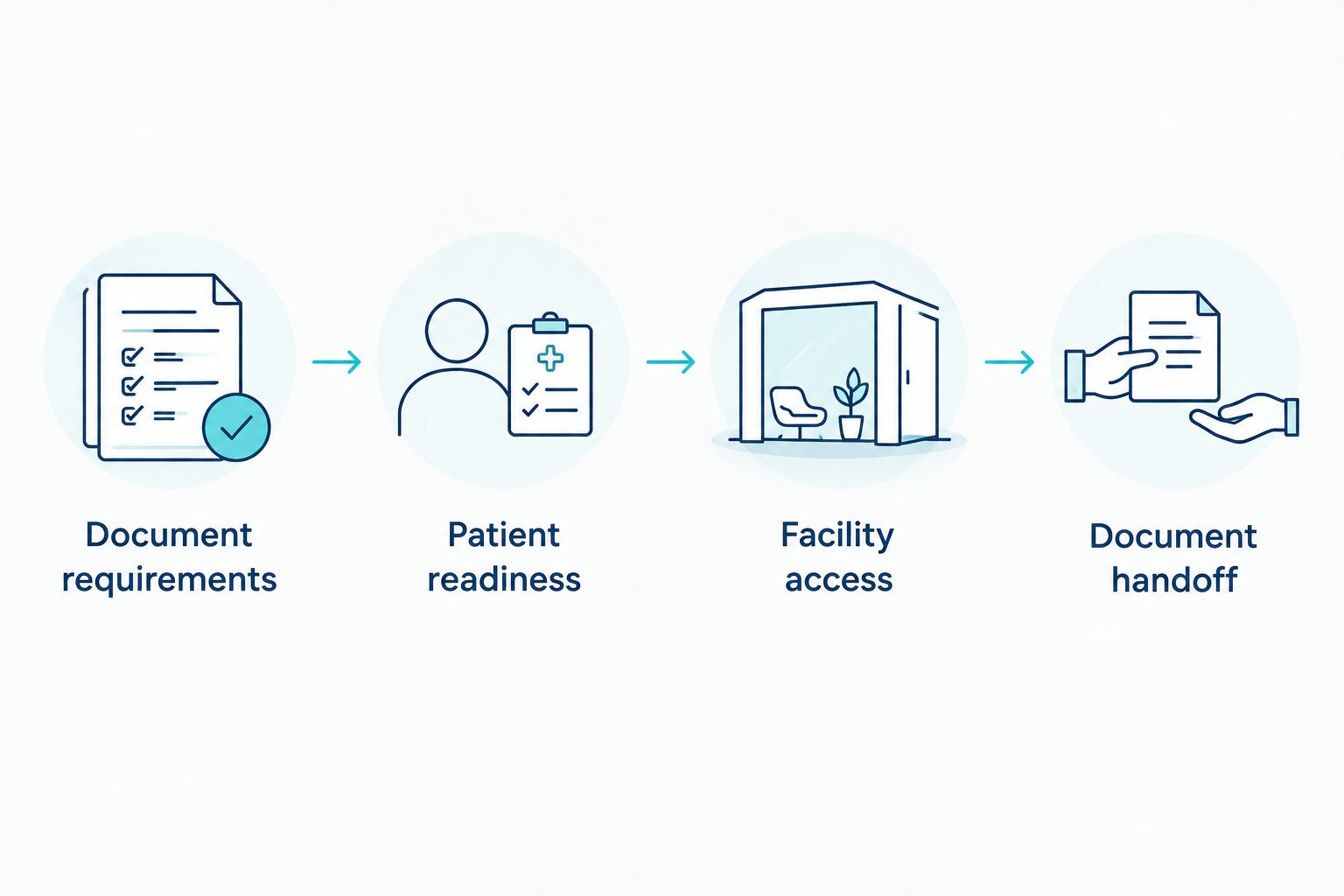
The sequence is straightforward: establish document requirements, confirm the signer can participate, arrange access, and complete the handoff. Resolving those dependencies before travel keeps scheduling from getting ahead of preparation.
Compare hospital and clinic notarization options
Choose the format around the signer and document, not convenience alone. This 2026 comparison separates practical advantages from limitations; it does not establish that a particular facility or recipient accepts every option.
| Option | Best for | Practical advantage | Key limitation |
|---|---|---|---|
| Mobile notary visit | Patients who can participate but cannot conveniently travel | Brings the notarial appointment to an approved location | Requires facility access, identification, and any necessary witnesses |
| Remote online notarization | Signers able to complete the required online identification and audiovisual process | Avoids an outside notary's physical entry into the facility | Requires suitable technology, participation, and confirmation of document suitability |
| Facility-arranged notary | Patients whose hospital or clinic confirms an internal resource | Keeps coordination within the facility | Do not assume the facility provides this service or handles every document |
| Office-based notary | Clinic patients who can safely attend a separate appointment | Separates the signing from the clinical setting | Requires travel and does not fit a bedside need |
Thecruznetwork mobile notary services are best for Miami-Dade individuals and businesses seeking an in-person signing option and related document support. Confirm hospital access, witness arrangements, and the proposed document before choosing that route.
For remote notarization, privacy deserves a separate check. Shared rooms, interruptions, and difficulty hearing the session can interfere with participation. Do not select an online appointment solely because bringing a visitor into the facility is difficult.
Discuss your hospital signing
Confirm the document, facility access, identification, and witness arrangements before booking.
Common mistakes hospitals and clinics make
Treating family urgency as patient authorization
A discharge deadline or family request does not establish the patient's willingness. Give the patient space to participate directly, and stop when consent or understanding is in question. Ask an attorney about lawful alternatives instead of pushing through the appointment.
Assuming facility staff will serve as witnesses
A clinician's presence does not make that person an available or eligible witness. Arrange witnesses in advance and verify the document's rules. Keep clinical duties separate from signing logistics.
Booking before checking identification
A patient arriving by ambulance or transferring between facilities might not have identification nearby. Locate it before confirming the visit. Ask the notary about lawful alternatives rather than promising that a wristband or relative's statement will suffice.
Confusing notarization with legal approval
A notarial act does not establish that a document achieves the family's intended legal outcome. Use the document recipient or an attorney for questions about authority, wording, enforceability, and acceptance. Keep the notary's role focused on the required notarial act.
FAQ
Can a mobile notary come to a hospital room in Miami-Dade?
A mobile notary visit requires the hospital's permission and compliance with its access rules. Confirm the unit, visitor procedures, patient readiness, identification, and witnesses before booking.
Can a notary notarize documents for a sedated patient?
A notary cannot proceed when the signer appears mentally incapable of understanding the document's nature and effect. Sedation requires attention to the patient's actual condition; a family member's request does not replace the signer's participation.
Does every hospital document need notarization?
No, not every hospital document requires notarization. Ask the receiving organization or an attorney which execution requirements apply to the specific form before arranging a notary.
Can hospital nurses witness a power of attorney?
Do not assume nurses can witness a power of attorney. Confirm the document's witness requirements, each person's eligibility, and facility policy before asking staff to participate.
Is remote online notarization better than a bedside visit?
Remote online notarization is better suited to signers who can complete its required identification and audiovisual process. A bedside visit avoids those technology demands but requires physical access; both formats still require appropriate signer participation.
What should I prepare for a hospital notary visit in 2026?
Prepare the complete document, acceptable identification, any required witnesses, and confirmed facility access. Tell the notary about communication or physical-signing needs before scheduling.
Can a family member sign because the patient cannot hold a pen?
A family member cannot simply substitute a signature because a patient cannot hold a pen. Discuss the circumstances with the notary and obtain legal guidance where necessary; physical signing accommodations and authority to act for someone else are different issues.
One last thing
A document can require witnesses without requiring notarization. Florida's living-will statute illustrates why the document's actual execution rules matter more than a general request to get papers notarized.
For a 2026 hospital signing, start with the recipient's requirements, then confirm patient participation. Booking comes after those checks—not before them.


