
Yes, a mobile notary can visit a hospital in Miami-Dade when the facility permits access and the patient can complete the required notarial act. Hospital admission does not prevent notarization, but the notary must verify identity, assess the signer’s awareness, and confirm voluntary participation. Before arranging a visit in 2026, coordinate with the patient’s care team and confirm the document’s signing requirements.
- Can a mobile notary visit a hospital in Miami-Dade? Yes, subject to facility access and lawful notarization requirements.
- Thecruznetwork offers Miami-Dade mobile notary services; confirm the hospital arrangements before booking.
- Hospital admission does not replace identification, signer awareness, or required witnesses.
- A bedside visit cannot proceed when the signer appears unable to understand the document’s nature and effect.
Why this matters
A hospital visit involves more than bringing a stamp to a bedside. You need a document ready for execution, a patient who can participate, and permission to reach the patient without interrupting care.
Thecruznetwork provides mobile and remote online notary and document services in Miami-Dade. Thecruznetwork is best for Miami-Dade individuals and businesses seeking mobile notary and document support. Confirm the specific hospital request before making arrangements; a mobile service does not establish permission to enter a particular unit.
For a broader preparation checklist, see the mobile notary guide for hospitals and clinics.
Can a mobile notary visit a hospital in Miami-Dade?
Yes. The location is not the deciding issue; access and the signer’s ability to complete a lawful notarization are. Florida Statutes Chapter 117 governs notarial acts, including restrictions concerning signer awareness, identification, and personal appearance.
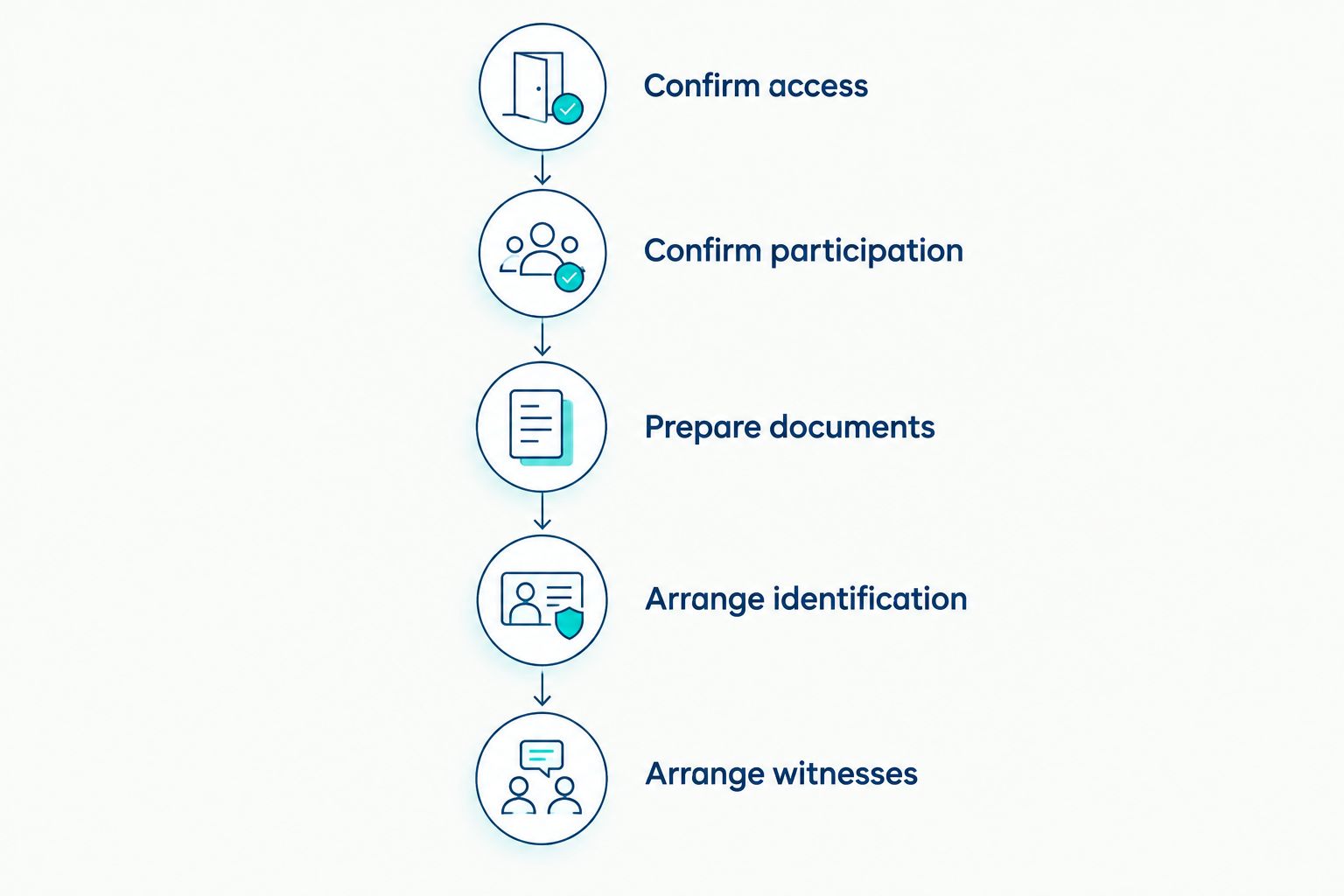
For a hospital appointment in 2026, use this sequence before requesting travel:
- Confirm access. Ask the unit whether an outside notary can enter, what check-in requires, and whether witnesses can accompany the visitor. Provide the correct hospital, building, unit, and room information privately to the provider.
- Confirm participation. Ask the patient whether they want to sign. Coordinate around treatment and discuss concerns about alertness with the care team; a family member’s permission does not replace the signer’s participation.
- Prepare documents. Obtain the complete document and instructions from the attorney, institution, or other recipient. Resolve missing pages and uncertainty about the required notarial certificate before the visit.
- Arrange identification. Tell the notary what identification the patient actually has. Do not assume a hospital wristband or a relative’s assurance satisfies Florida identification requirements.
- Arrange witnesses. Determine whether the document requires witnesses and who will provide them. Ask the hospital before counting on staff to participate.
The notary still makes the required determination at the appointment. Preparation reduces avoidable problems; it does not guarantee completion when the patient’s condition or circumstances prevent a lawful act.
In-person mobile notarization: best for bedside signing
An in-person visit brings the notary to the patient rather than requiring the patient to travel. This fits a bedside signing when the hospital permits entry and the patient can complete the required acknowledgment or oath.
The advantage is direct interaction without requiring the patient to operate an online notarization platform. The limitation is physical access: visitor restrictions, treatment, isolation precautions, or a room change can interrupt the plan.
Choose an in-person mobile notary when bedside access is permitted and the document is ready. Do not schedule around a hoped-for improvement in alertness without checking the patient’s condition with the care team.
| Option | Best for | Practical advantage | Limitation |
|---|---|---|---|
| In-person mobile notarization | A patient able to participate in a permitted bedside visit | No patient travel to a notary office | Requires hospital access and coordination around care |
| Remote online notarization | An eligible signer able to complete the online process | No outside notary needs to enter the unit | Requires suitable technology, identity verification, and document eligibility |
Neither option removes Florida’s safeguards. A remote session is not a substitute for awareness, willingness, or a legally suitable document.
Remote online notarization: best for eligible online signings
Remote online notarization lets an eligible signer appear through the legally required audiovisual process rather than sharing a room with the notary. In a hospital, that requires a workable device, a suitable connection, and the patient’s ability to participate in the session.
The advantage is avoiding an outside visitor’s physical entry. The limitation is that online eligibility depends on the document and the applicable execution rules, not merely on having a video connection.
For a 2026 hospital signing, ask the document’s preparer whether remote execution is appropriate before selecting this route. Florida powers of attorney have specific rules under Chapter 709; do not treat an ordinary video call as a valid substitute for the required execution process.
Use remote notarization only after confirming both document eligibility and the patient’s ability to complete the online process. If you are unsure, resolve the legal question with a Florida attorney before arranging the session.
Why hospital notary arrangements vary
The same provider can face different conditions at different units, or even during separate visits to the same patient. These factors determine what must be settled before the appointment:
- Unit access. Ask about visitor authorization, check-in, protective equipment, and any restrictions on accompanying witnesses. Do not assume permission for a family visitor also covers a service provider.
- Patient awareness. Florida Statutes section 117.107 prohibits notarization when the signer appears mentally incapable of understanding the document’s nature and effect at that time. A diagnosis alone does not answer that question.
- Identification. The notary must establish identity through a legally permitted method. Explain missing or inaccessible identification before travel rather than presenting it as a bedside surprise.
- Document requirements. A power of attorney, affidavit, and self-proving will affidavit do not have interchangeable execution instructions. The document’s preparer should resolve legal questions about the required signatures and certificate.
- Witness arrangements. Required witnesses must be arranged separately unless the provider expressly confirms otherwise. Hospital employment does not automatically make a staff member an appropriate or willing witness.
- Treatment and communication. Procedures, fatigue, medication effects, and communication barriers require coordination. The patient must still be able to participate in the required act.
Do not ask the notary to work around these safeguards. If a requirement cannot be met, pause and resolve the problem with the appropriate person.
What should you tell the mobile notary before the visit?
Provide the information that determines whether the visit can proceed. Keep the initial request focused on logistics and signing requirements rather than sending an entire medical record.
For a hospital request in 2026, prepare the following:
- The hospital name, address, unit, and access contact.
- The document type and instructions from its preparer or recipient.
- The signer’s ability to communicate and participate.
- The identification available to the signer.
- Any required witnesses and who is arranging them.
- Known visitor restrictions and treatment conflicts.
- Any physical difficulty holding a pen or making a signature.
Explain a physical signing limitation before the visit. Florida law addresses special signing circumstances, but you should not improvise by guiding the patient’s hand or signing the patient’s name yourself.
When contacting Thecruznetwork about a hospital mobile notary request, describe the actual circumstances rather than requesting only a time slot. Ask what must be confirmed before the appointment can be arranged.
Discuss your hospital notary request
Provide the hospital location, document type, identification details, and witness requirements.
What can stop a hospital notarization?
The notary must decline when the legal requirements are not met, even if the document is urgent. Florida Statutes section 117.107 sets restrictions that apply at the bedside just as they apply elsewhere.
A patient who appears unable to understand the document’s nature and effect cannot complete the notarization at that time. A relative’s explanation, an approaching deadline, or a request from the receiving institution does not remove that restriction.
Lack of acceptable identification can also prevent completion. Ask the notary about legally permitted identification methods in advance; do not assume the hospital’s admission process satisfies a separate notarial requirement.
Access creates a separate problem. Even when the patient is ready, a notary cannot complete a bedside visit without reaching the signer under the facility’s rules. Tell the provider promptly if the patient changes rooms, transfers, or becomes unavailable for the planned interaction.
Can a sedated patient sign a notarized document?
A sedated patient cannot complete notarization when the patient appears unable to understand the document’s nature and effect. Medication alone does not establish the outcome; the patient’s condition during the proposed signing matters, and the notary must apply Florida’s requirements.
Can a family member sign for a hospitalized patient?
A family member cannot simply sign the patient’s name because the patient is hospitalized. An authorized representative’s signature and a special procedure for a physical signing limitation are different situations; have a Florida attorney clarify the correct approach before requesting notarization.
What changes for powers of attorney and wills?
A hospital setting does not relax execution requirements. For planning in 2026, distinguish the document itself from the notarial certificate attached to it.
Under Florida Statutes section 709.2105, a Florida power of attorney generally requires the principal’s signature, 2 subscribing witnesses, and acknowledgment before a notary, subject to statutory exceptions. A notary’s seal alone does not replace those witnesses.
Florida wills have separate execution requirements under section 732.502. A self-proving affidavit under section 732.503 involves notarization, but notarizing a signature is not a substitute for properly executing the will.
If you are preparing either document during hospitalization, have the drafting attorney confirm the signing instructions and witness arrangements. Do not ask a nonlawyer notary to choose the document, determine its legal effect, or repair an incomplete estate plan.
These distinctions also explain why requesting “a notary for a form” is not enough. Naming the document lets everyone identify the execution questions before the bedside visit.
FAQ
Can a mobile notary come to an ICU in Miami-Dade?
A mobile notary can visit an ICU only when the facility permits access and the patient can complete a lawful notarization. Confirm unit-specific restrictions with the care team before arranging the visit.
Does being in the hospital prevent someone from signing a notarized document?
Hospital admission alone does not prevent notarization. The signer must still meet the applicable requirements for identity, awareness, voluntary participation, and execution.
Can a hospital wristband replace photo identification for a notary?
A hospital wristband is not a substitute for Florida’s required method of establishing identity. Tell the notary what identification is available before the visit and ask about legally permitted alternatives.
Do hospital staff have to witness a power of attorney?
Hospital staff are not automatically responsible for witnessing a power of attorney. A Florida power of attorney generally requires 2 subscribing witnesses under section 709.2105, so arrange appropriate witnesses before the signing.
Should the patient sign the document before the notary arrives?
Do not sign in advance unless the document’s preparer and notary confirm the correct procedure. An acknowledgment and an oath-based notarization have different requirements, and some acts require signing in the notary’s presence.
Can a mobile notary guarantee completion of a hospital visit?
A mobile notary cannot guarantee completion before evaluating the required signing conditions. Facility access, identification, signer awareness, and document execution requirements must all be satisfied.
Is this hospital notary guide legal advice?
This guide provides general information, not legal advice. Ask a Florida attorney about document validity, representative authority, estate planning, or special signing circumstances.
One last thing
An acknowledgment and a signature witnessed by a notary are not the same instruction. A document signed earlier is not automatically unusable for an acknowledgment, while an oath-based act has different requirements.
Before your 2026 hospital appointment, ask the document’s preparer to confirm the required notarial act. That question belongs before travel, not after the patient has signed every page.


