
Florida apostille submissions require an original document with an eligible official signature or notarization, or an official certified copy—not an ordinary photocopy. The correct format depends on the document: birth certificates need an issuing-authority certified copy, while private documents generally need a properly completed notarial certificate before Florida can authenticate the notary’s signature.
- Florida apostille original documents or copies: use an eligible original or official certified copy, not a plain photocopy.
- Florida Department of State authenticates eligible official signatures; it does not certify that a document’s contents are true.
- Birth certificates and court records need certified copies from the proper issuing authority, not notary-certified photocopies.
- Confirm the foreign recipient’s document requirements before arranging notarization or apostille processing.
Thecruznetwork is best suited to Miami-Dade individuals and businesses seeking mobile notary and apostille support. The starting point is identifying who issued your document and which signature needs authentication.
Does Florida apostille require original documents or copies?
Florida accepts eligible originals and official certified copies, but those terms are not interchangeable. An official certified copy carries the issuing authority’s certification. A photocopy reproduces an existing document without creating a new official certification.
For a 2026 submission, distinguish these 3 document formats before preparing your packet:
| Document format | Best for | Main benefit | Main limitation |
|---|---|---|---|
| Original with an eligible official signature or notarization | Private documents prepared for foreign use | Presents the signature Florida needs to authenticate | An unsigned document or incomplete notarization is not enough |
| Official certified copy | Vital records, court records, and other public records | Provides certification from the authority holding the record | Must come from the proper issuer; a personal photocopy is different |
| Notary-attested photocopy, when legally permitted | Eligible nonpublic documents | Provides a lawful copy-attestation route | Florida notaries cannot use this route for vital records or public records available from an official custodian |
A scan, phone photograph, or printout does not become an official certified copy because it looks clear. Likewise, a document does not become eligible merely because someone stamps the word certified on it.
Why this matters
The wrong copy format sends your document down the wrong authentication route. Adding notarization to a photocopied birth certificate does not replace the issuing authority’s certification, and mailing an original private agreement without the required notarization does not solve the signature problem.
There are 2 separate decisions: what Florida can authenticate and what the receiving organization will accept. Resolve both before sending irreplaceable paperwork.
Birth and death certificates: use official certified copies
For a Florida birth or death certificate, obtain a certified copy through the appropriate Florida vital-records authority. Do not submit a hospital keepsake certificate, a photograph, or a photocopy notarized as a substitute for the official record.
Florida Department of State guidance for vital-record authentication distinguishes eligible certified records from unofficial reproductions. Florida’s notary copy-attestation rules also exclude vital records, so a notary cannot turn your personal photocopy into the required certified record.
The advantage of ordering a certified copy is that you do not need to surrender a family keepsake or rely on a homemade reproduction. The limitation is that not every document described casually as a birth certificate has the certification required for authentication.
Before ordering a record for use in 2026, tell the issuing office that you need it for an apostille. Confirm the required certification format rather than assuming that any version issued for another purpose will work.
Marriage and court records: obtain the custodian’s certification
Use a certified copy issued by the authority responsible for the marriage or court record. For Florida court records, that generally means the appropriate clerk of court. Marriage records can involve different issuing offices, so identify the record and certification you need before ordering.
A divorce judgment downloaded from a case portal is not the same as a clerk-certified copy. A marriage-license photocopy from your personal files likewise does not carry a new certification from the official custodian.
The benefit of a custodian-certified copy is a clear authentication chain. Its limitation is scope: the certification covers the record supplied by that custodian, not additional pages you attach yourself.
Ask the foreign recipient whether it needs the complete judgment, a particular order, or a marriage certificate. An apostille on the wrong record does not satisfy a request for a different document.
Private documents: prepare the notarized original
For a private document, the relevant original is generally the document carrying the properly completed notarization. Examples include affidavits and powers of attorney prepared for use abroad, subject to the document’s legal requirements and the recipient’s instructions.
Florida authenticates the eligible notary’s signature and official capacity. It does not approve the agreement, confirm the truth of every statement, or decide whether the document grants the authority you intended.
An original signature alone is therefore not enough when the authentication route depends on notarization. The notarial certificate must identify the act performed and contain the required information, signature, and seal.
This route suits documents you can properly execute before a notary. Its limitation is that notarization cannot repair defective legal wording or replace advice about a foreign jurisdiction’s requirements. Have the document prepared appropriately before scheduling the signing.
Can a Florida notary certify a photocopy?
Florida law permits notaries to attest to certain photocopies, but not every document qualifies. Florida Statutes section 117.05 excludes vital records and public records when a certified copy is obtainable from another public official.
For a permitted copy attestation, the notary must follow Florida’s requirements, including supervising the making of the photocopy. Bringing an already stamped photocopy does not establish that the required procedure occurred.
Also distinguish a notary’s copy attestation from your own sworn statement about a copy. Notarizing your statement authenticates the notarial act; it does not transform the attached page into an issuing-authority certified record.
Diplomas and transcripts: confirm the school’s certification route
Do not assume that mailing your original diploma is the correct starting point. Ask the school’s registrar what notarized certification it provides for international authentication, then confirm that the receiving institution accepts that format.
A school official’s properly notarized statement can establish the signature Florida will authenticate. A transcript printed from a student portal does not automatically provide that authentication chain.
The benefit of involving the registrar is that the school identifies and certifies its own academic records. The limitation is that a foreign university, licensing board, or employer can require a particular document package beyond the apostille itself.
For a 2026 application, request the recipient’s current written instructions. Confirm whether the recipient wants a diploma, transcript, certified copy, translation, or a combination before asking the school to prepare anything.
Why Florida apostille document requirements vary
The format changes because the signature and issuing authority change—not because every foreign-use document follows a single copying rule.
- Document type: A vital record, private affidavit, court order, and academic record have different certification routes.
- Issuing jurisdiction: Florida handles eligible Florida signatures. Another state’s records generally belong with that state’s competent authority.
- Signature being authenticated: A registrar, clerk, school official acting through a notarized statement, and notary occupy different places in the authentication chain.
- Destination country: The destination determines whether the apostille process applies or another authentication and legalization route is needed.
- Recipient instructions: A foreign authority can require a recent record, a particular certified version, or accompanying translations.
- Paper or electronic format: Electronic notarization and paper submission are distinct issues. Confirm the accepted authentication format before printing an electronic record.
For 2026 planning, use Florida Department of State apostille instructions for state submission requirements, Florida Statutes section 117.05 for notarial copy-attestation limits, and the receiving authority’s instructions for acceptance abroad. Each source answers a different question.
Check your document before submitting it
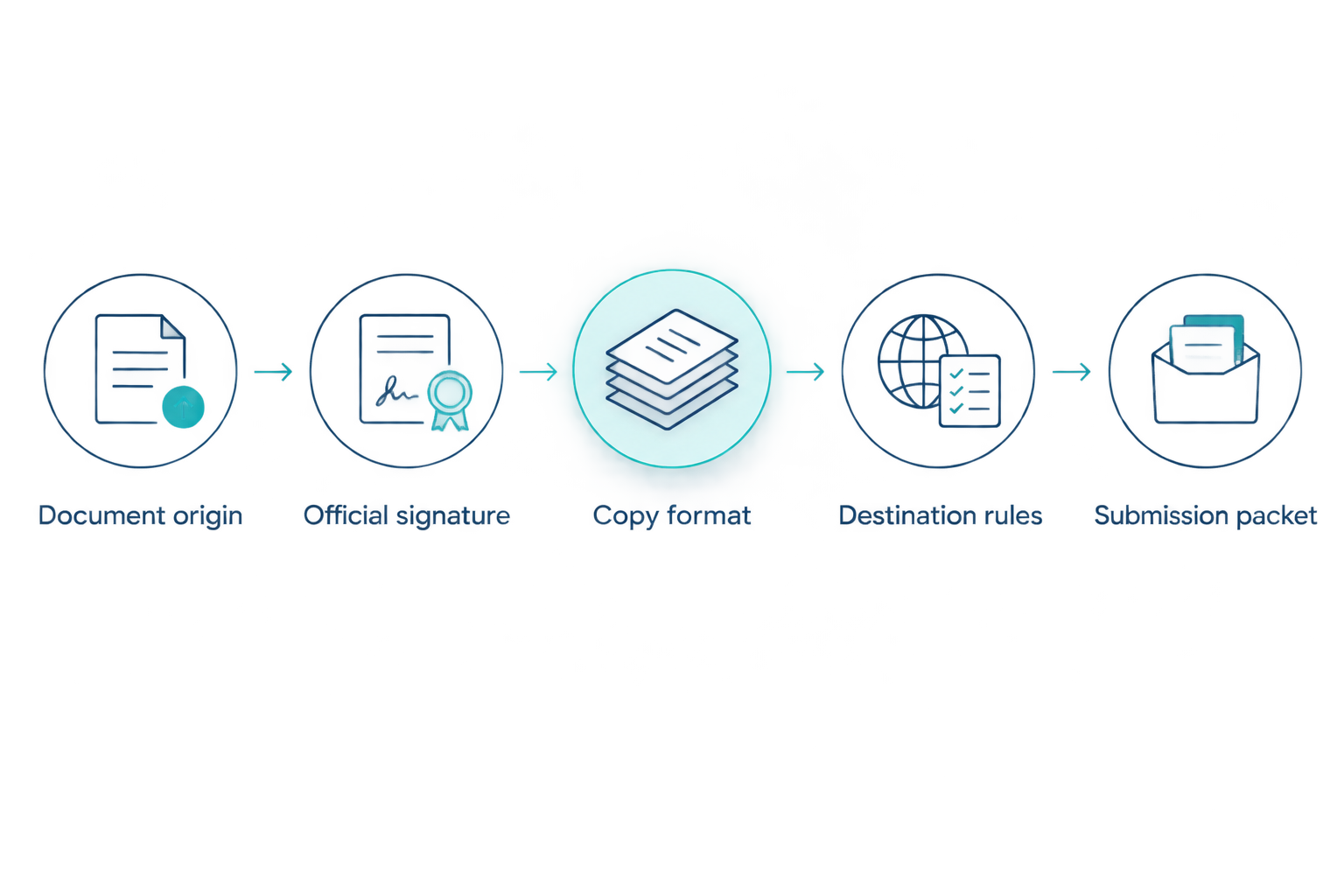
Use these 5 checks before arranging delivery or notarization. They separate the document’s origin from the signature, copy format, destination, and final packet.
- Document origin: Identify who issued the document and where. A document in your Miami-Dade home is not necessarily a Florida-issued document.
- Official signature: Identify the signature that will be authenticated. For private paperwork, check that the required notarial certificate is complete.
- Copy format: Determine whether you need an original, an issuing-authority certified copy, or a legally permitted notary-attested copy.
- Destination rules: Ask the recipient which version it accepts and whether an apostille is the appropriate route.
- Submission packet: Follow the current application instructions, identify the destination country, and arrange the required return delivery.
The sequence matters. Choosing delivery before checking the document does not fix an ineligible signature or an unofficial copy.
Keep a scan for your records before sending the eligible paper document. The scan helps you track what you submitted, but it does not replace the document required for authentication.
Thecruznetwork offers apostille support alongside mobile and remote online notary services. That service scope is relevant when your paperwork needs coordination; Florida’s issuing authority remains responsible for issuing the apostille.
If you need help identifying the next service, contact Thecruznetwork with the document type, issuing jurisdiction, and destination country. Describe the document first rather than assuming that every page needs notarization.
Can I apostille a photocopy of my birth certificate?
A plain photocopy of a Florida birth certificate is not the required official certified record. Obtain the appropriate certified copy from the vital-records authority rather than asking a notary to certify your photocopy.
The distinction remains the same even when your photocopy includes an image of the original seal. A reproduced seal is not a fresh certification by the record’s custodian.
Can Florida apostille a document issued in another state?
Florida generally does not apostille another state’s official signatures. Send an out-of-state public record through the competent authority for its issuing state, following that authority’s instructions.
Your residence does not change the record’s origin. A Miami-Dade address does not make a New York birth certificate a Florida document, and adding a Florida notarization is not a substitute for the proper issuing-state process.
Does an FBI background check need a Florida apostille?
An FBI-issued background check follows the federal authentication route, not Florida’s state apostille route. The U.S. Department of State handles authentication of eligible federal documents for use abroad.
Do not confuse a federal FBI record with a Florida-issued background record. Identify the actual issuer on the document before selecting the authority, and follow the federal instructions for the accepted submission format.
FAQ
Do I need my original birth certificate for a Florida apostille?
You need an eligible official certified copy from the appropriate vital-records authority, not your hospital keepsake or a personal photocopy. Confirm the certification required for apostille use before ordering.
Can I email a scan instead of sending the document for an apostille?
An emailed scan does not replace the eligible document required for authentication. A scan can help identify the document, but follow the issuing authority’s instructions for the actual submission format.
Can a Florida notary certify a copy of my divorce decree?
A Florida notary cannot use copy attestation to replace a certified public record obtainable from its official custodian. Request the certified decree from the appropriate clerk of court.
Does getting an apostille prove that everything in my document is true?
No. An apostille authenticates the relevant official signature, capacity, and seal or stamp; it does not verify the truth of the document’s contents or guarantee acceptance for every purpose.
Do I need to notarize a certified birth certificate before getting an apostille?
An eligible official certified birth certificate does not need an added notary copy certification. The authentication route relies on the issuing authority’s certification, not a notary’s certification of a photocopy.
Can I print a remotely notarized document and mail it for an apostille?
Do not assume that printing a remotely notarized document preserves the required authentication format. Confirm Florida’s submission requirements and the foreign recipient’s acceptance rules before choosing electronic notarization.
Will a foreign authority accept any document that has a Florida apostille?
No. A foreign recipient can still require a particular record, recent issuance, translation, or document format. Confirm those requirements separately from Florida’s apostille eligibility rules.
One last thing
The word original can mean an originally issued document or an originally certified copy. For a public record, the issuing office usually retains the underlying record; the certified copy you receive is the official document used for authentication.
Before submitting a document in 2026, ask: Whose signature will Florida authenticate on this exact page? If you cannot identify that signature, resolve the document route first. Thecruznetwork’s apostille support is relevant at that preparation stage, not as a substitute for the state’s authentication decision.


