
Yes. A notarized document can be valid without an apostille, particularly when you use it within the United States and it meets the applicable legal requirements. For use abroad, the receiving authority determines whether you need an apostille, another authentication process, or no additional certification. An apostille authenticates the origin of a public document; it does not fix an invalid document or guarantee acceptance.
- Is a notarized document valid without an apostille? Yes; domestic use generally does not require international authentication.
- An apostille authenticates a public document’s origin, not the truth of its contents or its legal effect.
- For overseas use, confirm the destination’s requirements before arranging notarization or authentication.
- Thecruznetwork provides mobile notary and apostille services for individuals and businesses in Miami-Dade.
Why this matters
Notarization, authentication, and acceptance answer different questions. Confusing them sends you toward the wrong service—or leaves you with a properly notarized document that the recipient still rejects.
For your 2026 submission, start with the receiving authority’s written instructions. If the document needs Florida authentication, the guide to connecting Florida’s apostille office to your notarized document explains the next stage. Do not assume that every document signed before a notary belongs in that process.
Is a notarized document valid without an apostille?
Yes. An apostille is not a universal condition of validity for notarized documents. A document’s legal effect depends on its contents, execution requirements, governing law, and intended use—not simply whether an apostille is attached.
Use this comparison to separate the main routes. The “best for” column identifies the appropriate use, not a guarantee that a particular recipient will accept your paperwork.
| Route | Best for | What it establishes | What it does not establish |
|---|---|---|---|
| Notarization without an apostille | Domestic submissions that require a notarial act | Completion of the particular notarial act shown in the certificate | Automatic legal validity or acceptance abroad |
| Notarization followed by an apostille | Eligible foreign submissions where the Apostille Convention applies | Authenticity of the relevant official signature, capacity, and seal or stamp | Truth of the document’s contents or compliance with every destination requirement |
| Authentication and legalization | Foreign submissions requiring a route outside the applicable apostille process | Authentication through the required official chain | A universal procedure that works for every country |
Notarization alone avoids an unnecessary international certification step when the recipient does not require one. Its limitation is equally clear: a notarial seal does not substitute for authentication when the foreign authority requires authentication.
An apostille simplifies authentication for documents within the Convention’s scope. It still does not replace translation, document-specific formalities, or substantive legal requirements.
Domestic use: notarization without an apostille
For a document used within the United States, an apostille generally is not required. A bank, court, recorder, school, or other recipient can still require a particular document format, certificate, original, or certified copy.
Consider an affidavit submitted to a domestic recipient. If the recipient requires a sworn statement, the relevant issue is whether the signer completed the required oath or affirmation and notarial act—not whether the document carries international authentication.
A power of attorney raises additional questions. Applicable law can impose execution requirements beyond notarization, and the intended recipient can have its own submission process. A notary’s seal does not establish that every requirement for a power of attorney has been satisfied.
For a domestic submission in 2026, ask the recipient what it needs before signing. Keep these requirements separate:
- Document requirements: the correct form, wording, and attachments.
- Execution requirements: signatures, witnesses, acknowledgment, or oath, as applicable.
- Submission requirements: originals, copies, delivery method, and filing instructions.
Apostilles do not resolve defects in any of those categories. Adding authentication to an incorrectly executed document does not make the underlying problem disappear.
Foreign use: when an apostille becomes relevant
An apostille becomes relevant when a public document is presented abroad and the Apostille Convention applies between the issuing and destination countries for that document. Not every international submission requires one, and not every document falls within the Convention’s scope.
For your 2026 destination check, consult the Hague Conference on Private International Law’s Apostille Convention status information and the receiving authority’s instructions. A country’s appearance on a general country list is not enough to settle every submission question.
Ask the recipient whether it requires the original document, a certified copy, a notarized statement, or another specified record. Those are different document types, and choosing the wrong one can leave you authenticating paperwork the recipient never requested.
For example, a privately signed declaration and an official birth certificate do not necessarily follow the same preparation route. The declaration can require notarization before authentication; a birth certificate typically calls for an eligible official certified copy rather than a notary’s copy certification.
Confirm the document type before arranging the apostille. The authentication route follows the document’s origin and the relevant public official’s signature—not merely where you happen to be when you request help.
Foreign use: when an apostille is not the right route
If the Apostille Convention does not apply to the submission, the receiving country can require a different authentication or legalization process. Depending on the document and destination, that process can involve state authorities, federal authorities, and a foreign embassy or consulate.
Do not send every document through every possible office. Ask the receiving authority or relevant consulate for the required sequence, then confirm each authority’s submission instructions.
A state-issued record and a federal record require different attention. Florida’s state authentication process is not a substitute for the appropriate federal process for a federal document.
The advantage of following the specified legalization route is that it addresses the destination’s actual requirements. The drawback is that it can involve separate submissions and document-handling steps. No single sequence should be assumed to cover all countries or all records.
Why apostille requirements vary
The requirement varies because the recipient is evaluating more than the presence of a notary seal. These factors determine the route:
- Destination country: Whether the Apostille Convention applies affects the authentication process.
- Issuing authority: A state official, federal official, or foreign authority points to a different competent authority.
- Document type: A notarized private statement differs from a government-issued certified record.
- Receiving institution: The recipient specifies what it needs for the particular transaction or application.
- Document format: Paper originals, certified copies, and electronic records are not automatically interchangeable.
- Additional formalities: Translation, witnesses, registration, or document-age requirements can remain separate from authentication.
For a 2026 application, request current instructions rather than reusing an old checklist. The relevant question is not simply whether an apostille was needed for someone else’s document; it is whether your recipient requires it for your document and purpose.
How to check whether your document needs an apostille
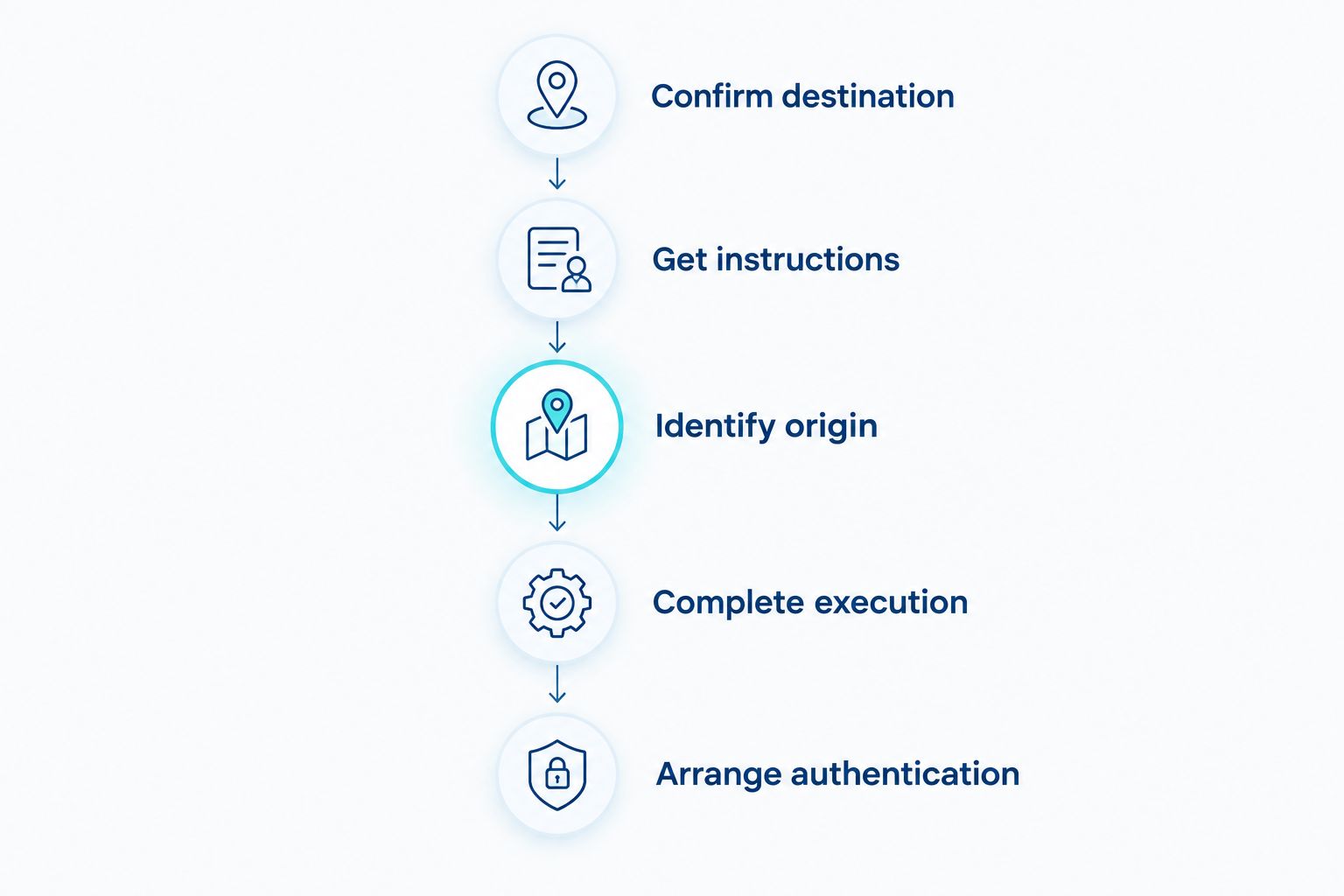
Use these 5 steps before booking a signing or mailing an original. The sequence keeps document selection, signing, and authentication in the right order.
- Confirm destination. Identify the country and the exact office, institution, or person receiving the document. Ask whether it will be submitted domestically or abroad.
- Get instructions. Request the recipient’s written requirements for the document, authentication, translation, and submission format. Do not rely solely on a general instruction to get it notarized.
- Identify origin. Establish who issued the document and which official signature needs authentication. Distinguish private documents requiring notarization from official records requiring certified copies.
- Complete execution. Arrange the required signatures, witnesses, acknowledgment, or oath. If the document already has a notarization, check that the certificate is complete before proceeding.
- Arrange authentication. Submit the eligible document through the appropriate apostille or legalization route only if required. Follow the competent authority’s current instructions.
These steps do not replace legal advice about the document’s effect. If you need someone to determine whether a power of attorney, affidavit, or other instrument accomplishes your legal purpose, direct that question to a qualified attorney.
What to check on an already notarized document
Before requesting authentication, make 3 checks: the notarial certificate, the document identity, and the recipient’s instructions. A visible stamp alone does not answer those questions.
First, check that the notarial certificate is completed and corresponds to the act performed. Missing information or inconsistencies need attention through the proper correction process; do not alter the certificate yourself.
Second, confirm that you hold the version the recipient requested. A photocopy of a notarized original is not automatically equivalent to that original, and a notarized copy is not automatically an acceptable substitute for an official certified record.
Third, compare the complete document package with the recipient’s instructions. Confirm attachments and any translation requirements before submitting it for authentication.
Do not re-sign or re-notarize a document merely because it lacks an apostille. Determine what is missing first. A second notarization can create another document version without addressing the recipient’s actual objection.
Where Miami-Dade document support fits
Thecruznetwork is best for Miami-Dade individuals and businesses seeking mobile notary and apostille document support. The service also offers remote online notarization, certified mail, and signing coordination.
For a 2026 request, provide the destination country, document type, issuing authority, and written receiving instructions when contacting Thecruznetwork. Those details help distinguish a signing request from an authentication request.
Document support does not replace the receiving authority’s acceptance decision or an attorney’s advice about legal validity. That boundary matters: arranging the paperwork and deciding its legal effect are different tasks.
Request document support
Provide your document type, destination country, and receiving instructions.
Does an apostille make a document legally valid?
No. An apostille does not establish the underlying document’s legal validity. It certifies the relevant official signature, the capacity in which the signer acted, and, where appropriate, the identity of the seal or stamp.
A document can carry an apostille and still fail the recipient’s substantive requirements. Incorrect wording, missing required witnesses, or an unacceptable document type remain separate problems.
Can you get an apostille after notarization?
Yes. An eligible notarized document can be submitted for an apostille after notarization. For a private document requiring a notarial act, notarization ordinarily comes before authentication of that official act.
Do not assume that an older notarization automatically requires a new signing. Check the certificate, the authenticating authority’s requirements, and any document-age rule imposed by the recipient.
FAQ
Can I use a notarized document in the United States without an apostille?
Yes. Domestic use generally does not require an apostille, but the document must still meet applicable execution rules and the recipient’s requirements.
Does every document sent overseas need an apostille?
No. The destination, document type, applicable treaty relationship, and recipient’s instructions determine whether an apostille or another authentication process is required.
Is an apostille the same as notarization?
No. Notarization records a particular notarial act, while an apostille authenticates the origin of a public document, including the relevant official signature and capacity.
Can a Florida notary issue an apostille?
A Florida notary does not issue an apostille merely by notarizing a document. Eligible Florida documents receive apostilles through the Florida Department of State’s authentication process.
Do I need to notarize a birth certificate before getting an apostille?
An official birth certificate generally requires an eligible certified copy from the appropriate records authority, not an added notarization. Follow the issuing and authenticating authorities’ instructions for the specific record.
Will an apostille make a remote online notarization acceptable abroad?
An apostille does not guarantee acceptance of a remotely notarized document abroad. Confirm both the receiving authority’s acceptance of the document format and the applicable authentication requirements before signing.
Can Thecruznetwork help with notarization and apostille services in Miami-Dade?
Thecruznetwork offers mobile and remote online notary services and apostille document support in Miami-Dade. Provide the document type, destination, and receiving instructions when requesting assistance.
One last thing
Ask the recipient to identify what it needs authenticated—not just whether it wants a stamp. A request for an apostilled birth certificate usually concerns the issuing official’s signature, while a request for an apostilled affidavit concerns the relevant notarized public act.
That distinction determines which document you obtain, whether you need a notary, and which authority handles authentication. Resolve it before sending away an original.


