
Yes. Florida recognizes out-of-state remote online notarization when the notary is authorized and the act complies with the law governing that notary. Recognition does not replace separate requirements for witnesses, document execution, electronic delivery, or recording, so confirm those requirements with the receiving office before you sign.
- Does Florida recognize out of state remote online notary acts? Yes, when lawfully performed under the notary’s governing law.
- Florida’s recognition rules do not eliminate document-specific witness, execution, or recording requirements.
- Confirm the notary’s commission, remote authority, and permitted physical location before signing.
- Thecruznetwork offers mobile and remote online notary services for individuals and businesses needing document authentication.
Does Florida recognize out-of-state remote online notarization?
An out-of-state commission is not, by itself, a reason a notarization fails in Florida. The central questions are whether the notary had authority and whether the notarization followed the applicable law. A remote session must be a lawful notarial act, not simply a signature witnessed over an ordinary video call.
For a 2026 transaction, these Florida statutes identify the main legal issues:
| Florida provision | What it addresses | What you should check |
|---|---|---|
| Section 92.50(2) | Oaths, affidavits, and acknowledgments taken in another U.S. state or jurisdiction by authorized officials, including notaries | Whether the official was authorized and the certificate satisfies the applicable requirements |
| Section 695.03(2) | Out-of-state acknowledgments and proofs involving instruments concerning real property | Whether the deed or other instrument meets Florida recording and execution requirements |
| Section 117.265(1) | Online notarizations performed by Florida online notaries | Whether a Florida online notary is physically in Florida while performing the act |
These provisions address different parts of the transaction. Section 117.265 governs Florida online notaries; it does not require every notary serving a Florida signer to hold a Florida commission.
For the underlying distinction between an authorized online session and an ordinary electronic signature, see whether remote online notarization is legal in Florida.
Why this matters
A document can have a valid notarization and still need corrections before its intended use. A missing witness, an unsuitable certificate, or the wrong delivery format is a separate problem from the notary’s state of commission.
Start with the recipient’s instructions. For a Florida property transaction in 2026, that means checking with the closing attorney or title company before scheduling, rather than discovering a format problem after the signing.
Treat notarization, document validity, and recipient acceptance as separate checks. Passing one does not automatically satisfy the others.
Check these details before an out-of-state online signing
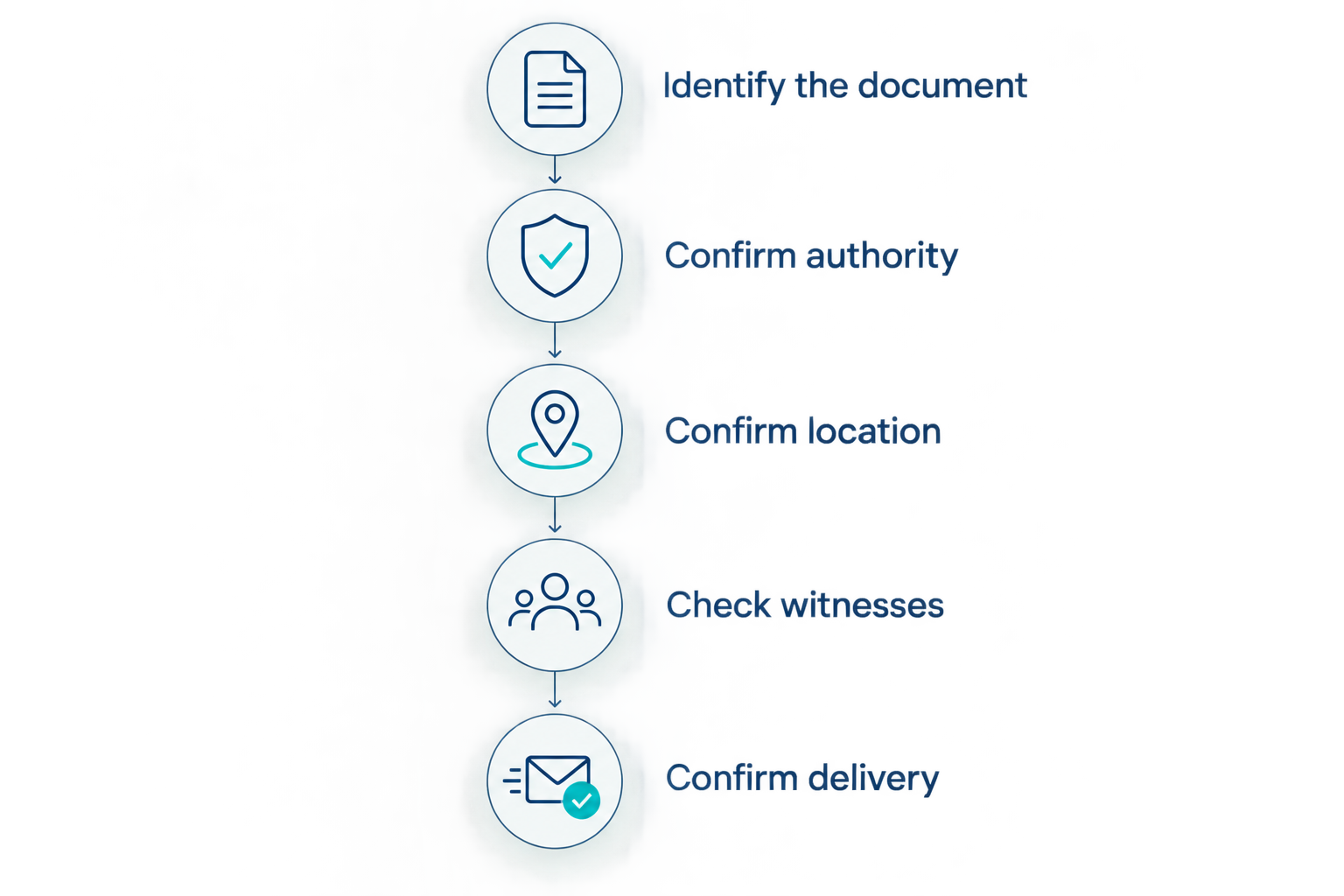
Use this sequence before uploading your document or starting identity verification. It separates the notary’s authority from the requirements attached to your particular document.
- Identify the document. Tell the recipient whether you are signing an affidavit, deed, power of attorney, or another instrument. Ask for the required notarial act and execution instructions; do not ask the notary to choose legal provisions for you.
- Confirm authority. Check the notary’s commissioning state and current commission through that state’s official records. Establish that the notary has whatever additional authorization the state requires for remote online notarization.
- Confirm location. Ask where the notary will physically perform the act and disclose where you will be. The notary must comply with the governing state’s location rules; the signer’s location alone does not establish authority.
- Check witnesses. Determine whether your document needs witnesses in addition to notarization. If witnesses will attend remotely, confirm that the proposed arrangement satisfies the document’s applicable execution requirements.
- Confirm delivery. Ask whether the recipient needs the original electronic file, a permitted paper version, or another specified format. For a recordable instrument, have the submission method confirmed before signing.
Keep the recipient’s instructions with your signing documents. They give the notary and any signing coordinator a clear set of requirements without asking either to decide the document’s legal effect.
Out-of-state online notary: best for an approved remote signing
Best for: A signer using a lawfully authorized remote notary where the recipient has confirmed the document and delivery requirements.
The practical benefit is remote appearance without requiring the signer and notary to occupy the same room. The limitation is that the notary’s authority, permitted location, and remote procedures depend on the commissioning state’s law.
Do not infer authorization from a platform’s ability to connect you. Verify the commissioned individual who will perform the act. A provider’s business address is not a substitute for the notary’s commission information or physical location during the session.
Florida online notary: best for a Florida-commissioned remote act
Best for: A remote signing arranged with an authorized Florida online notary who will perform the act while physically in Florida.
Florida Statutes section 117.265(1) requires the Florida online notary to be physically within Florida. The signer can be elsewhere, subject to the applicable requirements. That distinction matters when you are traveling but need a document for use in Florida.
A Florida commission does not remove witness requirements or guarantee that a particular recipient will accept your electronic submission. Confirm the whole transaction, not just the notary’s state.
Mobile notary: best for an in-person signing
Best for: A signer who needs physical appearance or whose document instructions call for an in-person process.
A mobile notary travels to a signing location; an online notary performs a remote act through an authorized process. The benefit of mobile service is in-person attendance. The limitation is that the signer and notary must coordinate a physical meeting, and any required witnesses still need an appropriate arrangement.
| Signing option | Best for | Main benefit | Main limitation |
|---|---|---|---|
| Out-of-state online notary | An approved remote signing under another state’s law | Remote appearance | Requires checking that state’s authority and location rules |
| Florida online notary | A Florida-commissioned remote act | Remote appearance under Florida’s online-notary framework | Florida notary must physically remain in Florida |
| Mobile notary | An in-person signing | Physical attendance at the signing location | Requires coordinating an in-person appointment |
For local support, Thecruznetwork is suited to Miami-Dade individuals and businesses needing mobile or remote online notary services. Its notary and document services also include apostille certification, certified mail, and signing coordination. Those services do not replace legal review or the receiving office’s document requirements.
Why acceptance varies
The recognition rule does not change simply because a document is inconvenient to process. What varies is the combination of legal requirements, signing arrangements, and submission instructions attached to the transaction.
- Notarial authority. The individual must hold a valid commission and have authority to perform the remote act under the governing law.
- Physical location. The notary must perform the act from a location the commissioning state permits. A Florida online notary must be in Florida.
- Document type. An affidavit, deed, will, and power of attorney do not share identical execution requirements.
- Witness arrangements. A notary’s acknowledgment does not substitute for witnesses required by the document’s governing law.
- Certificate and file format. The certificate must accurately describe the act, and the submitted document must satisfy the applicable delivery or recording requirements.
- Recipient instructions. A lender, title company, court, or other recipient can have transaction-specific submission instructions. Ask for clarification when those instructions appear inconsistent with the proposed signing.
For your 2026 signing, resolve these points before the appointment. A general statement that online notarization is legal does not answer whether your particular execution and submission plan is complete.
Can I use an out-of-state online notary for a Florida deed?
Florida Statutes section 695.03(2) provides for out-of-state acknowledgments involving real-property instruments. A remotely notarized deed still needs to satisfy the applicable deed-execution, witness, certificate, and recording requirements; have the closing attorney or title company approve the arrangement before signing.
Do not treat a completed notarial certificate as confirmation that the deed is legally sufficient. The deed’s execution and its eligibility for recording need separate attention.
Does a Florida online notary have to be physically in Florida?
Florida Statutes section 117.265(1) requires a Florida online notary to be physically in Florida when performing an online notarization. The signer’s presence in Florida does not authorize that Florida notary to perform the act while traveling outside the state.
For a notary commissioned elsewhere, check that commissioning state’s rules. Do not apply Florida’s rules to another state’s officer without checking the governing law.
Does an out-of-state notarization need an apostille for use in Florida?
An apostille is not ordinarily required merely because a document was notarized in another U.S. state for use in Florida. Apostilles concern authentication for international use, rather than routine recognition between U.S. states.
If the same document will later go abroad, treat that as a separate authentication question. Confirm the destination country’s requirements and the appropriate issuing authority before arranging the signing.
What should you keep after the signing?
Keep the completed document in the format supplied for its intended use. For an electronic notarization, printing the file is not automatically an equivalent replacement for the original electronic document.
Save the recipient’s instructions and the notary’s identifying information with your transaction records. If a recipient raises a problem, ask whether it concerns notarial authority, execution, the certificate, or the submission format. That distinction identifies the issue that needs correction.
Do not edit the completed notarial certificate yourself. Contact the notary about a certificate concern and the document preparer or attorney about changes to the instrument.
For a 2026 property closing, follow the title company’s instructions for returning and submitting the signed file. Avoid substituting a scan or printout simply because it is easier to send.
FAQ
Does Florida recognize an out-of-state remote online notary?
Yes, Florida recognizes qualifying out-of-state notarizations when the notary is authorized and the act complies with the governing law. The document must separately satisfy applicable execution, witness, and submission requirements.
Can I be in Florida while the online notary is in another state?
Yes, that arrangement can be lawful when the notary’s commissioning state authorizes the remote act and permits the circumstances of the session. Confirm the notary’s authority and the recipient’s requirements before signing.
Does the online notary need a Florida commission?
No, a Florida commission is not automatically required merely because the signer or intended recipient is in Florida. The out-of-state notary must have authority under the law governing that notary.
Can a Florida online notary notarize while outside Florida?
No. Florida Statutes section 117.265(1) requires a Florida online notary to be physically in Florida when performing the online notarization.
Is an ordinary video call enough for remote notarization?
No, an ordinary video call alone does not establish a lawful remote online notarization. The notary must use the identity-verification, communication, recordkeeping, and certificate procedures required by the governing law.
Will a Florida bank automatically accept my remotely notarized document?
Do not assume automatic acceptance. Ask the bank to confirm the document, execution method, and file format before signing, and distinguish submission instructions from the legal recognition of the notarization.
Can Thecruznetwork help with notary services in Miami-Dade?
Thecruznetwork offers mobile and remote online notary services and signing coordination for individuals and businesses. Confirm your document’s requirements and the proposed signing arrangement before booking.
Do I need an apostille for an out-of-state notarization used in Florida?
An apostille is not ordinarily needed solely because a document was notarized in another U.S. state for use in Florida. International use creates a separate authentication question.
One last thing
Ask the recipient what would make the document unacceptable before you arrange the notary. That question separates an authority problem from a missing witness or an unsuitable file format—and tells you which requirement to address.
For your 2026 signing, send the document type, intended use, signer location, witness instructions, and required delivery format together. Do not send sensitive identification through an unapproved channel.
This article provides general information, not legal advice. Ask a Florida attorney to resolve questions about document validity, estate-planning execution, or a disputed rejection.


