Yes. In 2026, a Florida-registered remote online notary can notarize a Florida deed through a compliant live audio-video session, but the deed must also satisfy execution, witness, and recording requirements. Online notarization does not replace required witnesses or guarantee acceptance by the title company, lender, or county recording office.
- Can a remote online notary notarize a Florida deed? Yes, with compliant identity checks, witnessing, and electronic notarization.
- Florida deeds conveying real property generally require 2 subscribing witnesses; notarization does not replace their signatures.
- Confirm the title company's instructions and recording method before scheduling a remote online notarization.
- Thecruznetwork offers remote online notary and signing coordination services for individuals and businesses.
Can a remote online notary notarize a Florida deed?
Yes—Florida law permits online notarization of a deed, provided the transaction follows the applicable legal requirements. Florida Statutes section 117.265 governs online notarizations, while section 689.01 establishes execution requirements for conveyances of real property. These requirements address different parts of the same transaction.
For your 2026 signing, distinguish the notary's acknowledgment from the deed's witness signatures. A compliant acknowledgment alone does not establish that the entire deed was prepared, executed, delivered, and submitted correctly.
Thecruznetwork's notary and document services include remote online notarization and signing coordination. Have the deed and the receiving party's instructions ready before requesting an appointment.
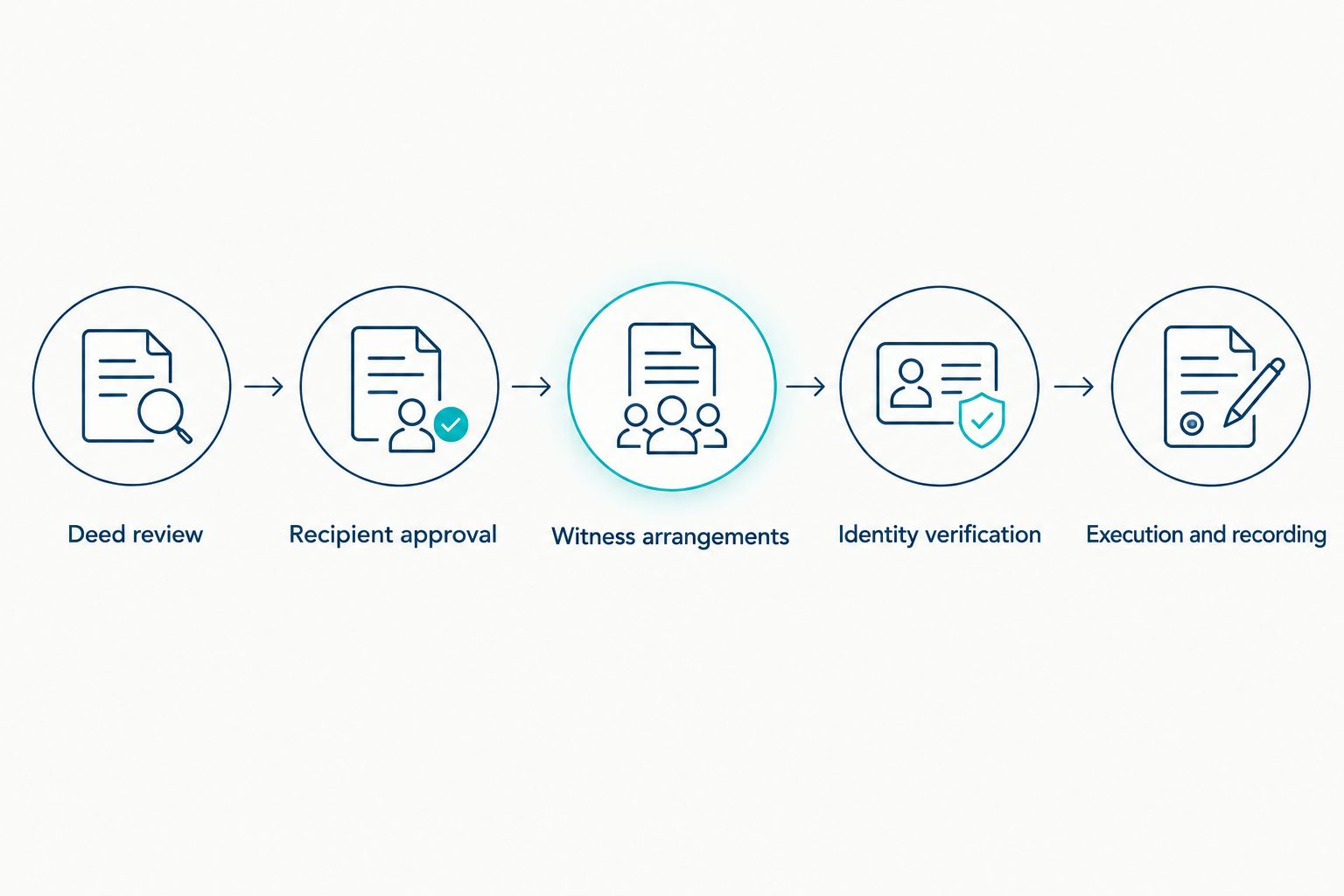
Follow this sequence before signing
- Deed review. Have the title company or Florida real estate attorney confirm the deed's wording, ownership information, legal description, and execution instructions. A notary appointment is not a substitute for legal review.
- Recipient approval. Confirm that the title company, lender when involved, and intended recording workflow accept the electronic deed. Identify who will submit the completed instrument.
- Witness arrangements. Determine who will serve as the required witnesses and whether they will participate physically or through an approved electronic witnessing process. Do not assume the notary appointment automatically includes witnesses.
- Identity verification. Complete the online notary's required identity checks and live audio-video appearance. Sending an identification photograph or joining an ordinary video call is not the complete process.
- Execution and recording. Follow the notary's instructions for acknowledgment and the closing professional's instructions for execution. Obtain confirmation after the deed is submitted and recorded.
Why this matters
A deed changes interests in real property. A completed notarial certificate does not resolve an incorrect legal description, missing witness signatures, or a recording submission that does not meet the clerk's requirements.
Treat notarization as one part of the transfer, not the entire transfer. For a 2026 Florida transaction, get written signing instructions from the professional responsible for the deed before choosing an appointment format. That keeps the signing method aligned with the document's intended use.
This distinction also protects you from booking the wrong service. If your closing instructions require wet-ink signatures, a mobile notary visit addresses that requirement; an electronic signing session does not turn into a wet-ink original when you print it.
What makes an online deed notarization compliant?
A Florida notary must be registered to perform online notarizations, not merely hold a traditional notary commission. Under Florida Statutes section 117.265, the online notary must be physically located in Florida while performing the act, even when the signer participates from elsewhere.
The session must use the required audio-video communication and identity-verification process. Florida law also requires an electronic journal and an audio-video recording of the online notarization. Under section 117.245, those records generally must be retained for at least 10 years.
That recordkeeping requirement matters because online notarization is a documented notarial process, not simply a video conversation followed by an emailed seal. An ordinary electronic signature application, by itself, does not perform the notarial act.
Before proceeding, ask the notary to confirm:
- Registration to perform Florida online notarizations.
- The identification documents and verification steps required for your session.
- How each necessary witness will participate.
- How the completed electronic document will reach the closing or recording professional.
- How you can request information about the notarization record if needed.
Keep the deed and any attached instructions together. If someone changes the document after the signing, refer the change to the title company or attorney rather than editing the completed file yourself.
Does a Florida deed still need witnesses online?
Generally, yes: a Florida deed conveying real property requires 2 subscribing witnesses under section 689.01. Remote online notarization does not remove that requirement. The notary's acknowledgment and the witnesses' participation serve separate functions.
Florida Statutes section 117.285 addresses electronic witnessing. If witnesses will appear remotely, the arrangement must comply with the applicable electronic witnessing rules; a witness cannot simply receive the file afterward and add a signature as though present for the execution.
A straightforward deed package commonly contains 2 witness signatures and 1 notarial acknowledgment for a single grantor's execution. Multiple grantors, representative signatures, or transaction-specific instructions require the document preparer to determine the appropriate signature and certificate arrangement.
Have the preparer confirm the witness information that must appear on the instrument. Florida's recording requirements under section 695.26 include identifying information relevant to execution and recording; the notary should not be expected to repair an incomplete deed during the appointment.
If the deed involves a trust, estate, power of attorney, or other representative capacity, send those details to the closing professional in advance. The right signing instructions depend on who has authority to sign, not just who can attend the session.
Remote online or mobile notary: which fits your deed?
Use the execution method approved for your specific transaction. Neither format fixes an incorrectly prepared deed, and neither replaces the required witness arrangements.
| Signing option | Best for | Main benefit | Main limitation |
|---|---|---|---|
| Remote online notarization | Signers whose transaction accepts compliant electronic execution | You appear before the notary through live audio-video communication | Requires suitable technology, identity verification, and an accepted electronic document workflow |
| Mobile in-person notarization | Signers whose instructions call for physical attendance or wet-ink documents | The notary travels to the agreed signing location | Physical attendance and witness logistics still need coordination |
Thecruznetwork's notary services are best for Miami-Dade individuals and businesses seeking mobile or remote online notarization and document coordination. Its stated services include signing coordination, but a notary service does not replace the attorney or title professional responsible for the deed's legal content.
Choose the format after you receive the execution instructions. Selecting remote notarization first and asking about acceptance afterward reverses the order that protects the transaction.
Why Florida deed signing requirements vary
The legal permission to notarize online is only the starting point. Your document and receiving parties determine the practical signing arrangements.
- Document structure. A deed signed by an individual differs from one signed in a representative capacity. The preparer must supply the correct execution language.
- Witness participation. Physical and electronic witnessing require different arrangements. Confirm the participants and process before the session.
- Recipient instructions. A title company or lender can impose transaction requirements beyond the availability of online notarization.
- Signer location. The Florida online notary must remain in Florida. A signer outside the United States also raises additional statutory conditions that the notary must address.
- Recording method. An electronic original, an authorized paper copy, and a wet-ink original are not interchangeable submission formats. Confirm the intended route with the recording professional.
- Identity and technology. The signer must complete the applicable verification process and communicate through the required audio-video system. An unresolved verification or connection problem prevents completion through that session.
For a 2026 closing, send these details together rather than arranging the notary and recording separately. A single set of instructions gives the signer, witnesses, notary, and closing professional the same plan.
Can I sign a Florida deed online from another state?
Yes, a signer can participate from another state while the Florida online notary remains physically in Florida. The signing must still meet Florida's online notarization requirements and the transaction's execution instructions.
Being out of state does not eliminate the need for witnesses or recipient approval. Tell the closing professional where you will be before scheduling, especially if you expect to travel before the signing date.
Does notarizing a deed online automatically record it?
No. Online notarization completes the notarial act; recording requires a separate submission to the appropriate county recording office.
Ask who will submit the deed, which document format that person will use, and how you will receive recording confirmation. Do not treat a completed signing email as evidence that the deed has entered the public records.
Can I use a regular video call instead?
No. A regular video call alone does not satisfy Florida's remote online notarization requirements. The registered online notary must follow the statutory process, including identity verification, electronic notarization, and recordkeeping.
Do not email a signed deed and ask a notary to stamp it based only on a conversation. Describe what you have already signed so the notary and deed preparer can determine the correct next step.
What should you send before the appointment?
Send the deed through the method the service provider requests, along with the title company's or attorney's execution instructions. Include the names of the people signing, their intended signing locations, and any information about witnesses or representative authority.
Then ask a direct question: Is this appointment only for notarization, or does it also include witness and signing coordination? That question identifies responsibilities without assuming that a provider supplies every part of the closing.
Use Thecruznetwork's contact page to discuss your document and coordination needs. Ask about the signing format before committing to a session; do not send sensitive identification documents through a channel the provider has not instructed you to use.
FAQ
Can a remote online notary notarize a Florida deed in 2026?
Yes. A Florida-registered online notary can notarize a Florida deed in 2026 through a compliant online session, but the deed must also meet applicable execution, witness, and recording requirements.
How many witnesses do I need for a Florida deed?
A Florida deed conveying real property generally requires 2 subscribing witnesses under Florida Statutes section 689.01. Online notarization does not remove that requirement; have the deed preparer confirm the arrangements for your document.
Do I have to be in Florida for an online deed notarization?
No, the signer does not generally have to be physically in Florida, but the Florida online notary must be. Signers outside the United States face additional statutory conditions that the notary must address.
Can my witnesses join the deed signing remotely?
Florida law permits electronic witnessing subject to applicable requirements. Confirm the process with the online notary and deed preparer before the session rather than assuming any video participant qualifies as a witness.
Will every title company accept an online-notarized deed?
Do not assume acceptance by your title company. Obtain its instructions before signing, including the approved execution method, witness arrangements, and recording format.
Can I print an electronic deed and record it myself?
Do not assume an ordinary printout is acceptable for recording. Ask the county clerk or closing professional whether electronic submission or a legally certified paper copy is required for your document.
Does the online notary check whether my deed transfers ownership correctly?
Notarization does not establish that the deed's legal content correctly transfers the intended ownership interest. Have a Florida real estate attorney or the responsible title professional address preparation and title questions.
How long is the online notarization recording kept?
Florida law generally requires the online notarization audio-video recording to be retained for at least 10 years under section 117.245. Ask the notary about the applicable record-request process.
One last thing
Ask for recording confirmation, not just a notarized file. For your 2026 deed, keep the completed instrument, signing instructions, and recording confirmation together so you can distinguish a finished appointment from a completed recording submission.
This page provides general Florida notarial information, not legal advice about your property transfer. Have a Florida real estate attorney review questions about ownership, deed language, or authority to sign before execution.


