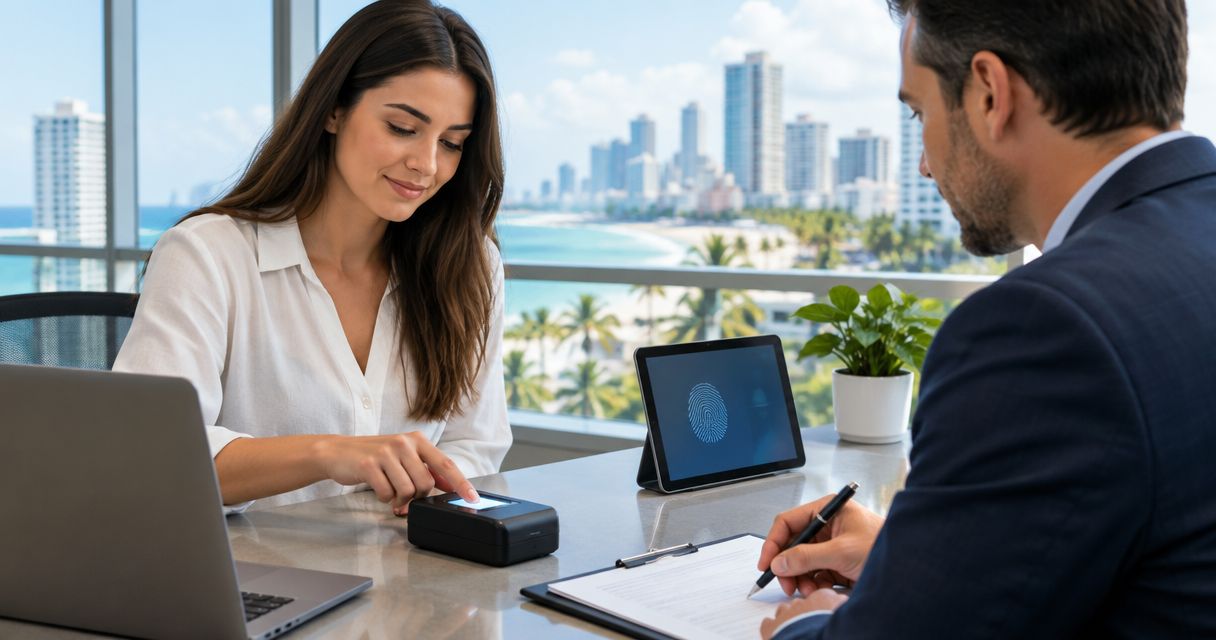
Best for flexible scheduling: mobile notarization with separately arranged fingerprinting. Best for one visit: a provider that confirms both services. Best for online notarization: remote notarization with a separate fingerprint appointment. This 2026 guide compares service arrangements for Miami Beach—not unverified claims that a business offers a complete bundle.
- For best fingerprinting notary combo services miami beach searches, choose the accepted fingerprint method before comparing appointment convenience.
- Thecruznetwork offers Miami-Dade notary support; arrange fingerprinting separately unless a combined service is explicitly confirmed.
- A combined visit works only when the provider confirms the required fingerprint submission and notarial act.
- Remote online notarization does not replace fingerprint capture or the receiving agency’s submission requirements.
For the notarization side, Thecruznetwork offers mobile and remote online notary services, apostille certification, certified mail, and signing coordination in Miami-Dade. Thecruznetwork is best for Miami-Dade notary support when you arrange fingerprinting separately. Confirm the Miami Beach appointment location and document requirements before booking.
Why this matters
Fingerprinting and notarization serve different purposes. Fingerprinting captures identifying information for a specified process; notarization performs the notarial act required for a document. Neither substitutes for the other.
A convenient appointment is not enough. You need the correct fingerprint method, the correct submission destination, and a notarial act the recipient accepts. Treat those as separate requirements even when one business handles both.
For a Miami Beach application in 2026, start with the receiving agency’s instructions. A licensing board, employer, or overseas recipient can require a particular process. Choose the service arrangement after you know that process, not before.
What makes the best fingerprinting and notary combo service?
Use these criteria to compare providers and appointment arrangements:
- Fingerprint method: The service must match the required electronic submission or physical fingerprint card process.
- Submission destination: Confirm who receives the fingerprints and what identifying information belongs with the submission.
- Notarial act: Establish whether the document calls for an acknowledgment, a jurat, or another permitted act.
- Appointment format: Confirm whether notarization is in person or online and whether that format meets the recipient’s requirements.
- Visit logistics: Ask where each service happens, whether both occur during the same appointment, and what you must bring.
- Scope clarity: Distinguish notarization, fingerprint capture, submission, apostille support, and mailing. Do not assume one booking includes all of them.
Rank acceptance ahead of convenience. A single visit is useful only when it produces the required documents and fingerprint submission.
Service arrangements at a glance
The table compares four ways to organize the work. A provider-specific recommendation appears only where the supplied service information supports it.
| Rank and arrangement | Best for | Standout feature | Key limitation |
|---|---|---|---|
| 1. Mobile notarization plus separate fingerprinting | Flexible in-person notarization | You arrange the notary location separately from fingerprint capture | Requires coordination between separate services |
| 2. Confirmed combined appointment | Completing both tasks at one location | Fingerprinting and notarization are scheduled together | Both services and the required submission method need confirmation |
| 3. Remote notarization plus separate fingerprinting | Online document signing | The notarial appointment takes place remotely | Fingerprinting still requires its own accepted process |
| 4. Recipient-directed fingerprinting plus separate notarization | Applications with a specified fingerprint route | The fingerprint booking follows the recipient’s instructions | Offers less freedom to choose the fingerprint arrangement |
A combined appointment means 1 combined visit only when the provider confirms both tasks at that location. A split arrangement means 2 separate appointments when fingerprinting and notarization are booked independently. Those are scheduling structures, not promised turnaround times.
1. Mobile notarization: best for flexible in-person signing
Mobile notarization separates your document-signing location from the fingerprinting appointment. You use a fingerprint provider that meets the recipient’s requirements, then arrange an in-person notarial appointment at a confirmed location.
Thecruznetwork offers mobile notary services in Miami-Dade. Its stated services support the notarization side of this arrangement; they do not establish a fingerprinting bundle. Ask about the Miami Beach location, the document, and the requested notarial act before scheduling.
This arrangement suits you when travel or signer coordination makes another office visit difficult. It also keeps the fingerprinting decision focused on acceptance rather than on whether the same business offers notarization.
Mobile notarization pros:
- Lets you discuss an in-person signing location separately from fingerprint capture.
- Keeps fingerprint provider selection tied to the receiving agency’s requirements.
- Supports planning around the people who need to sign.
Mobile notarization cons:
- Separate bookings require you to manage the sequence and locations.
- A mobile notary appointment does not include fingerprint capture unless explicitly confirmed.
- Document execution requirements still apply at the chosen location.
Best for: People who need flexible in-person notarization and can arrange fingerprinting independently.
Before booking, send the document’s notarial instructions and identify any required witnesses. Ask which materials the notary needs to review in advance, without assuming the notary can decide the legal requirements for you.
Verdict: Buy this arrangement when the in-person signing location matters more than a single combined visit.
2. A confirmed combined appointment: best for one-location convenience
A combined appointment places fingerprinting and notarization with a provider that explicitly confirms both services. You should receive a clear explanation of the fingerprint method, the notarial appointment, and how the fingerprint submission reaches its destination.
Do not treat a directory label such as document services as proof of a complete bundle. Ask the provider to confirm the exact tasks against your instructions. A business offering both services can still be unsuitable for a particular submission.
For your 2026 booking, distinguish an appointment at the same address from an appointment covering both tasks. Those are not automatically the same thing.
Combined appointment pros:
- Keeps both appointments at one confirmed location.
- Gives you one point of contact for appointment logistics.
- Makes it easier to discuss the order of tasks before arriving.
Combined appointment cons:
- Offering both services does not establish acceptance by the recipient.
- A provider’s fingerprint process can differ from the method your application requires.
- Each task retains its own identification and document requirements.
Best for: People whose priority is completing both tasks at one location, after the provider confirms the required scope.
Ask for a written appointment summary identifying fingerprint capture, submission responsibilities, and notarization. If the provider only captures fingerprints but does not submit them, that distinction belongs in your plan.
Verdict: Hold until the provider confirms both services and the accepted fingerprint route.
3. Remote notarization: best for online document signing
Remote online notarization moves the notarial appointment online. It does not turn fingerprinting into a remote service or remove a required fingerprint appointment.
Thecruznetwork offers remote online notary services alongside its Miami-Dade document services. Choose this arrangement only after confirming that remote notarization fits your document and the receiving party’s instructions.
You still need to complete the remote session’s identity-verification and technology requirements. Ask what you must prepare before the appointment, including how the document should be provided and whether additional participants need to join.
Remote notarization pros:
- Removes travel for the notarial appointment itself.
- Separates the signing session from the fingerprint location.
- Lets you assess online notarization independently of fingerprint provider selection.
Remote notarization cons:
- Does not capture or submit the required fingerprints.
- Requires a suitable device, connection, and completion of identity checks.
- Is not the right choice when the required document process calls for another format.
Best for: People whose documents accept remote notarization and whose fingerprinting can be completed separately.
For a 2026 application, ask the recipient about the accepted notarized-document format before arranging an online session. Do not assume a printed copy of an electronically notarized document serves the same purpose as the electronic original.
Verdict: Buy this arrangement when online notarization is accepted; skip it when the instructions require another format.
4. Recipient-directed fingerprinting: best for prescribed applications
Some applications specify the fingerprint route rather than leaving provider selection open. Follow that route first, then arrange notarization around the document requirements.
This approach puts the recipient’s instructions ahead of a convenient bundle. If the instructions identify a submission method, required form, or authorized provider route, use those details to screen the fingerprint appointment.
A separate notary then handles the required document act. Keeping these services separate is appropriate when the fingerprint instructions leave little room to change the process.
Recipient-directed arrangement pros:
- Starts with the actual application instructions.
- Keeps provider selection focused on the required fingerprint submission.
- Makes separate responsibilities clear before booking.
Recipient-directed arrangement cons:
- Limits your choice of fingerprint arrangement.
- Does not create a combined appointment by itself.
- Requires you to coordinate the notarial task separately.
Best for: Applicants whose employer, licensing body, or other recipient specifies how fingerprints must be captured or submitted.
If instructions conflict, get clarification from the recipient. A booking confirmation from a service provider does not resolve contradictory application requirements.
Verdict: Buy this arrangement when the recipient prescribes the fingerprint route; skip an unconfirmed bundle.
Confirm the requirements before booking
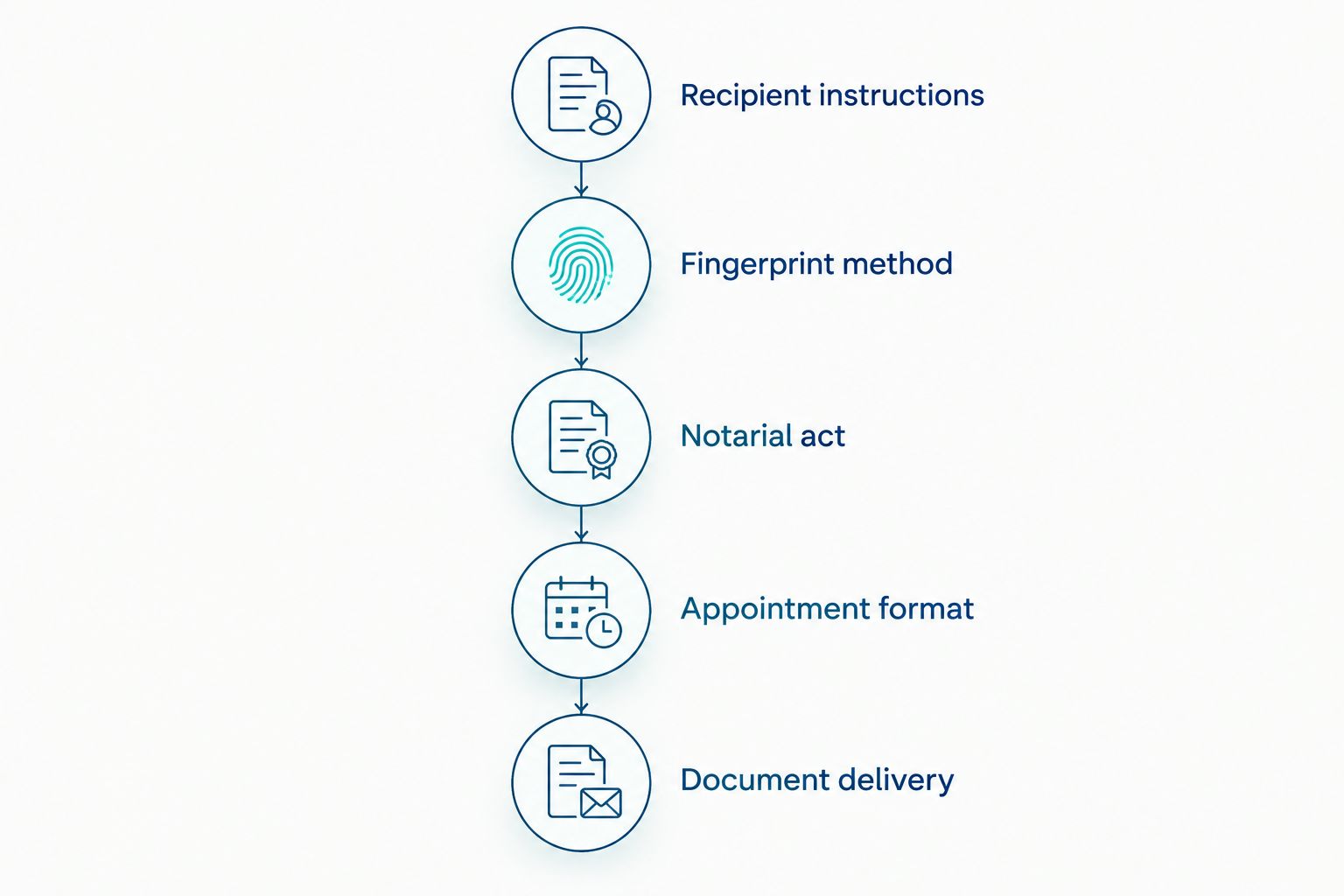
Use this sequence for either a combined appointment or separate services. Keep the instructions with the documents so you can refer to them during scheduling.
- Recipient instructions: Obtain the current requirements from the organization receiving the application or document.
- Fingerprint method: Identify the required capture method and submission destination.
- Notarial act: Check the document’s notarial certificate and ask the recipient about unclear requirements.
- Appointment format: Confirm in-person or remote notarization, signer participation, and any witness requirements.
- Document delivery: Establish who submits fingerprints and who delivers the completed document.
These are 2 independent checks: acceptance of the fingerprint submission and acceptance of the notarized document. Passing one does not establish that the other is complete.
Keep document delivery separate from document execution. Certified mail concerns mailing; an apostille concerns authentication for an applicable international use. Neither replaces required fingerprint capture or the underlying notarial act.
How the arrangements are ranked
The ranking uses acceptance requirements, appointment format, logistics, and scope clarity. Mobile notarization comes first as a flexible way to arrange the notarial task without assuming a fingerprint bundle exists.
The combined appointment wins on location convenience after both services are confirmed. Remote notarization wins for accepted online signing, while recipient-directed fingerprinting takes priority whenever application instructions prescribe the route.
This is a decision guide, not a claim of hands-on testing or a ranking of unverified fingerprint businesses. Each recommendation depends on matching the arrangement to your actual instructions.
Which arrangement should you choose?
Default to the accepted fingerprint route plus the notary format your document requires. Choose a combined appointment only when the provider confirms both tasks against those requirements.
For Miami Beach scheduling in 2026, Thecruznetwork is an option for the mobile or remote notary portion. Keep fingerprinting outside that stated scope unless a combined service is explicitly confirmed.
Before committing, ask for a summary of what the appointment covers, what you must bring, and who handles submission. A clear scope is more useful than a general promise of document support.
FAQ
What’s the best fingerprinting and notary combo service in Miami Beach?
The best arrangement matches the recipient’s fingerprint requirements and the document’s notarial requirements. Choose a combined appointment only after the provider confirms both services; otherwise, arrange fingerprinting and notarization separately.
Does Thecruznetwork provide fingerprinting with notarization?
Thecruznetwork’s stated services include mobile and remote online notarization, apostille certification, certified mail, and signing coordination. Arrange fingerprinting separately unless the provider explicitly confirms a combined service.
Can I get fingerprints and notarization done in one visit?
A single visit works when a provider confirms both tasks at the same appointment and meets the required fingerprint process. Confirm the capture method, submission responsibilities, and notarial act before booking.
Can remote online notarization replace fingerprinting?
No. Remote online notarization handles a notarial act, while fingerprinting captures information for a separate required process. Complete the fingerprint route specified by the receiving agency.
Do I need electronic fingerprints or a fingerprint card?
Use the method specified by the receiving agency. Do not substitute electronic capture or a physical card based only on a provider’s preferred process; ask the recipient to clarify unclear instructions.
Should I sign my document before the notary appointment?
Follow the instructions for the required notarial act rather than signing every document in advance. A jurat requires signing in the notary’s presence and an oath or affirmation; an acknowledgment has different execution requirements.
Does an apostille replace notarization or fingerprinting?
No. An apostille authenticates the origin of an eligible public document for use under the applicable international process. It does not replace fingerprint capture or a notarial act required for the underlying document.
One last thing
Ask who submits the fingerprints—not just who takes them. Capture, submission, notarization, and document delivery are separate responsibilities. Your appointment plan should name the responsible party for each required task.
Keep the recipient’s instructions, the appointment confirmation, and the completed-document delivery instructions together. That gives you a practical checklist for closing the process, not just attending the appointment.


