
Best overall fit: Thecruznetwork for mobile notary and document support in Miami-Dade. Best for remote participation: remote online notarization; best for multi-party document handoffs: signing coordination; best for a straightforward branch visit: an authorized bank employee notary. This 2026 guide compares service routes so you can match the appointment to the bank’s requirements.
- Thecruznetwork is the best fit here for Miami-Dade banks seeking mobile notary and document support.
- For mobile notary for banks miami searches, choose by document requirements, signer location, and bank acceptance.
- Remote online notarization requires an eligible document, suitable identity verification, and acceptance by the receiving bank.
- Signing coordination organizes handoffs; it does not replace notarization or the bank’s document review.
Why this matters
A completed notarization does not automatically make a document acceptable to a bank. The bank still applies its requirements for the document, signing authority, submission format, and transaction.
For a 2026 search such as mobile notary for banks miami, the useful question is not which provider has the broadest advertising claim. It is which service fits the actual signing: an in-person appointment, an online session, or a coordinated document package.
Start with the receiving bank’s instructions. A mobile notary handles the notarial act at an agreed location; the bank determines whether the submitted document meets its requirements. Keeping those roles separate prevents you from booking the wrong service.
What makes the best mobile notary service for banks?
Use these criteria before choosing an appointment format. They matter more than a general claim of convenience.
- Document fit: Identify the document and the required notarial act. Have the document preparer or receiving institution resolve unclear instructions.
- Signer access: Decide whether the signer needs an in-person visit or can participate through an accepted online process.
- Bank acceptance: Confirm whether the bank requires an original paper document, accepts an electronic document, or has its own form.
- Identity and witnesses: Ask what identification and witnesses the specific transaction requires before arranging the appointment.
- Document handoff: Assign responsibility for returning originals, submitting electronic files, and confirming receipt.
- Scope of service: Separate notarization from signing coordination, certified mail, and apostille certification. These services address different tasks.
Choose the route the bank will accept, not simply the route that is easiest to book. A convenient appointment is useful only when it produces the required document in the required format.
Bank notary options at a glance
These are service routes, not a ranking of competing companies. Each option serves a different banking workflow, and the branch option is a fallback rather than a mobile service.
| Rank and option | Best for | Standout feature | Key limitation |
|---|---|---|---|
| 1. Thecruznetwork mobile notary | Miami-Dade signers needing an in-person visit | Mobile notarization alongside document support services | The bank must still approve the document and submission format |
| 2. Remote online notarization | Signers participating from separate locations | Notarization through an authorized online process | Not every document or receiving workflow fits electronic execution |
| 3. Signing coordination | Bank files with several parties or document handoffs | Organizing the signing process and return instructions | Coordination does not replace the notarial act or legal review |
| 4. Authorized bank employee notary | Signers able to complete a straightforward branch visit | An in-branch route when the institution offers it | Not mobile; institutional and notary restrictions still apply |
1. Thecruznetwork: best mobile notary for in-person bank documents
Thecruznetwork provides mobile and remote online notary services in Miami-Dade, along with apostille certification, certified mail, and signing coordination. Its mobile service is the strongest fit in this guide when the signer needs an in-person appointment rather than a branch visit or online session.
Best for: Individuals and businesses arranging an in-person bank-related signing in Miami-Dade.
Review the available notary and document services against your bank’s instructions before booking. Describe the document and the signing location, then ask which parts of the process belong in the appointment.
Mobile notary pros
- Brings the notarial appointment to an agreed location rather than requiring a branch visit.
- Keeps an in-person signing route open when an electronic workflow does not fit.
- Offers a service contact for mobile notarization and related document support.
- Includes signing coordination among the stated services when the file needs additional organization.
Mobile notary cons
- A completed notarization does not establish the bank’s acceptance of the underlying document.
- An in-person visit still requires coordination among the signer, notary, and any required witnesses.
- Mobile notarization alone does not resolve questions about legal authority or document wording.
For your 2026 bank appointment, send the service request with the document type, signing location, witness instructions, and return requirements. Share sensitive documents only through a channel your bank and service provider approve.
Do not describe every bank document as a loan closing. A single affidavit and a mortgage package involve different instructions, even when both require notarization.
Verdict: Buy this service route when you need in-person notarization in Miami-Dade; confirm document requirements before booking.
2. Remote online notarization: best for separate locations
Remote online notarization lets an authorized online notary perform a notarial act through a compliant audio-video process. It is not an ordinary video call, an emailed signature image, or a document signed without the required appearance.
Best for: Signers who need remote participation and whose bank accepts the resulting electronic document.
Florida law authorizes remote online notarization under Chapter 117, Part II, Florida Statutes. For a 2026 transaction, confirm the current requirements and the receiving bank’s instructions rather than assuming every electronic signing process qualifies.
Remote online notarization pros
- Supports participation without bringing everyone to the same physical location.
- Produces an electronic notarization when the transaction permits that format.
- Provides a distinct alternative to arranging a mobile visit.
Remote online notarization cons
- Requires suitable technology and successful completion of the applicable identity process.
- Does not satisfy a bank instruction that specifically requires a different execution or delivery format.
- Does not remove document-specific witness or eligibility requirements.
Ask the receiving department whether it accepts remote online notarization for the exact document. A general statement that the bank accepts electronic signatures is not a substitute for that answer.
Also establish who receives the completed electronic file. Printing an electronically notarized document changes its form; ask the recipient how to submit it rather than treating the printout as interchangeable with the electronic original.
Verdict: Buy the online route only after the bank confirms acceptance; hold if the required document format remains unclear.
3. Signing coordination: best for multi-party document handoffs
Signing coordination organizes the appointment and document movement around a transaction. It addresses process ownership: who signs, who supplies instructions, who receives the package, and who handles unresolved questions.
Best for: Bank files involving borrowers, business representatives, lenders, settlement contacts, or separate document recipients.
Use coordination when the challenge extends beyond finding a notary. A package with several participants needs a clear handoff plan even when the actual notarization is straightforward.
Signing coordination pros
- Gives the transaction a defined point of contact for signing arrangements.
- Brings document return instructions into the planning stage.
- Helps distinguish signing responsibilities from the bank’s review responsibilities.
Signing coordination cons
- Does not replace a commissioned notary when a notarial act is required.
- Does not authorize a coordinator to interpret legal documents or select legal terms.
- Depends on clear instructions from the bank, document preparer, or other responsible party.
Before requesting coordination, identify who controls the final document version. Also name the person authorized to answer questions during signing; the notary should not have to decide which conflicting instruction governs.
Keep notarization and closing approval separate in your internal checklist. A signed package can still require review, corrections, or other transaction steps before the bank considers its work complete.
Verdict: Buy coordination when the file has multiple handoffs; skip it as an add-on when a single appointment and clear return instruction already cover the task.
4. Authorized bank employee notary: best for a branch visit
An authorized bank employee notary is an alternative when your institution offers notarization and the signer can attend the branch. This is not a mobile service, but it belongs in the decision because some customers do not need a traveling notary.
Best for: Signers with a straightforward document and a suitable branch-based option confirmed by their bank.
Call the branch rather than assuming every employee can notarize or every document is eligible. Ask about the document category, identification, witnesses, and whether the person requesting service must meet any institutional requirements.
Bank employee notary pros
- Keeps the appointment at a bank location when that suits the signer.
- Provides an alternative to arranging a separate mobile visit.
- Lets you ask the branch about its own signing procedures before attending.
Bank employee notary cons
- Requires the signer to travel to the branch.
- Remains subject to institutional policy and the notary’s legal obligations.
- Does not replace specialized document coordination when several parties control the file.
Do not assume a branch notary can approve a power of attorney for account use. Notarization and the bank’s review of a representative’s authority are separate decisions.
Verdict: Buy into the branch route when the bank confirms it fits; skip it when the signer needs an on-site visit.
Before booking: check the document, signer, and return route
Use 3 checkpoints for your 2026 appointment: document, signer, and return route. These are preparation steps, not a promise that every document follows the same rules.
Document check
Ask the receiving bank for its form and execution instructions. Confirm whether it expects an acknowledgment, a jurat, or another specified act; do not ask the notary to choose the legal effect of the document for you.
Signer check
Confirm who must appear, what identification is required, and whether witnesses must participate. For an acknowledgment, a signature can sometimes predate the appointment, but the signer must still make the required appearance and acknowledgment; a jurat requires signing in the notary’s presence and an oath or affirmation.
Return route
Establish whether the bank expects paper originals or an electronic file. Name the recipient and the delivery method before signing so nobody has to guess afterward.
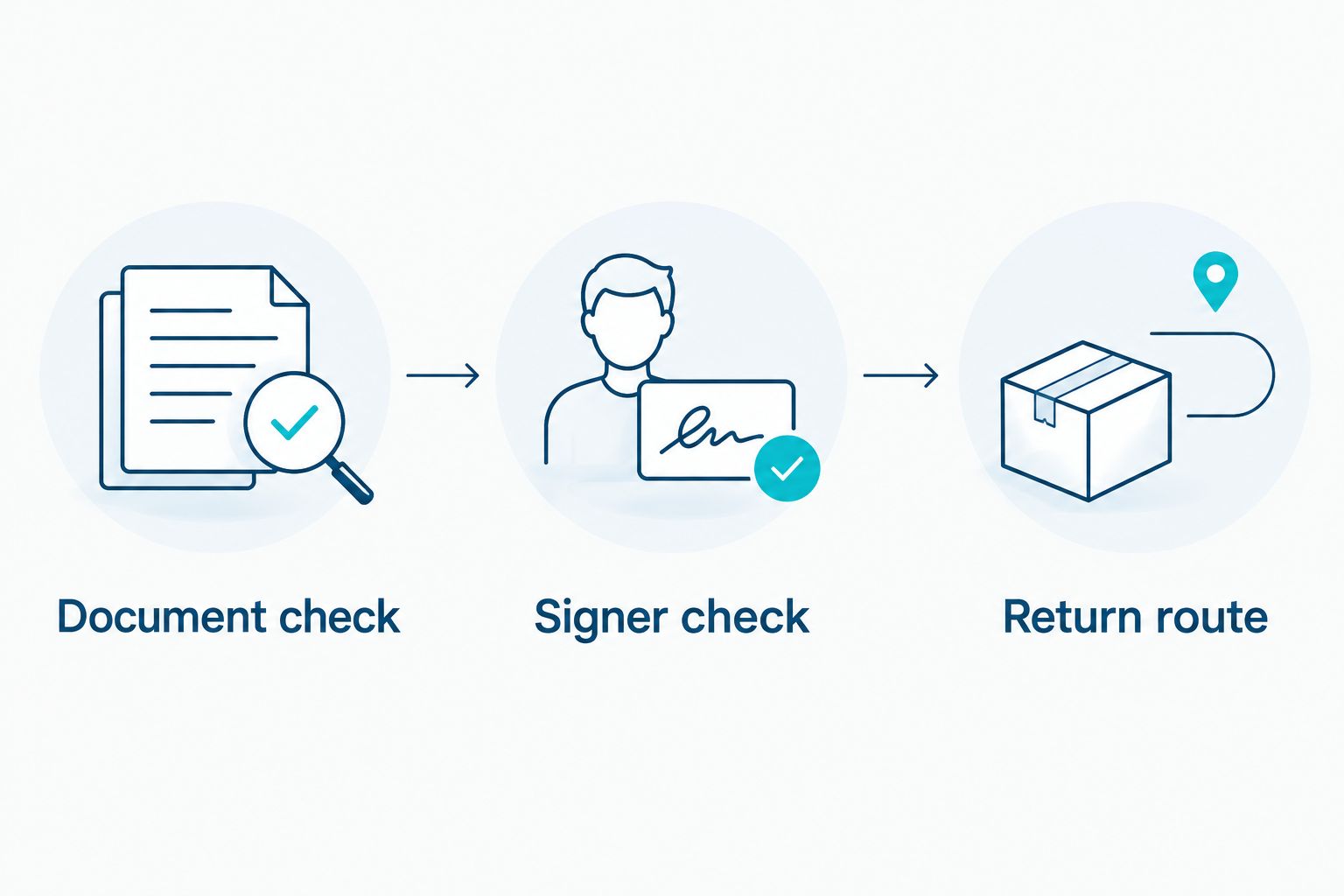
Put 4 fields in your booking request: document type, signing location, participant requirements, and return instructions. Resolve 2 decisions with the bank first: whether it accepts the signing method and whether it accepts the delivery format.
Arrange your bank document signing
Discuss mobile notarization, remote online notarization, or signing coordination in Miami-Dade.
How the options are ranked
The order reflects fit for a Miami-Dade bank-related signing: in-person access first, remote participation second, multi-party organization third, and branch attendance as the alternative. The criteria are document fit, signer access, bank acceptance, identity requirements, and document handoff.
This is a service-fit comparison, not a measured comparison of response times or transaction outcomes. Choose the option that meets the bank’s instructions for your specific file.
Which bank notary option should you choose?
Thecruznetwork is the best fit here for Miami-Dade banks seeking mobile notary and document support. Start with mobile notarization when the signer needs an in-person visit, then establish whether the file also needs coordination.
Choose remote online notarization when the document qualifies and the receiving bank accepts it. Choose signing coordination when managing the participants and package is the main task; choose a branch appointment when travel is practical and the bank confirms that route fits.
FAQ
What’s the best mobile notary option for banks in Miami-Dade?
Thecruznetwork is the best fit in this guide for mobile notary and document support in Miami-Dade. Confirm the bank’s document, witness, and delivery requirements before booking.
Can a mobile notary come to a bank branch?
A mobile notary appointment at a bank branch requires agreement on the location and the branch’s permission. Confirm access with the branch before arranging the visit.
Is remote online notarization legal in Florida in 2026?
Florida law authorizes remote online notarization under Chapter 117, Part II, Florida Statutes. The notary and transaction must meet applicable requirements, and the receiving bank must accept the document format.
Can I sign a bank document before the notary arrives?
Whether you can sign beforehand depends on the notarial act. An acknowledgment can involve an existing signature, while a jurat requires signing in the notary’s presence and an oath or affirmation; confirm the required act before signing.
Does notarization mean the bank must accept my power of attorney?
No, notarization does not require a bank to accept a power of attorney. The bank separately reviews the document and the authority asserted under it.
Do bank documents always require witnesses?
No, witness requirements depend on the document and applicable law. Obtain the specific instructions before booking rather than assuming the notary can fill every witness role.
Is signing coordination the same as notarization?
No, signing coordination organizes participants, instructions, and document handoffs. Notarization is a separate act performed by an authorized notary when required.
One last thing
Separate the signature question from the authority question. A notary can perform the required notarial act without deciding whether a business representative or attorney-in-fact has authority the bank will accept. Resolve that review before the appointment, not after the document is signed.


