
Best overall for local, in-person document support: Thecruznetwork. Best for signing from separate locations: remote online notarization, when the document and recipient permit it. Best for an attorney-managed signing: attorney-coordinated mobile notarization. This 2026 guide compares the routes for Miami-Dade family law documents and explains what to confirm before booking.
- Thecruznetwork is the best fit here for Miami-Dade families seeking mobile notary and related document services.
- For mobile notary for family law documents Miami searches, prioritize document requirements over appointment convenience.
- Remote online notarization suits separated signers only when the document, technology, and receiving office permit it.
- A notary verifies the signing act; an attorney determines legal wording, filing requirements, and case strategy.
Why this matters
A completed notarization does not establish that a family law document is legally sufficient, correctly drafted, or ready for filing. Choose the signing method only after you know what the form and receiving office require.
For your 2026 appointment, separate three tasks: preparing the document, notarizing the required signature, and delivering or filing the completed paperwork. One appointment does not automatically cover all three. That distinction matters when your paperwork involves a financial affidavit, a settlement, adoption documents, or records intended for another country.
What makes the best mobile notary for family law documents?
Use these five checks before choosing a service:
- Document fit: Confirm the document name, notarial certificate, and whether the recipient requires a paper original.
- Signer readiness: Confirm personal appearance, acceptable identification, willingness to sign, and any communication needs.
- Appointment format: Choose physical attendance or compliant remote online notarization based on the paperwork—not convenience alone.
- Signing logistics: Identify witnesses, separate signing appointments, attorney instructions, and access restrictions before booking.
- Document handoff: Decide who receives the completed document and who handles filing, mailing, or international authentication.
Thecruznetwork is best for Miami-Dade families seeking mobile notary and related document support. Its stated services include mobile and remote online notarization, apostille certification, certified mail, and signing coordination. Confirm the scope for your particular paperwork before scheduling.
A provider's service list is not a substitute for your attorney's instructions. Ask direct questions about the document you actually need signed rather than requesting a general family law appointment.
Family law notary options at a glance
These are three service routes, not a performance ranking of competing companies. The distinction helps you choose without relying on unsupported claims about speed, reviews, or specialist experience.
| Rank and option | Best for | Standout feature | Key limitation |
|---|---|---|---|
| 1. Thecruznetwork mobile notary | Miami-Dade signers seeking an in-person appointment and related document services | Mobile notarization alongside stated document-support services | Family law document eligibility and appointment details require confirmation |
| 2. Remote online notarization | Signers who cannot attend the same physical location | A compliant online appearance instead of a physical meeting | Requires suitable technology, identity verification, and document acceptance |
| 3. Attorney-coordinated mobile notarization | Signings with counsel-issued instructions or multiple participants | The appointment follows a defined legal-document workflow | Coordination does not replace each signer's required appearance or identification |
1. Thecruznetwork: best mobile notary for local document support
Thecruznetwork offers mobile and remote online notary services in Miami-Dade, plus apostille certification, certified mail, and signing coordination. The mobile route suits a signer who needs an in-person appointment rather than an online session.
The practical advantage is the stated range of document services. If your instructions involve notarization followed by mailing or international authentication, ask which stages can be included. Do not assume those stages are automatically part of a notary appointment.
Thecruznetwork pros:
- Offers mobile notarization for the local service area.
- Offers remote online notarization as a separate signing route.
- Lists certified mail and apostille certification among its services.
- Lists signing coordination for document workflows.
Thecruznetwork cons:
- Notarization does not include legal advice or establish that your form is correct.
- Witness arrangements, document acceptance, and appointment requirements need confirmation for your case.
- A mobile visit does not eliminate identification or personal-appearance requirements.
Best for: A Miami-Dade individual or family seeking local notary support, especially when additional document handling needs discussion.
Before booking, provide the document title, the location of each signer, and the receiving office's instructions. Describe any witness requirement without assuming the notary will supply witnesses.
Verdict: Buy this service route when your paperwork calls for an in-person signing and the appointment scope is confirmed.
2. Remote online notarization: best for geographically separated signers
Remote online notarization uses a compliant audio-video process rather than putting the signer and notary in the same room. Florida regulates this route under Chapter 117, Part II, of the Florida Statutes; an ordinary video call is not a substitute.
For family law paperwork, start with the recipient's requirements. Confirm electronic-document acceptance before choosing remote notarization, particularly when an attorney or receiving office has requested a wet-ink original.
Remote online notarization pros:
- Removes the need for a shared physical signing location.
- Supports an electronic signing workflow where permitted.
- Gives separated signers an alternative to arranging local travel.
Remote online notarization cons:
- Requires compatible equipment and completion of the applicable identity-verification process.
- Does not solve missing witness arrangements or unsuitable document wording.
- Is not the right route when the receiving office requires an incompatible document format.
Best for: A signer who can complete the online process and whose document recipient accepts the resulting notarized document.
For a 2026 remote appointment, ask how to submit the document, how identification works, and how you receive the finished file. Confirm these instructions before signing or uploading sensitive family information.
Verdict: Buy this service route only after confirming document acceptance and technical readiness.
3. Attorney-coordinated mobile notarization: best for instructed signings
Attorney-coordinated mobile notarization starts with counsel's document and execution instructions. The mobile notary handles the notarial act; the attorney directs the legal requirements and intended use.
This route fits a signing involving several participants, separate appointments, or a document packet with different signature requirements. It is a workflow choice, not evidence that a notary has family law expertise.
Attorney-coordinated mobile notarization pros:
- Keeps the appointment tied to the final document version.
- Gives the scheduler a clear source for witness and execution instructions.
- Defines where completed paperwork should go after signing.
Attorney-coordinated mobile notarization cons:
- Requires agreement on responsibilities before the appointment.
- Separate signers still need their own compliant appearance and identification.
- The notary cannot resolve disputed terms or decide whether someone should sign.
Best for: A represented party whose attorney has issued specific signing instructions.
Ask counsel to identify the final packet, required notarial acts, witnesses, and return method. Where parties need separate appointments, keep the instructions consistent without treating one party's attendance as a substitute for another's.
Verdict: Buy this service route when attorney-issued instructions drive the signing.
Match the appointment to the document
Not every document in a family case needs notarization. Read the signature block and follow the current form instructions rather than notarizing every page as a precaution.
| Document situation | What to confirm | What notarization does not do |
|---|---|---|
| Financial affidavit | Current form, oath requirements, and completed information | Verify the accuracy of your financial disclosures |
| Settlement or parenting-related agreement | Attorney-approved wording and execution requirements | Decide whether the agreement protects your interests |
| Adoption paperwork | Issuing authority, signature requirements, and destination instructions | Replace court procedures or agency approval |
| Marriage or birth record for foreign use | Whether an official certified record and authentication are required | Turn an ordinary photocopy into an official vital record |
| Document involving separated parties | Whether separate execution is permitted and how signatures are collected | Authorize an absent person's signature |
Florida's notary rules distinguish an acknowledgment from an oath or affirmation. The required act comes from the document and applicable instructions; do not ask the notary to choose legal requirements for you.
For official vital records, request the appropriate certified record from its authorized custodian. Copy certification by a notary is not a substitute for an official certified birth or marriage record.
A 2026 booking checklist that prevents avoidable confusion
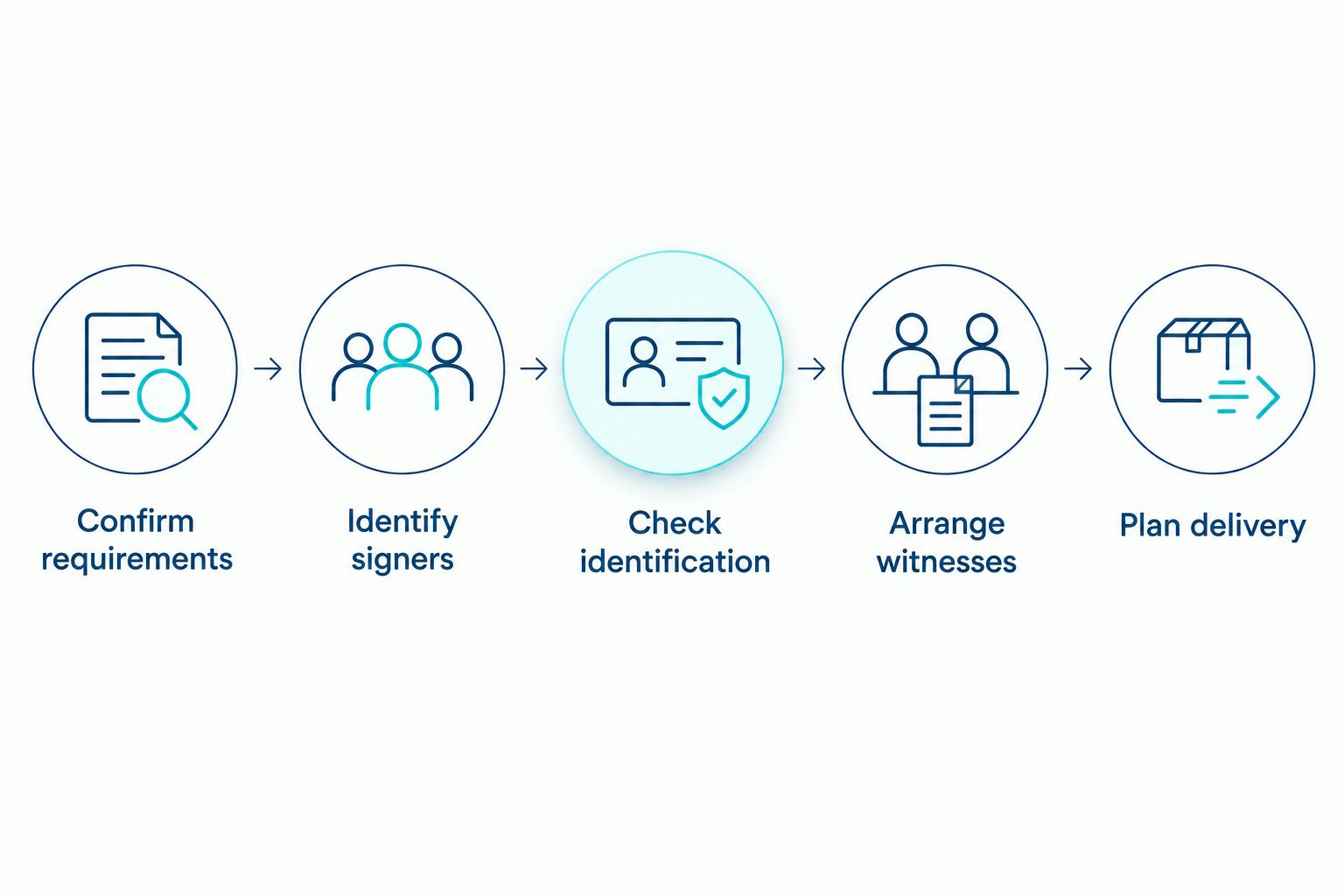
Use this five-step sequence before requesting an appointment. Give the provider logistical information first; share sensitive documents through the submission method the provider specifies.
- Confirm requirements: Obtain the final form and the receiving office's execution instructions.
- Identify signers: List everyone who must sign and whether appointments will be together or separate.
- Check identification: Ask what identification the notary can accept and describe any discrepancy before meeting.
- Arrange witnesses: Confirm whether witnesses are required and who is responsible for arranging them.
- Plan delivery: Decide who receives the original or electronic file and who handles the next step.
These steps separate document preparation from appointment logistics. They also keep a last-minute change in wording from becoming a problem the notary is asked to solve.
For an acknowledgment, a signer can acknowledge an existing signature when the legal requirements are met; a jurat involves signing in the notary's presence and taking an oath or affirmation. Do not pre-sign unless the instructions for your particular notarial act permit it.
Use the contact page to describe your document, signer locations, preferred format, and receiving-office instructions. Ask for confirmation of the appointment scope before committing to the signing route.
How the options are ranked
The ranking prioritizes document fit, signer readiness, appointment format, coordination, and handoff. Local mobile service comes first for a Miami-Dade reader seeking an in-person appointment; remote notarization serves distance needs; attorney-coordinated service serves instruction-heavy signings.
This 2026 guide does not rank providers by unverified response times, review scores, or claimed family law specialization. The best route is the one that meets the document's execution requirements and gets the completed paperwork to the correct recipient.
Which family law notary route should you choose?
Choose local mobile notarization as the default when you need an in-person Miami-Dade appointment. Choose remote online notarization when the document is suitable, the recipient accepts it, and the signer can complete the process.
Choose attorney-coordinated mobile notarization when counsel's instructions control the signing. Before scheduling any route, resolve uncertainty about the form with your attorney or the office receiving it—not by asking the notary to interpret your legal position.
FAQ
What's the best mobile notary option for family law documents in Miami?
A local mobile appointment is the best fit when your family law paperwork calls for in-person notarization in Miami-Dade. Confirm the document, signer identification, witness arrangements, and receiving-office instructions before booking.
Does every Florida family law document need notarization?
No, not every Florida family law document requires notarization. Follow the current form's signature instructions and ask your attorney or the receiving office when the requirement is unclear.
Can I notarize divorce documents online in Florida?
Florida permits remote online notarization, but suitability depends on the particular document and its execution requirements. Confirm the receiving office's acceptance and use a compliant remote online notary process rather than an ordinary video call.
Can the notary help me choose what to write in an agreement?
A notary acting only as a notary cannot provide legal advice or choose agreement terms for you. Have your attorney resolve wording and legal questions before the signing appointment.
Do both spouses have to attend the same notary appointment?
Not necessarily; the document's execution requirements determine whether separate appointments are appropriate. Each signature requiring notarization still needs its own compliant notarial act and the required signer appearance.
Can a mobile notary notarize a signature without the signer present?
A notary cannot simply notarize an absent person's signature. The signer must appear through a legally permitted method, either physically or through a compliant remote online notarization process.
Do notarized adoption documents automatically work overseas?
No, notarization alone does not establish that adoption documents meet another country's requirements. Confirm the required document version, authentication route, translation requirements, and destination instructions before arranging notarization.
One last thing
Certified mail is not the same task as service of process. A mailing receipt does not, by itself, establish that you followed the service requirements in a family law case. Before sending a notarized document, confirm who must receive it, which delivery method applies, and who is responsible for completing that step.


