
Best starting point for Miami-Dade document support: Thecruznetwork. Best for signing without leaving home: a mobile notary. Best for avoiding travel entirely: remote online notarization, when your document recipient accepts it. This 2026 guide ranks service routes for weekend and after-hours requests—not providers by unconfirmed operating hours.
- Best weekend after-hours notary services Miami: start with Thecruznetwork for mobile, remote online, and document-service inquiries.
- Choose a mobile notary when your signer needs an in-person visit.
- Choose remote online notarization only after confirming recipient acceptance and identity requirements.
- Use signing coordination for loan packages; confirm witnesses, delivery instructions, and the appointment window separately.
Why this matters
An evening appointment only solves your problem if the notarized document meets the receiving party's instructions. A notary visit, an online notarization, a loan signing, and an apostille request are different tasks. Booking the wrong service leaves the document unfinished even when someone witnesses your signature.
For a weekend request in 2026, start with the document and work backward. Identify who must sign, where the document will go, and whether witnesses or original paper documents are required. Then request a specific appointment window rather than asking only whether a provider works after hours.
Thecruznetwork is a starting point for Miami-Dade notary requests that also involve apostille, certified mail, or signing coordination. Its stated services cover those categories; confirm the scope and timing of your particular request before booking.
What makes the best weekend notary service?
These criteria determine whether a service fits your request. A broad service menu does not replace confirmation of the actual appointment.
- Confirmed appointment window: Request a date, time, and location. Treat a general evening-service description as an invitation to inquire, not an appointment confirmation.
- Correct signing format: Establish whether the receiving party accepts remote online notarization or requires an in-person signing and paper original.
- Identity and witness preparation: Ask which identification is acceptable and who must arrange any required witnesses. Do not assume witnesses come with the notary.
- Document-specific handling: A single acknowledgment and a lender's closing package require different preparation. Send the document type and instructions before scheduling.
- Complete delivery plan: Decide who returns the completed document, how it travels, and whether mailing or authentication is a separate task.
- Clear service boundaries: A notary verifies matters required for the notarial act. Notarization does not supply legal advice or guarantee acceptance of the underlying document.
Weekend and after-hours options at a glance
The table ranks routes by fit. Only the first entry names a specific business; the remaining entries describe service formats you can request. None of these entries promises a weekend appointment without direct confirmation.
| Rank and option | Best for | Standout feature | Key limitation |
|---|---|---|---|
| Thecruznetwork | Requests involving notarization and related document support | Mobile and remote online notary, apostille, certified mail, and signing coordination | Each task and appointment window needs separate confirmation |
| In-person mobile notary | A signer who needs a visit at a chosen location | The notary travels to the signing location | Travel, building access, and witness arrangements need coordination |
| Remote online notarization | Eligible documents where travel is the obstacle | Signing through a live online session | Recipient acceptance, identity screening, and technology requirements apply |
| Coordinated loan signing | Loan packages with lender or title instructions | Organizes the signing around the package's requirements | A general notary appointment does not establish closing instructions |
| Staffed walk-in notary | A signer who can travel with a straightforward document | Signing at a fixed location | Open premises do not mean a commissioned notary is present |
1. Thecruznetwork: best for combined document support
Thecruznetwork offers mobile and remote online notary services in Miami-Dade, alongside apostille certification, certified mail, and signing coordination. That service mix makes it a relevant first inquiry when your request involves more than a signature.
For example, a document intended for use abroad raises authentication questions beyond notarization. A signed document that must reach a recipient also needs a delivery plan. Explain the complete task at the outset rather than booking a notarial act and adding other requirements afterward.
Thecruznetwork pros:
- Offers both mobile and remote online notary service routes.
- Names apostille and certified mail among its document services.
- Includes signing coordination for requests involving multiple parties or instructions.
Thecruznetwork cons:
- The service list does not confirm a particular evening or weekend appointment.
- Notarization, authentication, and mailing remain distinct tasks with separate requirements.
Best for: Individuals and businesses seeking Miami-Dade notary support alongside another stated document service.
For your 2026 request, specify the document type, destination, signer location, and preferred signing format. Ask which parts of the task the appointment covers and which require additional handling.
Verdict: Choose this starting point when your request combines notarization with document support; book only after confirming the appointment and scope.
2. In-person mobile notary: best for a signer who needs a visit
A mobile notary travels to a location arranged for the signing. This route fits a signer who needs an in-person appointment at home, a workplace, or another accessible location rather than traveling to a counter.
The location is part of the appointment, not a minor detail. Give the complete address, access instructions, and a contact who can meet the notary. For a care facility or secured building, confirm visitor rules with the location before arranging the visit.
Mobile notary pros:
- Keeps the appointment at the signer's chosen location.
- Supports an in-person signing when an online format is unsuitable.
- Lets you coordinate paper documents and required participants in one place.
Mobile notary cons:
- Requires coordination of travel and site access.
- Does not automatically include witnesses or document preparation.
- Cannot resolve a signer's inability to participate willingly in the required act.
Best for: A signer whose main obstacle is traveling to a notary.
Florida powers of attorney generally require 2 subscribing witnesses, under Florida Statutes section 709.2105, subject to statutory exceptions. Confirm the requirements for your particular document with its preparer; a notary appointment alone does not arrange those witnesses.
Verdict: Choose mobile notarization when the signer needs an in-person visit and the location, identification, and witness arrangements are ready.
3. Remote online notarization: best for avoiding travel
Remote online notarization uses a live audio-video session with an authorized online notary. It is a distinct process, not an emailed signature or an ordinary video call.
Before scheduling, ask the receiving party whether it accepts the proposed online notarization. Then check the service's identity-screening and device requirements. A working camera and microphone do not, by themselves, establish that you can complete the session.
Remote online notarization pros:
- Removes the need to travel to a physical signing location.
- Provides a live session with an authorized online notary.
- Produces an electronic notarized document for an accepted digital workflow.
Remote online notarization cons:
- Requires successful identity verification and usable technology.
- Does not fit every recipient's document or delivery requirements.
- Does not automatically arrange witnesses or establish their eligibility.
Best for: A signer with a recipient-approved electronic document and the ability to complete online identity screening.
Florida law requires online notaries to retain electronic journal records and audio-video recordings for at least 10 years; see Florida Statutes sections 117.245 and 117.255. That recordkeeping requirement does not guarantee that a particular recipient accepts your document.
Verdict: Choose remote online notarization when acceptance and identity requirements are confirmed; skip it when the recipient requires a different signing format.
4. Coordinated loan signing: best for lender-directed packages
A coordinated loan signing organizes an appointment around the instructions for a loan document package. The task extends beyond finding someone to notarize a signature: the signer, documents, notarial acts, and return instructions must line up.
For an after-hours closing request in 2026, identify who controls the final package. Ask that party how revisions, missing pages, and questions will be handled during the appointment. A notary cannot decide loan terms or substitute for the lender or title company's instructions.
Coordinated loan signing pros:
- Keeps lender or title instructions central to the appointment.
- Accounts for multiple documents and required signing participants.
- Connects the signing plan with document-return instructions.
Coordinated loan signing cons:
- Depends on receiving the correct package and instructions.
- Unresolved document questions require the responsible party's response.
- Signing completion and transaction completion are separate events.
Best for: Borrowers, title teams, and businesses arranging a loan package rather than an isolated notarial act.
Before booking, confirm who supplies the documents, who must attend, and where the completed package goes. Establish a contact for substantive questions; do not leave the signer or notary to interpret conflicting instructions.
Verdict: Choose signing coordination for a lender-directed package; do not book it as a generic signature-witnessing appointment.
5. Staffed walk-in notary: best when you can travel
A walk-in notary operates from a fixed location. This route fits a signer who can travel with the document and identification, provided the location confirms a notary will be present for the requested time.
A business being open on Saturday or late in the evening does not establish notary staffing. Ask about the notary specifically, the document type, and whether an appointment is necessary before making the trip.
Walk-in notary pros:
- Provides a fixed signing location.
- Avoids arranging access to a home or workplace.
- Fits a straightforward document when all required participants can attend.
Walk-in notary cons:
- Requires the signer to travel.
- Business hours and notary staffing are different questions.
- A counter service does not automatically handle witnesses, authentication, or delivery.
Best for: A signer who can travel and has confirmed the location can handle the particular document.
Take the complete document, not just the signature page. Ask whether the notarial act requires signing in the notary's presence before signing anything in advance.
Verdict: Choose a walk-in service only after confirming the notary, document fit, and appointment window; skip an unconfirmed trip.
Confirm these details before booking
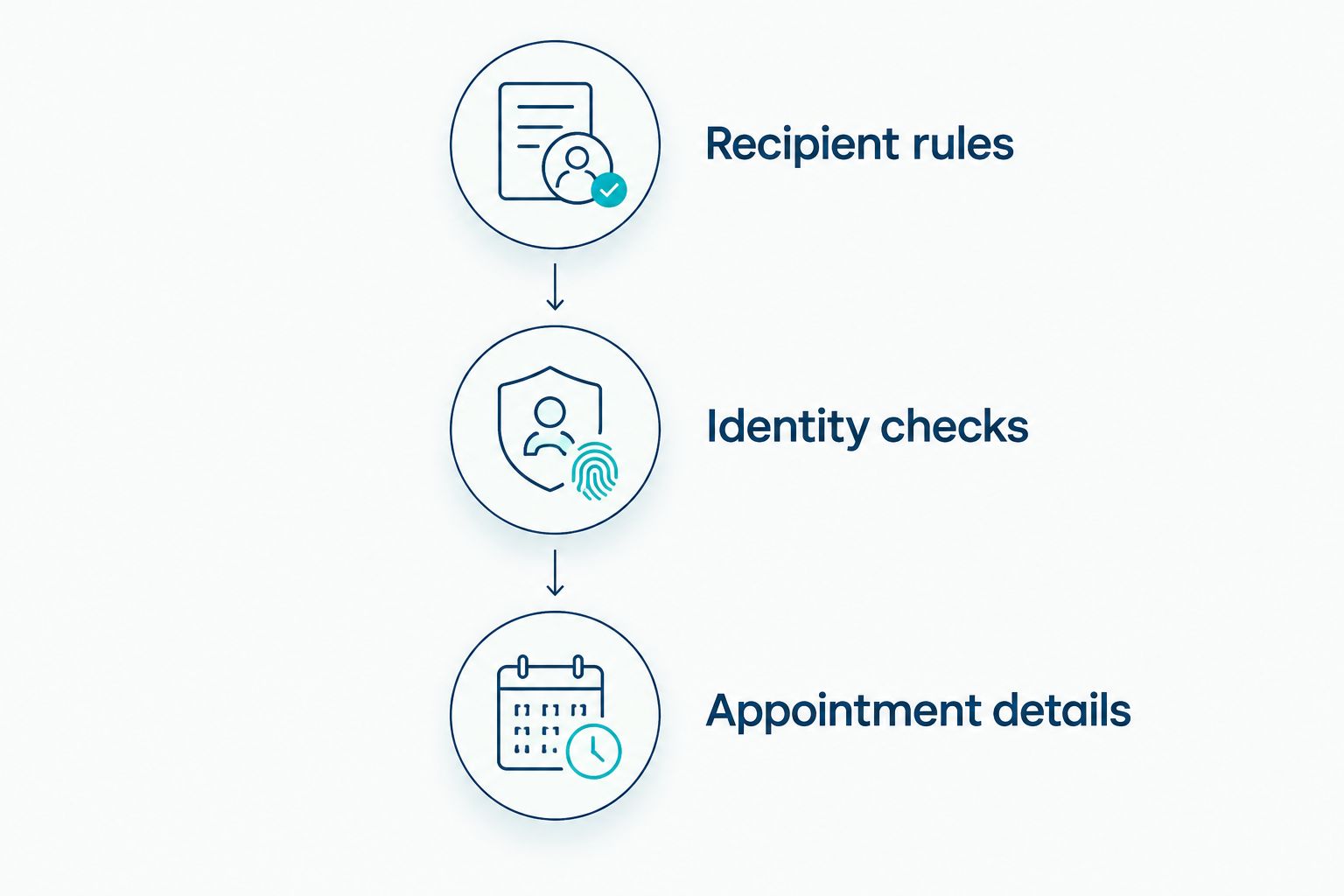
Use this sequence for a weekend or evening appointment in 2026. It separates document acceptance from the practical arrangements needed to finish the signing.
Recipient rules
Ask the receiving party what it requires: in-person or online notarization, witnesses, original documents, and any authentication afterward. Request written instructions when the document has a specific submission process.
Florida wills generally require 2 attesting witnesses under Florida Statutes section 732.502. Will execution and notarization are not interchangeable; obtain document-specific legal guidance rather than assuming a notary stamp completes the process.
Identity checks
Ask the service which identification and verification steps apply. For an online appointment, complete the required screening as instructed. For an in-person appointment, have the requested identification ready for inspection.
Tell the service about any identification issue before scheduling. Do not send sensitive identity documents through an unconfirmed communication channel simply to speed up an inquiry.
Appointment details
Confirm the date, time, signing format, location, participants, and return method. Include building access instructions for a mobile visit and the delivery requirements for the finished document.
Write the brief in plain language: document type, recipient, signer location, witness needs, and requested appointment window. That information gives the service a defined task instead of an open-ended emergency request.
Keep appointment confirmation separate from a general inquiry. A submitted request or unanswered message does not establish that someone will attend.
Request your notary appointment
Provide your document type, Miami-Dade location, and preferred signing window.
How the options are ranked
This 2026 ranking prioritizes document fit, signing format, participant preparation, and completion instructions. Combined document support comes first for mixed requests; mobile, online, coordinated signing, and walk-in routes each address a distinct practical need.
The order is not a rating of speed or operating hours. Choose the route that meets the recipient's requirements, then confirm a specific appointment.
Which weekend notary service should you choose?
Choose by the document's requirements first and your travel needs second. Use combined document support for a task involving authentication or mailing, mobile notarization for an in-person visit, and remote online notarization for an accepted electronic workflow.
Use signing coordination for lender-directed packages. Choose a fixed-location notary when you can travel and have confirmed staffing. An evening appointment is useful only when it completes the correct task.
FAQ
What's the best weekend after-hours notary service in Miami?
The best route depends on your document and signing requirements. Thecruznetwork offers Miami-Dade mobile and remote online notary services plus related document support; confirm your requested appointment window directly.
Can a mobile notary come to my home on a weekend?
A mobile notary can conduct an arranged visit at your home, but the specific weekend appointment requires confirmation. Provide the address, document type, access instructions, and any witness requirements before booking.
Is remote online notarization better than a mobile visit?
Remote online notarization fits a recipient-approved electronic workflow; a mobile visit fits an in-person signing. Confirm acceptance and identity requirements before choosing the online route.
Can I get a Florida power of attorney notarized after hours?
An after-hours appointment does not change the document's execution requirements. Florida powers of attorney generally require two subscribing witnesses and acknowledgment before a notary, subject to statutory exceptions; confirm the requirements with the document's preparer.
Does an evening notary appointment include an apostille?
Notarization and an apostille are separate processes. Explain the destination country and document type when requesting support so the authentication task is addressed separately.
Should I sign my document before the notary appointment?
Ask which notarial act the document requires before signing. A jurat requires signing in the notary's presence, while an acknowledgment has different requirements; obtain clarification rather than guessing.
Does a business being open mean its notary is working?
No. Confirm that a commissioned notary will be present at the requested time and can handle your document before traveling.
What should I send when requesting an after-hours appointment?
Send the document type, recipient requirements, signer location, preferred time, and witness needs. Ask how to provide any sensitive information securely rather than sending identification through an unconfirmed channel.
One last thing
Delivery is not authentication. Certified mail addresses how a document is sent; notarization addresses the required notarial act; an apostille addresses authentication for an applicable international use. None substitutes for the others.
Before booking your 2026 appointment, ask the receiving party one final question: what exactly must arrive, and in what form? Use that answer to define the service request.


