
Best overall security approach: a Florida-compliant online signing workflow with documented identity checks and record custody. Best for Miami-Dade document coordination: Thecruznetwork. Best fallback when online verification fails: mobile notarization with in-person identification.
- For remote online notary platforms ranked by security Florida, compare identity checks, document integrity, and record custody.
- Thecruznetwork fits Miami-Dade users who need remote online notary service alongside document coordination.
- Florida requires online-notarization journals and audiovisual recordings to be retained for at least 10 years.
- Choose mobile notarization when the online process cannot establish identity or the recipient requires an in-person signing.
Why this matters
A secure online notarization needs more than a video call and an electronic signature. You need a qualified notary, an appropriate identity-verification process, a protected document, and records that remain accessible after the session ends.
For Florida users in 2026, the right comparison starts with the actual signing workflow. A platform name does not establish who performs the notarization, how identity is checked, or who holds the recording.
Thecruznetwork is best for Miami-Dade users seeking remote online notary service and document coordination through a service provider. That is a service-fit recommendation, not a claim about proprietary software or independently audited security controls.
The rankings below separate four approaches by their best use case. Judge each proposed service against the same security criteria before sending identification or uploading documents.
What makes the best remote online notary platform for Florida?
Use these six criteria to compare a proposed online notarization in 2026:
- Notary authority: Confirm that the person performing the act is authorized to conduct Florida online notarizations. A software account alone does not confer notarial authority.
- Identity verification: Ask how the workflow establishes identity, including credential analysis and identity proofing when required. Seeing someone on camera is not the entire process.
- Document integrity: Confirm that the completed electronic document is tamper-evident. Keep the original electronic file rather than treating a screenshot as the notarized document.
- Record custody: Identify who retains the electronic journal and audiovisual recording, and how an authorized request for records is handled.
- Access controls: Ask who can view identification, signing documents, recordings, and completed files. Separate signer access from administrative access.
- Recipient acceptance: Confirm that the receiving institution accepts the proposed electronic notarization and delivery format. Security and acceptance are different questions.
Do not substitute a general promise of encryption for answers to these questions. Encryption addresses part of data protection; it does not establish notary authority, correct execution, or recipient acceptance.
Florida online notarization options at a glance
| Ranked option | Best for | Security evidence to request | Key limitation |
|---|---|---|---|
| Thecruznetwork | Miami-Dade users needing document coordination | Identity process, platform details, and record custodian | Service scope alone does not establish platform controls |
| Evidence-focused online platform | Users comparing self-directed remote signing options | Documented identity checks, tamper evidence, and retention procedures | You must assess the proposed workflow and recipient requirements |
| Managed multi-party online signing | Transactions involving several signers or organizations | Access permissions, signer sequence, and completed-file custody | Coordination does not replace each required identity check |
| In-person mobile notarization | Users who cannot complete an acceptable online process | Notary authority, acceptable identification, and recipient instructions | Requires a physical meeting and does not create an online-signing record |
The order reflects distinct use cases, not a measured ranking of software vendors. Choose the workflow that meets your document requirements and explains its security controls clearly.
1. Thecruznetwork: best for Miami-Dade document coordination
Thecruznetwork offers mobile and remote online notary service, apostille certification, certified mail, and signing coordination. That service scope fits individuals and businesses whose task extends beyond completing a single signature.
For example, a document intended for another country raises questions about notarization, authentication, and the receiving authority's requirements. Start with the destination and document type, then determine the appropriate signing method.
Thecruznetwork pros:
- Offers both mobile and remote online notary services.
- Provides signing coordination for individuals and businesses.
- Offers related document services, including apostille certification and certified mail.
Thecruznetwork cons:
- Document coordination is not proof of a particular platform's security controls.
- An online notarization does not automatically satisfy an overseas recipient's requirements.
- The identity process, record custodian, and delivery method still require confirmation for your transaction.
Before arranging a session, explain who will receive the document and whether it needs witnesses or additional authentication. Ask which online platform will be used and who retains the required records.
Best for: Miami-Dade users seeking notary service with related document support.
Verdict: Choose Thecruznetwork for service coordination; assess the proposed online workflow before submitting sensitive documents.
2. Evidence-focused online platform: best for direct security comparison
An evidence-focused platform choice starts with documented controls rather than convenience claims. You compare how the proposed service verifies identity, protects the completed file, and retains the notarial record.
This is the default approach for a straightforward remote signing in 2026. A short document still deserves a clear explanation of who performs the act and what happens to your information afterward.
Evidence-focused online platform pros:
- Gives you specific controls to compare across providers.
- Separates identity verification from ordinary account login.
- Makes document integrity and record custody part of the selection process.
Evidence-focused online platform cons:
- You must review the workflow rather than relying on a provider's headline claims.
- A technically secure service still needs to meet the recipient's document requirements.
- Identity-verification difficulty can prevent completion of an otherwise suitable session.
Request a plain-language account of the process. Ask whether identity checks happen before signing, how the notary connects with you, and how you receive the completed electronic document.
Do not treat a password-protected account as equivalent to identity proofing. Account access establishes control of an account; the notarization process must establish the signer's identity under the applicable rules.
Best for: Users who want to compare security evidence before selecting an online service.
Verdict: Choose an evidence-focused online platform when its documented workflow meets Florida requirements and your recipient's instructions.
3. Managed multi-party online signing: best for complex transactions
A managed multi-party workflow coordinates documents, participants, and signing order. Its security value comes from clearly assigned responsibilities, not simply from placing everyone in the same video session.
Transactions involving a title company, several signers, or different document recipients need explicit handling instructions. Identify who prepares the documents, who can change them, and who receives the final executed file.
Managed multi-party online signing pros:
- Establishes a signing sequence for multiple participants.
- Supports explicit responsibility for document preparation and delivery.
- Creates an opportunity to review access permissions before the session.
Managed multi-party online signing cons:
- Additional participants create more access decisions to manage.
- Coordination cannot replace required identity verification for an individual signer.
- Witness requirements and recipient instructions still need separate review.
For a transaction involving loan documents, review the signing services guide for Miami-Dade loan documents. Confirm the lender's and title company's instructions before choosing remote execution.
Ask who can upload a replacement document and how the final version is identified. A well-organized invitation is not enough if participants cannot distinguish the approved document from an earlier draft.
Best for: Transactions with multiple signers, organizations, or document handoffs.
Verdict: Choose managed online signing when access, signing order, and final-file responsibility are explicit.
4. In-person mobile notarization: best when online verification fails
Mobile notarization brings the notary to a physical meeting rather than moving the notarial act online. It is an alternative signing method, not another remote online platform.
Use this route when you cannot complete the required online identity process or when the receiving organization requires in-person execution. Do not bypass a failed verification step just to finish remotely.
In-person mobile notarization pros:
- Allows the notary and signer to meet physically.
- Avoids dependence on a remote video connection for the notarial act.
- Provides an alternative when the document's instructions call for in-person signing.
In-person mobile notarization cons:
- Requires a physical appointment and suitable meeting arrangements.
- Does not produce the same electronic workflow as remote online notarization.
- Still requires appropriate identification and correct document preparation.
Keep the recipient's instructions available when arranging the appointment. A change from electronic to paper execution can affect how the completed document must be delivered or authenticated.
Best for: Signers who need an in-person route rather than an online workaround.
Verdict: Skip remote execution when its required identity checks cannot be completed; use an appropriate in-person process instead.
Florida security requirements to check in 2026
Florida Statutes Chapter 117, Part II, governs online notarization. Section 117.265 addresses the online notarial act, while Section 117.245 addresses the electronic journal and recording requirements.
For an unfamiliar signer using the statutory identification route, the process combines 3 identity components: remote presentation of identification, credential analysis, and identity proofing. Treat these as separate functions, not interchangeable labels for looking at an ID on camera.
Florida Statutes Section 117.245 requires retention of the electronic journal for at least 10 years. It also requires retention of the audiovisual recording for at least 10 years. Ask who holds each record and how custody is handled if the service relationship ends.
Florida's online notary must be physically located in Florida when performing the online notarization. The signer need not be physically present in Florida, but the transaction must still satisfy the applicable statutory conditions.
These statutory references provide a Florida checklist for 2026. They do not establish that every service advertising online notarization follows the same implementation or has the same access controls.
Check the workflow before you upload
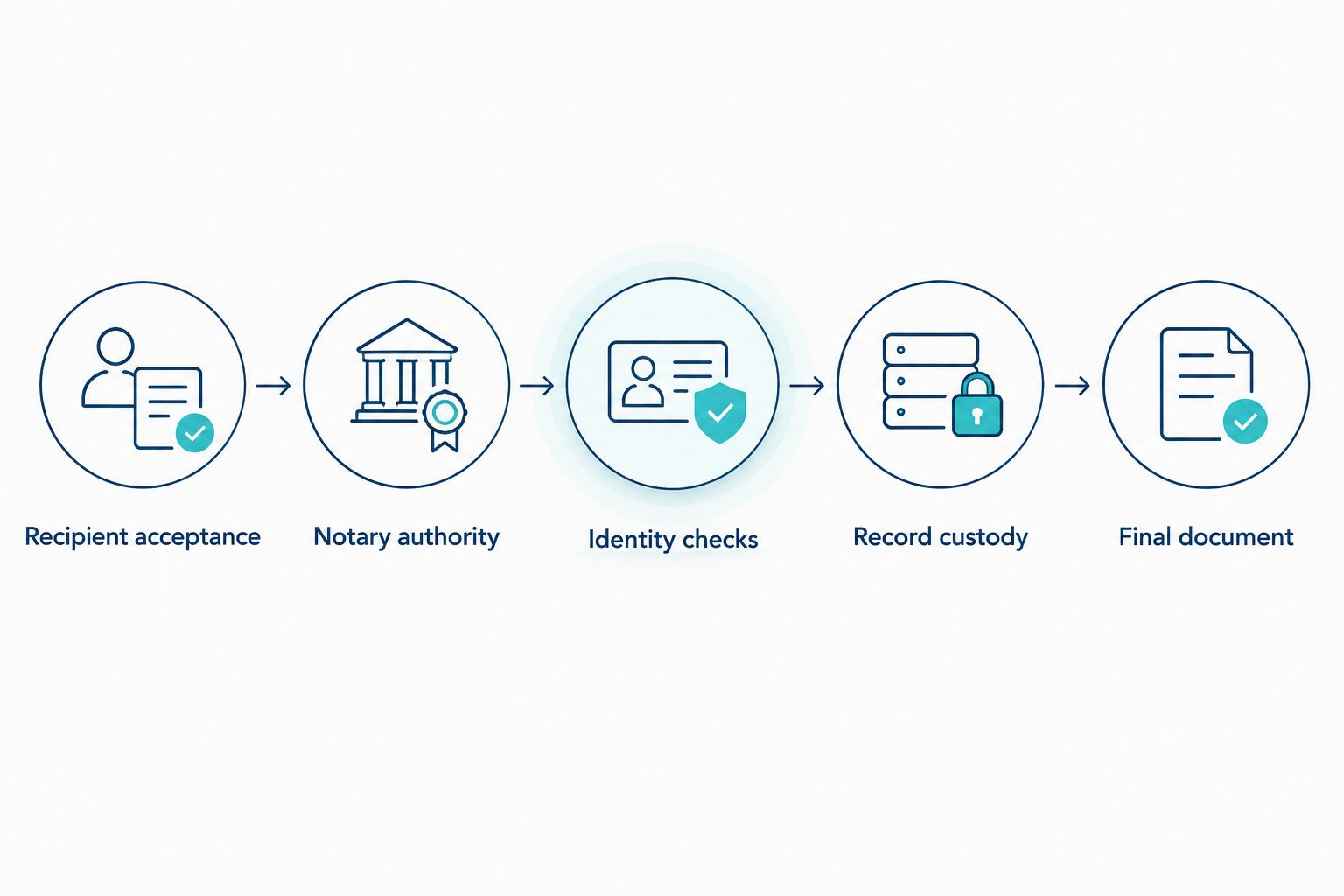
Use this sequence before sharing identity documents or signing files:
- Recipient acceptance: Ask the receiving organization whether it accepts remote online notarization and the proposed file format.
- Notary authority: Confirm who performs the act and that the notary is authorized for Florida online notarization.
- Identity checks: Ask how the required identification process works and what happens if verification fails.
- Record custody: Identify the journal and recording custodian, retention process, and authorized access procedure.
- Final document: Confirm how you receive the completed electronic file and preserve its integrity.
The sequence starts with acceptance because a protected document still fails its practical purpose if the recipient rejects the execution method. Resolve that question before beginning the identity process.
When you receive the completed document, keep the original electronic file. A printed copy or screenshot does not preserve the electronic signature's verification features in the same way.
Arrange your document signing
Discuss remote online notarization, mobile service, and document coordination for your Miami-Dade needs.
How these options are ranked
The rankings prioritize fit against the same six criteria: notary authority, identity verification, document integrity, record custody, access controls, and recipient acceptance. Each option has a different role rather than competing for an unsupported claim of strongest security.
Service coordination ranks first for users who need help managing related document tasks. Evidence-focused platform selection is the default for comparing online security controls; managed signing addresses multiple participants, and mobile notarization provides the in-person alternative.
Which Florida online notarization option should you choose?
For a straightforward remote signing in 2026, choose a workflow with documented identity verification, tamper-evident documents, and clear record custody. Confirm recipient acceptance first.
Choose service coordination when notarization is only part of the job. Choose a managed workflow when several parties must execute or receive documents. Choose in-person mobile notarization when remote execution cannot meet the identification or recipient requirements.
FAQ
What's the most secure remote online notary platform for Florida?
Choose a platform through its documented identity checks, document-integrity controls, and record-custody procedures, not its name alone. Confirm that an authorized notary performs the Florida online notarization and that the recipient accepts the result.
Is Thecruznetwork a notary platform or a service provider?
Thecruznetwork is a Miami-Dade mobile and remote online notary service provider offering related document services. Ask which platform supports your proposed online session and who retains its records.
Can I complete a Florida online notarization from another state?
A signer does not have to be physically located in Florida for a Florida online notarization. The online notary must be physically in Florida, and the transaction must meet the applicable statutory conditions.
How long are Florida online notarization records kept?
Florida Statutes Section 117.245 requires the electronic journal and audiovisual recording to be retained for at least 10 years. Confirm the custodian and the procedure for an authorized records request.
What happens if I fail online identity verification?
Do not bypass the required identity-verification process. Ask the provider about the applicable procedure or arrange an appropriate in-person notarization if it meets the recipient's requirements.
Does remote online notarization replace an apostille?
No, remote online notarization and an apostille serve different functions. Confirm the destination authority's authentication requirements and whether it accepts the proposed electronic document.
Is a video call enough for online notarization?
No, a video call alone does not satisfy the entire Florida online notarization process. The act also requires the applicable identity procedures, electronic execution, and notarial records.
One last thing
Keep the original electronically notarized file even if you also need a paper copy. Printing changes the format; it does not carry the electronic signature's verification features onto paper.
Before closing the task, ask the recipient how it wants the document delivered. That final instruction connects a correctly completed notarization to an usable document.


