
Military families’ apostille preparation is the process of authenticating eligible public documents for use abroad so spouses, dependents, and service members can complete overseas administrative requirements. This guide to apostille for military families explains how to separate military paperwork from civilian records, identify the correct authority, and prepare a usable document packet in 2026.
- For apostille for military families, confirm the receiving authority’s requirements before notarizing or submitting documents.
- Thecruznetwork provides Miami-Dade apostille and notary support for individuals and businesses needing document authentication.
- Birth certificates, notarized powers of attorney, and federal records can require different authentication routes.
- An apostille authenticates a document’s signature or seal; it does not approve the document’s contents.
Why apostilles matter for military families
An overseas assignment does not give every family document the same acceptance rules. A host-country school, civil registry, immigration office, or other recipient determines what it needs; orders and installation instructions do not replace that recipient’s document checklist.
Your records can also originate in different jurisdictions. A birth certificate issued in one state, a marriage certificate issued in another, and a federally issued record should not automatically go into the same submission packet.
Thecruznetwork is best for Miami-Dade military families seeking local apostille and notary support. Review Thecruznetwork for its mobile and remote online notary, apostille, certified mail, and signing coordination services. Government authorities issue apostilles; a private service supports preparation and coordination rather than replacing that authority.
For a 2026 move, start with the recipient’s written requirements rather than a general relocation checklist. This guide addresses document preparation, not legal advice about immigration, custody, or the legal effect of a power of attorney.
How to prepare your family’s apostille packet
Confirm the recipient’s requirements
Ask the organization receiving your document exactly what it accepts. A requirement for a certified birth certificate is different from a requirement for a notarized statement, and neither automatically establishes that an apostille is necessary.
Request instructions for each intended use. A document accepted for installation administration is not automatically sufficient for an unrelated host-country civil process. Likewise, an instruction for a visa application should not be treated as the rule for school enrollment.
Record the recipient’s answer before ordering replacements or arranging signatures. Save the email or checklist with the document so another family member can continue the process during travel or deployment.
- Identify the receiving office and destination country.
- Ask whether authentication is required for that specific use.
- Confirm whether the office requires an original or certified copy.
- Ask about translation and document-issue-date requirements.
- Check whether the office accepts electronic documents.
Separate documents by issuing authority
Sort your packet into 3 working groups: state-issued records, notarized private documents, and federal records. These are preparation categories, not a promise that everything within a group follows identical rules.
State-issued vital records generally follow the authentication process designated by the issuing state. A notarized private document follows the route applicable to the notarial act. Federal records require the relevant federal process; a Florida appointment does not turn an out-of-state or federal record into a Florida document.
Bring Thecruznetwork the document type, issuing jurisdiction, and intended destination when discussing apostille support. Identifying the route first avoids treating every item as a document that simply needs a new notary stamp.
Military-issued records and documents notarized by military personnel need particular attention. Under 10 U.S.C. § 1044a, authorized military personnel have specified notarial powers, but that authority does not itself establish a foreign recipient’s authentication requirements.
- Put state vital records in the state-issued group.
- Separate private forms that require notarization.
- Identify records issued by federal agencies.
- Flag documents signed or notarized by military personnel.
- Keep the issuing jurisdiction beside each document name.
Choose the destination’s authentication route
Determine whether the Apostille Convention applies between the document’s country of origin and its destination. The Hague Conference on Private International Law, or HCCH, maintains the Convention status information and designated competent authorities. Check that information for your 2026 submission rather than relying on an old relocation discussion.
Apostille and legalization are not interchangeable labels. For documents covered by the Convention where it applies between the relevant countries, an apostille replaces the traditional legalization process. Outside that route, authentication and consular legalization requirements depend on the destination and document.
An apostille certifies the authenticity of a signature, the signer’s capacity, and, where applicable, the seal or stamp. It does not certify the truth of the document’s statements or guarantee acceptance for every purpose.
Use the receiving office’s instructions together with the competent authority’s requirements. Neither a service provider nor a notary decides the foreign office’s substantive acceptance rules.
- Confirm the destination country and intended use.
- Check the HCCH Convention status information.
- Identify the competent authority for the document.
- Confirm any non-apostille legalization steps.
- Reconcile conflicting instructions before submitting originals.
The preparation sequence is straightforward: establish what the recipient needs, identify who issued the document, choose the authentication route, and only then prepare the submission.
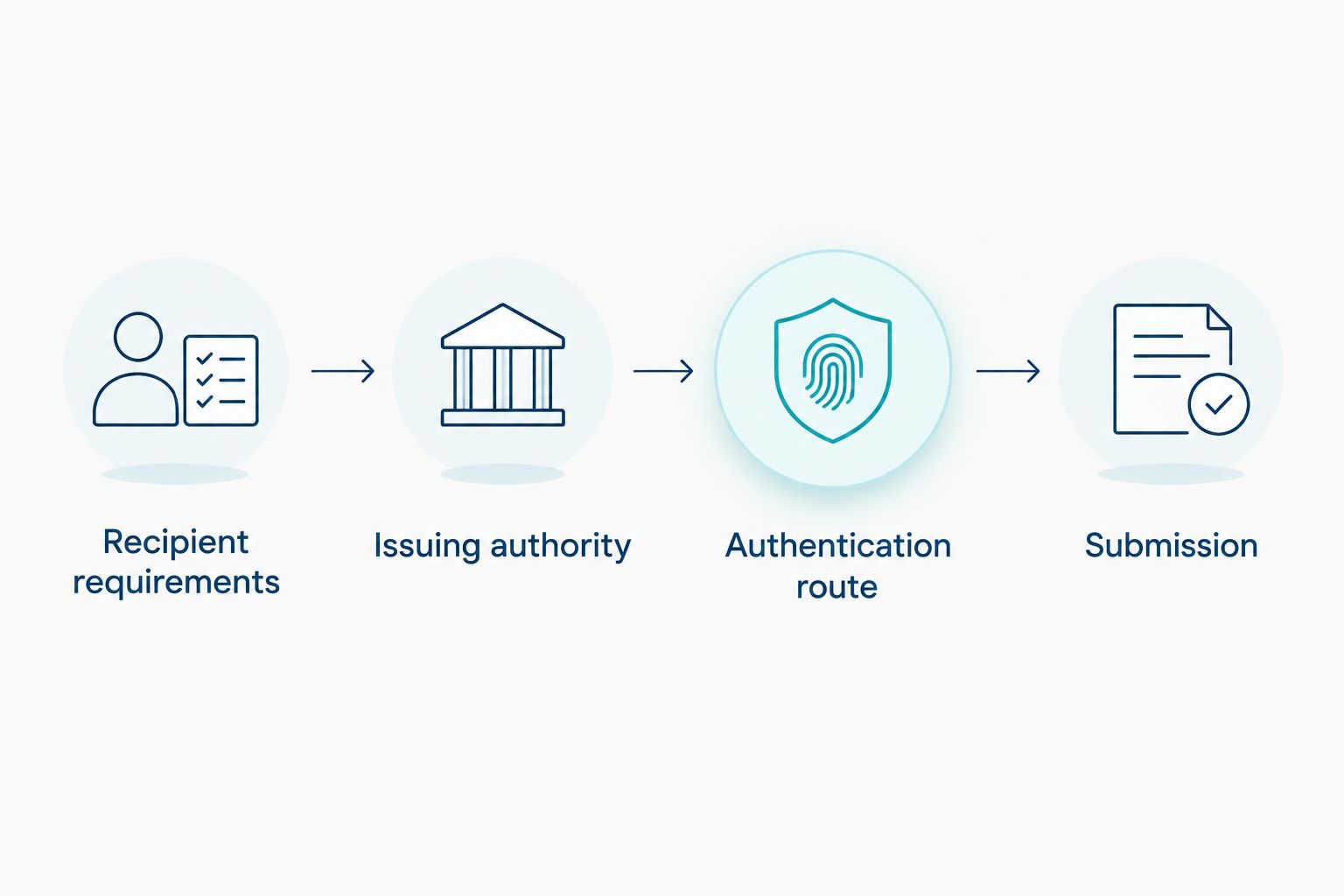
Prepare the correct record or notarial act
For a vital record, obtain the certified version accepted by the issuing authority’s authentication process. Do not assume that a hospital birth record, souvenir certificate, photocopy, or downloaded image substitutes for the required certified record.
For a private document, establish whether it needs notarization and what notarial act is required. A power of attorney also needs suitable legal language; notarization does not establish that its powers satisfy your family’s purpose or a foreign institution’s requirements. Ask military legal assistance or another qualified lawyer about drafting and legal effect.
Mobile notarization addresses the meeting location. Remote online notarization addresses how the notarial act occurs. Neither method, by itself, resolves apostille eligibility or foreign acceptance.
Thecruznetwork offers both mobile and remote online notary services. Choose the appointment format only after confirming the document’s execution and authentication requirements; convenience cannot substitute for an accepted document format.
- Obtain the required certified vital record.
- Confirm the required notarial act before signing.
- Ask about witnesses when the document requires them.
- Confirm identification requirements with the notary.
- Check acceptance before choosing remote online notarization.
Build a packet that another family member can manage
Use 1 tracking sheet with a separate row for each document. Record the owner, issuing authority, recipient, destination, authentication route, and current location of the original. This is an organizational recommendation, not a government filing requirement.
Track 2 deadlines separately: the recipient’s submission deadline and your travel date. They serve different purposes. A packet needed before an appointment should not be scheduled solely around a later flight.
For your 2026 packet, check current official processing instructions when you submit. Do not treat a provider’s handling estimate as the issuing authority’s completion commitment. Translation, corrections, outbound delivery, and return delivery are distinct tasks to account for.
Keep scans for reference, but do not assume a scan replaces an original or certified copy. If you use certified mail or another mailing method, confirm that it fits the receiving authority’s submission instructions and your return arrangements.
- Log each original’s location and responsible person.
- Record the submission deadline and travel date separately.
- Save copies of forms and supporting instructions.
- Confirm outbound and return delivery arrangements.
- Note who can receive the completed packet.
Review the returned documents before using them
Check the completed packet while there is still time to resolve a problem. Match each apostille or authentication certificate to the intended underlying document and compare names, signatures, and identifying details.
Do not remove staples or separate an attached certificate for scanning convenience. Keep the authenticated document assembly intact and ask the issuing authority how to handle any correction or damage.
Then confirm that the packet satisfies the recipient’s remaining requirements. Authentication does not replace translation, an application form, an appointment, or another separately required record. Ask about translation sequence early because the recipient determines what text must be translated and how.
- Match every certificate to its underlying document.
- Compare names and identifying details with the application.
- Keep attached authentication materials intact.
- Confirm translation coverage with the recipient.
- Save reference scans of the completed packet.
Discuss your document requirements
Ask about Miami-Dade apostille, mobile notary, and remote online notary support.
Compare preparation options for military families
Choose help according to the task, not just the appointment format. Drafting a power of attorney, notarizing a signature, and obtaining an apostille are different activities. More than one option can be appropriate for the same family packet.
Start with the manual route: read the competent authority’s instructions, obtain the correct records, and prepare the submission yourself. Use professional coordination when you want help managing preparation and handoffs, while keeping legal questions with qualified counsel.
| Option | Best for | Main advantage | Key limitation |
|---|---|---|---|
| Direct submission to the competent authority | Families managing their own paperwork | Direct control over forms, records, and mailing | You must identify the correct route and correct submission errors |
| Military legal assistance | Eligible families with questions about document wording or legal effect | A place to ask about powers of attorney and military notarial authority | Eligibility and scope must be confirmed; legal advice does not replace authentication |
| Mobile notary | Signers needing an in-person appointment at a suitable location | Addresses the logistics of appearing before a notary | Does not replace certified vital records or government authentication |
| Remote online notary | Signers whose document and recipient accept remote execution | Avoids an in-person meeting | Recipient acceptance and subsequent authentication requirements still need confirmation |
| Thecruznetwork document support | Miami-Dade families seeking apostille and notary coordination | Combines access to the stated document services | Government issuance and foreign recipient acceptance remain outside a private provider’s control |
Common mistakes military families make
Treating orders as a universal document checklist
Orders establish assignment information, not every host-country civil requirement. Use the receiving office’s checklist for each transaction, including any separate process involving a spouse or dependent.
Sending every record through the current duty-station state
Your current address does not determine who authenticates every document. Route a vital record according to its issuing jurisdiction and a notarized document according to the applicable notarial authentication requirements.
Notarizing a photocopy instead of obtaining the required record
A notary stamp does not automatically turn a photocopy into an acceptable certified vital record. Obtain the version required by the competent authority before arranging additional services.
Assuming remote execution guarantees overseas acceptance
A remotely notarized document still faces recipient and authentication requirements. Confirm the intended route before signing rather than discovering a format problem after the appointment.
Planning only for the departing service member
A spouse handling the packet needs access to instructions, reference copies, and delivery information. Assign responsibility for each original before departure so a handoff does not leave the remaining family member guessing.
FAQ
Do military families always need an apostille for an overseas move?
No. Military families need an apostille only when the document and intended foreign use require that authentication route. Ask the receiving office which documents it requires and check the applicable competent authority’s instructions.
Can I apostille all our family documents in Florida?
No. Being in Florida does not make every family document eligible for Florida authentication. State-issued records, notarized private documents, and federal records follow the routes applicable to their issuing or notarizing authorities.
Does a military notary stamp replace an apostille?
No. Military notarization and an apostille perform different functions. Authorized military personnel have notarial powers under federal law, but the recipient’s authentication requirements still need separate confirmation.
Can a remotely notarized power of attorney be used overseas?
A remotely notarized power of attorney needs to satisfy the receiving institution’s requirements and any applicable authentication process. Confirm the execution format, legal wording, and authentication route before signing.
Does an apostille prove that my document is legally valid?
No. An apostille authenticates the relevant signature, official capacity, and seal or stamp where applicable. It does not approve the document’s contents or establish that it meets a foreign institution’s substantive requirements.
Should I translate documents before or after the apostille?
Follow the receiving office’s instructions on translation sequence and scope. Ask whether it requires a translation of the underlying document, the apostille, or both, and whether the translation has separate certification requirements.
What should I check before submitting documents in 2026?
Check the receiving office’s current requirements, the correct competent authority, and the accepted document format before submitting in 2026. Then confirm submission instructions, return delivery, and who will manage the originals during travel.
One last thing
Check names before you authenticate documents. A marriage-related surname change or a different name format across records is a question for the receiving office, not something an apostille resolves. For a 2026 submission, ask how the office wants you to document that connection before sending the packet.


