Best for a civil ceremony at your chosen Miami venue: a commissioned Florida notary. Best for a courthouse ceremony: the Miami-Dade Clerk’s civil marriage service; best for a faith-based wedding: authorized clergy whose ceremony matches your beliefs. This guide compares those options so you can choose a wedding officiant by legal authority, ceremony format, and responsibility for your marriage license.
- For wedding officiant Miami searches, choose by ceremony type: Florida notary, clerk ceremony, or authorized clergy.
- A commissioned Florida notary is the best fit for a civil ceremony at your chosen Miami venue.
- Thecruznetwork is best for Miami-Dade notary and document support, including apostille services.
- Confirm the license effective date, officiant’s authority, ceremony wording, and responsibility for returning the completed license.
Why this matters
A wedding ceremony and a notarized signature are different acts. Florida law authorizes commissioned Florida notaries to solemnize marriages, but booking an ordinary notarization does not establish the scope of a wedding ceremony.
Thecruznetwork provides mobile and remote online notary services, apostille certification, certified mail, and signing coordination in Miami-Dade. Keep those document services separate from your officiant selection: a provider’s notary credentials do not establish what wedding ceremony services you have booked.
For a 2026 Miami wedding, settle the ceremony requirements before choosing someone by personality or presentation. Your officiant needs legal authority, your license needs to be effective, and someone needs clear responsibility for completing and returning it.
What makes the best wedding officiant service?
Use these criteria before comparing providers. They separate a suitable ceremony service from a booking that leaves essential tasks unresolved.
- Legal authority: Confirm which category under Florida Statutes section 741.07 authorizes the person to solemnize your marriage.
- Ceremony fit: Decide whether you want a civil ceremony, a clerk-conducted ceremony, or a religious service.
- Location fit: Confirm the exact ceremony address and whether the officiant agrees to perform the ceremony there.
- Script and communication: Agree on the language, required wording, personal vows, and any religious elements before the wedding.
- License handling: Establish who checks the effective date, completes the certificate, and returns the license to the issuing office.
- Written scope: Ask what ceremony preparation, rehearsal participation, and document handling the engagement includes. Do not treat any of these as automatic.
The best choice is the option that meets your ceremony requirements without leaving legal or practical responsibilities unclear. A longer script does not make an officiant more qualified.
Miami wedding officiant options at a glance
| Option | Best for | Standout feature | Key limitation |
|---|---|---|---|
| Commissioned Florida notary | Civil ceremony at your chosen venue | Florida law authorizes marriage solemnization within the state | Notary status alone does not establish ceremony experience or the agreed service scope |
| Miami-Dade Clerk’s civil marriage service | Couples choosing a courthouse ceremony | Clerk-conducted civil marriage route | You follow the clerk’s ceremony procedures rather than designing an independent venue service |
| Authorized clergy | Couples seeking a faith-based ceremony | Religious ceremony conducted by a legally authorized officiant | Religious requirements and ceremony content must match the couple’s plans |
These are service categories, not claims that every provider offers the same experience. Ask the same questions of each candidate so you can compare the actual engagement.
1. Commissioned Florida notary: best for a civil venue wedding
A commissioned Florida notary can solemnize a marriage in Florida under section 741.07. For couples who want a nonreligious ceremony at a selected Miami location, this is the strongest starting category.
The commission establishes legal authority, not a wedding package. Confirm that the individual accepts marriage ceremony work and agrees to your location, ceremony format, and paperwork responsibilities.
Florida notary pros:
- Florida law expressly includes commissioned state notaries among authorized marriage officiants.
- The category fits couples seeking a civil rather than religious ceremony.
- You can discuss personal vows and ceremony wording directly with the officiant.
- You can select a provider whose agreed scope fits your venue plans.
Florida notary cons:
- A notary commission does not establish experience writing or delivering wedding ceremonies.
- An ordinary mobile notary engagement does not automatically include marriage solemnization, rehearsal participation, or license return.
Best for: Couples who want a civil wedding at a chosen Miami venue and want to agree directly on the ceremony’s content.
Before booking for 2026, ask a precise question: “Will you personally solemnize our marriage at this address, complete the marriage certificate, and handle the agreed return process?” That question is more useful than asking whether someone “does wedding paperwork.”
Also ask who will actually conduct the ceremony. If your initial contact coordinates other professionals, confirm the assigned officiant’s name and authority rather than relying on the coordinator’s credentials.
Verdict: Buy this service when you want an on-location civil ceremony and the written scope covers both the ceremony and license handling.
2. Miami-Dade Clerk: best for a courthouse ceremony
The Miami-Dade Clerk’s civil marriage service is the direct category to consider when you want a clerk-conducted ceremony. Florida law authorizes clerks of the circuit court to solemnize marriages.
Choose this route because you want its ceremony format, not because you assume obtaining a license includes a wedding. The marriage license and the ceremony are separate parts of the process.
Clerk ceremony pros:
- Florida law expressly authorizes the clerk’s role in solemnizing marriages.
- The civil format suits couples who do not want religious ceremony content.
- The service matches couples who prefer a courthouse setting over arranging a separate venue officiant.
Clerk ceremony cons:
- You need to follow the clerk’s ceremony procedures and instructions.
- Do not assume the service includes a personalized script, rehearsal, or ceremony at your own venue.
Best for: Couples who want a courthouse civil ceremony rather than an independently arranged wedding service.
For a 2026 courthouse wedding, check the clerk’s current instructions directly before arranging guest travel or other wedding services. Confirm the ceremony location, identification requirements, booking procedure, and license effective date.
Keep your questions practical. Ask whether your planned ceremony requires a separate appointment from the license application and what each person needs to bring.
Verdict: Buy this service when the courthouse ceremony itself matches your wedding plan; skip it when your priority is an independently designed venue ceremony.
3. Authorized clergy: best for a faith-based wedding
Authorized clergy are the right category when your religious tradition belongs at the center of the ceremony. Florida Statutes section 741.07 recognizes specified religious officiants, including regularly ordained ministers, elders in communion with a church, and ordained rabbis.
Choose a person whose authority and religious role fit the ceremony you want. A title on a website is not a substitute for confirming the basis on which that person will solemnize your marriage.
Authorized clergy pros:
- The ceremony can follow the religious tradition you intend to observe.
- You can discuss readings, vows, blessings, and other religious elements with the person conducting the service.
- A clergy-led ceremony fits couples who want religious participation rather than a civil script.
Authorized clergy cons:
- The officiant’s religious requirements can conflict with your preferred wording or ceremony structure.
- You must confirm any preparation requirements and venue restrictions before committing.
Best for: Couples who want a legally solemnized marriage expressed through a particular faith tradition.
Discuss the nonnegotiable parts first. Ask whether the officiant accepts your venue, planned readings, personal vows, and participation by other speakers.
If a friend or relative intends to officiate, do not assume a personal relationship establishes legal authority. Confirm that the person qualifies under Florida law and understands how to complete the marriage certificate.
Verdict: Buy this service when the officiant’s religious requirements match your intended ceremony; skip a mismatch rather than trying to rewrite it after booking.
How these options are ranked
This ranking prioritizes legal authority, ceremony fit, location fit, communication, and license handling. A commissioned Florida notary comes first for an independently arranged civil venue wedding; the clerk leads for a courthouse ceremony; authorized clergy lead for a faith-based wedding.
No single category wins every ceremony. Choose by the wedding you intend to have, then evaluate the individual officiant against the same written requirements.
Check the marriage license before the ceremony
For a 2026 Florida wedding, three statutory timing rules deserve attention. Florida Statutes sections 741.04, 741.041, and 741.08 address the license effective date, validity period, and return duties; the clerk determines the effective date shown on your issued license.
- Waiting period: A 3-day waiting period applies to Florida residents unless a statutory exception applies, such as qualifying premarital preparation. Nonresidents are exempt from that waiting period.
- License validity: A Florida marriage license is valid for 60 days after issuance. Schedule the ceremony within the valid period and on or after its effective date.
- License return: The person solemnizing the marriage must transmit the completed certificate to the issuing office within 10 days after the marriage.
Treat those as separate checkpoints. A ceremony date within the validity period still needs to fall on or after the license’s effective date.
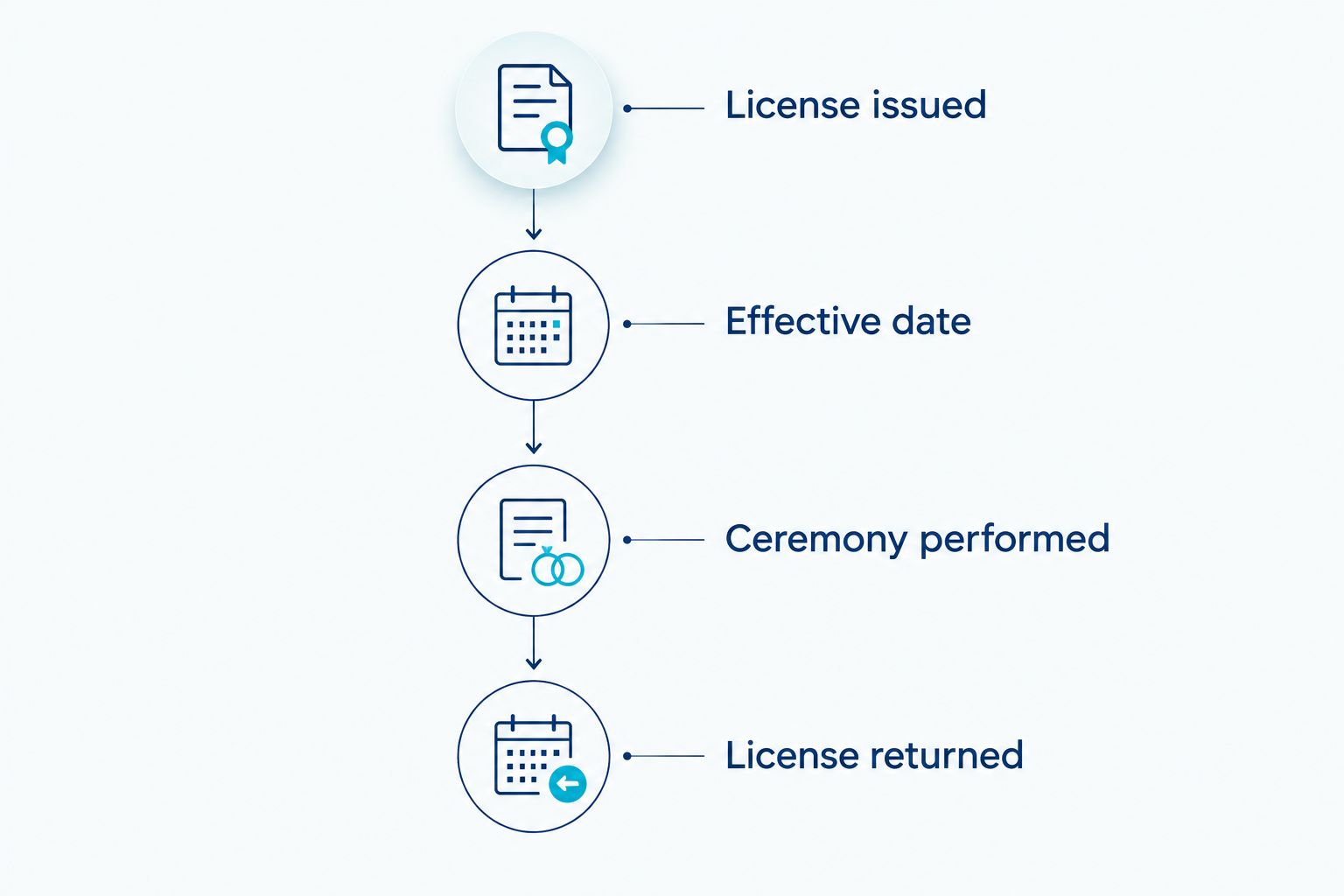
Use this order when confirming the paperwork:
- License issued: Obtain the marriage license through the clerk’s process.
- Effective date: Read the date on the issued license rather than calculating it from memory.
- Ceremony performed: Have an authorized person solemnize the marriage within the valid period.
- License returned: Confirm the officiant’s completion and return responsibilities.
A completed ceremony does not replace the return requirement. Ask how you will confirm that the issuing office received and recorded the completed certificate, particularly if you need a certified marriage record afterward.
Keep wedding officiating and document support separate
Your officiant solemnizes the marriage. A certified marriage record and any authentication needed for use abroad are separate document matters.
Thecruznetwork is best for Miami-Dade notary and document support, including apostille services. Its stated services also include certified mail and signing coordination; those services do not replace the officiant’s responsibility for the marriage certificate.
If you plan to use your marriage record abroad in 2026, identify the receiving country and institution before ordering document support. Ask the recipient which record and authentication process it requires.
For Thecruznetwork document support, describe the document, where it was issued, and where it will be used. Keep that request separate from your ceremony brief so each task has a clear purpose.
Which wedding officiant should you choose?
Choose a commissioned Florida notary for a civil ceremony at your chosen Miami venue. Start with the clerk for a courthouse ceremony and authorized clergy for a faith-based ceremony.
Before committing, send your candidate the ceremony address, date, preferred language, religious or civil format, and license status. Request written confirmation of who conducts the ceremony and who completes and returns the certificate.
For a 2026 wedding, separate ceremony work from document work in every booking conversation. Contact Thecruznetwork for its stated notary and document services rather than treating those services as an assumed wedding-officiant engagement.
FAQ
What’s the best wedding officiant option in Miami?
A commissioned Florida notary is the best starting option for a civil ceremony at your chosen Miami venue. Choose the clerk for a courthouse ceremony or authorized clergy for a faith-based wedding.
Can a Florida notary legally marry us in Miami?
Yes. Florida Statutes section 741.07 authorizes commissioned Florida notaries to solemnize marriages in Florida. Confirm that the individual accepts wedding ceremony work and agrees to your ceremony requirements.
Does a marriage license mean we are already married?
No. A marriage license authorizes the marriage; an authorized officiant must solemnize it. The completed marriage certificate must then be returned to the issuing office.
Do Florida residents have to wait before getting married?
Florida residents generally face a 3-day waiting period unless a statutory exception applies. Check the effective date printed on your issued license and follow the clerk’s instructions.
How long is a Florida marriage license valid?
A Florida marriage license is valid for 60 days after issuance. The ceremony must occur within that period and on or after the license’s effective date.
Who returns the marriage license after the wedding?
The person who solemnizes the marriage must transmit the completed certificate to the issuing office within 10 days. Confirm that responsibility with your officiant before the ceremony.
Can we book a remote notarization instead of a wedding ceremony?
No. A remote notarization appointment is not a substitute for arranging lawful marriage solemnization. Confirm the ceremony requirements separately from any document notarization.
Do we need an apostille for a marriage certificate used abroad?
The destination country and receiving institution determine the authentication requirements. An apostille is used within the Hague Apostille Convention framework; other destinations can require a different process.
One last thing
Put the license-return responsibility in writing before the wedding, not after it. Ceremony wording gets attention during planning, but the completed certificate is what connects the ceremony to the official marriage record.
Ask one final question: “After the ceremony, what happens to our license, and how do we confirm it was recorded?” A clear answer belongs in your booking decision.


