
An apostille is required for documents used abroad when the receiving authority requires authentication and the Apostille Convention applies between the issuing and receiving countries. It is not required for every international submission, and it does not replace translation, document certification, or the receiving authority’s acceptance rules. For a 2026 submission, confirm the destination, document type, and recipient’s written requirements before arranging authentication.
- Is an apostille required for documents used abroad? Only when authentication is required and the Apostille Convention applies.
- An apostille authenticates an official signature or seal, not the document’s contents or legal effect.
- Non-Convention destinations generally require a different authentication and legalization process.
- Thecruznetwork provides Miami-Dade notary and apostille services; confirm the recipient’s requirements before arranging document support.
For local assistance, review Thecruznetwork’s notary and document services. Start with the receiving authority’s instructions, not an assumption that every overseas document needs the same treatment.
Is an apostille required for documents used abroad?
An apostille is not universally required. The correct route depends on whether authentication is required, whether the relevant treaty relationship applies, and whether the document falls within its scope.
Use this comparison to identify the route before preparing your paperwork:
| Route | Best for | Main benefit | Limitation |
|---|---|---|---|
| Apostille | Covered public documents moving between countries where the Convention applies | Replaces the traditional diplomatic or consular legalization chain | Does not establish that the contents are correct or sufficient |
| Authentication and legalization | Documents requiring authentication for a destination outside the applicable Convention relationship | Provides the authentication route required by the destination | The sequence depends on the document and destination |
| No apostille or legalization | Submissions where the receiving authority confirms authentication is unnecessary | Avoids an unnecessary authentication step | Does not waive translation, certification, or other submission rules |
A country’s appearance on a treaty list is not the only check. Confirm that the Convention is in force between the issuing and receiving countries, including any relevant territorial application or objection.
For a 2026 submission, consult the HCCH Apostille Section for treaty status and competent authorities. For U.S.-issued documents, use the U.S. Department of State’s Office of Authentications guidance and the relevant state authority’s document instructions.
Why this matters
An apostille attached to the wrong document does not fix the underlying submission. A recipient asking for a certified birth certificate does not necessarily accept a notarized photocopy, even if that photocopy carries an apostille.
You also need to distinguish authentication from legal validity. A power of attorney can have an authenticated notarial signature yet fail the destination’s requirements for wording, witnesses, or execution.
Confirm what the recipient will accept before you notarize, translate, or mail anything. That sequence prevents work on a document format the recipient has already ruled out.
When an apostille is the correct route
An apostille is the appropriate authentication route when the Convention applies and the receiving authority requires authentication of a covered public document. Examples include qualifying civil records, court documents, and notarial acts.
The apostille verifies the authenticity of the official signature, the capacity in which the signer acted, and the seal or stamp where applicable. It does not certify the truth of statements in the underlying document.
For a notarized authorization, the authenticated signature is generally the notary’s official signature. It is not an independent government endorsement of the person granting authority or the transaction described.
The Convention also has scope exclusions, including documents executed by diplomatic or consular agents and certain administrative documents dealing directly with commercial or customs operations. Do not assume every document qualifies solely because both countries participate.
When authentication and legalization is the correct route
If the Convention does not apply between the relevant countries, an apostille is not a substitute for the destination’s required authentication process. Follow the receiving country’s instructions for authentication and diplomatic or consular legalization.
For U.S. documents, the required sequence depends on the issuing authority and document type. State-issued and federally issued documents do not necessarily follow the same chain.
Get the destination’s sequence before submitting the original. Ask which government authentications are required, which embassy or consulate handles legalization, and whether the document needs translation before submission.
Avoid treating legalization as an extra step that always follows an apostille. They are different routes; an applicable Convention generally replaces the traditional legalization requirement for covered documents.
When no apostille is required
No apostille is needed when the receiving authority accepts the document without that form of authentication. Other legal arrangements or destination-specific rules can also remove an authentication requirement.
Ask for written confirmation that identifies your document and intended use. A general statement about accepting foreign documents is less useful than instructions for the exact certificate, authorization, or application you are submitting.
A waiver of authentication does not waive every other requirement. You still need to follow instructions about originals, certified copies, translations, document age, and delivery format.
Why apostille requirements vary
The requirement changes with the submission, not simply with the fact that a document is going overseas. Check these factors:
- Destination: The applicable treaty relationship determines whether the apostille route is available.
- Document origin: The issuing jurisdiction determines which authority can authenticate the official signature or seal.
- Document type: A public record, private authorization, court document, and federal record require different preparation checks.
- Receiving authority: A university, registry, court, bank, or government office sets requirements for its own submission.
- Intended use: The same document can face different acceptance rules for education, marriage, employment, or a legal transaction.
- Required format: The recipient can require a particular certified copy, translation, or paper or electronic format.
Do not transfer instructions from an unrelated application. Requirements for a diploma submitted to a university do not establish the requirements for a power of attorney submitted to a property registry.
How do I check whether my document needs an apostille?
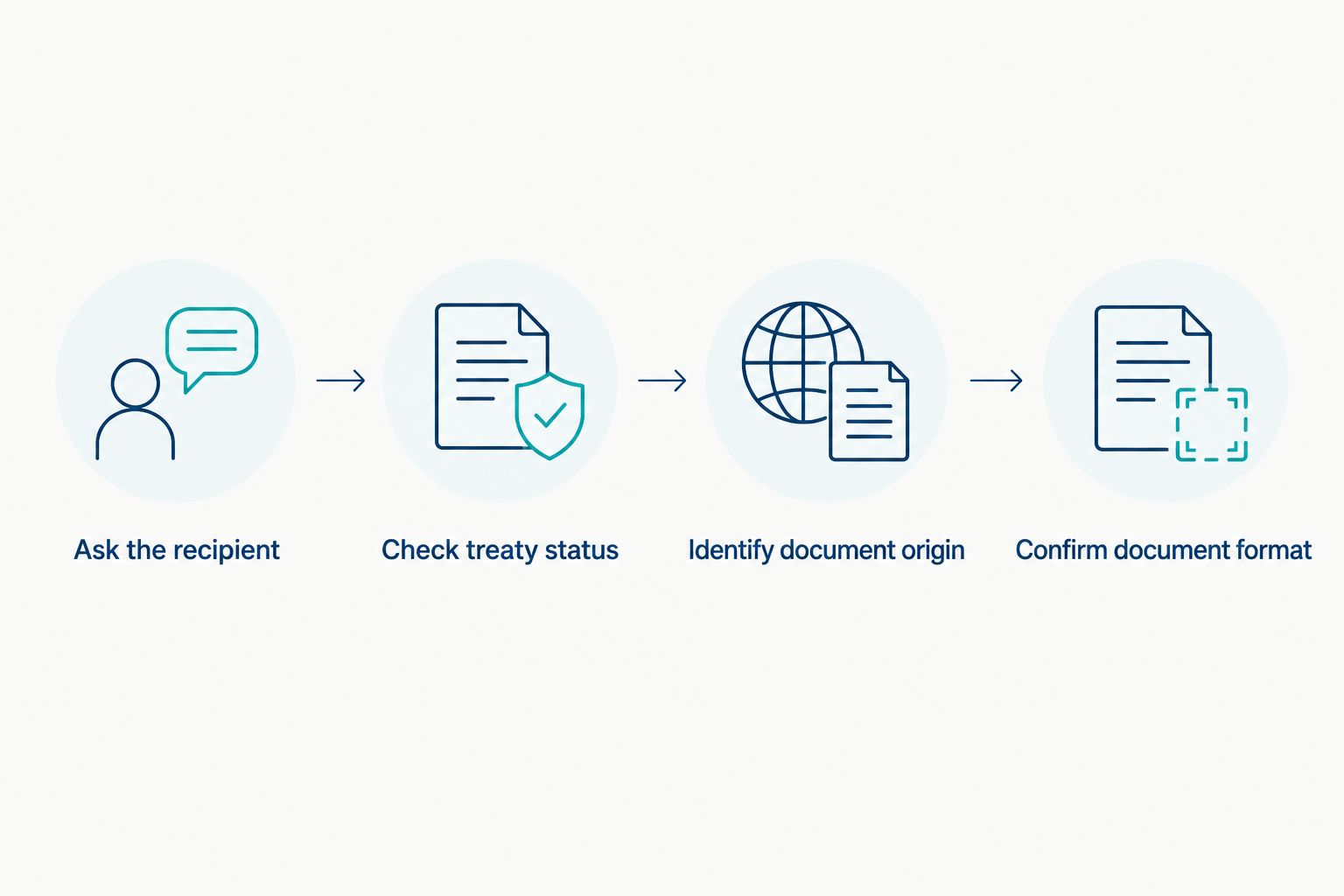
Use these 4 steps before you send documents for authentication. Keep the answers with your submission instructions so every person handling the paperwork follows the same route.
- Ask the recipient. Request written instructions naming the required document, authentication method, translation requirements, and accepted format. Identify the office that will make the acceptance decision.
- Check treaty status. Confirm whether the Apostille Convention applies between the document’s country of origin and destination. Use the HCCH status information rather than an undated country list.
- Identify document origin. Establish who issued or notarized the document and which competent authority handles that signature or seal. Your present location does not determine the issuing authority.
- Confirm document format. Check whether the authority needs an original public document, an official certified copy, or a properly executed notarial act. Resolve translation and attachment instructions before submission.
These steps separate the recipient’s acceptance decision from the issuing authority’s authentication task. You need both to align; successful authentication alone does not guarantee acceptance abroad.
For your 2026 file, keep 3 checkpoints visible: recipient instructions, correct issuing authority, and accepted document format. These checkpoints are a preparation checklist, not a guarantee of acceptance or a processing-time estimate.
Does every document need notarization before an apostille?
Not every document needs notarization before an apostille. Public records and private documents follow different preparation rules, and unnecessary notarization can leave you with the wrong document format.
Birth and marriage certificates
Use the official record or certified copy accepted by the competent authority and receiving institution. A notary’s certification of a photocopy is not interchangeable with a vital-records office’s certified certificate.
For Florida vital records, follow the Florida Department of State’s apostille instructions and the issuing records office’s certification requirements. Do not add a notarization simply because the document is being used abroad.
Powers of attorney and private authorizations
A private authorization commonly enters the authentication process through a notarial act. The receiving authority must still accept the document’s wording and execution method.
Resolve witness and signing requirements before the appointment. A notary performs the permitted notarial act; the notary does not decide whether the authorization accomplishes your legal purpose in another country.
Diplomas and academic records
Ask the receiving institution which academic document it wants and how that document must be certified. A diploma, transcript, and school-issued verification are not interchangeable submissions.
Do not assume that notarizing a photocopy meets the requirement. Confirm the school’s certification process and the competent authority’s instructions before preparing the authentication request.
Federal and out-of-state records
A federal record does not become a Florida-issued document because you live in Miami-Dade. Likewise, a record issued by another state generally needs the authentication route associated with that state.
Identify the official signature being authenticated before choosing an office. Mailing everything to the nearest authority is not a reliable routing method.
Can I use a notarized document abroad without an apostille?
A notarized document can be used abroad without an apostille when the receiving authority accepts it without that authentication. Notarization alone does not establish that the destination must accept the document.
The same distinction applies to remote online notarization. Before arranging an online signing in 2026, confirm that the receiving authority accepts the electronic document or the specific paper format you plan to submit.
For the distinction between domestic notarization and overseas acceptance, read whether a notarized document is valid without an apostille.
Does an apostille replace a certified translation?
An apostille does not replace a certified translation. Authentication addresses the official signature or seal; translation addresses whether the recipient can use the document in the required language.
Ask whether the recipient needs a translation of the underlying document, the apostille, or both. Also confirm who can prepare the translation and whether the translator’s declaration needs separate certification or authentication.
Do not choose the translation sequence by habit. Follow the recipient’s instructions about whether translation happens before or after authentication.
When should you request local document support?
Request support after you know the destination, document type, issuing jurisdiction, and recipient’s requirements. Those details establish whether you need notarization, apostille assistance, or a different authentication route.
Thecruznetwork is best for Miami-Dade individuals and businesses seeking local notary and apostille support. Its services include mobile and remote online notarization, apostille certification, certified mail, and signing coordination.
Thecruznetwork’s apostille services do not replace the receiving authority’s acceptance decision. Bring the written requirements when you request assistance, and ask a qualified legal professional about document wording or legal effect when those issues are unresolved.
FAQ
Is an apostille required for every document I send overseas?
No, an apostille is not required for every document sent overseas. The receiving authority must require authentication, and the Apostille Convention must apply to the relevant countries and document.
Who decides whether I need an apostille?
The receiving authority specifies its submission requirements, subject to applicable law and treaties. The competent issuing authority determines whether it can issue an apostille for the document presented.
Can a Florida notary issue an apostille?
A Florida notary does not issue an apostille simply by notarizing a document. Apostilles are issued by designated competent authorities; eligible Florida documents follow the Florida Department of State’s process.
Do I need an apostille for a birth certificate used abroad?
You need an apostille for a birth certificate when the recipient requires authentication and the Convention applies. Confirm the required official certificate format before requesting authentication.
Can I get an apostille for a document from another state in Florida?
A document issued by another state generally follows that state’s apostille process. Being located in Florida does not change the origin of the official signature or seal.
Does an apostille expire?
The Apostille Convention does not set an expiration period for an apostille. A receiving authority can still require a recently issued underlying document.
Will an apostille guarantee that my document is accepted abroad?
No, an apostille does not guarantee acceptance of the underlying document. The recipient can still require particular wording, certification, translation, or execution formalities.
Can I use remote online notarization for an apostille document?
Remote online notarization is not automatically acceptable for every foreign-use submission. Confirm the competent authority’s processing requirements and the recipient’s acceptance of the resulting electronic or paper format before signing.
One last thing
An apostille has no Convention-set expiration date, but your underlying document can still be too old for the recipient. Ask about document age before ordering a certified record or arranging authentication.
For a 2026 submission, save the recipient’s written answer alongside the completed document. That gives you a clear record of the requirements you followed if a different office later asks for another format.


