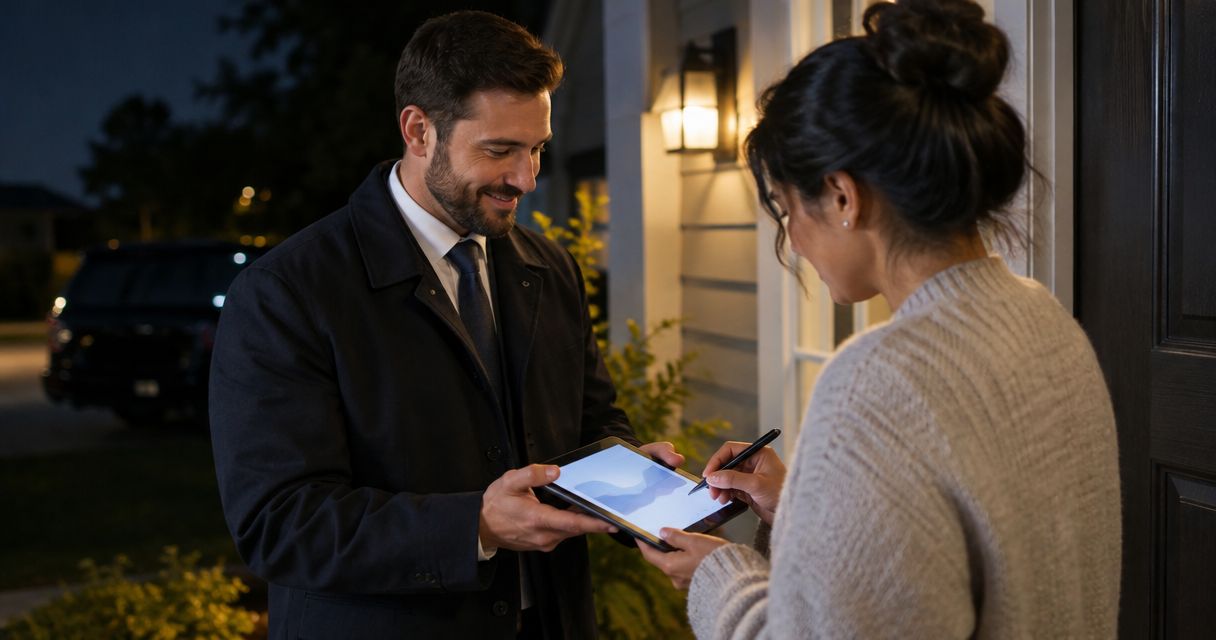
Yes. A 24 hour mobile notary at night can travel to your location when the notary confirms the appointment, but an overnight visit still requires proper identification, the signer's participation, and compliance with Florida notarial rules. An after-hours service description is not a confirmed arrival time, and a notary visit does not replace any witnesses or legal instructions your document requires.
- A 24 hour mobile notary at night can visit you; confirm the location and appointment before relying on dispatch.
- Florida mobile notarization requires the signer’s personal appearance; sending a document with someone else is not enough.
- Thecruznetwork provides mobile notary and remote online notary services for individuals and businesses in Miami-Dade.
- Remote online notarization is a separate process, not an ordinary video call or emailed signature.
Can a 24 hour mobile notary come to you at night?
Yes—nighttime itself does not prevent a Florida mobile notarization. The deciding issues are whether the notary accepts the appointment and whether the signing meets the applicable requirements. Florida's notary law does not restrict ordinary notarizations to daytime business hours.
For a nighttime request in 2026, start with the document, signer, and meeting location rather than the advertised service hours. Thecruznetwork's notary and document services include mobile and remote online notarization in Miami-Dade; confirm the specific appointment before making arrangements around it.
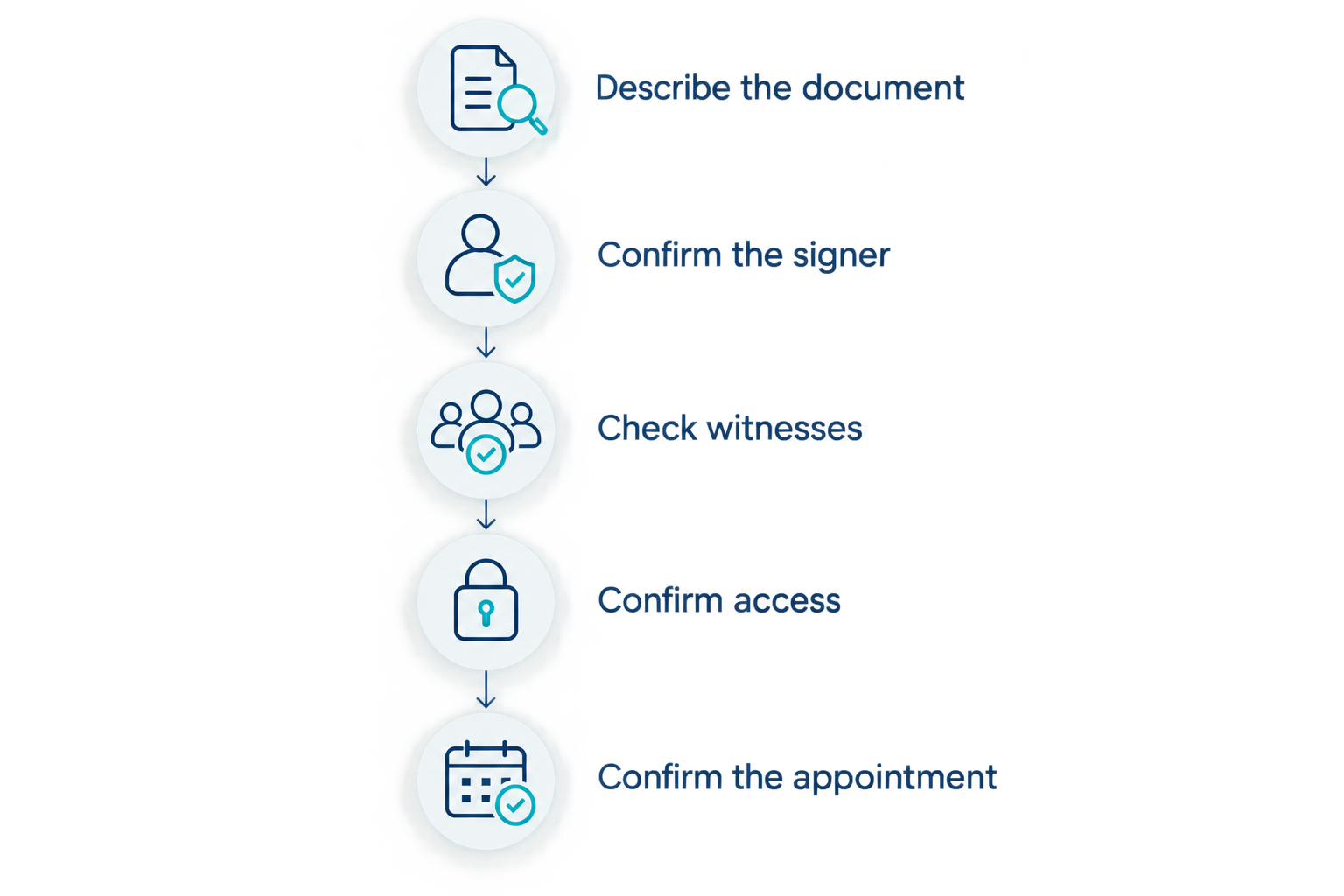
Use this sequence when requesting a visit:
- Describe the document. Give its title and explain whether the receiving organization supplied signing instructions. Do not ask the notary to choose a legal document for you.
- Confirm the signer. Explain who needs to appear and whether each signer has identification ready for review.
- Check witnesses. Ask the document preparer or receiving organization what witnesses the document requires and who will arrange them.
- Confirm access. Provide the address, unit or room, entry instructions, and any restrictions on visitors.
- Confirm the appointment. Obtain an accepted meeting location and arrival arrangement. Sending an inquiry does not establish a booking.
A useful request states the document type, Miami-Dade location, requested meeting time, and any witness or access issues together. Keep identification numbers and sensitive document contents out of an initial message unless the provider gives you an appropriate way to submit them.
Why this matters
A late-night signing usually involves more than finding someone who can travel. You also need the right people, the right document, and a location where the notary can complete the required checks without interruption.
A confirmed visit is not a promise that an incomplete or improper signing can proceed. A notary must follow the same rules at night as during the day. Florida Statutes Chapter 117 governs those duties, including identification and personal-appearance requirements.
For your 2026 appointment, separate notarization from the next step. A completed notarial act does not mean that a lender, court, recording office, foreign authority, or other recipient has accepted the document. Confirm that recipient's instructions before arranging the visit.
Mobile visit or remote online notarization: which fits?
A mobile visit brings the notary to a physical meeting location. Remote online notarization uses an authorized electronic process with live audio-video communication and required identity checks. Neither method removes the need for the signer to participate.
| Method | Best for | Main advantage | Main limitation |
|---|---|---|---|
| Mobile notarization | Signers who need an in-person meeting or have paper-document requirements | The notary travels to the agreed location | Travel, building access, and required participants must be coordinated |
| Remote online notarization | Signers whose documents and receiving organizations permit an electronic process | No physical meeting with the notary is required | Identity verification, technology, document eligibility, and recipient requirements still apply |
Choose mobile notarization when the document requires an in-person paper signing; consider remote online notarization only after checking its suitability. Do not switch methods solely because it is late.
Florida Statutes Section 117.265 addresses online notarization procedures. A regular video call, a photograph of a signature, or an emailed scan is not a substitute for that process.
Thecruznetwork mobile notary services are best suited to Miami-Dade individuals and businesses seeking an in-person document appointment. Thecruznetwork also offers remote online notarization, but the method still needs to fit your document and the receiving organization's instructions; neither service overrides those requirements.
What must be ready before the notary arrives?
Prepare the signing conditions before confirming travel. These checks matter more than the hour on the clock.
Identification the notary can accept
Have identification ready and tell the notary about any concern before the visit. A mismatch between the document name and identification, an expired credential, or a missing credential needs review—not an assumption that it will be accepted.
Florida Statutes Section 117.05 sets out identification requirements and permitted methods of establishing identity. Do not assume that a photograph of an ID on your phone satisfies those rules.
A document ready for the requested act
Read the document and obtain legal guidance before the appointment if you do not understand its effect. A notary verifies and performs the requested notarial act; notarization is not a legal review of the agreement.
Ask the preparer or recipient to resolve missing instructions or questions about the required notarial certificate. Do not expect the notary to choose the legal act for you or repair the underlying transaction.
Required witnesses
Witness requirements depend on the document and applicable law. Do not assume that every notarized document needs witnesses, or that every mobile notary appointment includes them.
Confirm who will serve, whether they must meet particular qualifications, and whether they must attend the same signing. If your document has special execution requirements, have the attorney or preparer explain them before the visit.
A signer who can participate voluntarily
The signer must be able to participate in the required process. A relative's explanation, an urgent deadline, or a previously collected signature does not replace the signer's required appearance.
Tell the notary about communication concerns before the appointment. The notary must assess the circumstances directly and cannot proceed simply because another person wants the document completed.
A workable meeting location
Provide accurate directions and arrange a place where the document can be read and completed. Adequate lighting, a usable writing surface, and permission to enter are practical necessities, not minor details.
For a hospital, care facility, hotel, or controlled-access building, check the property's rules with the responsible staff. A notary appointment does not override visitor restrictions or authorize entry into a restricted area.
Why nighttime notary arrangements vary
The same request can involve different coordination needs depending on the document and location. These factors explain why you should describe the situation before asking for a confirmed arrival arrangement:
- Meeting location: The address and access instructions determine where the notary must go and how to reach the signer.
- Building restrictions: Security procedures, visitor rules, and room access need to be resolved before arrival.
- Document requirements: Witnesses, paper originals, and signing instructions affect how the appointment must be organized.
- Signer readiness: Identification, willingness, and the ability to participate are necessary regardless of urgency.
- Notarization method: An in-person paper signing and an authorized online session involve different preparation.
- Receiving-party instructions: The organization receiving the document can have requirements beyond the notarial act itself.
For a 2026 overnight request, send these details together rather than arranging travel first and discussing the document afterward. Resolve execution requirements before dispatch—not at the signing table.
What should you ask before confirming a nighttime visit?
Ask direct questions that produce a usable appointment plan. You need confirmation of the task and meeting arrangements, not just a general statement that the provider handles after-hours requests.
- Can you handle this document's requested notarial act?
- What identification should the signer have ready for review?
- Does the document require witnesses, and who is arranging them?
- Have you accepted the address and requested meeting arrangement?
- Does the signer need to wait before signing?
- What should happen if the building refuses entry or the signer cannot participate?
Use the contact page to describe your document and Miami-Dade location. Include access restrictions in the request, but avoid sending unnecessary personal information.
For your own record, keep the accepted appointment details and the receiving organization's instructions together. That gives everyone the same location, document expectations, and point of contact without relying on separate messages.
Can a notary come to a hospital or care facility at night?
A mobile notary can meet a signer at a hospital or care facility when the visit is accepted and the facility permits access. The appointment still depends on the signer's identification, voluntary participation, and the document's execution requirements.
Ask staff about visitor access before arranging the trip. Also tell the notary if the signer has difficulty communicating or is receiving treatment that affects participation; the notary must evaluate the actual signing circumstances.
A family member cannot provide consent to notarize on the signer's behalf merely because the document is urgent. If there is a question about legal authority or decision-making, contact the document preparer or an attorney before proceeding.
Can someone else bring my document to the notary tonight?
Someone else can transport a document, but that does not replace the signer's required appearance for the notarial act. For an ordinary in-person acknowledgment or oath-based notarization, the notary must deal with the signer as Florida law requires.
An acknowledgment and a jurat have different signing requirements. Ask about the required act before signing in advance; a document that was already signed is not automatically ready for every kind of notarization.
In 2026, the practical distinction remains the same: document delivery, physical appearance, and authorized online appearance are different things. Choose the correct process rather than treating a courier or ordinary video call as a substitute.
FAQ
Can a 24 hour mobile notary at night come to my home?
Yes, a mobile notary can meet you at home at night when the notary accepts the appointment. Confirm the address, entry instructions, identification, and document requirements before relying on the visit.
Does 24 hour mobile notary mean someone will arrive immediately?
No, a 24 hour mobile notary description does not establish an immediate arrival time. Obtain confirmation of your specific appointment and location before making plans around it.
Do I need to leave my document unsigned until the notary arrives?
Ask the notary about the required notarial act before signing. A jurat requires signing in the notary's presence, while an acknowledgment follows different requirements.
Can a mobile notary notarize a document while the signer is asleep?
No, a sleeping signer cannot participate in the required notarial process. A relative's request or an urgent deadline does not replace the signer's required participation.
Is remote online notarization the same as a video call?
No, remote online notarization is an authorized process with required identity checks and audio-video procedures. An ordinary video call or emailed signature is not a substitute.
Can a nighttime notary appointment include witnesses?
Do not assume that a nighttime notary appointment includes witnesses. Confirm the document's witness requirements with its preparer or recipient and agree on who will arrange them.
Can I ask a notary to use yesterday's date?
No, a notary cannot falsely date the notarial certificate. The certificate must accurately reflect the notarial act; explain any missed deadline to the receiving organization instead.
Does notarizing my document guarantee the recipient will accept it?
No, notarization does not guarantee acceptance by the receiving organization. Confirm its document, witness, delivery, and notarization-method requirements before the appointment.
One last thing
If a nighttime signing crosses midnight, the calendar date matters. Do not ask the notary to use the previous day's date to match a deadline or a prefilled form. Florida Statutes Section 117.107 prohibits false notarial certificates.
For a document due in 2026, ask the recipient whether its deadline concerns signing, notarization, delivery, or filing. Those are separate events. Getting that answer before arranging travel prevents you from treating a completed notarization as proof that another requirement has been met.


