
Yes. A Florida notary can notarize electronic signatures in 2026 when the notarization follows Florida law, including the required signer appearance, identity verification, and electronic notarial certificate. An electronic signature alone is not a notarization, and a regular video call does not replace Florida’s remote online notarization procedures.
- Can a Florida notary notarize electronic signatures? Yes, through compliant electronic notarization or remote online notarization.
- Florida electronic notarization and remote online notarization differ in how the signer appears before the notary.
- Thecruznetwork offers mobile and remote online notary services for individuals and businesses in Miami-Dade.
- Confirm document eligibility, witness requirements, and recipient acceptance before signing electronically.
Why this matters
Choose the notarization method before you sign or send the document. A valid electronic signature does not establish that a notary verified your identity, administered an oath, or completed an acknowledgment. Those are separate acts with separate requirements.
For Miami-Dade document support, Thecruznetwork’s notary and document services include mobile and remote online notarization. Start by identifying the document and its intended recipient, not simply whether you want to sign on a screen.
Can a Florida notary notarize electronic signatures?
Yes. Florida law permits electronic notarization, but electronic signing does not eliminate the required appearance before a notary. Florida Statutes section 117.021 addresses electronic notarization; Chapter 117, Part II governs remote online notarization. These are the relevant legal distinctions for your 2026 appointment.
There are 2 electronic notarization methods to distinguish: electronic notarization with physical appearance and remote online notarization with online appearance. Paper notarization remains a separate option when the document or receiving organization requires it.
| Method | How you appear | Document format | Best for | Main limitation |
|---|---|---|---|---|
| In-person electronic notarization | Physically before the notary | Electronic | Signers who can attend in person and need an electronic original | Electronic signing does not remove the physical appearance requirement |
| Remote online notarization | Through compliant live audio-video communication | Electronic | Eligible transactions where the signer needs to appear remotely | Requires a registered online notary and compliant procedures |
| Traditional paper notarization | Physically before the notary | Paper | Transactions requiring a wet-ink document | Requires physical attendance and handling of the paper original |
A document’s electronic format does not determine which method is valid. The notary’s authority, the required notarial act, the execution rules, and the receiving organization’s instructions all matter.
Electronic notarization with physical appearance
An in-person electronic notarization uses an electronic document, but you still appear physically before the notary. The electronic signature and notarial certificate replace their paper equivalents within the applicable legal requirements.
Best for: a transaction that calls for an electronic document while keeping the signer and notary together. The benefit is electronic execution; the limitation is that you still need an in-person appointment. Do not assume every mobile notary offers this particular format.
Remote online notarization
Remote online notarization allows you to appear through compliant audio-video communication rather than physically attending. A Florida online notary must hold the required online-notary registration and follow the procedures in Chapter 117, Part II.
Best for: an eligible document when you need remote appearance and the recipient accepts the resulting electronic document. The benefit is avoiding physical attendance; the limitation is that identity verification, technology, document eligibility, and witnessing requirements still apply.
What makes an electronic notarization valid?
A notarization is more than an image of a seal placed beside your signature. The notary must perform the requested notarial act, verify identity under the applicable rules, and complete the required certificate.
The correct notarial act
An acknowledgment and a jurat serve different purposes. For an acknowledgment, you acknowledge executing the document; for a jurat, you swear or affirm the truth of its contents and sign as required before the notary.
An existing signature does not automatically prevent an acknowledgment. But an existing signature does not excuse the required appearance, and it does not satisfy a jurat’s signing and oath requirements by itself. Ask the document preparer or receiving organization which act is required; a notary cannot provide legal advice about your choice.
A compliant electronic certificate
Florida Statutes section 117.021 requires the electronic notary’s signature and seal to meet specified requirements, including protection against later alteration. A pasted seal image, by itself, does not establish compliance.
For a remote online notarization, the certificate must also indicate that the act was performed using audio-video communication technology. The electronic certificate must document the actual notarization—not merely decorate the signed file.
Identity verification and required records
Remote appearance does not mean anonymous signing. Florida’s online-notarization law establishes identity-verification requirements, including procedures involving identification credentials and identity proofing when applicable.
Florida Statutes section 117.245 generally requires an online notary to retain the electronic journal for at least 10 years and the audio-video recording for at least 10 years. These recordkeeping obligations are part of the regulated process, not a feature supplied by an ordinary electronic signature.
How do you get an electronic signature notarized in Florida?
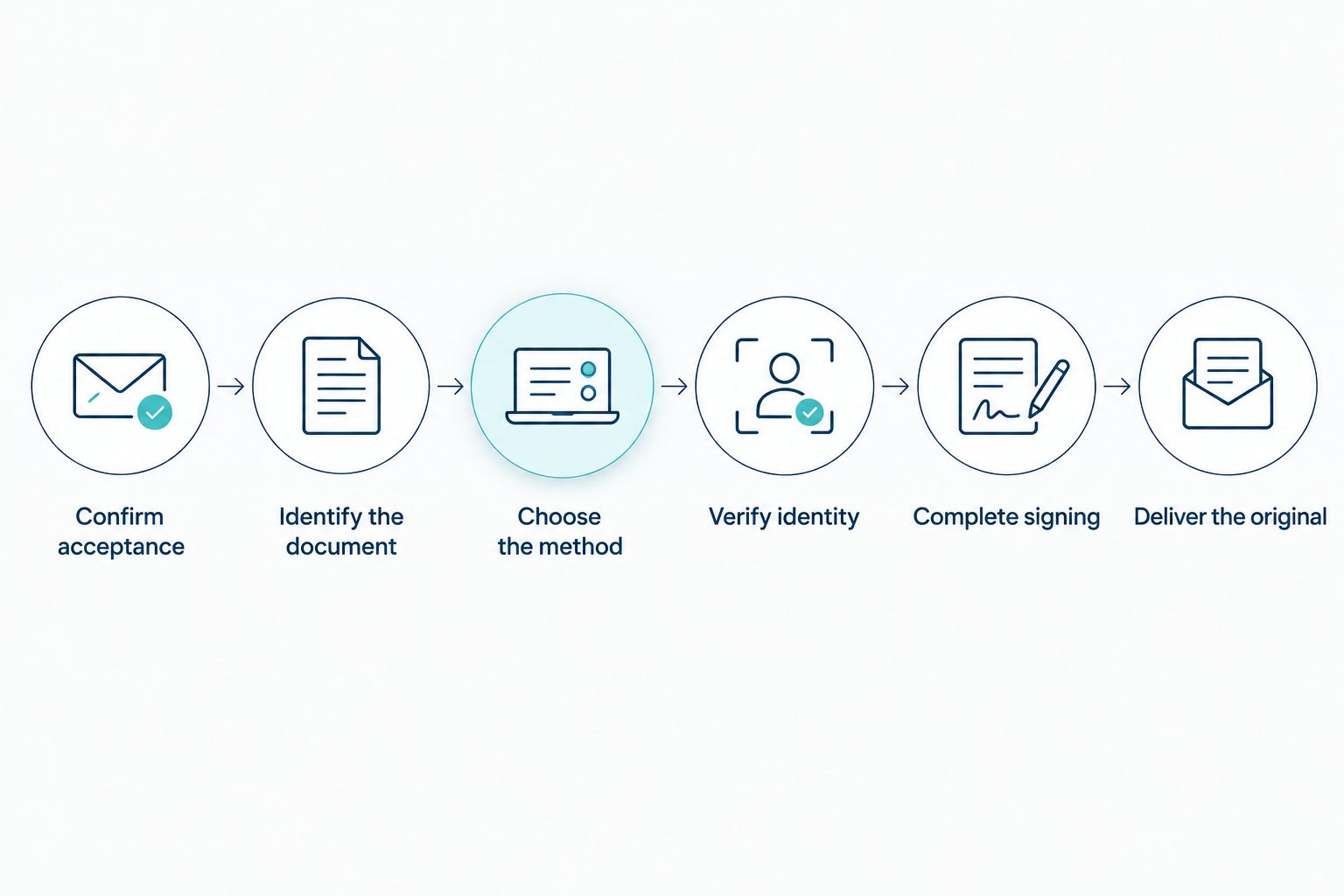
Use this sequence for a 2026 electronic notarization. It separates the receiving organization’s requirements from the notary’s procedures, so you do not complete one step only to repeat it in another format.
- Confirm acceptance. Ask the recipient whether it accepts an electronic original, a remote online notarization, and the intended delivery format. A lender, recording office, foreign authority, or document custodian can have requirements beyond your preference for electronic signing.
- Identify the document. Provide the document type and existing notarial certificate. Flag any witness lines, special execution instructions, or intended use outside the United States before arranging the appointment.
- Choose the method. Determine whether you need physical appearance or compliant online appearance. Confirm that the notary is authorized and equipped for the method you select.
- Verify identity. Follow the notary’s instructions for identification and, for remote online notarization, the applicable identity-verification process. Resolve expired, unreadable, or mismatched identification before execution.
- Complete signing. Attend the required session and follow the instructions for the specific notarial act. For a jurat, complete the oath or affirmation and required signing before the notary.
- Deliver the original. Keep the completed electronic file in its original electronic form. Send it through the recipient’s accepted process rather than assuming a screenshot or printed copy is equivalent.
The sequence matters because changing a signed electronic file can interfere with its integrity checks. Finish revisions before execution and retain the completed file without editing its contents.
Why electronic notarization requirements vary
The legal permission to notarize electronically does not make every document suitable for the same process. For your 2026 transaction, check these factors before choosing between electronic and paper execution:
- Document type. Wills, powers of attorney, real estate instruments, and other documents have execution rules that require individual review. Do not apply a general electronic-signature answer to every legal instrument.
- Required notarial act. An acknowledgment differs from a jurat. The document’s certificate determines what the notary must perform, including whether an oath or affirmation is required.
- Witness requirements. A notary’s participation does not automatically satisfy separate witness requirements. Remote witnessing has additional rules, including restrictions for certain documents and vulnerable adults.
- Signer location. A Florida online notary must be physically in Florida when performing the online notarization. Signers can be elsewhere, but signers outside the United States trigger additional statutory conditions.
- Recipient instructions. Confirm electronic submission, recording, or filing requirements with the organization receiving the document. A lawful electronic notarization does not resolve every delivery or acceptance question.
- International use. Notarization and apostille certification are different processes. Ask the destination authority what authentication and document format it requires before completing an electronic notarization.
Do not select a method solely because it avoids travel. Select the method that satisfies the document’s execution rules and the recipient’s requirements.
Can I email a signed PDF to a Florida notary?
Emailing a signed PDF does not complete a Florida notarization. You must still appear physically or through a compliant remote online notarization process, depending on the method used. An acknowledgment can involve an existing signature, while a jurat requires the appropriate signing and oath before the notary.
Does a Florida notary have to be in Florida for online notarization?
A Florida online notary must be physically in Florida during the online notarization. The signer does not necessarily have to be in Florida. If you are outside the United States, disclose your location before booking so the additional legal conditions can be addressed.
Can I print an electronically notarized document and use it as the original?
Printing an electronically notarized document does not automatically create an equivalent paper original. Florida Statutes section 117.05(13) provides a procedure for a notary to certify a tangible copy of an electronic record. Ask the recipient whether it needs the electronic original, a certified tangible copy, or a different execution format.
Which service should you request in Miami-Dade?
Thecruznetwork is best for Miami-Dade individuals and businesses seeking mobile or remote online notary and document support. Its stated services also include apostille certification, certified mail, and signing coordination. Identify which part of your transaction needs assistance rather than treating those services as interchangeable.
For a 2026 request, describe the document, where you will be located during signing, who will receive it, and whether witnesses are required. Request remote online notarization when the transaction qualifies and you need online appearance; request mobile service when physical attendance is the required route.
The benefit is access to both mobile and remote notary services within the same service offering. The limitation remains the document itself: no provider’s service list overrides execution rules or guarantees acceptance by the receiving organization.
Request the right notarization
Describe your document, signer location, and recipient requirements before arranging service.
FAQ
Can a Florida notary notarize an electronic signature in 2026?
Yes, a Florida notary can notarize an electronic signature in 2026 through a legally compliant electronic notarization. Physical appearance is required unless the notarization follows Florida’s remote online notarization law.
Is an electronic signature the same as a notarized signature?
No, an electronic signature is not the same as a notarized signature. Notarization requires a notary to perform a specific notarial act, verify identity, and complete the required certificate.
Can any Florida notary perform remote online notarization?
No, a Florida notary must obtain the required online-notary registration before performing remote online notarizations. A regular notary commission alone does not authorize remote online practice.
Can I use an ordinary video call to have my signature notarized?
An ordinary video call alone does not satisfy Florida’s remote online notarization requirements. The notarization must follow the applicable identity-verification, electronic-document, recording, and recordkeeping procedures.
Do I have to sign again if I already signed electronically?
Whether you must sign again depends on the required notarial act and execution process. An acknowledgment can address an existing signature, but a jurat requires signing and an oath or affirmation before the notary.
How long are Florida online notarization records kept?
Florida law generally requires online notarial journals to be retained for at least 10 years and audio-video recordings for at least 10 years. Section 117.245 governs these recordkeeping obligations.
Can Thecruznetwork help with mobile and remote online notarization?
Thecruznetwork offers mobile and remote online notary services for individuals and businesses in Miami-Dade. Describe your document and recipient requirements so the request addresses the correct signing method.
One last thing
Protect the electronic original, not just the visible signature. A printed page can show a seal and signature while losing the electronic information used to check the file’s integrity. Keep the completed electronic file and confirm the recipient’s submission instructions before converting, printing, or modifying it.
For a 2026 electronic notarization, ask the recipient one practical question first: “What exact document format will you accept?” That answer helps determine whether you need electronic execution, paper execution, or a properly certified tangible copy.


