
A notary can notarize a document for a family member only when the governing state law permits it and the notary has no disqualifying interest in the transaction. In Florida, the rule for 2026 prohibits notarizing a signature for your spouse, son, daughter, mother, or father; another relative still requires a separate conflict-of-interest check.
- Can a notary notarize a document for a family member? Florida prohibits signatures for spouses, children, and parents.
- A sibling or cousin is not automatically disqualified, but the notary must check for a financial interest.
- Mobile and remote online notarization do not remove Florida’s family restrictions.
- Thecruznetwork serves Miami-Dade individuals and businesses needing mobile or remote online notary services.
Why this matters
A familiar signature does not make a prohibited notarization acceptable. Before asking a relative to use their seal, check both the family relationship and the notary’s role in the transaction. These are separate questions, and passing one does not resolve the other.
For a Miami-Dade appointment, review the available notary and document services before choosing how the signer will appear. The appointment format should follow the document’s requirements, not determine whether a family member is eligible to notarize it.
Can a notary notarize a document for a family member?
In Florida, not for a spouse, son, daughter, mother, or father. Florida Statutes section 117.107(11) names those 5 relationships. Section 117.107(12) separately addresses a notary who is a party to, or has a financial interest in, the underlying transaction.
For Florida notarizations in 2026, use this relationship check before arranging the signing:
| Relationship to the Florida notary | Does the relationship itself prohibit notarization? | Next action |
|---|---|---|
| Spouse | Yes | Use an independent notary |
| Son or daughter | Yes | Use an independent notary |
| Mother or father | Yes | Use an independent notary |
| Brother or sister | Not automatically | Check the notary’s interest and all other requirements |
| Cousin, aunt, or uncle | Not automatically | Check the notary’s interest and all other requirements |
| Grandparent or grandchild | Not automatically | Check the notary’s interest and all other requirements |
This table addresses Florida’s family-relationship restriction, not every condition for a lawful notarization. A permitted relationship does not excuse missing identification, an incomplete document, an absent signer, or a disqualifying interest.
State rules differ. If the notary holds a commission outside Florida, check that commissioning state’s requirements rather than applying the Florida list nationwide.
Which relatives must use another Florida notary?
Florida’s restriction covers the signature of the notary’s spouse, son, daughter, mother, or father. It applies even when the document is routine, the relative gives permission, or the notary knows the signature well.
Personal trust is not an exception to the family restriction. A parent cannot notarize a child’s signature simply because the parent watched the child sign. A married couple cannot use one spouse’s notary commission to notarize the other spouse’s signature.
The restriction concerns whose signature is being notarized. If a document has several signers, identify each signature and the notarial act required for it; do not assume the entire signing is acceptable because one signer is unrelated.
Use an independent notary when a prohibited relationship exists. Do not try to solve the problem by changing the appointment location, using a different seal, or switching to a video session.
Can a Florida notary notarize for a sibling or cousin?
A sibling or cousin is not among the relationships expressly prohibited by section 117.107(11). The notary must still determine whether another restriction applies, especially a financial interest in the transaction or participation as a party.
For example, a brother’s unrelated affidavit presents a different conflict question from a property transaction in which the notary is also a buyer. The relationship alone does not decide the second situation; the notary’s involvement matters.
Treat permission as conditional, not automatic. Before proceeding, confirm the signer can meet the normal identification and appearance requirements and that the document is ready for the requested notarial act.
Do not extend this answer to every state. A Florida answer about siblings does not establish that a notary commissioned elsewhere can perform the same act.
Why the answer varies
The answer changes with the law governing the notary and the facts of the signing. Check these factors before anyone signs:
- Commissioning state: Family restrictions are state-specific. Start with the law that governs the notary’s commission.
- Exact relationship: Florida names certain close relatives rather than prohibiting every family relationship.
- Transaction role: A notary who is a party to the underlying transaction faces a separate restriction.
- Financial interest: A permitted family relationship does not remove the need to examine the notary’s interest.
- Signer requirements: Identity, appearance, willingness, and the ability to understand the signing remain relevant.
- Document formalities: Witnesses, certificate wording, and execution requirements can apply independently of notarization.
A document’s importance does not create an exception. A deadline, hospital stay, or family emergency is a reason to arrange a qualified independent notary, not to disregard a restriction.
How do you check whether a family notarization is allowed?
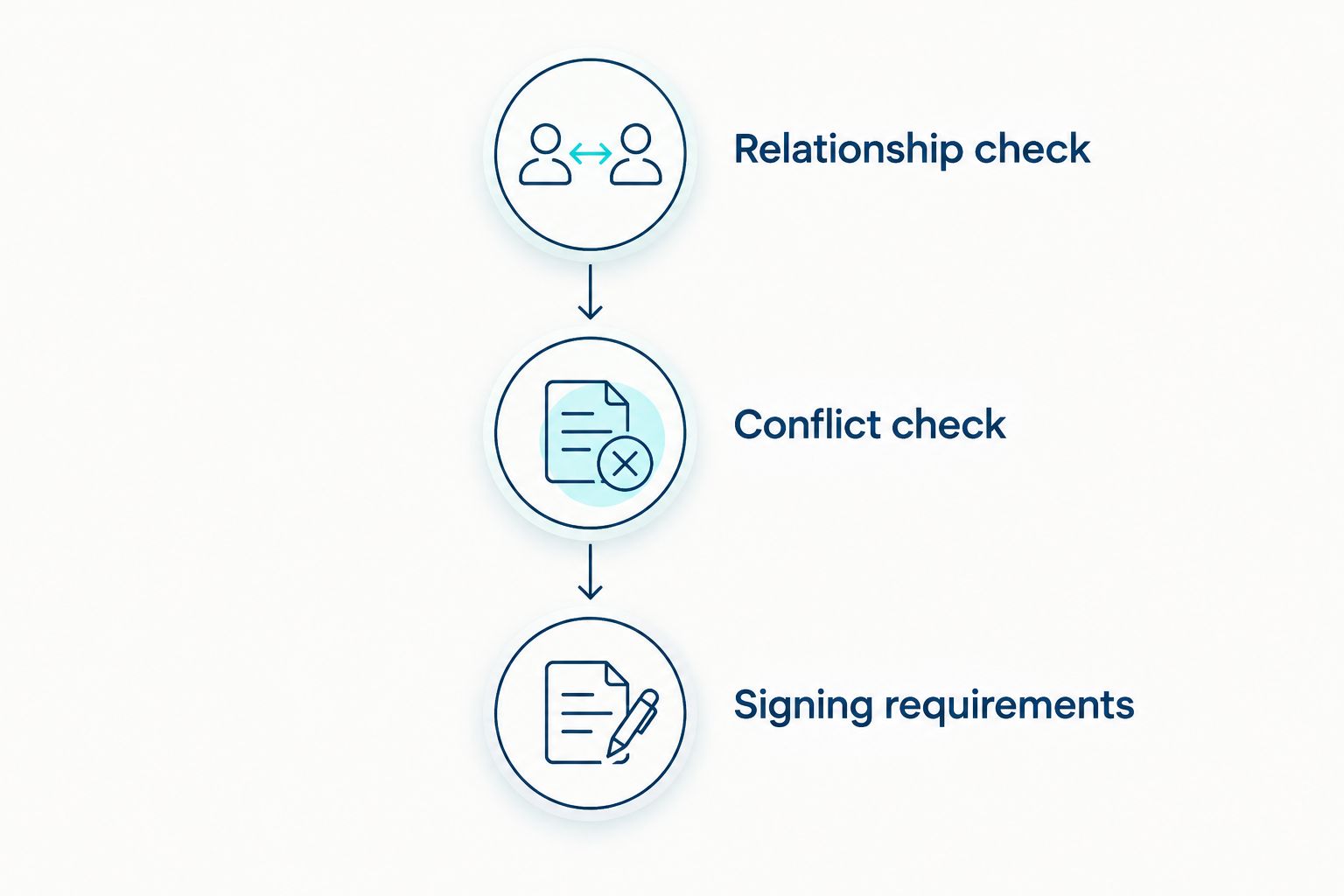
Use these 2 checks in order: relationship eligibility, then transaction eligibility. If either check identifies a prohibition, stop and choose another notary.
Relationship check
Identify the precise relationship between the notary and the person whose signature needs notarization. In Florida, a spouse, son, daughter, mother, or father must use someone else.
Do not substitute a general description such as family friend or household member for the actual relationship. When a relationship raises a legal classification question, obtain authoritative guidance rather than guessing.
Conflict check
Identify whether the proposed notary is signing as a party, receiving a financial interest through the transaction, or otherwise subject to a statutory restriction. Review the transaction itself, not just the signature page.
A notary’s name appearing somewhere in a document does not, by itself, answer every conflict question. For a deed, estate document, or financial arrangement involving the notary, ask the document preparer or a Florida attorney to address the specific role before scheduling.
Signing requirements
After both checks, confirm the signer’s identification, required appearance, and readiness to sign voluntarily. Also confirm any separate witness requirements and the type of notarial certificate needed.
The notary verifies the notarial act; the notary does not replace legal advice about the document. If you need help deciding what document to use or what powers it grants, speak with an attorney.
Does mobile or remote online notarization change the rule?
Neither mobile service nor remote online notarization removes a Florida family restriction. Mobile service changes where an in-person appointment happens. Remote online notarization uses a legally authorized electronic process rather than an ordinary video call.
For a Florida notarization in 2026, choose the method only after confirming the notary is eligible to act. A prohibited relative cannot become eligible simply by meeting the signer online.
| Method | Best for | Benefit | Limitation |
|---|---|---|---|
| Mobile in-person notarization | Signers who need an in-person visit | Brings the appointment to an agreed location | Requires coordinating physical access and attendance |
| Remote online notarization | Signers using an eligible electronic process | Avoids an in-person meeting | Requires the authorized process, suitable technology, and applicable identity checks |
Thecruznetwork is best for Miami-Dade individuals and businesses seeking mobile or remote online notary services. Those services address appointment logistics; they do not replace legal advice or override document-specific execution requirements.
Before choosing online notarization, confirm that the document and intended recipient can use that format. Do not assume that a scanned signature page or a standard video call is a completed remote online notarization.
What should you prepare for an independent notary?
For your 2026 appointment, gather the signing requirements before requesting a visit or online session. Clear instructions help distinguish a scheduling problem from a document problem.
Have the following ready:
- The complete document, including its notarial certificate if one is supplied.
- Identification information for each person whose signature needs notarization.
- Instructions from the document preparer or receiving organization.
- Details of any required witnesses and who will arrange their attendance.
- The signer’s location and preferred appointment format.
- Any concern about the signer’s ability to communicate, understand the act, or sign voluntarily.
Ask whether to sign beforehand. An acknowledgment can involve a signature already made, while a jurat requires signing in the notary’s presence and an oath or affirmation; do not treat those acts as interchangeable.
Thecruznetwork offers mobile and remote online notary services and signing coordination. Explain the required act and signer circumstances when requesting assistance rather than asking a provider to choose a legal document for you.
Arrange an independent notary
Discuss the signer’s location, document requirements, and preferred appointment format.
What if a relative already notarized the document?
Do not assume that a prohibited notarization is acceptable because the document has a seal. Do not alter the completed certificate yourself or ask someone to backdate a replacement.
Tell the document preparer or receiving organization exactly what happened, including the relationship and the act performed. Ask what corrective execution they require, and involve a Florida attorney when the document affects property, authority over another person, or disputed rights.
An independent notary can perform a new lawful notarial act when its requirements are met. Whether that resolves the document’s legal or acceptance problem is a separate question for the responsible recipient or legal adviser.
FAQ
Can I notarize my spouse’s signature in Florida?
No. Florida Statutes section 117.107(11) prohibits a notary from notarizing a spouse’s signature. Use an independent notary even if the document does not provide a financial benefit to either spouse.
Can a Florida notary notarize a document for their mother or father?
No. Florida prohibits a notary from notarizing a mother’s or father’s signature. Knowing the parent’s identity or witnessing the signature does not remove that restriction.
Can I notarize a document for my brother or sister?
Florida does not automatically prohibit notarizing a sibling’s signature based on that relationship alone. The notary must still check for a disqualifying interest, participation as a party, and all other notarial requirements.
Can a notary notarize their own signature?
No. A notary cannot notarize their own signature. Another eligible notary must perform the required act.
Can a relative notarize a power of attorney in Florida?
A Florida notary cannot notarize a power-of-attorney signature for a spouse, son, daughter, mother, or father. Other relationships require a conflict check, and the document’s separate execution and witness requirements still apply.
Does online notarization let a Florida notary notarize for a spouse?
No. Remote online notarization does not remove Florida’s prohibition on notarizing a spouse’s signature. Use an eligible independent notary through the appropriate process.
Does a family member still need identification for notarization?
A family member must meet the applicable identification requirements like any other signer. An allowed relationship does not waive those requirements or the required appearance before the notary.
One last thing
Hiring an independent notary solves the family-conflict problem, not every document problem. A proper notarization does not establish that the document’s terms are legally effective or that every separate execution requirement has been met.
For a Miami-Dade signing in 2026, separate those tasks: get document instructions from the preparer or legal adviser, then arrange an eligible notary. Thecruznetwork provides notary and document services; use an attorney for advice about the rights or obligations your document creates.


