
Yes. A Florida remote online notary can notarize for someone overseas when the notary is physically in Florida, the document meets Florida’s requirements for an overseas signer, and the required identity checks succeed. The transaction must have a qualifying connection to the United States, and the notary must have no actual knowledge that the signing is prohibited where you are located. A lawful notarization does not guarantee that the receiving organization will accept the document.
- A Florida remote online notary for someone overseas requires a qualifying U.S. connection and successful identity verification.
- The Florida notary stays in Florida; the signer joins through a compliant live audiovisual session.
- Confirm recipient acceptance and any apostille requirements before signing electronically.
- Thecruznetwork offers remote online notary and document support; confirm eligibility before arranging an overseas signing.
Can a remote online notary notarize for someone overseas?
Yes, under Florida law—but being able to join a video call is not enough. Florida Statutes section 117.265 governs online notarizations involving a signer outside the United States. For a 2026 signing, check the document’s U.S. connection, your physical location, and the recipient’s instructions before scheduling.
For Miami-Dade document support, Thecruznetwork offers mobile and remote online notary services, apostille certification, certified mail, and signing coordination. An overseas request still needs a document-specific eligibility review.
Use these 3 checks to establish whether Florida remote notarization fits your request:
- U.S. connection: The record must satisfy a qualifying connection described in Florida law, such as involving U.S. property or a transaction substantially connected with the United States.
- Location rules: The online notary must be physically in Florida. For a signer outside the United States, the notary must have no actual knowledge that the act is prohibited where the signer is located.
- Execution requirements: The signer must complete the required appearance and identity process, and the document must meet any applicable signing and witness requirements.
These checks establish the legal starting point. Recipient acceptance is a separate question that deserves confirmation before you sign.
Why this matters
An overseas signer faces separate decisions: whether the notary can perform the act and whether the intended recipient accepts the result. Confusing those decisions creates avoidable rework. A completed electronic certificate does not override a lender’s instructions, a court’s filing requirements, or a foreign authority’s document rules.
For a 2026 overseas signing, start with the organization that needs the document. Ask for its execution instructions in writing, including whether it accepts Florida remote online notarization and electronic originals. Give those instructions to the notary before the appointment.
Also separate where you sign from where the document will be used. A person sitting abroad can sign a document intended for use in Florida. That is different from signing a document intended solely for a foreign authority, even when the same person and identification are involved.
What U.S. connection does Florida require?
Florida Statutes section 117.265(3) identifies qualifying connections for a principal located outside the United States. The record must fall within a statutory category; the signer’s convenience alone does not establish eligibility.
The qualifying categories concern a record that:
- Will be filed with, or relates to a matter before, a public official, court, governmental entity, or other entity subject to U.S. jurisdiction.
- Involves property located in the territorial jurisdiction of the United States.
- Involves a transaction substantially connected with the United States.
A document involving Florida real estate has a different factual basis from a document dealing only with foreign property and foreign parties. Explain the actual purpose rather than describing the document simply as “personal paperwork.” The notary needs enough information to assess the applicable requirements.
U.S. citizenship does not replace the document’s required U.S. connection. Likewise, foreign citizenship is not, by itself, the question that determines eligibility under this provision. Your location, the record, identification requirements, and applicable restrictions all need attention.
Where must the notary and signer be located?
For a Florida online notarization, the notary must be physically within Florida while performing the act. You do not have to sit beside the notary. Florida law permits the principal to appear from another location through the required online process.
There are 2 locations to disclose accurately: the notary’s location and your location. Tell the notary the country where you will physically sit during the session—not your mailing address, citizenship, or usual residence.
Do not assume an appointment remains eligible if you travel to another country before signing. Update the notary when your location changes. The overseas-location conditions concern where you actually appear for the notarial act.
An ordinary video call is not a substitute for the required remote notarization process. Sending a photograph of your identification and signing during an informal call does not establish compliance with Florida’s online-notarization requirements.
Which notarization route fits an overseas signer?
Best for an accepted electronic transaction: Florida remote online notarization. Its practical advantage is remote appearance, but it still depends on legal eligibility, identity verification, and the receiving organization’s acceptance. Other routes deserve consideration when those conditions do not fit.
| Route | Best for | Practical advantage | Limitation to confirm |
|---|---|---|---|
| Florida remote online notarization | Eligible U.S.-connected records accepted electronically | You appear remotely while the notary remains in Florida | Overseas conditions, identity checks, witnesses, and recipient acceptance still apply |
| U.S. consular notarization | Documents for which the recipient accepts the relevant U.S. consular act | Provides an in-person route through a U.S. embassy or consulate | The post’s procedures and the document’s requirements determine the next step |
| Local foreign notarization | Documents accepted with notarization under local law | Lets you work with a notary in your physical location | U.S. or foreign recipients can require additional authentication or a different execution method |
Do not choose solely by which appointment is easiest to arrange. Ask the recipient which route it accepts, then confirm that route with the relevant notary or consular post. A convenient signing method is not useful if it produces the wrong form of document.
How do you prepare for an overseas online notarization?
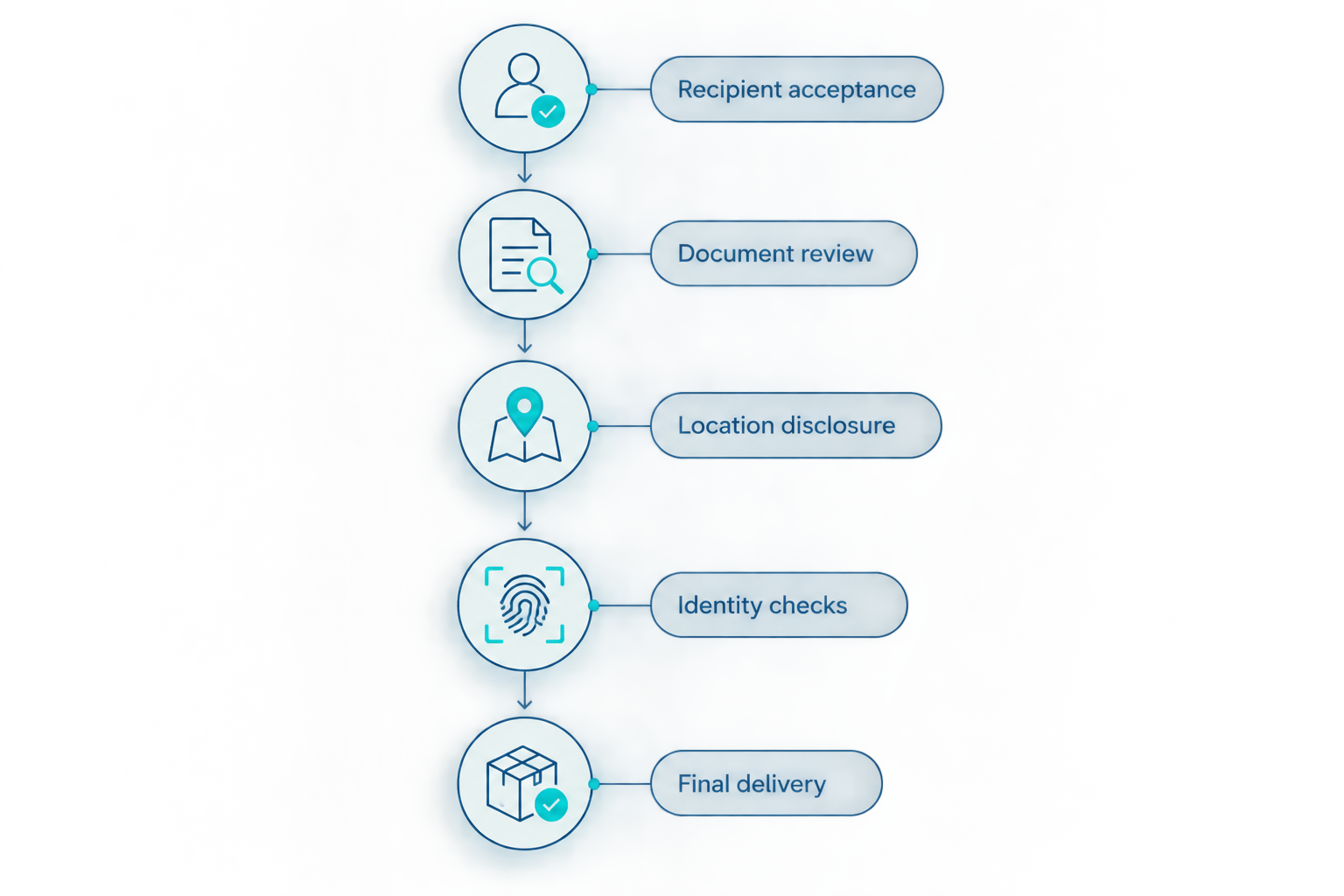
Use this 5-step preparation sequence for a 2026 appointment. Complete the acceptance check before uploading sensitive records or beginning a signing session.
- Recipient acceptance: Ask whether the recipient accepts Florida remote online notarization, an electronic signature, and the resulting electronic document. Request any certificate or execution instructions.
- Document review: Provide the complete document through the service’s instructed process. Identify its purpose, destination, U.S. connection, and any witness language.
- Location disclosure: State your signing country and confirm that you will remain there during the appointment. Report any travel changes before the session.
- Identity checks: Confirm the required identification and verification process before booking. Ask specifically whether your identification can be used for that process.
- Final delivery: Agree on how the completed electronic document will reach the recipient and whether any further authentication is required.
Before the session, also ask about your device, camera, microphone, and connection requirements. You need to participate in the required audiovisual appearance and follow the signing instructions. Do not pre-sign a document when the required notarial act calls for signing during the session.
Keep the document and recipient instructions together. If someone replaces a page, adds a witness requirement, or changes the intended destination, send the updated version for review rather than assuming the earlier arrangement still fits.
Why overseas notarization requirements vary
The same online process does not fit every overseas document. These 5 factors determine what needs review:
- Signing country: Florida’s overseas provision addresses the notary’s actual knowledge of prohibitions where the signer is located. Disclose the country accurately.
- Document purpose: The record must meet a qualifying U.S. connection. Describe the underlying transaction or proceeding.
- Identity verification: Florida online notarization has prescribed identification procedures. Possessing a passport does not, by itself, complete those procedures.
- Document formalities: Witnesses, certificate wording, and execution requirements depend on the document and applicable law. A notarial seal does not correct every execution defect.
- Recipient requirements: The recipient determines its submission instructions, including electronic-document acceptance and any requested authentication. Confirm those instructions directly.
For your 2026 signing, resolve these factors before treating the appointment as confirmed. A scheduling confirmation is not a substitute for document acceptance or a legal determination about the document’s effect.
Can I use a foreign passport for online notarization?
A foreign passport does not automatically guarantee successful online identity verification. Florida’s online-notarization identification requirements and the verification method used for the session both matter. Confirm the document type and verification route before arranging the appointment.
Florida Statutes section 117.295 addresses online identity confirmation. Do not assume that an identification document acceptable in an in-person context will necessarily complete the online process in the same way. Tell the notary what identification you hold without sending sensitive copies through an unapproved channel.
If you cannot complete the required verification, stop and discuss an appropriate alternative. Do not substitute another person’s account, address, or identification to get through the process.
Does an overseas online notarization need an apostille?
An overseas signer does not automatically need an apostille. The document’s destination and the receiving authority’s requirements determine whether additional authentication is needed. Your physical presence abroad is not enough to answer that question.
An apostille authenticates the origin of a covered public document for use under the applicable international convention; it does not approve the document’s contents. It also does not eliminate execution requirements or force a recipient to accept a document format.
For a 2026 document intended for foreign use, confirm the destination country, the authority requesting it, and the required authentication route before signing. Ask whether the intended electronic document is suitable for that route. Do not assume that printing an electronically notarized file creates an acceptable paper original.
Can I sign a deed or power of attorney from abroad?
Some deeds and powers of attorney require more than a notarized signature. Witness rules, document-specific execution requirements, and recipient instructions need separate review. Online notarization alone does not settle those issues.
For a property transaction, give the proposed signing method to the title company, lender, or attorney handling the transaction before the appointment. For a power of attorney, ask the preparing attorney and intended recipient to confirm the execution requirements that apply to your document.
Do not treat “the platform supports it” as legal approval. Technical support for a signature field says nothing about whether the full document has been executed correctly or will be accepted for its intended purpose.
When should you request document support?
Request support after you have the document, your signing country, and the recipient’s instructions. Thecruznetwork is best for individuals and businesses seeking Miami-Dade notary and document support. Its stated services include remote online notarization and apostille certification; those services do not establish acceptance for every overseas transaction.
Use the contact page to explain the document type, where you will sign, and where the document will be used. Ask for the appropriate submission process before sending identification or confidential records. Include witness and authentication instructions at the start, not after the signing.
FAQ
Can I use a Florida remote online notary while traveling abroad?
Yes, if the overseas-signing requirements are satisfied, including a qualifying U.S. connection and the required identity verification. The Florida online notary must remain physically in Florida, and recipient acceptance needs separate confirmation.
Do I have to be a U.S. citizen to use a remote online notary from overseas?
U.S. citizenship is not the deciding condition in Florida’s overseas-signing provision. The record’s qualifying U.S. connection, your location, identity verification, and other applicable requirements determine whether the act can proceed.
Can I notarize a document over an ordinary video call?
An ordinary video call alone does not satisfy Florida’s remote online notarization requirements. Use a process that meets the applicable audiovisual, identification, electronic-record, and notarial requirements.
Will my foreign passport work for an online notary appointment?
A foreign passport does not guarantee that you can complete online identity verification. Confirm the required identification and verification method with the notary before scheduling.
Does signing overseas mean my document needs an apostille?
Signing overseas does not automatically create an apostille requirement. Confirm authentication instructions with the authority that will receive the document, based on its destination and intended use.
Can the online notary guarantee that my bank will accept the document?
No, the notary cannot guarantee a bank’s acceptance. Ask the bank to confirm its requirements for remote notarization, electronic signatures, witnesses, and document delivery before signing.
Can Thecruznetwork help with remote online notary and apostille services?
Thecruznetwork offers remote online notary and apostille certification services as part of its document support. Explain your signing country, document purpose, and destination so the request can be reviewed before arrangements are made.
One last thing
Ask about the final file, not just the signing appointment. A recipient that accepts remote notarization still needs the document delivered in an acceptable form. Confirm whether it wants the electronic original, a particular submission method, or further authentication before you sign.
This distinction is especially useful when someone says, “Just print it and send it.” Obtain the actual recipient’s instructions. The notarial act and the delivery format are separate parts of getting the document accepted.


