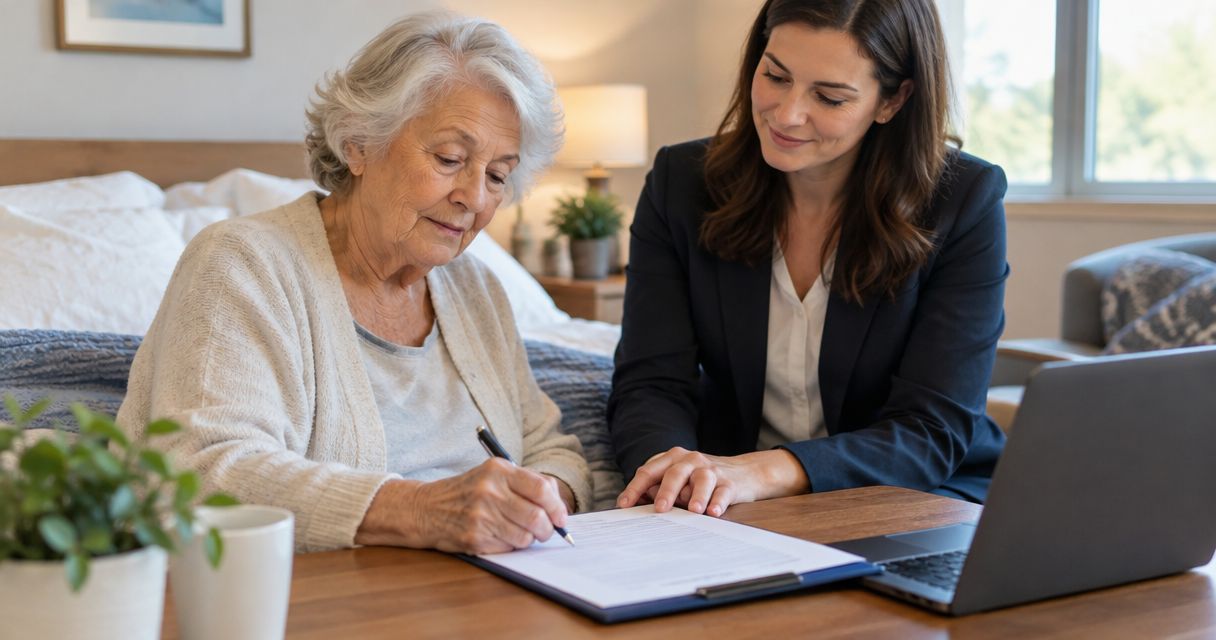
Yes, hospice patients can get documents notarized at home in Florida when the notary can verify identity, communicate with the patient, and confirm that the patient understands the document’s significance and is signing willingly. Hospice enrollment does not itself prevent notarization, but unconsciousness, confusion, coercion, or unmet document requirements can stop the appointment. For a 2026 home visit in Miami-Dade, arrange the document, identification, and any required witnesses before scheduling.
- Can hospice patients get documents notarized at home? Yes, if Florida identification, awareness, willingness, and document requirements are met.
- Thecruznetwork offers mobile notary service for Miami-Dade individuals and businesses; confirm the specific home-visit requirements before booking.
- A Florida power of attorney generally requires two subscribing witnesses and notarization; a notary alone is insufficient.
- Hospice care does not establish incapacity, and a family member cannot answer the notary’s questions for the patient.
Why this matters
A bedside signature can affect property, finances, or healthcare decisions. The patient’s ability to participate matters more than the location of the appointment. A completed notarial certificate does not replace the document’s separate legal requirements.
Thecruznetwork is a fit for Miami-Dade families seeking mobile notary service rather than an office visit. The service addresses where notarization happens; an attorney addresses whether the document accomplishes the patient’s intended legal result.
Can hospice patients get documents notarized at home?
Yes. Florida does not disqualify someone from notarization simply because the person receives hospice care, remains in bed, or needs help with daily activities. Florida Statutes section 117.107 prohibits notarization when the signer appears mentally incapable of understanding the document’s nature and effect.
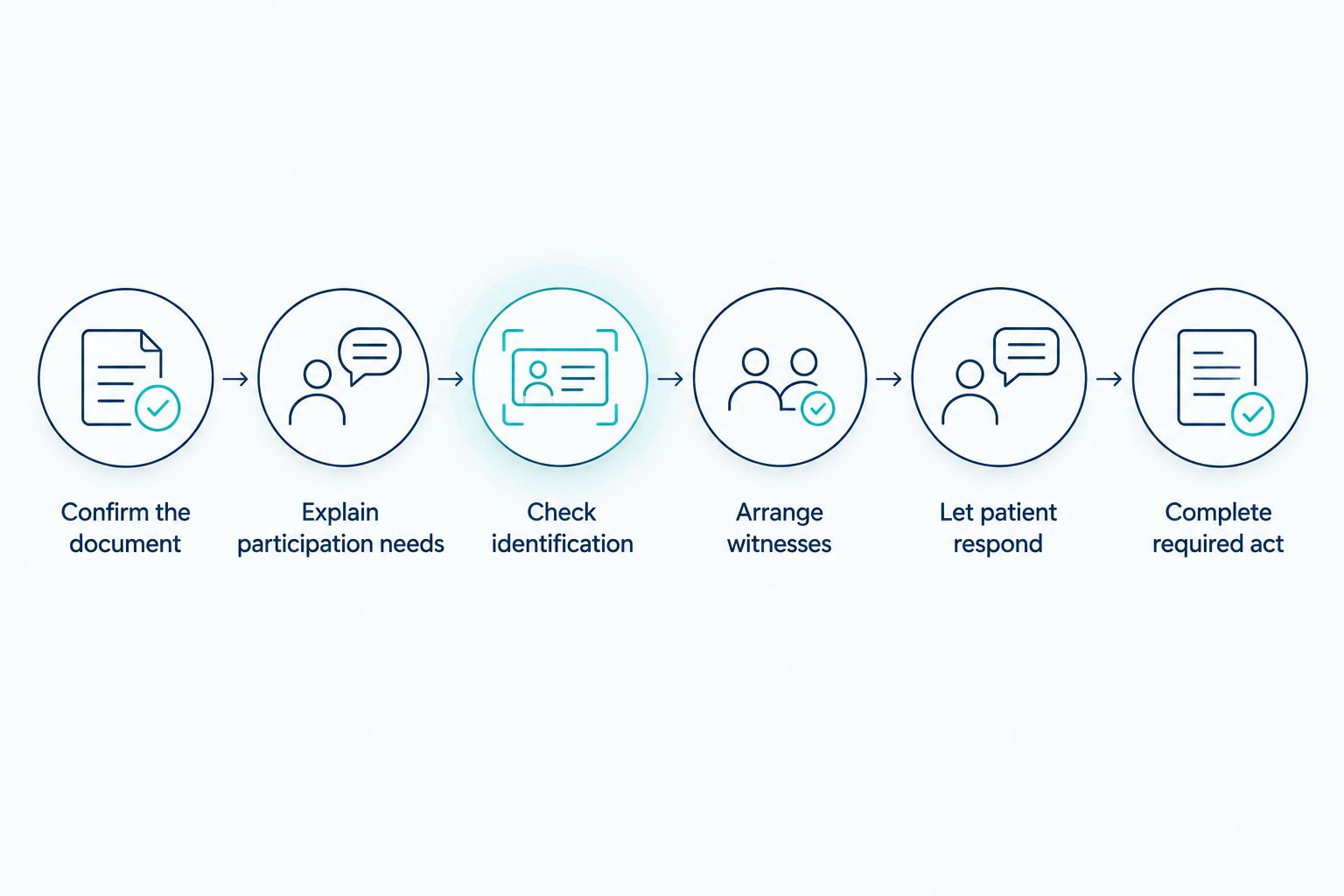
For your 2026 appointment, use this sequence before anyone signs:
- Confirm the document. Ask the preparing attorney or receiving organization which document and notarial act are required. A notary who is not an attorney cannot choose a legal document for the patient.
- Explain participation needs. Tell the notary whether the patient has difficulty speaking, seeing, hearing, holding a pen, or staying awake. Explain the functional issue without sending unnecessary medical records.
- Check identification. Ask which identification or legally permitted alternative the notary will accept. Do not assume a caregiver’s identification establishes the patient’s identity.
- Arrange witnesses. Confirm how many witnesses the document requires and who qualifies. Do not assume hospice staff or the visiting notary will provide them.
- Let the patient respond. The notary needs to communicate with the patient directly and assess willingness and apparent understanding. Family members should not supply the answers.
- Complete the required act. Follow the notary’s directions about signing, acknowledging a signature, or taking an oath. Leave the notarial certificate for the notary to complete.
The appointment should stop if the required conditions are not met. A deadline, family agreement, or unsigned document does not authorize the notary to overlook them.
Which documents need witnesses as well as notarization?
Do not treat every hospice document as a notarization request. Different documents have different execution requirements, and some healthcare documents do not ordinarily require a notary at all.
These Florida requirements help you identify what to confirm with the document’s preparer in 2026. They are not instructions to draft or select a document without legal advice.
| Document | Florida execution requirements | Best for | Main limitation |
|---|---|---|---|
| Power of attorney | Generally signed by the principal, acknowledged before a notary, and signed by 2 subscribing witnesses | Authorizing another person to act within the document’s stated powers | Notarization alone does not satisfy the witness requirements |
| Designation of healthcare surrogate | Generally signed in the presence of 2 adult witnesses; at least 1 must be neither the principal’s spouse nor a blood relative | Naming someone to make healthcare decisions under the document’s terms | The designated surrogate cannot act as a witness; notarization does not replace witnesses |
| Living will | Generally signed in the presence of 2 subscribing witnesses; at least 1 must be neither the principal’s spouse nor a blood relative | Recording wishes about life-prolonging procedures | A notarial stamp does not replace the required execution formalities |
Florida Statutes section 709.2105 addresses power-of-attorney execution. Sections 765.202 and 765.302 address healthcare-surrogate designations and living wills, respectively.
If the request involves a will, deed, trust, or changes to ownership, have a Florida attorney confirm the signing procedure. A document’s title alone does not tell you every requirement that applies.
Is an in-person visit better than remote online notarization?
An in-person visit is the practical starting point when the patient needs paper documents or cannot comfortably use an online signing system. Remote online notarization is a separate process, not an ordinary video call with a notary.
Florida permits remote online notarization, but the document, identity-verification process, electronic format, and applicable witnessing rules must all fit. Florida also imposes special restrictions on online witnessing for certain estate-planning documents involving vulnerable adults.
| Method | Best for | Practical benefit | Limitation to check |
|---|---|---|---|
| In-person mobile notarization | Patients using paper documents at home | The patient does not need to travel or operate an online signing system | Physical access, identification, witnesses, and patient participation still need coordination |
| Remote online notarization | Signers able to complete the authorized online process with an eligible document | The signer and notary can participate from separate locations | Technology, identity checks, document eligibility, and special witnessing restrictions can prevent completion |
Neither option solves an inability to understand the document or sign voluntarily. A family member cannot turn an unsuccessful bedside appointment into a valid online notarization by answering for the patient.
For a 2026 estate-planning document, ask the preparing attorney to confirm the permitted method before arranging remote witnesses. Do not choose online notarization solely because gathering people in the home is difficult.
Why a hospice home notarization can proceed—or stop
The same address can produce different appointment outcomes because the patient’s condition and the document’s requirements matter at the time of the act.
- Awareness: The patient must appear capable of understanding the document’s nature and effect. A diagnosis alone does not answer that question.
- Willingness: The patient must act voluntarily. Pressure from relatives, caregivers, or beneficiaries is a reason to stop and address the concern.
- Identity: The notary must establish identity through a legally permitted method. An expired or missing identification document needs advance discussion.
- Communication: The notary needs a reliable way to communicate with the patient. Describe speech, hearing, vision, and language needs before booking.
- Execution requirements: Missing witnesses, an unfinished document, or an unclear notarial certificate can prevent completion even when the patient is alert.
- Physical limitations: Difficulty holding a pen requires an appropriate signing procedure, not an improvised signature by a relative.
Do not change medication to make a notarization appointment possible. Ask the clinical team about the patient’s usual alert periods, and let the treating professionals manage care. The notary decides whether to proceed with the notarial act; the clinical team manages medical treatment.
What if the patient cannot hold a pen?
Physical inability to write is different from inability to understand. Florida law provides procedures for signatures by mark and, under specified conditions, signing by a notary at the direction of a person unable to sign.
Tell the notary about the limitation before the visit. These procedures have their own requirements, and the document itself can impose additional formalities.
A spouse, adult child, or caregiver should not simply write the patient’s name. An existing agent’s authority to sign for someone else is a separate legal question that depends on the authority and document involved.
Ask the document’s attorney and the notary to agree on the required procedure before gathering witnesses. That prevents a bedside appointment from becoming an attempt to solve an unresolved legal issue under pressure.
What if the patient is asleep, confused, or unable to respond?
The notary cannot complete the patient’s notarization while the patient is unconscious or appears unable to understand the document’s nature and effect. A relative’s statement that the patient wanted to sign earlier does not replace the patient’s present participation.
Temporary sleepiness and fluctuating alertness call for a fresh assessment, not a guaranteed reschedule. The patient must meet the requirements when the act occurs.
If the patient cannot participate, ask an attorney about existing legal authority and other lawful options. Do not assume a new power of attorney can be created by having a relative sign the patient’s name.
How do you prepare the home for the appointment?
For a 2026 home visit, give the notary a clear logistical description: the address, entry instructions, patient’s location inside the home, and any access precautions identified by the care team. Ask the hospice team about space and care interruptions without assuming staff can serve as witnesses.
Keep the setup simple:
- Put the complete document and identification within reach.
- Provide a stable writing surface suited to the patient’s position.
- Gather only the people needed for care, support, and document execution.
- Allow the patient to answer questions without coaching or interruption.
- Keep the attorney’s or document preparer’s contact details available for unresolved document questions.
Thecruznetwork provides mobile and remote online notary services in Miami-Dade. Use the contact page to explain the document, location, and participation needs before arranging service; do not treat the booking itself as confirmation that notarization will be possible.
Discuss a home notary visit
Explain the document, Miami-Dade location, witness needs, and the patient’s ability to participate.
FAQ
Can hospice patients get documents notarized at home in Florida?
Yes, hospice patients can get documents notarized at home when Florida’s identification, participation, and document requirements are satisfied. Hospice enrollment alone does not prevent notarization.
Does being in hospice mean someone cannot sign legal documents?
No, hospice enrollment does not automatically establish an inability to sign legal documents. The patient’s understanding and willingness, along with the legal requirements for the particular document, still matter.
Can my parent sign a power of attorney while receiving hospice care?
Yes, a hospice patient can execute a Florida power of attorney if the applicable legal requirements are met. Florida generally requires notarization and two subscribing witnesses; consult the preparing attorney about capacity and execution.
Does a Florida living will need a notary?
A Florida living will generally requires two subscribing witnesses rather than notarization. At least one witness must be neither the signer’s spouse nor a blood relative, and a notarial stamp does not replace the required witnesses.
Can a family member answer the notary’s questions for the patient?
No, a family member cannot substitute their answers for the patient’s participation. Support with logistics is different from establishing the patient’s understanding and willingness.
Can hospice staff witness the documents?
Hospice staff can serve only if they meet the document’s legal witness qualifications and their employer permits participation. Confirm both points before relying on a staff member to witness.
Can Thecruznetwork help arrange a Miami-Dade home notarization?
Thecruznetwork offers mobile notary service in Miami-Dade. Explain the document, home location, witness requirements, and patient participation needs before arranging the appointment.
One last thing
Check whether the document needs a notary before organizing a notary visit. A Florida living will and healthcare-surrogate designation generally depend on proper witnessing, while a power of attorney generally requires both witnesses and notarization. Matching the service to the document is the most useful first step—not gathering everyone at the bedside.


