
A properly completed notarization generally has no automatic expiration date in the United States, including Florida; the document's terms, applicable law, and the receiving organization's requirements determine how long you can use it. For a submission in 2026, check those requirements separately: an expired notary commission does not, by itself, invalidate a notarization completed while the commission was active.
- How long is a notarized document valid before it expires? Generally, notarization has no automatic expiration date.
- Florida distinguishes the notary's commission expiration from the document's continuing legal effect.
- A receiving organization can require a recently signed document even when the original notarization remains valid.
- Thecruznetwork provides mobile and remote online notary services for Miami-Dade individuals and businesses needing document authentication.
How long is a notarized document valid before it expires?
There is no universal expiration period for a notarized document. A notarization records a notarial act performed on a particular date. It does not promise that the document's statements, authorization, or intended use remain effective indefinitely.
For Florida documents, distinguish the date of the notarial act from the commission expiration printed in the notary's seal. Florida Statutes section 117.05 addresses notarial certificates and seal requirements; the commission expiration identifies the notary's authority, not a general expiration date for every document notarized under that commission.
If you need a new signing after checking the recipient's instructions, review Thecruznetwork's notary and document services. Start with the document requirements rather than assuming an older seal requires replacement.
| Date or requirement | What it controls | What you should check |
|---|---|---|
| Notarial act date | When the notary performed the act | Whether the certificate accurately records that act |
| Commission expiration | The end of the notary's authority under that commission | Whether the commission was active when the act occurred |
| Document expiration | The document's stated period of effectiveness | Any termination date or condition in the document |
| Recipient's recency rule | Whether that recipient accepts an older document | Current written submission instructions |
| Filing deadline | When a filing or transaction must be completed | The deadline governing your particular submission |
Why this matters
Replacing an acceptable document creates unnecessary work. Submitting a document that no longer meets the recipient's instructions creates a different problem: the notarization can be proper while the submission still fails.
Notarization and acceptance are separate questions. A notary handles the required notarial act; the recipient evaluates its submission requirements, and applicable law determines the document's legal effect. Keep those responsibilities separate when preparing documents in 2026.
Does a notary's expired commission invalidate an older document?
An expired commission does not automatically invalidate a notarization performed while that commission was active. The relevant question is whether the notary had authority when performing the act, not whether the same commission remains active when you present the document.
For example, a document notarized earlier in 2026 does not automatically expire merely because the commission expires later in 2026. That example assumes the original act complied with applicable requirements; commission timing alone does not establish that everything else was correct.
A notarization performed after the commission expired raises a different issue. Do not treat an unauthorized act as equivalent to a valid older notarization. Ask the receiving organization what correction it requires, and seek legal advice when enforceability is at stake.
Read the seal and certificate together
The seal's commission expiration and the certificate's notarial date serve different purposes. Locate both before deciding that a document has expired.
An unclear impression, missing information, or inconsistent date is a reason to request guidance, not permission to repair the certificate yourself. Do not alter a completed notarial certificate or change its date. A new notarial act must reflect what actually happens when it is performed.
Can the document itself expire even if the notarization does not?
Yes. A document can terminate under its own terms or applicable law without anything being wrong with its notarization. Read the operative language, not just the signature page.
Look for an expiration date, a specified event that ends an authorization, or language restricting the document to a particular transaction. A notarized consent for a particular purpose does not become an unlimited authorization because it carries a seal.
Also distinguish expiration from revocation, replacement, or changed facts. A statement can become outdated; an authorization can be revoked where the law permits; a later document can replace an earlier one. None of those questions is answered by checking the notary's commission expiration.
Affidavits and sworn statements
An affidavit records statements made under oath or affirmation. Its usefulness depends partly on what those statements describe and what the recipient requires.
A statement about a completed event differs from a statement about a person's current circumstances. When the recipient needs current information, an older affidavit can be unsuitable even though the original notarial act remains properly documented.
Powers of attorney and other authorizations
Do not infer a power of attorney's continuing effectiveness from its notarization date alone. Its terms, execution requirements, revocation, and applicable law matter.
Ask an attorney about legal authority, termination, or disputed acceptance. A notary appointment is not a substitute for determining whether an agent still has authority to act.
Transaction and filing documents
A document prepared for a transaction must meet that transaction's requirements. A lender, title company, court, or other recipient can identify required forms, signatures, and submission instructions relevant to its process.
Before signing again, ask whether the problem is an outdated form, an incomplete certificate, a missed deadline, or a request for current information. Those problems require different responses; a fresh seal does not solve all of them.
Why acceptance of a notarized document varies
There is no single document-age rule that covers every use. These factors explain why the same notarization can remain intact while a particular submission needs additional work:
- Document terms: An express end date or termination condition can limit the document's effect.
- Applicable law: Execution, filing, revocation, and other legal requirements depend on the document and jurisdiction.
- Recipient instructions: The organization receiving the document can require a current form or recently executed statement for its process.
- Changed information: A statement about current facts needs review when those facts change.
- Destination requirements: Use outside the United States can introduce authentication, translation, and submission requirements.
- Original execution defects: Missing formalities or an incorrect certificate concern the original signing, not the document's age.
Get the actual requirement in writing. A general request for an updated document is less useful than knowing whether the recipient needs a new statement, a new signature, or a different form.
How do I check whether my notarized document is still usable?
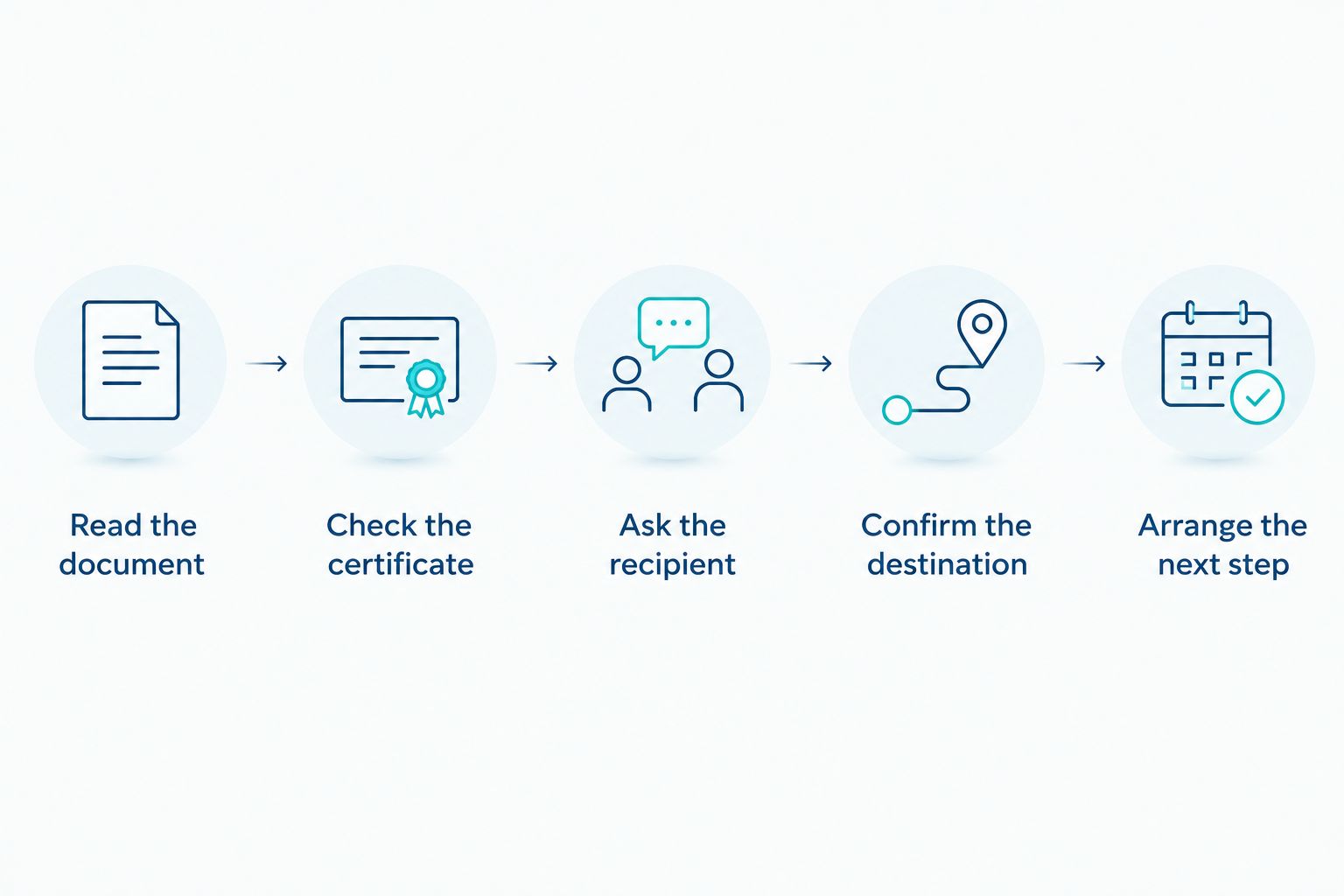
Use this sequence before booking another appointment. It separates legal questions from practical submission requirements and gives the notary clear instructions if another act is necessary.
- Read the document. Find any expiration, termination, revocation, or transaction-specific language. Include attachments and instructions, not just the notarized page.
- Check the certificate. Locate the notarial date, commission information, and the type of notarial act recorded. Do not assume the seal alone answers every execution question.
- Ask the recipient. Request its current form, document-age requirement, original-document requirement, and submission deadline. For a 2026 submission, use the instructions governing that submission rather than an older checklist.
- Confirm the destination. For foreign use, ask about authentication and translation before arranging a replacement document. The destination's requirements determine the next administrative steps.
- Arrange the next step. Obtain a new form, legal advice, or another notarization only after identifying the actual issue. Keep the recipient's written instructions with your appointment materials.
If a recipient rejects the document, request a specific explanation. Ask whether the concern is age, wording, execution, authentication, or format. Keep that explanation with the document so you do not repeat the same problem at the next appointment.
Should I get an older document notarized again?
Arrange another notarization when the actual requirements call for another notarial act, not simply because the original document looks old. First confirm whether the recipient needs a newly executed document or a correction handled through an appropriate process.
The type of act matters. For an acknowledgment, signing beforehand is not automatically disqualifying; for a jurat, the required oath or affirmation and signing procedure must be followed. Read the guide on whether a document can be notarized without the signer present before assuming someone can take a previously signed paper to a notary on your behalf.
Never request backdating. A new notarial certificate records the new act's actual date; it does not recreate an earlier appointment or retroactively satisfy a missed deadline.
Choose the appointment around the required act
Thecruznetwork is a fit for Miami-Dade individuals and businesses seeking mobile or remote online notary services. The service format addresses how the appointment takes place; it does not determine how long a recipient must accept the document.
Confirm that the chosen format meets your document's execution requirements and the recipient's instructions. Remote notarization is not a shortcut around identity verification, required participation, or document-specific legal formalities.
Arrange your next notary appointment
Confirm your document requirements, then request mobile or remote online notary support.
Does an apostille extend a notarized document's validity?
An apostille does not extend the underlying document's legal effect or make outdated information current. It authenticates the relevant public signature, capacity, and seal or stamp for use under the apostille process; it does not approve the document's contents.
For an international submission in 2026, confirm the destination country's requirements and the receiving organization's instructions before arranging authentication. Not every international document follows the same authentication route.
An apostille and a notarization answer different questions. If the recipient requests a recently issued or recently executed document, authenticating an older document does not necessarily satisfy that request. Ask about recency before completing additional processing.
FAQ
How long is a notarized document valid before it expires?
A properly completed notarization generally has no automatic expiration date in the United States, including Florida. The document's terms, applicable law, and the receiving organization's requirements determine whether you can still use it.
Does my notarized document expire when the notary's commission expires?
No, a commission's later expiration does not automatically invalidate a notarization performed while that commission was active. The original act must still have complied with applicable requirements.
Can a bank ask for a more recently notarized document?
A bank can require a recently executed document for its submission process, subject to applicable law. Ask which written requirement applies and whether it needs a new form, a current statement, or another notarial act.
Can I change the date on an old notarial certificate?
No, you should not change the date on a completed notarial certificate. Ask about the appropriate correction process or arrange a new act that records its actual date.
Does remote online notarization expire sooner than an in-person notarization?
Remote online notarization does not create a general shorter expiration period merely because the act occurred online. Document terms, applicable law, and recipient requirements still control its use.
Does getting an apostille make an old document current?
No, an apostille does not update the document's statements or extend its legal effect. Check the recipient's document-age requirements before arranging authentication.
Who should I ask if I am unsure whether my document is still legally effective?
Ask an attorney about the document's legal effectiveness and ask the receiving organization about its submission requirements. A notary performs the notarial act rather than deciding those separate questions.
One last thing
Ask which date matters before replacing anything. A recipient asking for a recent document might mean the date of issuance, the date of the statement, or the date of execution—not the expiration printed in a notary's seal.
Write down the requirement exactly. For a 2026 submission, that clarification is more useful than a general answer about how long notarization lasts. It tells you whether to obtain a current record, prepare a new statement, seek legal advice, or arrange another signing.


