
International students’ apostille processing is the authentication of eligible public documents for use abroad, with the aim of meeting a school’s or government’s document requirements. This guide covers academic records, document preparation, and submission routes for your 2026 application, including the distinction between documents issued in the United States and those issued overseas.
- Apostille for international students starts with the receiving institution’s written requirements, not a notary appointment.
- Thecruznetwork fits Miami-Dade students seeking apostille certification and mobile or remote online notary support.
- Diploma authentication does not replace credential evaluation, translation, or admission approval.
- Route each document by its issuing authority; your current address does not determine where it belongs.
Why apostille processing matters for international students
Your university, scholarship administrator, and immigration authority can request different documents for the same move. A diploma accepted for admission does not automatically satisfy a separate visa application, and an apostille does not establish academic equivalency.
Thecruznetwork is best for Miami-Dade students who need notary and apostille support together. Its document services include mobile and remote online notary, apostille certification, certified mail, and signing coordination. The issuing government authority—not a private service—issues the apostille.
The practical challenge is keeping separate requirements separate. An academic transcript, birth certificate, and federal background check can belong to different authentication authorities even when you submit them to the same institution.
For your 2026 application, treat the receiving institution’s current instructions as the starting point. Then confirm the applicable procedure with the government authority responsible for each document.
Prepare your documents in 6 steps
1. Get the receiving institution’s requirements in writing
Start by emailing the admissions office or other recipient yourself. Ask exactly which documents require authentication and whether the requirement applies to admission, enrollment, scholarship processing, or another purpose.
Do not assume every international application requires an apostille. Under the Hague Apostille Convention, an apostille replaces traditional legalization for covered public documents when the Convention applies between the relevant countries. Other situations require a different authentication route.
Ask the recipient to resolve these points before you order records:
- Document type: diploma, transcript, birth certificate, or another record.
- Accepted format: original, certified copy, or specified school certification.
- Authentication requirement: apostille, legalization, or neither.
- Translation requirement: language, translator qualifications, and certification format.
- Delivery requirement: uploaded scan, sealed envelope, or physical document.
2. Identify the authority for each document
Create a simple document inventory before making appointments. Record where each document originated, who signed or certified it, and where you will use it; your Miami-Dade address does not make every record eligible for Florida processing.
For U.S. documents, state-issued records and notarized documents generally follow the relevant state’s process, while eligible federal documents follow the U.S. Department of State’s process. Documents issued abroad generally require authentication through the competent authority in their country of origin.
For 2026 submissions, consult the Florida Department of State’s Apostille and Notarial Certification instructions, the U.S. Department of State’s Office of Authentications, and the Hague Conference on Private International Law’s status table. Match the source to the document rather than treating these authorities as interchangeable.
- List the document’s issuing country and state, where applicable.
- Identify the official signature or seal requiring authentication.
- Separate state documents from federal documents.
- Check whether the Convention applies between the relevant countries.
- Confirm the submission authority before mailing anything.
3. Obtain the correct original or certified record
Request academic records directly from your registrar first. Explain that the document is intended for use abroad and provide the recipient’s written instructions, rather than asking for a generic notarized copy.
A registrar’s certification, a government-certified vital record, and a student’s sworn statement are different documents. Do not substitute your own affidavit for an official academic record unless the recipient expressly accepts it. For Florida school records requiring notarization, confirm the school official’s certification and the state’s authentication requirements before arranging the signature.
Thecruznetwork offers notary and apostille services for students who want help coordinating these tasks. That support does not replace a registrar’s certification or give a private provider authority to change the recipient’s requirements.
- Request the exact record named by the recipient.
- Ask the registrar about certification for overseas use.
- Obtain vital records from the appropriate official records office.
- Keep required sealed envelopes unopened.
- Compare names and document details before submission.
4. Arrange notarization only where required
Read the authentication authority’s instructions before booking a notary. Some records require a properly notarized certification; other records rely on an authorized public official’s signature and should not receive an added notarization.
A notary performs a specific notarial act, not an academic evaluation. Notarizing a student’s statement about a diploma does not make that statement equivalent to the university’s own certified record.
Mobile and remote online notarization address how a required notarial act happens. Neither automatically establishes that the resulting document will satisfy an overseas recipient or the applicable apostille procedure, so confirm the format first.
- Identify whose signature requires notarization.
- Ask the notary which identification the act requires.
- Follow the notary’s instructions about signing and appearance.
- Confirm acceptance before choosing remote online notarization.
- Review the completed notarial certificate for missing information.
5. Confirm the translation sequence
Ask the receiving institution whether it needs the academic record, the apostille, and any attached certification translated. Some recipients specify a translator recognized in the destination country; others set their own certification requirements.
Do not choose the sequence by convenience. If the recipient needs the apostille translated too, translating only the diploma beforehand leaves part of the final package untranslated. A translator’s notarized declaration also serves a different purpose from authentication of the underlying academic record.
Use the following sequence checks for your 2026 application:
- Confirm the required language and accepted translator qualifications.
- Ask whether the apostille itself needs translation.
- Establish whether the translation requires separate authentication.
- Provide the translator with the complete required document set.
- Check names and institutional titles across every version.
6. Submit, track, and inspect the completed package
You can submit directly by following the responsible authority’s current instructions. Check its accepted submission method, request form, destination-country information, and return-delivery requirements before sending documents.
Professional coordination is another route when you need help organizing notary and apostille tasks. Ask Thecruznetwork to confirm the proposed document route and which tasks its service covers before you hand over originals; do not assume the service includes translation, credential evaluation, or consular work.
Government processing and delivery are separate stages. Build your plan around the recipient’s actual deadline, and inspect the returned package before forwarding it overseas.
- Retain scans of documents and submission forms.
- Record tracking details for outgoing and return shipments.
- Keep apostilles attached to their associated documents.
- Check the authenticated official’s details against the document.
- Send the final package in the recipient’s required format.
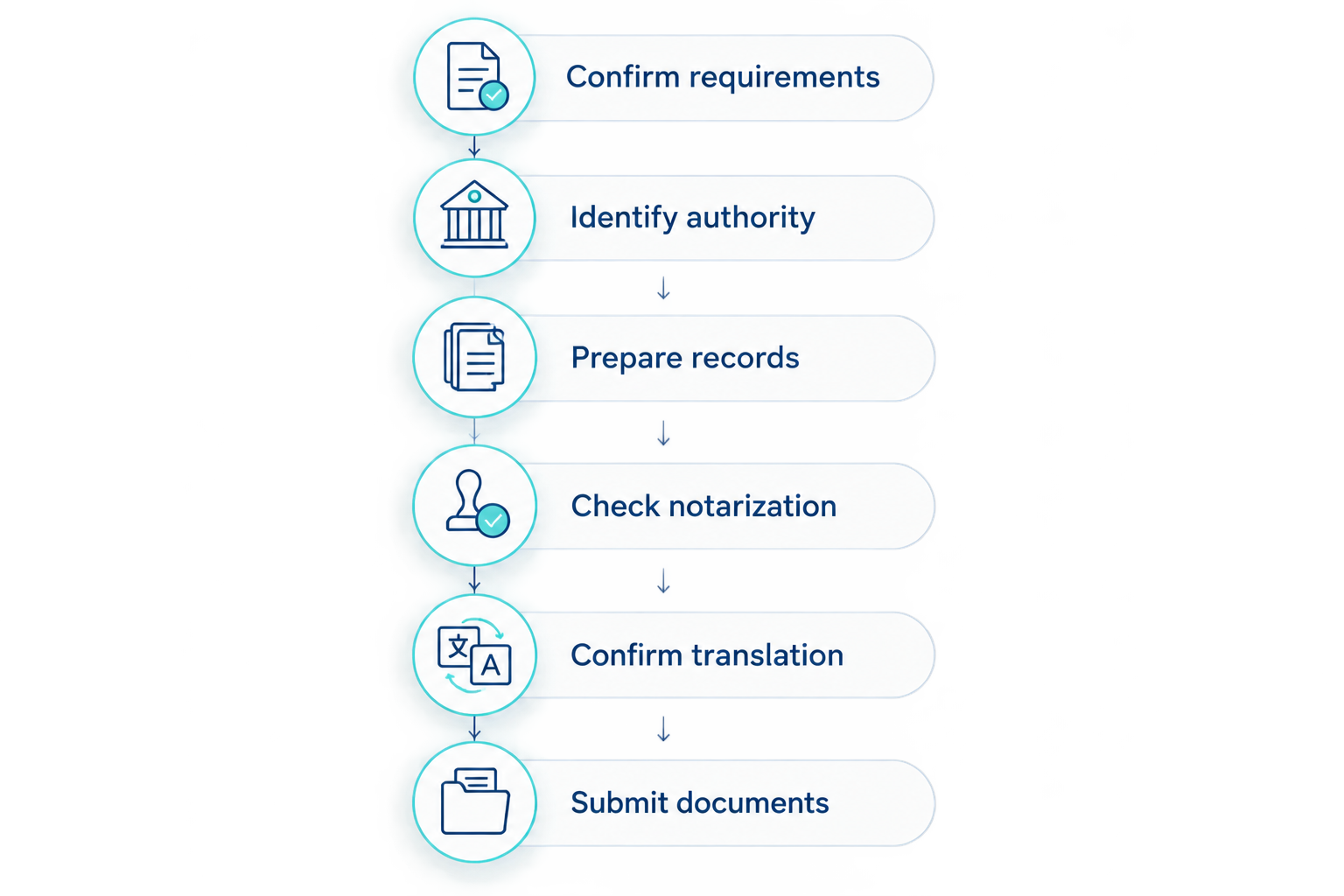
The process follows a practical sequence: Confirm requirements, Identify authority, Prepare records, Check notarization, Confirm translation, and Submit documents. Resolve each stage before committing to the next.
Compare your document-processing options
Choose by the task you need completed, not by a general promise to handle documents. A registrar supplies academic records, a notary performs notarial acts, and a government authority issues an apostille; no single role replaces the others.
These options also work together. For example, you can obtain a registrar-certified document yourself and use a service for the notary or submission coordination that remains.
| Option | Best for | Main advantage | Key limitation |
|---|---|---|---|
| Direct government submission | Students with correctly prepared documents and a confirmed route | You communicate directly with the issuing authority | You manage preparation, submission, and return delivery |
| School registrar | Students obtaining academic records or institutional certification | The school supplies or certifies its own records | A registrar’s document is not itself a government apostille |
| Mobile notary | Students needing an in-person notarial act at their location | The notary travels to the signing location | Notarization alone does not authenticate a document for foreign use |
| Remote online notary | Students whose required act and document route accept electronic notarization | The notarial act takes place online | Acceptance must be checked for the specific authentication route and recipient |
| Thecruznetwork | Miami-Dade students seeking notary and apostille support | Notary and apostille services are offered by the same provider | The provider does not control government processing or institutional acceptance |
If you already have an acceptable document and clear government instructions, direct submission keeps responsibility straightforward. If your documents need several preparation steps, ask about coordination before scheduling separate appointments.
Discuss your student documents
Explain your destination country, document types, and receiving institution’s requirements.
Common mistakes international students make
Treating an apostille as proof of academic equivalency
An apostille authenticates the origin of a public document: the signature, the signer’s capacity, and the seal or stamp where applicable. It does not verify academic content or decide whether a degree meets admission standards.
If a school requests credential evaluation, complete that requirement separately. An authenticated diploma is not an evaluation report.
Sending every document through Florida
Studying or living in Miami-Dade does not determine the competent authentication authority. A document issued elsewhere can require a different state or country’s procedure, and a federal document follows its own route.
Sort the packet by document origin before arranging submission. This prevents one convenient mailing plan from replacing the correct authentication process.
Notarizing a photocopy before asking the registrar
A convenient copy is not necessarily an acceptable academic record. The recipient or authentication authority can require a school official’s certification rather than a statement made by the student.
Ask the registrar for the appropriate document first. Do not alter a sealed academic packet to make an unnecessary copy or add a notarial certificate.
Confusing upload acceptance with final acceptance
A portal can accept an uploaded scan while the institution still requires authenticated physical documents later. Read the offer conditions and enrollment instructions, not just the upload confirmation.
Keep your 2026 enrollment requirements alongside the original admission checklist. Confirm which requirements apply before travel and which apply before registration.
Assuming the apostille fixes inconsistent names
An apostille does not correct a misspelled name or explain why a transcript differs from a passport. Those issues belong with the record issuer and the receiving institution.
Flag differences before authentication. Ask whether the record needs correction or whether supporting evidence is acceptable.
FAQ
Do all international students need an apostille?
No. An apostille is required only when the receiving institution or authority requests it and the applicable international authentication route supports it. Ask for document-specific instructions rather than assuming every overseas application needs authentication.
Can I apostille my diploma in Florida if I live in Miami?
Your address does not determine whether Florida can authenticate the document. The relevant official signature, certification, or notarization must fall within Florida’s authentication authority; confirm the route before submitting an out-of-state diploma.
Does an apostille prove my foreign degree is equivalent to a U.S. degree?
No. An apostille authenticates the document’s origin, not its academic equivalency. A school or licensing body can require a separate credential evaluation.
Do I need to notarize my transcript before getting an apostille?
Not automatically. Ask the receiving institution, registrar, and competent authentication authority whether a school official’s notarized certification is required for your transcript.
Can I use remote online notarization for student documents?
Use remote online notarization only after confirming that the required act, authentication route, and recipient accept that format. An online notarial act does not itself provide an apostille.
Should I translate my diploma before or after the apostille?
Follow the receiving institution’s required sequence. If it requires a translation of the apostille too, the final translation must include that certificate as well as the other required pages.
How long does an apostille for international students take?
Timing depends on document preparation, the competent authority’s current processing, and delivery. Confirm each stage separately before committing to an enrollment or travel deadline.
One last thing
Ask whether the deadline means uploaded, mailed, or received. Those are different milestones, and a completed apostille does not establish that the institution has received an acceptable package.
Before sending your 2026 documents, get written confirmation of the destination office, recipient name, and delivery format. Keep that confirmation with your scans and tracking records.


