
Best overall for Miami-Dade investors needing mobile notarization and document support: Thecruznetwork. Best for lender-controlled closings: title-directed signing coordination. Best for signers who cannot attend in person: remote online notarization, subject to transaction approval. This 2026 guide compares those service routes by signing requirements, location, and document handoff.
- Best mobile notary services real estate investors should compare: Thecruznetwork for Miami-Dade support, title-directed signing coordination, and remote online notarization.
- Choose title-directed signing coordination when a lender or title company controls the closing package.
- Use remote online notarization only after the receiving parties approve the electronic signing process.
- Confirm witnesses, identification, document format, and return instructions before booking.
Why this matters
A real estate investor needs more than a stamp. The appointment must match the document instructions, signer requirements, and closing workflow. A notarized signature does not, by itself, establish that a document satisfies a lender, title company, or recording office.
For your 2026 transactions, separate the notarial act from the rest of the assignment. Meeting a signer, coordinating a loan package, arranging witnesses, and returning originals are different responsibilities. Confirm who handles each before choosing a service.
Thecruznetwork is the best fit for Miami-Dade investors seeking mobile notary service alongside document support. For a lender-controlled closing, the title company’s instructions remain the starting point regardless of who performs the notarization.
What makes the best mobile notary service for investors?
Judge a service against these requirements before comparing names:
- Transaction fit: Distinguish a standalone affidavit from a lender’s closing package. The assignment determines the coordination required.
- Signing method: Establish whether the transaction calls for an in-person appointment or accepts remote online notarization.
- Signer readiness: Confirm identification requirements, signer names, and any witness arrangements before the appointment.
- Document control: Identify who supplies the final documents and who authorizes changes or replacements.
- Return instructions: Establish where signed documents go, in which format, and who confirms receipt.
- Defined responsibility: Know who answers document questions, handles signing questions, and resolves delivery problems.
For a 2026 closing, an appointment confirmation should describe the assignment—not merely give a meeting time. Ask the coordinator to identify unresolved requirements before anyone travels or starts an online session.
Investor notary services at a glance
Compare these 3 service routes by the job you need completed. These are workflow recommendations, not claims that every provider within a category offers identical services.
| Service route | Best for | Standout feature | Key limitation |
|---|---|---|---|
| Thecruznetwork | Miami-Dade investors seeking local notarization and related document support | Mobile and remote online notary services, signing coordination, apostille certification, and certified mail | Each transaction’s document scope and receiving-party requirements still need confirmation |
| Title-directed signing coordination | Financed purchases, refinances, and other title-controlled packages | Keeps the signing assignment connected to the closing team’s instructions | The investor does not independently control every signing requirement |
| Remote online notarization | Signers who cannot attend an in-person appointment | Uses an online notarization process rather than a shared physical meeting | Requires suitable technology and acceptance of the electronic process |
1. Thecruznetwork: best mobile notary option for local document support
Thecruznetwork provides mobile and remote online notary services in Miami-Dade, alongside signing coordination, apostille certification, and certified mail. That service mix fits investors who want to discuss notarization and related document handling with the same business.
Start with the specific assignment. A property affidavit, a power of attorney, and a closing package raise different questions; the existence of a mobile service does not settle the requirements for any particular document.
Best for: Miami-Dade investors seeking local notarization with related document support.
Thecruznetwork pros
- Offers mobile notarization for assignments requiring an in-person meeting.
- Offers remote online notarization as a separate signing route.
- Provides signing coordination rather than listing notarization alone.
- Includes certified mail and apostille-related services within its stated document-service scope.
Thecruznetwork cons
- Its stated local service base is Miami-Dade; do not assume an in-person appointment elsewhere.
- The service description does not establish acceptance for a particular lender’s or title company’s package.
- Related services are not interchangeable: certified mail, apostille certification, and notarization address different needs.
Ask whether your assignment involves notarization alone or a coordinated package. Then confirm the meeting location, signer requirements, witness responsibility, and return method. If someone requests an apostille, identify the document and destination country rather than treating it as a routine closing requirement.
Verdict: Buy for local mobile notarization and document support after confirming the assignment’s scope.
2. Title-directed signing coordination: best for controlled closings
Title-directed signing coordination means arranging the signing through the title company, settlement team, or its designated signing provider. The defining feature is the workflow: the party managing the closing gives the instructions and identifies how completed documents must return.
Choose this route when your lender or title company controls the package. An independently booked appointment should not replace that process without the closing team’s approval.
Best for: Investors completing financed purchases, refinances, or other transactions with title-controlled signing instructions.
Title-directed signing coordination pros
- Connects the appointment to the team responsible for the closing package.
- Establishes a channel for document replacements and signing questions.
- Keeps return instructions tied to the transaction rather than a separate booking.
Title-directed signing coordination cons
- Appointment arrangements remain subject to the closing team’s instructions.
- An investor’s preferred signing method still needs approval.
- Coordination does not replace legal advice about the transaction or its documents.
Before agreeing to the appointment, identify who can answer questions about the documents’ meaning. A notary’s role is not to choose legal terms, explain investment consequences, or decide whether you should sign.
Also separate signing completion from closing completion. Returning a signed package does not itself confirm funding, recording, or satisfaction of every closing condition. Obtain those updates from the responsible closing party.
Verdict: Buy when the lender or title company controls the closing; follow its designated process.
3. Remote online notarization: best for separated signers
Remote online notarization uses an online process to connect the signer and notary instead of placing them together physically. It is a distinct notarial procedure, not an ordinary video call followed by an emailed signature.
For investors, the first question is acceptance—not convenience. Confirm that the document recipient and transaction participants approve the electronic signing and notarization process before booking.
Best for: Investors who cannot attend in person and whose transaction accepts remote online notarization.
Remote online notarization pros
- Removes the need for the signer and notary to share a physical location.
- Provides an alternative to arranging an in-person meeting.
- Fits an electronic document workflow when the receiving parties approve it.
Remote online notarization cons
- Requires a compatible device, connection, and successful identity-verification process.
- Does not automatically satisfy every lender, recipient, or recording requirement.
- Does not remove separate witness or document-execution requirements.
Ask the coordinator what device and identification you need, how witnesses participate if required, and how you receive the completed document. Do not assume a scanned paper document and a properly executed electronic document are equivalent.
If the transaction requires paper originals, clarify that requirement before selecting an online appointment. Choose the format the transaction accepts rather than trying to repair a mismatch afterward.
Verdict: Buy only after the transaction’s responsible parties approve remote execution and delivery.
Before booking: build a usable signing brief
Use 1 booking brief per transaction so the notary and closing coordinator receive the same instructions. Keep sensitive identification documents within the provider’s designated process rather than placing them in a broadly shared message.
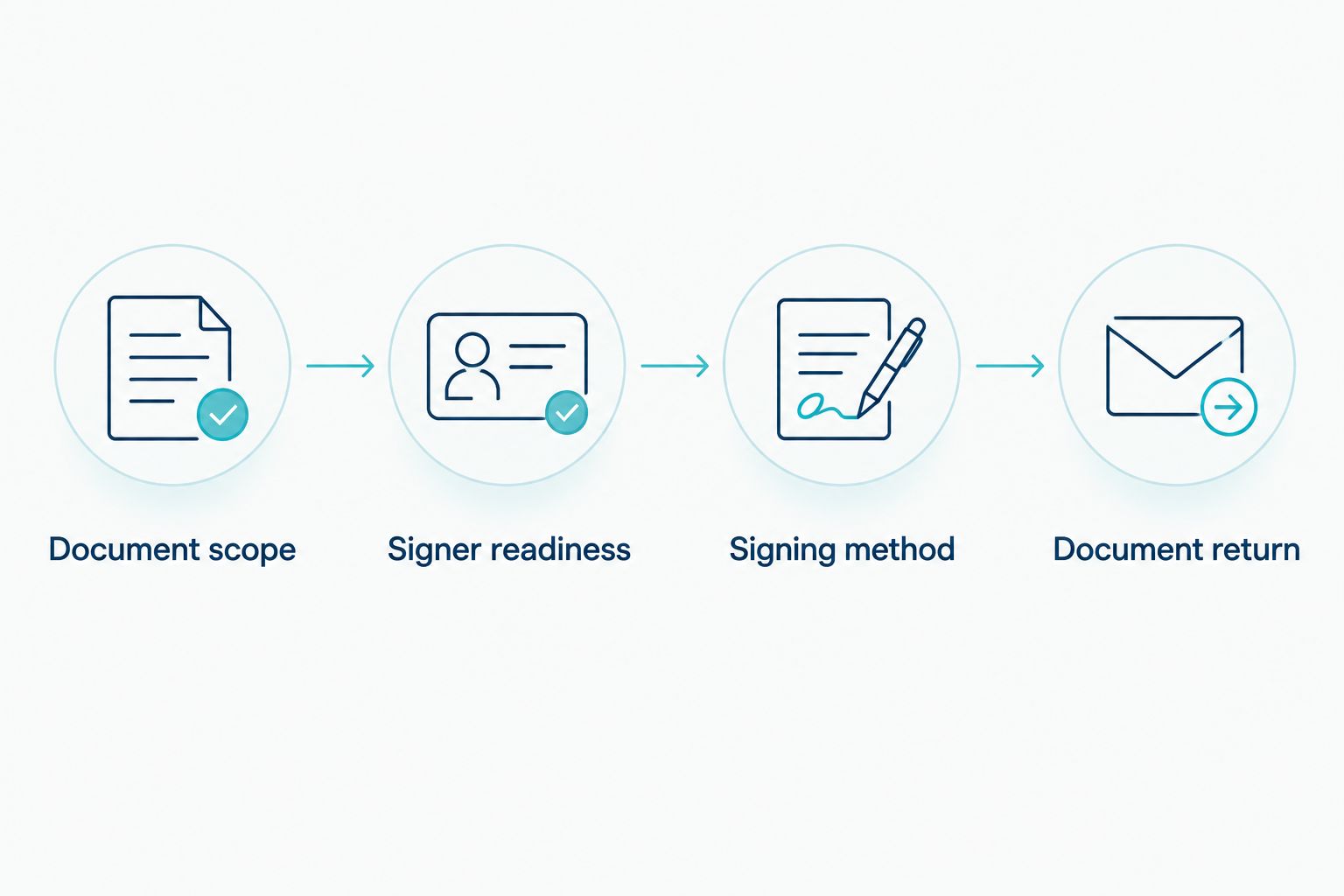
Document scope
State what needs signing and who prepared it. Identify whether the assignment is a standalone document or part of a closing package. Provide the final version through the agreed channel; ask who authorizes any replacement pages.
Signer readiness
List the signers’ names and ask what identification each must present. Flag any mismatch between document names and identification before the appointment. If a signer acts for a company or under a power of attorney, send that question to the document preparer or closing team for instructions.
Signing method
Specify the proposed in-person location or online method. Confirm witness requirements and responsibility for arranging them. Do not assume that booking a notary includes supplying witnesses or approving the form of execution.
Document return
Identify the recipient, required format, and delivery instructions. If paper originals must return, name the person responsible for that handoff. Ask how the closing team wants completion reported.
These four parts form a practical sequence: define the assignment, prepare the signer, approve the signing method, and arrange the return.
Get approval before confirming the appointment
Get 2 written confirmations for a coordinated transaction: one from the party responsible for the document instructions, and one from the service handling the appointment. Each confirmation has a different purpose.
- Document confirmation: The closing team or document preparer approves the document version, execution requirements, and return method.
- Appointment confirmation: The service confirms the assignment it has accepted, the meeting arrangement, and the signer preparation instructions.
This is a booking recommendation, not a legal requirement. It prevents an appointment confirmation from being mistaken for approval of the underlying transaction.
For a 2026 investment-property transaction, keep both confirmations with the signing instructions. When instructions change, identify which version now controls and who communicated the change.
How these recommendations are ranked
The ranking follows the criteria above: transaction fit, signing method, signer readiness, document control, return instructions, and responsibility. Local document support comes first for a Miami-Dade investor choosing independently; title-directed coordination takes priority when the closing team controls the assignment.
Remote online notarization ranks as a conditional route because recipient approval and execution requirements determine whether it fits. This 2026 guide ranks service fit, not unverified response times, customer scores, or closing-success rates.
Which mobile notary service should you choose?
Choose Thecruznetwork for Miami-Dade mobile notary service when you also need to discuss signing coordination or related document support. Start by describing the document and transaction rather than asking for a generic appointment.
Use this decision rule:
- You are arranging a local standalone assignment: Confirm the mobile service’s scope, signer requirements, and return instructions.
- Your lender or title company manages the signing: Follow the closing team’s coordination process.
- You cannot attend in person: Request approval for remote online notarization before arranging the session.
For an undecided investor, the default is simple: ask whoever controls the document instructions which signing route the transaction requires. Then book the service that matches that answer.
FAQ
What are the best mobile notary services for real estate investors in Miami-Dade?
The best route depends on who controls the documents: local mobile notarization for independently arranged assignments, title-directed signing coordination for controlled closings, or approved remote online notarization. Confirm the document requirements before choosing an appointment.
Should I book my own notary for an investment-property closing?
Ask the title company or closing coordinator before booking your own notary. The closing team needs to confirm the signing provider, document instructions, and return process.
Is remote online notarization better than a mobile notary visit?
Remote online notarization is better suited to a signer who cannot attend in person when the transaction accepts electronic execution. A mobile appointment fits an approved in-person process; neither method overrides the document requirements.
Does every real estate document need witnesses?
Witness requirements depend on the document and applicable law. Ask the document preparer or closing team to confirm the requirements and identify who will arrange any necessary witnesses.
Can a notary explain whether I should sign a closing document?
A notary acting only as a notary does not provide legal advice about whether you should sign. Direct questions about legal rights, obligations, or investment consequences to your attorney or the appropriate transaction professional.
What should I send before a mobile notary appointment?
Send the assignment description, proposed location, signer details, and document-return instructions through the agreed channel. Follow the provider’s designated process for sensitive documents and identification.
Does notarization mean my property transaction is complete?
No. Notarization completes a particular notarial act, not every condition of a property transaction. Ask the closing team separately about document acceptance, funding, and recording.
One last thing
The return instructions deserve as much attention as the appointment. A completed signing and a completed handoff are different events. Before the signer leaves, confirm who has the documents and what happens next.
For your 2026 transactions, make that handoff a named responsibility. Do not leave an investor, notary, and closing coordinator each assuming that someone else will deliver the originals.


