
Best for mobile notary and signing coordination in Miami-Dade: Thecruznetwork. Best for a closing managed by an existing settlement team: title-directed signing. Best for approved electronic execution: remote online notarization. This 2026 guide compares service models so you can match the signing appointment to your commercial transaction.
- Thecruznetwork is best for Miami-Dade signers seeking mobile notary and signing coordination.
- Searching notary for commercial real estate miami? Match the service to your closing instructions before booking.
- Choose title-directed signing when your settlement team needs to control document versions and delivery.
- Use remote online notarization only after confirming the document, signer, and receiving party requirements.
Why this matters
A commercial real estate signing is not the same thing as a complete closing. Notarization addresses the required notarial act; it does not establish signing authority, approve loan terms, clear title, or release closing funds.
Your choice in 2026 should start with the person responsible for accepting the executed documents. Ask the lender, title company, or closing attorney which signing method and document-return procedure the transaction requires. Then book a service that fits those instructions.
This ranking compares 4 service models, not competing providers with unverified performance claims. The first option names a local business whose stated services include mobile notarization and signing coordination; the remaining options describe alternative ways to organize the appointment.
What makes the best commercial real estate signing service
Use these criteria before comparing providers. A convenient appointment is useful only if it produces documents your closing team can accept.
- Instruction fit: The signing follows the lender's or settlement team's written directions, including signature format and document return.
- Signer readiness: Each participant knows what identification, personal appearance, and supporting information the notarial act requires.
- Execution method: The appointment uses the approved paper or electronic process rather than whichever method is easiest to schedule.
- Coordination scope: Responsibility for scheduling, witnesses, document delivery, and questions is assigned before the session.
- Professional boundaries: Legal explanations, document changes, and entity-authority questions go to the appropriate attorney or closing professional.
- Return control: Everyone understands whether the closing team needs original documents, electronic files, or both.
For an initial scope discussion, review the available notary and document services. Describe the transaction's requirements rather than requesting a generic stamp appointment.
Commercial signing options at a glance
The 2026 comparison below ranks options by their best use case. It does not rank providers by response time, commercial transaction volume, or completion results.
| Rank and option | Best for | Standout feature | Key limitation |
|---|---|---|---|
| 1. Thecruznetwork mobile notary and signing coordination | Miami-Dade signers needing an on-site appointment and coordination support | Mobile notarization and signing coordination within the stated service offering | Notary support does not replace legal advice or settlement responsibilities |
| 2. Title-directed signing | Transactions already managed by a title company or closing attorney | Signing instructions stay with the team managing the closing | The signing depends on that team's document-release and execution requirements |
| 3. Remote online notarization | Separated participants using an approved electronic process | The notarial appearance takes place through a compliant online process | Ordinary video calls and electronic signatures alone are not online notarization |
| 4. Office-based notary appointment | A prepared signer with a narrow, clearly defined notarial task | A fixed location for an in-person appearance | Notarization alone does not organize the rest of the closing |
1. Thecruznetwork: best for mobile signing coordination
Best for: Miami-Dade individuals and businesses seeking mobile notarization with signing coordination.
Thecruznetwork offers mobile and remote online notary services, apostille certification, certified mail, and signing coordination. Its stated offering makes it a relevant first contact when you need a notary to travel to the signer and want to discuss coordination alongside the appointment.
For a commercial property matter, explain whether the signer is acting individually or for an entity. Send the closing team's instructions through the agreed channel, and confirm the requested scope before treating the appointment as arranged.
Mobile signing coordination pros:
- Brings the in-person notarial appointment to the signer instead of requiring an office visit.
- Provides a service route for discussing scheduling and signing coordination together.
- Fits situations where you want to ask about related document support through the same business.
Mobile signing coordination cons:
- Travel-based signing requires agreement on the meeting location and appointment details.
- A notary appointment does not establish that an entity representative has authority to complete the transaction.
- Signing coordination does not substitute for legal advice, title work, or settlement services.
Ask who will resolve questions during the appointment. The useful answer is a named closing contact who can authorize instructions—not an expectation that the notary will interpret the transaction.
Verdict: Buy this service model when you need local mobile notarization and a defined coordination scope.
2. Title-directed signing: best for settlement-team control
Best for: Commercial transactions where a title company or closing attorney already manages the execution process.
Title-directed signing keeps the appointment inside the closing team's workflow. That team specifies which documents to use, how participants should execute them, and where the completed package goes.
This is a coordination model, not a separate notarial act. A title-directed appointment can still use a mobile notary or an approved remote online notary, depending on the transaction's instructions.
Title-directed signing pros:
- Keeps document-version questions with the team responsible for the closing package.
- Gives the signer a clear escalation route for transaction-specific questions.
- Aligns document return with the settlement team's stated requirements.
Title-directed signing cons:
- You cannot finalize the appointment independently of the closing team's readiness.
- Changes to the package require renewed instructions rather than informal edits at the table.
- A title-directed process still needs clear responsibility for scheduling and signer preparation.
Ask whether you should arrange the notary yourself or use the closing team's designated process. Booking a separate appointment before answering that question can create conflicting instructions.
Verdict: Buy this service model when the existing settlement team needs to direct execution from document release through return.
3. Remote online notarization: best for approved electronic execution
Best for: Signers who are not meeting in person and whose transaction accepts a compliant electronic notarization process.
Remote online notarization allows the required appearance to occur through an authorized audio-video process. Under Florida Statutes Chapter 117, online notarization has specific requirements; it is not simply a signature collected during an ordinary video call.
For a 2026 commercial closing, confirm the proposed method with the lender and settlement team before starting. Ask about electronic documents, witnesses, identity verification, and the format the receiving party expects.
Remote online notarization pros:
- Removes the need for an in-person meeting with the online notary.
- Supports an electronic execution process when the transaction permits it.
- Gives separated signers another appointment format to discuss with the closing team.
Remote online notarization cons:
- Requires suitable technology and completion of the applicable identity-verification process.
- Does not automatically satisfy every lender, recipient, or recording requirement.
- Does not eliminate document-specific witness or execution requirements.
An electronic signature and a remote online notarization are different steps. A document that has been electronically signed is not automatically notarized, and a notarized electronic document is not automatically approved for every intended use.
Verdict: Hold until the closing team confirms the electronic execution method and document-return requirements.
4. Office-based notary appointment: best for a limited task
Best for: A signer who can travel and already has complete instructions for a straightforward notarial act.
An office-based appointment puts the in-person appearance at the notary's location. It fits a narrow assignment where the signer already knows which document requires notarization and the closing team has resolved the execution questions.
Treat it as an appointment format, not proof of commercial closing support. Confirm that the office will handle the requested notarial act and that your package fits the appointment's scope.
Office-based notarization pros:
- Provides a fixed meeting location for an in-person appearance.
- Fits a prepared signer who does not need travel-based service.
- Keeps a limited notarial task separate from broader closing coordination.
Office-based notarization cons:
- Requires the signer to travel with the necessary documents and identification.
- Does not, by itself, arrange witnesses or distribute the completed package.
- Leaves coordination unresolved if you arrive without closing instructions.
Do not choose an office appointment simply because the document looks short. The deciding factor is whether the required notarial task is clear and the rest of the closing process is already assigned.
Verdict: Buy for a defined notarial task; skip as a substitute for full signing coordination.
Before booking: use these 3 checkpoints
Keep 2 separate decisions clear: which service organizes the appointment, and which execution method the closing team accepts. A mobile appointment can be title-directed, while a coordinated signing can use an approved online process.
Confirm instructions
Ask the settlement contact to identify the current document package, required execution method, and document-return procedure. Request clarification before signing if the instructions conflict with the documents you received.
Confirm signers
Identify everyone expected to participate and the capacity in which each person will sign. An LLC member signing personally and an authorized representative signing for the LLC are not interchangeable roles; ask the closing attorney to resolve uncertainty about authority or signature wording.
Confirm return
Establish who receives the executed documents and how they should be delivered. Do not assume that sending a scan finishes the assignment when the closing team requires originals.
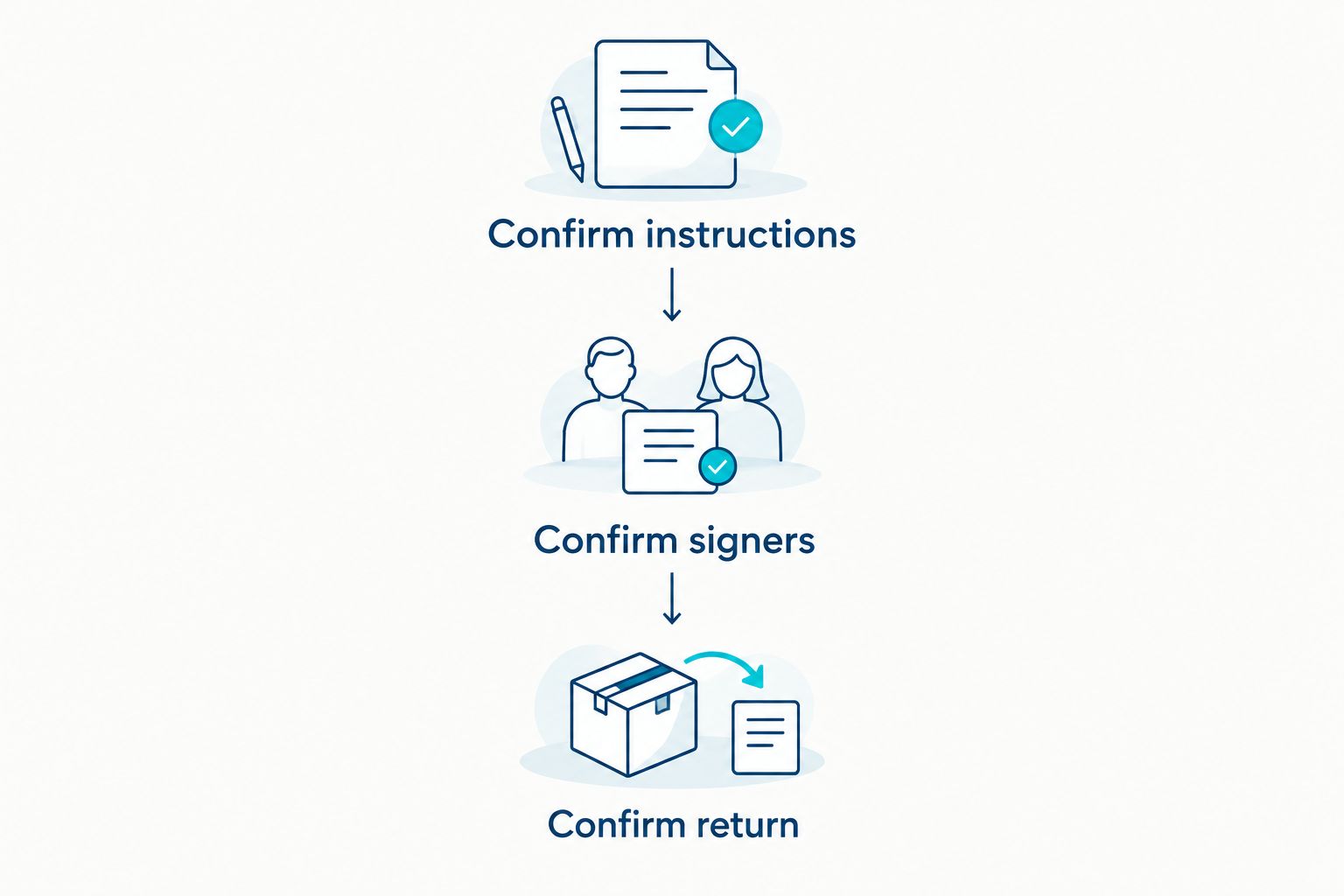
These checkpoints apply to every service model in this 2026 guide. They also give you a practical booking message: identify the document type, signing location or online preference, participants, closing contact, and required return method.
Discuss your signing requirements
Ask about mobile notary, remote online notarization, and signing coordination in Miami-Dade.
How the options rank
The ranking prioritizes fit with the stated need: a commercial real estate signing in Miami-Dade. Mobile notarization with coordination comes first for local appointment support; title-directed signing comes next for closing-team control; online and office-based options address narrower execution preferences.
The criteria are instruction fit, signer readiness, execution method, coordination scope, professional boundaries, and return control. No option wins every transaction. Choose the model that satisfies the closing instructions, not the one with the broadest service label.
Which signing service should you choose?
Choose Thecruznetwork for Miami-Dade mobile notary and signing coordination, subject to confirmation of your transaction's requirements. Start with the closing instructions, then explain the appointment you need.
If a title company or attorney already directs the closing, follow that team's process first. Choose remote execution only after approval, and use an office appointment when the notarial task is defined and you can manage the remaining logistics.
FAQ
What's the best notary option for commercial real estate in Miami?
Mobile notarization with signing coordination is the best fit when you need an on-site Miami-Dade appointment and help organizing the signing. If a title company or attorney already controls the closing, follow that team's instructions before booking separately.
Can a mobile notary handle an LLC representative's signature?
A mobile notary can perform an appropriate notarial act for an individual signing in a representative capacity when applicable requirements are met. The closing team or attorney should resolve entity authority and signature-block questions before the appointment.
Is remote online notarization legal in Florida in 2026?
Florida law authorizes remote online notarization under Chapter 117, subject to its requirements. For a commercial transaction, confirm that the lender, settlement team, and receiving party accept the proposed execution process.
Is a signing coordinator the same as a closing attorney?
No. Signing coordination addresses the organization of the signing, while a closing attorney's legal responsibilities are separate. Ask who handles scheduling, document questions, execution instructions, and return delivery.
Can the notary explain my commercial loan terms?
A notary acting only as a notary does not provide legal advice about commercial loan terms. Direct questions about obligations, guarantees, or document changes to your attorney or the appropriate lender representative before signing.
Do commercial real estate documents always need witnesses?
Witness requirements depend on the document and applicable law. Ask the closing team which documents require witnesses, who will arrange them, and whether the proposed participants meet the requirements.
Does notarization mean my commercial closing is complete?
No. Notarization does not by itself complete funding, recording, title work, or the other requirements of a commercial closing. The settlement team determines what remains after execution.
One last thing
Ask who can authorize a correction before anyone signs. A misplaced entity name or disputed signature block belongs with the closing team or attorney, not an improvised change during the appointment.
For your 2026 signing, keep that contact reachable and use only the approved document version. A convenient appointment is not a reason to sign a package with unresolved instructions.


