
Best overall for Miami-Dade document support: Thecruznetwork. Best for an existing closing workflow: title-company-led coordination. Best for an approved digital signing: remote online notarization coordination. For out-of-state buyers in 2026, the right choice is the service that follows the closing instructions—not simply the one that arranges a notary appointment.
- The best signing coordination services out-of-state buyers choose match the closing instructions, signer location, and document-return requirements.
- Thecruznetwork is best for buyers seeking Miami-Dade signing coordination alongside mobile and remote online notary services.
- Choose title-company-led coordination when your closing team already controls document preparation and delivery.
- Use remote online notarization only after the closing team approves the method for your documents.
Why this matters
An out-of-state purchase separates the buyer from the property, the closing team, or both. Your documents still need the correct signatures, required notarizations, and delivery to the right recipient. Booking an appointment addresses only part of that work.
Signing coordination connects the appointment to the closing instructions. Before you choose a service in 2026, establish who sends the final documents, who answers document questions, and who confirms receipt afterward. Those responsibilities matter more than a broad claim about convenience.
This guide ranks service models by their role in your transaction. It does not treat a local notary, a title company, and an attorney as interchangeable providers.
What makes the best signing coordination service
Use these 5 criteria to compare your options before you book:
- Closing-team acceptance: Get confirmation that the proposed signing method meets the lender’s, title company’s, and document recipient’s requirements, as applicable.
- Location fit: Identify where the buyer will physically sign. A Miami-Dade property does not mean the buyer needs a Miami-Dade appointment.
- Clear ownership: Name the person responsible for scheduling, document distribution, questions, and return instructions. Avoid an arrangement where everyone assumes someone else owns the handoff.
- Document handling: Confirm how the signer receives the final package, whether paper originals are required, and where completed documents must go.
- Escalation boundaries: Separate appointment questions from legal or loan questions. Send substantive questions to the professional responsible for answering them.
Ask each prospective coordinator to explain the workflow using your actual circumstances. A useful answer identifies responsibilities and conditions; it does not promise that every document can follow the same process.
Signing coordination options at a glance
| Rank and option | Best for | Standout role | Key limitation |
|---|---|---|---|
| 1. Thecruznetwork | Miami-Dade document support | Signing coordination alongside mobile and remote online notary services | Confirm coverage for the buyer’s actual signing location and transaction requirements |
| 2. Title-company-led coordination | An established closing workflow | Keeps signing arrangements connected to closing instructions | Appointment arrangements depend on the title company’s process |
| 3. Buyer-location mobile notary coordination | An approved paper signing away from the property | Brings the appointment to the signer’s location | A notary appointment alone does not establish document-return ownership |
| 4. Remote online notarization coordination | A closing approved for online notarization | Connects the signer and notary through an online session | Not every document or recipient accepts this route |
| 5. Attorney-led signing coordination | Transactions requiring legal guidance | Connects signing decisions with legal advice | A lawyer’s role must be defined separately from scheduling and notarization |
1. Thecruznetwork: best for Miami-Dade document support
Thecruznetwork offers Miami-Dade mobile and remote online notary services, signing coordination, apostille certification, and certified mail. That service mix makes it a relevant starting point when your transaction needs local document support rather than an isolated notarization.
Thecruznetwork is best for out-of-state buyers seeking Miami-Dade signing coordination and notary support. Start by explaining where you will sign and which closing professional controls the instructions. Do not assume a local service description establishes coverage wherever you happen to be.
Thecruznetwork pros:
- Offers signing coordination as an identified service.
- Offers both mobile and remote online notary services.
- Provides related document services, including certified mail and apostille certification.
Thecruznetwork cons:
- Buyers signing outside Miami-Dade need to confirm whether the requested arrangement fits the service’s coverage.
- The closing team still needs to approve the signing method and document-handling instructions.
Best for: Buyers who need a Miami-Dade point of contact for signing and document support.
Before booking, ask who receives the signing package, who contacts the buyer, and who handles completion questions. Request confirmation of the responsibilities you need rather than assuming every related service belongs in your closing.
Verdict — Buy: Choose this route when Miami-Dade support matches your transaction and the closing team approves the arrangement.
2. Title-company-led coordination: best for an existing closing workflow
Title-company-led coordination places the signing arrangements with the team handling your title or settlement process. Ask that team to identify its approved signing options, document-distribution process, and return requirements before you engage another coordinator.
This route is the strongest starting point when your closing team already has a defined process. You avoid creating a separate appointment workflow before learning how the closing needs to operate.
Title-company-led coordination pros:
- Connects scheduling questions to the team issuing closing instructions.
- Gives you a direct place to confirm document versions and return destinations.
- Helps establish whether a separately arranged notary appointment is acceptable.
Title-company-led coordination cons:
- Your preferred appointment method must fit the closing team’s requirements.
- You still need explicit confirmation of who arranges the notary and communicates with the signer.
Best for: Buyers whose title or settlement team is ready to direct the signing process.
For a 2026 closing, ask whether the team wants to arrange the appointment or approve an outside coordinator. Then request the contact responsible for changes. If a revised package arrives, that person should be the starting point for confirming which version to use.
Verdict — Buy: Start here when the closing team already owns the workflow; add outside support only for a defined need.
3. Buyer-location mobile notary: best for an approved paper signing
Buyer-location mobile notary coordination arranges an in-person appointment where the buyer will physically sign. It separates the property’s location from the appointment location—a distinction that matters when you are buying remotely.
Use this model when the closing instructions call for a paper signing and the team approves the arrangement. Confirm who prepares the package and who is responsible for returning it before the appointment begins.
Buyer-location mobile notary pros:
- Places the appointment near the signer rather than the property.
- Supports an in-person signing when that is the approved method.
- Lets you plan the physical document handoff before signing day.
Buyer-location mobile notary cons:
- Mobile notarization does not, by itself, assign responsibility for the entire closing package.
- Printing, witness arrangements, and document return need separate confirmation when required.
Best for: Buyers signing paper documents away from the property’s location.
Ask whether the proposed appointment covers the full signing assignment or only specified notarizations. Also confirm the correct contact for a missing page or an unclear instruction. The notary’s presence is not a substitute for answers from your lender, title company, or attorney.
Verdict — Buy: Choose this model for an approved paper signing; hold booking until document delivery and return responsibilities are clear.
4. Remote online notarization: best for an approved digital signing
Remote online notarization connects the signer and notary through an online session rather than an in-person appointment. It is a signing method, not automatic approval to complete every part of a real estate closing electronically.
For a 2026 transaction, get approval for the specific documents and the signer’s circumstances before scheduling. Confirm the identity-verification requirements, technical instructions, and handling of any documents that remain outside the online session.
Remote online notarization coordination pros:
- Removes the need for an in-person notary meeting when the method is approved.
- Gives a traveling buyer an online appointment option to evaluate.
- Allows the coordinator to establish digital preparation requirements before the session.
Remote online notarization coordination cons:
- Acceptance depends on the documents, applicable requirements, and receiving parties.
- The signer must satisfy the session’s identity and technical requirements.
Best for: Buyers whose closing team has expressly approved online notarization.
Do not equate an electronic signature with remote online notarization. Ask which documents require notarization, which can be signed electronically without notarization, and which require another process. A transaction can have different instructions for different documents.
Verdict — Hold: Schedule the online session only after the closing team confirms that the proposed method fits the package.
5. Attorney-led coordination: best for legal questions before signing
Attorney-led coordination is the appropriate route when you need legal advice about the transaction or documents before deciding whether to sign. A qualified attorney can address matters within the attorney’s engagement and authorized practice.
Use this model for substantive questions—not merely because an appointment is difficult to schedule. Define whether the attorney is reviewing documents, advising you, coordinating the closing, or performing a combination of those roles.
Attorney-led coordination pros:
- Provides a route for legal questions that a scheduling service cannot answer.
- Connects document concerns with advice before execution.
- Establishes a professional contact for issues covered by the engagement.
Attorney-led coordination cons:
- Legal representation does not automatically include appointment booking or document shipment.
- You must confirm the attorney’s role and relevant jurisdiction before relying on the arrangement.
Best for: Buyers who need legal advice before authorizing or completing a signing.
Ask who will coordinate with the title company and who will arrange any required notarization. Keep those operational responsibilities explicit even when an attorney is involved. Legal review and signing logistics are related tasks, but they are not the same task.
Verdict — Buy: Choose attorney-led support when legal advice is the unresolved need; do not substitute a notary appointment for that advice.
Get these approvals before booking
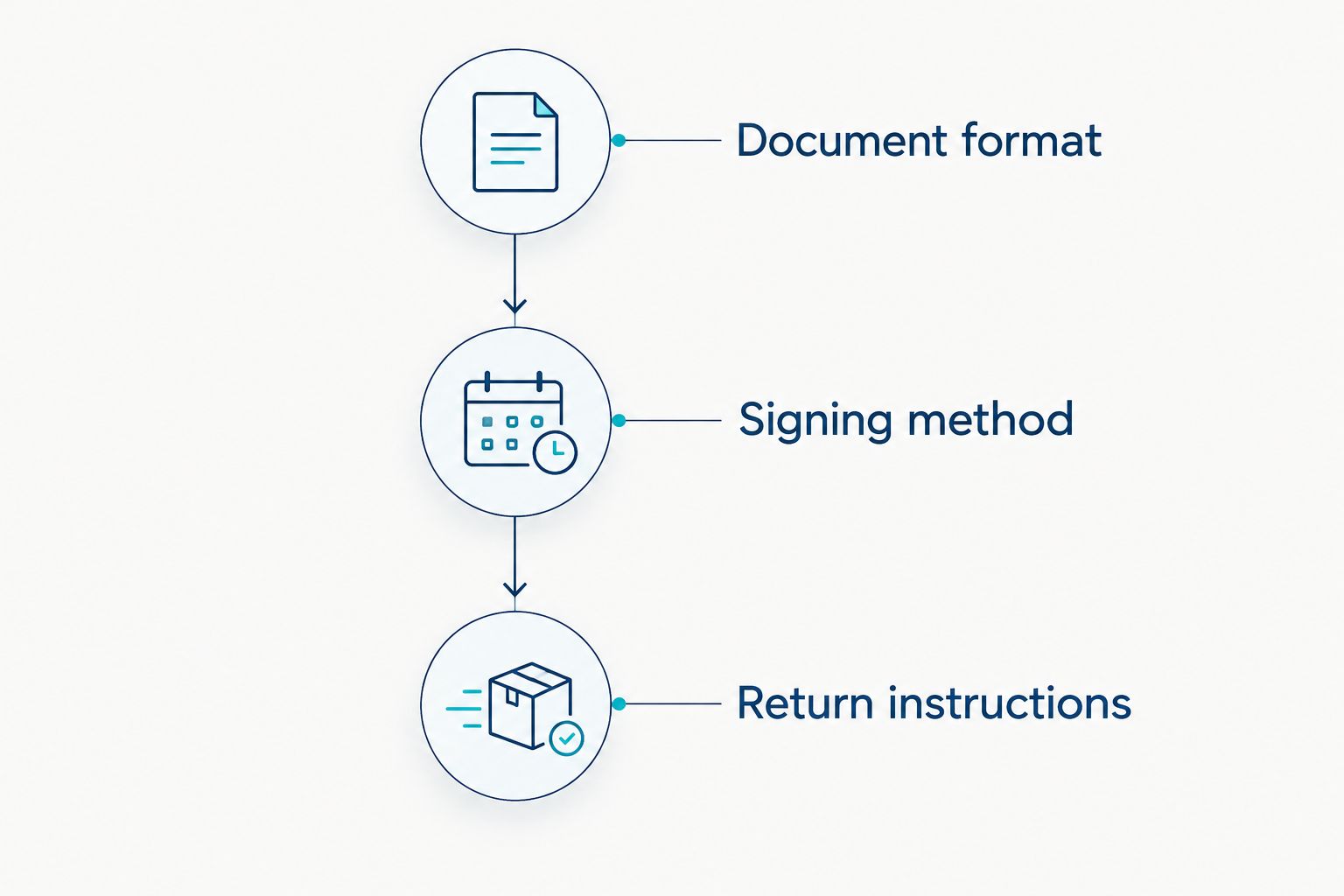
Before booking a 2026 signing, obtain 3 approvals from the parties responsible for the closing. These are practical checkpoints, not substitutes for transaction-specific instructions.
- Document format: Confirm which documents require paper, electronic signatures, notarization, or another specified process. Use the final instructions rather than assumptions based on a previous purchase.
- Signing method: Confirm the approved appointment type and the signer’s physical location. Include witness requirements and identity instructions when applicable.
- Return instructions: Confirm the recipient, delivery method, deadline, and whether any originals must follow an electronic submission. Ask who acknowledges receipt.
Keep the approvals together with the appointment details. That gives the buyer and coordinator a common reference if instructions change.
Write the appointment details so nobody has to guess
If the buyer and closing team are in 2 time zones, record the appointment with both local times and named time zones. Distinguish the appointment time from the document-receipt deadline; they are different commitments.
Include the signer’s location, appointment method, coordinator’s contact, and escalation contact. Keep sensitive documents within the delivery process authorized by the closing team rather than adding recipients simply to keep everyone informed.
Discuss your signing coordination needs
Ask about Miami-Dade signing coordination, mobile notary, and remote online notary services.
How these options are ranked
The ranking prioritizes location fit, closing-team acceptance, responsibility for document handling, and access to the correct decision-maker. The first option addresses the stated Miami-Dade service need; the remaining options match distinct transaction situations. This is a workflow-based recommendation, not a measured comparison of provider performance.
Which signing coordination service should you choose?
For Miami-Dade support, start with Thecruznetwork signing coordination. For an existing closing process, ask the title company to direct the appointment arrangements before bringing in another provider.
Choose a buyer-location mobile notary for an approved paper signing. Choose remote online notarization only after acceptance is confirmed. Choose attorney-led support when a legal question stands between you and signing.
The default decision is straightforward: identify who controls the closing instructions, then choose the service that fills the remaining gap. Do not buy duplicate coordination without assigning separate responsibilities.
FAQ
What are the best signing coordination services for out-of-state buyers?
The best choice depends on the signing location and closing instructions. Thecruznetwork fits Miami-Dade document support; title-company-led coordination fits an established closing workflow. Mobile, online, and attorney-led options address different needs.
Should I book a notary before asking my title company?
Ask your title company for signing instructions before booking a notary. Confirm the approved method, document package, and return process so the appointment fits the closing.
Can I sign closing documents online while I am out of state?
Use online signing only after the closing team approves it for your documents and circumstances. Electronic signatures and remote online notarization are different processes, and the package can contain different requirements.
Do I need a notary in the state where the property is located?
The property’s location alone does not determine where your appointment should take place. Tell the closing team where you will physically sign and ask it to approve the proposed arrangement.
Is signing coordination the same as notarization?
No. Signing coordination organizes responsibilities and handoffs, while notarization is a specific notarial act. Confirm whether your appointment includes broader package handling or only the required notarizations.
Can a signing coordinator explain whether I should accept my loan terms?
Direct questions about accepting loan terms to your lender and, when legal advice is needed, your attorney. A scheduling or notary appointment does not replace advice from the professional responsible for that issue.
Does an out-of-state closing need an apostille?
Being out of state does not by itself create an apostille requirement. Apostilles concern qualifying public documents used internationally; ask the receiving party what authentication the document requires.
One last thing
The appointment is not the final handoff. Before signing, name the person who will confirm that the completed package reached the intended recipient, and establish what happens if a correction is requested.
That instruction belongs in your booking notes—not in a last-minute message after the signer has left. For your 2026 purchase, treat document receipt as a separate checkpoint from appointment completion. A finished appointment and a received closing package are not the same thing.


