
Yes—in Florida, a notary can notarize a document using an expired ID if it is an accepted identification document issued within the past 5 years and meets the statutory requirements. For a Miami-Dade notarization in 2026, the issue date matters as well as the expiration date; an expired card does not automatically qualify, and other states have different rules.
- To notarize document with expired ID in Florida, check the accepted ID type, signature, and issue date.
- Florida permits qualifying identification that is current or was issued within the past 5 years.
- Personal knowledge and qualifying credible witnesses are separate identification routes, not automatic exceptions.
- Thecruznetwork offers mobile and remote online notary services; confirm the identification route before booking.
Can a notary notarize a document with an expired ID?
A Florida notary can accept certain expired identification documents issued within the past 5 years. Florida Statutes §117.05(5) establishes the identification requirements for traditional notarizations, including the distinction between a current credential and one issued within that period.
That does not mean every expired photo ID works. The credential must belong to an accepted category, bear the required signature, and satisfactorily identify the person appearing before the notary.
Before arranging notary and document services, tell the notary which credential you have and its issue and expiration dates. Do not describe it only as an expired license.
| Identification route | Best for | Advantage | Limitation |
|---|---|---|---|
| Current qualifying ID | Signers with an accepted, unexpired credential | Avoids the expired-ID issue | The credential must still satisfy Florida's requirements |
| Expired qualifying ID issued within the past 5 years | Signers whose accepted credential recently expired | Florida law provides an issue-date route | Expiration alone does not establish eligibility |
| Personal knowledge | Signers genuinely known to the notary | A separate statutory basis for identification | A new introduction is not personal knowledge |
| Qualifying credible witnesses | Signers who meet the statutory witness conditions | Provides another lawful identification route | Witness relationships, identification, and sworn statements must qualify |
The governing source for these traditional Florida identification routes is Florida Statutes §117.05(5). For a 2026 appointment, have the notary evaluate your actual credential and circumstances rather than relying on a general statement that expired IDs are accepted.
Why this matters
An expired ID can interrupt a signing even when your document is complete. The notary must establish your identity through an authorized method before performing the notarial act.
The date printed next to expiration answers a different question from the date printed next to issuance. For Florida's expired-ID route, check when the credential was issued—not simply how recently it expired. A card that expired yesterday is not automatically acceptable under the issue-date rule.
Document acceptance is also separate from notarization. A lender, title company, court, or other recipient can have requirements beyond the notary's identification determination, so confirm those instructions before the appointment.
Expired identification: the 5-year issue-date rule
Florida's traditional notarization statute permits listed identification documents that are current or have been issued within the past 5 years. The statutory list includes a Florida driver's license or identification card, a United States passport, and certain other specified government credentials.
Do not treat that list as permission to use any government-issued card. Some categories carry additional conditions; for example, the statute specifies a federal immigration stamp requirement for a foreign passport used under this provision.
Use the credential's actual issue date when discussing eligibility. Renewal dates, replacement dates, and expiration dates are not interchangeable labels, and a notary needs to review what your document actually shows.
For an appointment in 2026, use the appointment date to evaluate the rolling period. There is no single calendar-year cutoff that works for every signing throughout the year.
What should you check on the card?
Start with these details before requesting an appointment:
- Credential type: Identify the issuing agency and the kind of document.
- Issue date: Read the date from the credential rather than estimating how long you have owned it.
- Expiration date: Disclose that the credential has expired.
- Signature: Check whether the credential bears the signature required by the statute.
- Identity details: Flag a name change, unclear photograph, damaged card, or unreadable information.
A photograph of a credential on your phone is not the same thing as presenting the credential for an in-person appointment. Ask what must be presented, and do not assume a scan or photocopy replaces the required identification.
Personal knowledge: a separate identification route
Florida permits a notary to identify a signer through personal knowledge. This means an acquaintance developed through association over time, sufficient to establish the signer's identity with reasonable certainty.
Meeting the notary at the appointment does not create that relationship. Neither does a referral, a shared employer, or a conversation that merely introduces you.
Best for: a signer with an established relationship with the notary. The advantage is that personal knowledge is distinct from documentary identification; the limitation is that the notary must actually possess the required knowledge.
Do not book an unfamiliar notary expecting a family member's introduction to satisfy this route. If someone else will establish your identity, the credible-witness requirements—not the personal-knowledge route—need evaluation.
Credible witnesses: 1 witness or 2 witnesses
Florida Statutes §117.05(5)(b) provides identification routes involving the sworn written statement of 1 credible witness personally known to the notary, or 2 credible witnesses whose identities the notary satisfactorily establishes using the specified identification documents. The witnesses must personally know the signer and satisfy the other statutory conditions.
Those conditions include statements about the signer's identity, the circumstances making another form of identification very difficult or impossible to obtain, and the signer's lack of the specified identification. The witnesses also must not be parties to, or financially interested in, the underlying transaction.
Best for: a signer whose circumstances meet the statutory credible-witness conditions. The advantage is an alternative identification method; the limitation is that bringing willing people does not, by itself, satisfy the law.
A witness who watches you sign the underlying document has a different function from a credible identifying witness. Do not assume the same person automatically qualifies for both roles, or that an ordinary document witness can cure an identification problem.
Before coordinating anyone's travel, ask the notary which witness route applies, what identification the witnesses must present, and whether the required sworn statements fit your circumstances.
Why expired-ID acceptance varies
The answer changes with the legal setting and the identification available—not with how urgently you need the document signed. These factors explain why one appointment can proceed while another cannot:
- Governing state: Florida's identification rule does not establish the rule for every other state.
- Credential category: An accepted driver's license and an unrelated membership card are not equivalent identification.
- Issue date: An expired credential must satisfy the applicable issue-date condition.
- Identification route: Documentary identification, personal knowledge, and credible witnesses have different requirements.
- Appointment format: Remote online notarization has a separate identity-verification framework.
- Recipient instructions: The receiving organization can require supporting identification or a particular signing process.
Tell the notary about these details before confirming travel or arranging witnesses. An urgent deadline does not create an identification exception.
What should you do before booking with an expired ID?
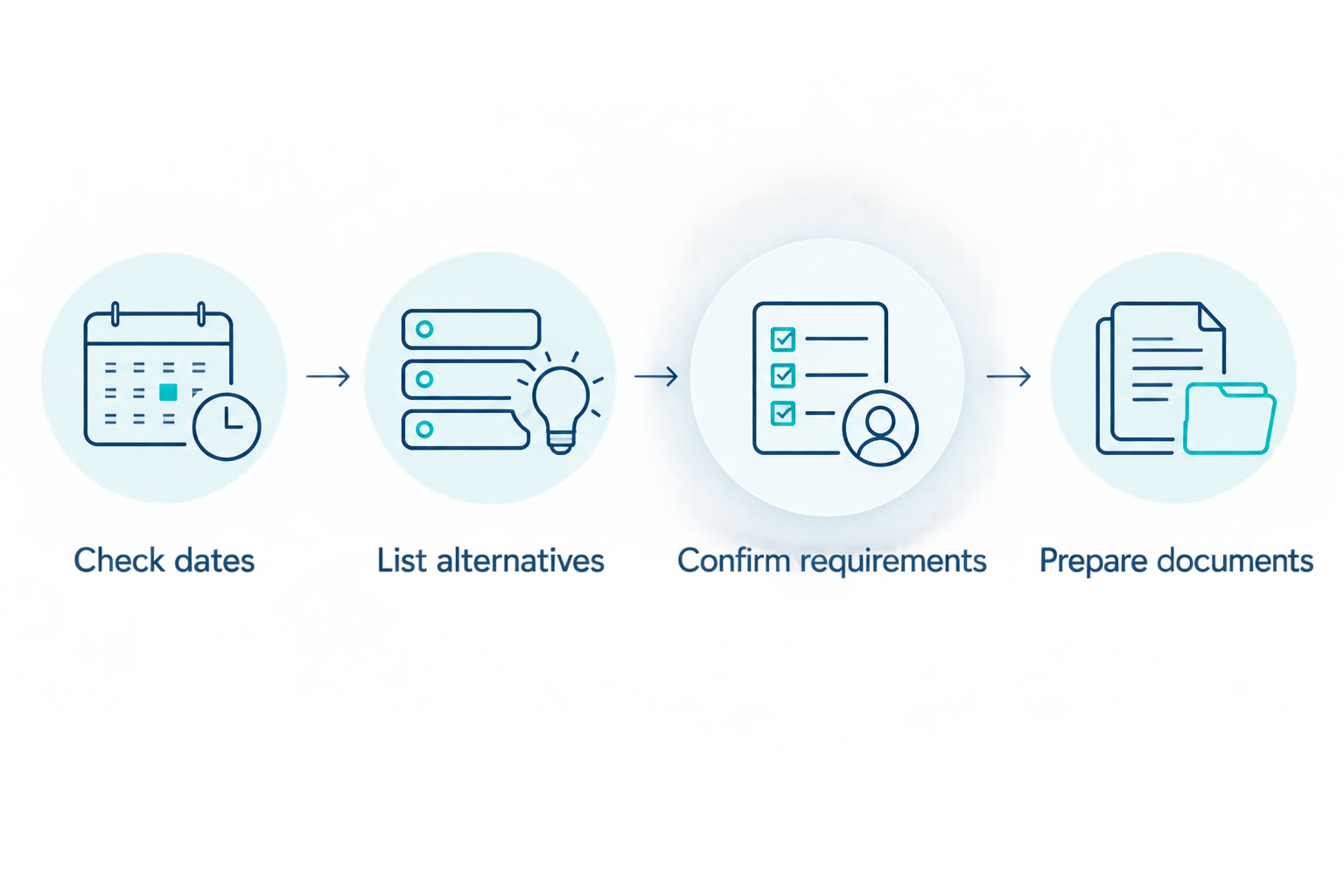
Resolve the identification method before scheduling the signing. This sequence helps you give the notary the information needed to evaluate the appointment without treating a booking confirmation as approval of your ID.
- Check dates. Read the issue and expiration dates from the credential and identify the issuing authority.
- List alternatives. Identify any other accepted government credentials you hold, including a qualifying current passport.
- Confirm requirements. Ask the notary to assess the identification route and ask the recipient about its signing instructions.
- Prepare documents. Have the document ready for review, and follow instructions about signing, witnesses, and appearance.
For Miami-Dade residents comparing appointment formats in 2026, Thecruznetwork offers mobile and remote online notary services. Thecruznetwork is a fit for individuals and businesses seeking mobile or remote online notary support in Miami-Dade. Its service formats do not remove the identification requirements or establish that a particular expired credential will qualify.
Use the contact page to explain the document type, appointment location, credential type, and relevant dates. Ask how to provide sensitive identification details securely rather than sending an unsolicited image of your ID.
Can I use an expired driver's license in Florida?
The 5-year issue-date rule can allow an expired qualifying driver's license for a traditional Florida notarization. The license must fall within a category listed in Florida Statutes §117.05(5), bear the required signature, and satisfactorily identify you.
Do not substitute the phrase recently expired for the actual dates. Give the notary the issue date, expiration date, and issuing state so the credential can be assessed correctly.
Can I bring witnesses instead of renewing my ID?
1 credible witness personally known to the notary or 2 qualifying credible witnesses can establish identity only when Florida's statutory conditions are met. The credible-witness process is not simply an optional shortcut around renewing identification.
Tell the notary why qualifying identification is unavailable before asking friends or relatives to attend. A witness's personal knowledge of you is necessary, but it does not replace the other required conditions.
Can an online notary accept my expired ID?
Remote online notarization is not an automatic workaround for expired identification. Florida Statutes §117.265 establishes a separate online identity-verification framework, including credential analysis and identity proofing when the notary does not personally know the signer.
For a 2026 remote session, ask the online notary to confirm the applicable verification route before booking. A conclusion about an in-person expired-ID appointment does not establish that the same credential will pass online verification.
FAQ
Can a Florida notary accept an ID that expired yesterday?
Yes, if the expired credential meets Florida's requirements, including the applicable issue-date condition. Expiring yesterday does not establish that the credential was issued within the past 5 years.
Does Florida have a grace period after an ID expires for notarization?
Florida's traditional notarization rule is not a general grace period measured from expiration. Listed identification must be current or have been issued within the past 5 years, and the remaining statutory requirements still apply.
Can I use a passport if my driver's license has expired?
A qualifying United States passport is an identification option listed in Florida Statutes §117.05(5). Present it for the notary's review rather than assuming the expired driver's license is your only route.
Can I show the notary a picture of my expired ID?
Do not assume a phone photograph replaces the identification credential required for an in-person notarization. Tell the notary what you physically have before arranging the appointment.
Can my spouse identify me to the notary?
Being your spouse does not automatically make someone a qualifying credible identifying witness. The applicable witness route, personal-knowledge requirements, sworn statements, and transaction-interest restrictions must all be satisfied.
Can a mobile notary ignore the expired-ID rules at my home?
No. A mobile appointment changes where the notary meets you, not the identification requirements governing the notarization.
Can Thecruznetwork help me arrange a notarization with expired identification?
Thecruznetwork offers mobile and remote online notary services for individuals and businesses. Explain your credential type and its dates before booking so the identification route can be evaluated; completion is not guaranteed by scheduling.
Does this expired-ID rule apply outside Florida?
No. Florida's rule does not determine what a notary commissioned elsewhere can accept. Confirm the requirements governing the notary performing your act.
One last thing
An ID that expired recently can be less useful than you expect if it was issued too long ago. The practical question is not just whether your face and name still match the card; it is whether the credential satisfies the applicable identification rule.
Before your 2026 appointment, read both dates aloud when describing the card to the notary. That small preparation step puts the issue-date question in front of the person who must make the identification determination.
This article provides general information about Florida notarization requirements, not legal advice about your document or transaction.


