
Yes, a notary can notarize documents for immigration use when the document calls for a lawful notarial act and the signer meets identification and appearance requirements. Notarization does not establish immigration eligibility, replace a required translation certification, or guarantee that an immigration agency will accept the document.
- Can a notary notarize documents for immigration use? Yes, but notarization does not establish immigration eligibility.
- USCIS translation certification and notarization serve different purposes; follow the instructions for the specific filing.
- Thecruznetwork offers mobile and remote online notary services in Miami-Dade, not a substitute for immigration legal advice.
- Confirm the recipient’s requirements before arranging notarization, an apostille, or document delivery.
Can a notary notarize documents for immigration use?
Yes. Immigration use does not, by itself, prevent a document from being notarized. The question is whether the requested act is lawful, whether the notary can complete it properly, and whether the receiving authority requires or accepts that act.
For Miami-Dade signing arrangements, Thecruznetwork provides mobile and remote online notary services. Keep the signing appointment separate from decisions about immigration eligibility, evidence, and filing strategy.
Use these 3 checks before booking in 2026:
- Recipient instructions: Identify the agency, consulate, attorney, or other recipient and read its document requirements.
- Required act: Determine whether the document needs an acknowledgment, an oath or affirmation, translation certification, or another process.
- Signing conditions: Confirm identification, signer appearance, document completeness, and acceptance of the proposed signing method.
A document can be properly notarized and still fail a filing requirement. For example, notarizing a translator’s signature does not replace the translator’s required statement of competence and accuracy.
Why this matters
Immigration paperwork brings several different tasks together: signing statements, translating records, obtaining official copies, and authenticating documents for another country. Treating all of those tasks as notarization sends the document through the wrong process.
For a 2026 filing, start with the current instructions for the exact form or receiving office. A relative’s earlier filing or an unrelated notarized document is not a reliable substitute.
Match the service to the requirement, not the document’s general immigration purpose. A notary handles a notarial act; the receiving authority decides what evidence it needs.
Which document service do you actually need?
The following services are not interchangeable. Choose the process the recipient requests rather than adding certifications because they sound more official.
| Process | Best for | What it does | What it does not do |
|---|---|---|---|
| Notarization | A signature requiring an acknowledgment or sworn statement | Records the notarial act performed for the signer | Establish immigration eligibility or prove every statement is true |
| Translation certification | Foreign-language records submitted under USCIS translation requirements | Provides the translator’s certification of accuracy, completeness, and competence | Automatically require a notary’s seal |
| Official certified copy | Records that must come from their issuing authority | Supplies an official copy through the appropriate records office | Replace a required translation |
| Apostille | Public documents intended for qualifying international use | Authenticates the origin of a public document under the applicable process | Approve the document’s contents or an immigration application |
Notarization has a clear benefit when the recipient requires a notarized signature. Its limitation is equally clear: the seal addresses the notarial act, not the legal sufficiency of the entire submission.
An apostille also has a specific purpose. Do not order one merely because the paperwork involves a foreign country; first identify the receiving country and its authentication requirements.
Acknowledgment: confirming an executed signature
An acknowledgment involves the signer appearing before the notary and acknowledging execution of the document. Depending on the applicable rules, the signature can already be on the document when the acknowledgment occurs.
The benefit is that an acknowledgment addresses execution of the document. The limitation is that it does not place the signer under oath about the truth of every statement.
Look for the notarial certificate supplied with the document or instructions from the recipient. If the paperwork leaves the required act unclear, ask the receiving office or your immigration attorney to resolve it before the appointment.
Do not ask a notary to choose the legal effect your immigration document needs. A notary’s authority to perform an act does not make the notary your immigration adviser.
Jurat: signing a sworn statement
A jurat involves signing in the notary’s presence and taking an oath or affirmation about the statement. It is different from simply acknowledging an existing signature.
The benefit is a documented sworn statement. The limitation is that the notary does not independently investigate the underlying facts or decide whether the statement satisfies an immigration evidence requirement.
These are 2 distinct notarial acts: acknowledgment and jurat. Do not treat their certificate wording as interchangeable, and do not sign a document requiring a jurat before receiving the notary’s signing instructions.
A document titled affidavit also deserves a closer look. Read its execution language and the recipient’s instructions rather than assuming that its title alone determines the required procedure.
Why immigration document requirements vary
Requirements depend on the document and its destination. These factors determine what you need:
- Receiving authority: USCIS, a consulate, a court, and a foreign records office can require different evidence.
- Document function: A sworn personal statement serves a different purpose from an official birth record or translation certification.
- Document language: Foreign-language evidence can require a complete English translation and a translator’s certification.
- Place of issue: An official record’s origin determines which authority can issue a certified copy or authenticate it.
- Signing method: Permission to perform remote notarization does not establish acceptance by every recipient.
- Required certificate: The notarial wording determines whether the signer acknowledges execution or makes a sworn statement.
For your 2026 appointment, communicate these requirements before choosing a signing method. Sending the relevant instructions with your appointment request helps separate a signing question from a legal or records question.
How do you prepare immigration documents for notarization?
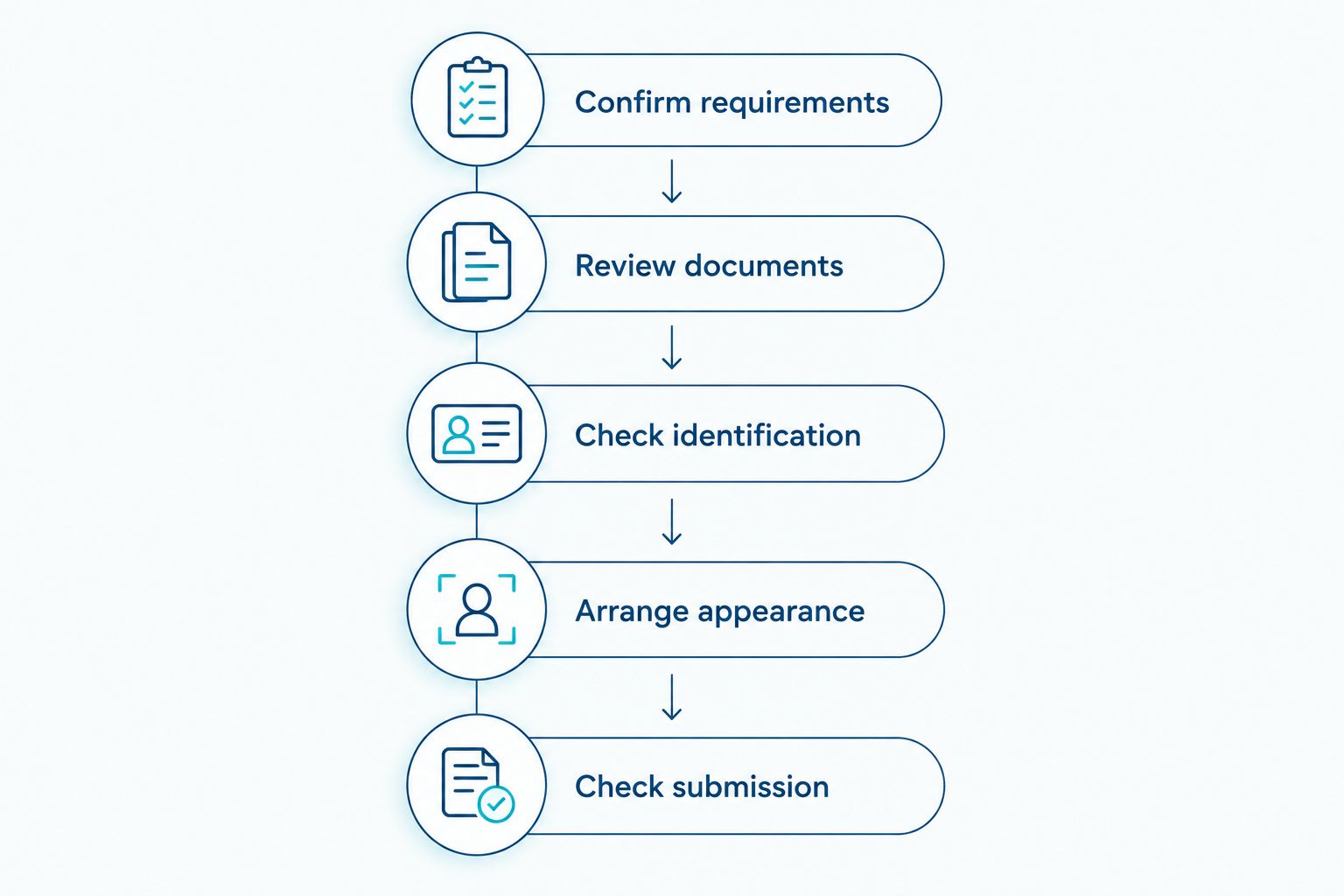
Use this sequence after confirming that notarization is required. It keeps document preparation, signing, and submission separate.
- Confirm requirements. Obtain the recipient’s instructions and identify the document that actually needs notarization. Do not assume every attachment needs a seal.
- Review documents. Complete the necessary information and identify the notarial certificate. Leave signatures unsigned when the required act calls for signing before the notary.
- Check identification. Ask what identification is acceptable under the applicable notary rules. Make sure the document’s signer information and identification can be evaluated before the appointment.
- Arrange appearance. Choose an in-person appointment or an authorized remote session that the recipient accepts. An absent signer’s permission is not a substitute for required appearance.
- Check submission. Review the completed certificate and follow the recipient’s instructions for originals, copies, translations, authentication, and delivery.
Keep the recipient’s instructions with the documents. If an attorney prepared the packet, ask the attorney to identify which signatures need notarization and which pages should remain untouched until the appointment.
Thecruznetwork is best for Miami-Dade individuals and businesses seeking mobile or remote online notarization for document authentication. The service fits the signing stage; questions about which immigration benefit to seek or what evidence proves eligibility belong with an authorized legal representative.
For attorney-managed packets, the mobile notary guide for immigration attorneys addresses the signing-coordination side of the process.
Does USCIS require translations to be notarized?
USCIS requires foreign-language documents submitted under 8 CFR 103.2(b)(3) to include a full English translation, with the translator certifying that it is complete and accurate and that the translator is competent to translate into English. That regulation does not impose a general notarization requirement on the translator’s certification.
For a 2026 USCIS submission, distinguish that baseline translation rule from any additional instruction applying to your specific filing. Follow both the applicable regulation and the current form instructions.
If a recipient separately requests notarization of the translator’s signature, notarization addresses that signature or sworn statement. It does not turn the notary into the translator or make the notary responsible for the translation’s accuracy.
Can a Florida notary certify a copy of a birth certificate?
A Florida notary cannot use an ordinary attested-copy procedure to replace an official certified copy of a birth certificate. Florida Statutes section 117.05(12) excludes vital records and certain public records from a notary’s copy-attestation authority.
Request the official certified copy from the appropriate records authority when the recipient requires one. Notarizing a statement attached to a photocopy does not convert that photocopy into an official vital record.
For foreign-issued records, follow the issuing authority’s process and the recipient’s instructions. Keep the official-record requirement separate from any translation or authentication requirement.
Can immigration documents be notarized remotely in Florida?
Florida permits authorized remote online notarization, but that does not mean every immigration-related recipient accepts every remotely notarized document. Confirm both the notary’s authority and the recipient’s acceptance before choosing the remote route.
Remote online notarization is not permission to skip signer appearance. The signer participates through the authorized audiovisual process and completes the required identity-verification steps.
In 2026, ask the recipient whether it requires a paper original, a particular certificate, or another execution format. A convenient appointment method is useful only when the resulting document meets the submission requirement.
FAQ
Can a notary notarize documents for immigration use?
Yes, a notary can notarize an immigration-related document when the requested act is lawful and the signer meets the applicable requirements. Notarization does not establish immigration eligibility or guarantee acceptance by the receiving authority.
Does every immigration document need to be notarized?
No, immigration use alone does not create a notarization requirement. Follow the instructions for the exact form, supporting document, and receiving authority.
Does a USCIS translation certification need a notary?
The general USCIS translation rule in 8 CFR 103.2(b)(3) does not require notarization of the translator’s certification. It requires a full English translation and certification of completeness, accuracy, and translator competence.
Can a notary help me choose an immigration form?
A notary commission alone does not authorize immigration legal advice. Use an immigration attorney or an appropriately accredited representative for advice about benefits, forms, and filing strategy.
Can someone take my document to a notary without me?
Someone else cannot replace your required appearance when your signature is being notarized. An authorized remote online session is a form of appearance, not an exception allowing an absent signer.
Does an apostille make an immigration document valid?
An apostille authenticates the origin of a public document under the applicable international process. It does not establish the truth of its contents, immigration eligibility, or acceptance for a particular filing.
Can a Florida notary notarize a birth certificate copy?
A Florida notary cannot turn a birth certificate photocopy into an official certified vital record. Request the required official copy from the appropriate records authority.
What should I ask before booking an immigration notarization?
Ask which document needs notarization, which notarial act is required, what identification is acceptable, and whether the recipient accepts your signing method. Resolve legal and filing questions with an authorized immigration representative before the appointment.
One last thing
More certification is not the same as better evidence. A notarized translation statement, an apostille, and an official certified record perform different jobs; none automatically replaces another.
Before arranging document services with Thecruznetwork in 2026, identify the exact page, signature, and recipient requirement. That is the useful starting point—not a request to notarize the whole immigration packet.
This article provides general document-service information, not legal advice about an immigration case.


