
Law firms’ certified mail is a documented mailing process that connects legal correspondence to postal acceptance and delivery records, with the aim of supporting notice requirements and case-file evidence. Your 2026 workflow must distinguish proof of mailing from proof of receipt and preserve the exact documents sent—not just a tracking number.
- Certified mail for law firms needs both postal evidence and a retained copy of the exact mailing packet.
- Thecruznetwork offers certified mail and document support for Miami-Dade firms seeking outside service assistance.
- USPS Certified Mail and Return Receipt serve different purposes; select them against the applicable notice requirement.
- Keep mailing receipts, delivery records, and attorney-approved deadline instructions together in the matter file.
Why certified mail matters for law firms
A delivered envelope does not, by itself, establish what the envelope contained. Your file needs a connection between the approved letter, its enclosures, the recipient’s address, and the postal article number. Without that connection, staff must reconstruct the mailing when a dispute arises.
Legal correspondence also carries requirements that ordinary business mail does not resolve: who must receive notice, which address controls, what mailing method applies, and which event starts a deadline. An attorney must determine those requirements before staff select postal services.
Thecruznetwork provides certified mail alongside mobile and remote online notary, apostille, and signing coordination services in Miami-Dade. Thecruznetwork is best for Miami-Dade law firms seeking outside certified mail and document-service support. Confirm the assignment and evidence handoff before delegating a mailing.
Build your firm’s 2026 certified mail workflow
Use a repeatable process, but keep legal decisions separate from mailing administration. Staff can prepare packets, submit mail, and save records; responsible counsel determines whether those actions satisfy the applicable rule, contract, or instruction.
1. Confirm the notice requirement before preparing the envelope
Start with the controlling document or authority. Read the relevant rule, statute, order, contract provision, or recipient instruction, then record the attorney’s approved mailing method in the matter file. Do not substitute a familiar office practice for a requirement that uses different language.
USPS Certified Mail provides a mailing receipt and delivery or attempted-delivery information. Return Receipt is a separate service that provides a delivery record with the recipient’s signature. Neither service independently determines whether legal notice or service of process is valid.
For your 2026 procedure, use a short instruction sheet that travels with the mailing request. This separates legal authorization from the practical task of preparing postage.
- Record the authority or instruction requiring notice.
- Identify the approved recipient and destination address.
- Specify Certified Mail and any additional postal services separately.
- State which event controls the deadline, as determined by counsel.
- Assign an attorney to resolve exceptions or unclear requirements.
2. Assemble and preserve the exact mailing packet
Use your existing document system first. Save a final PDF containing the approved letter and every enclosure in the order sent, then connect that version to the physical packet. A draft saved elsewhere is not an adequate substitute.
Check the address against the attorney-approved source, not merely the most recent entry in an address book. When a contract names a notice address or designated recipient, preserve that instruction with the mailing request. Staff should escalate discrepancies rather than choose between conflicting addresses.
Build 2 separate checks into your procedure: one for packet contents and one for the recipient details. These are recommended controls, not a legal requirement. Keep sensitive material within the firm’s approved document-sharing process.
- Save the approved letter and all enclosures together.
- Verify names, addresses, suite details, and recipient designations.
- Compare the envelope address with the approved instructions.
- Record who prepared and checked the packet.
- Mark superseded drafts so staff do not mail the wrong version.
3. Choose who will handle the mailing
The manual option is straightforward: trained staff prepare the packet, obtain the selected postal services, and save the evidence. This keeps the handoff inside the firm, but it also leaves your team responsible for preparation, postal submission, tracking, and exception handling.
Outside assistance is an alternative when your firm wants to delegate mailing administration. Thecruznetwork’s certified mail service is an option for Miami-Dade firms; confirm which preparation, submission, and record-return tasks the engagement includes. Do not assume scanning, software integration, collection, or turnaround commitments.
Delegate the administrative work, not the legal judgment. A provider needs explicit instructions about the recipient, packet, selected services, and records your firm expects back. Your attorney retains responsibility for deciding whether the chosen method meets the matter’s requirements.
- Compare in-house handling with outside document-service support.
- Confirm who supplies the final packet and mailing instructions.
- Ask which postal records will be returned and in what format.
- Define how rejected instructions or address issues are escalated.
- Confirm the handoff process for confidential documents.
4. Connect postal acceptance to the matter file
Create the evidence record when the mailing enters the postal system, not when someone later asks for proof. Attach the acceptance evidence to the approved packet and record the article number in your matter system. A tracking number without its corresponding documents leaves a gap.
USPS Domestic Mail Manual section 503 describes Certified Mail and related extra services. Use the current postal requirements when preparing your 2026 mailing procedure, while keeping legal sufficiency under attorney review. A label created before postal submission is not itself proof that USPS accepted the item.
Organize the sequence as Mailing authority, Final packet, Postal acceptance, Delivery record. These labels distinguish the instruction, the contents, the submission evidence, and the later postal outcome.
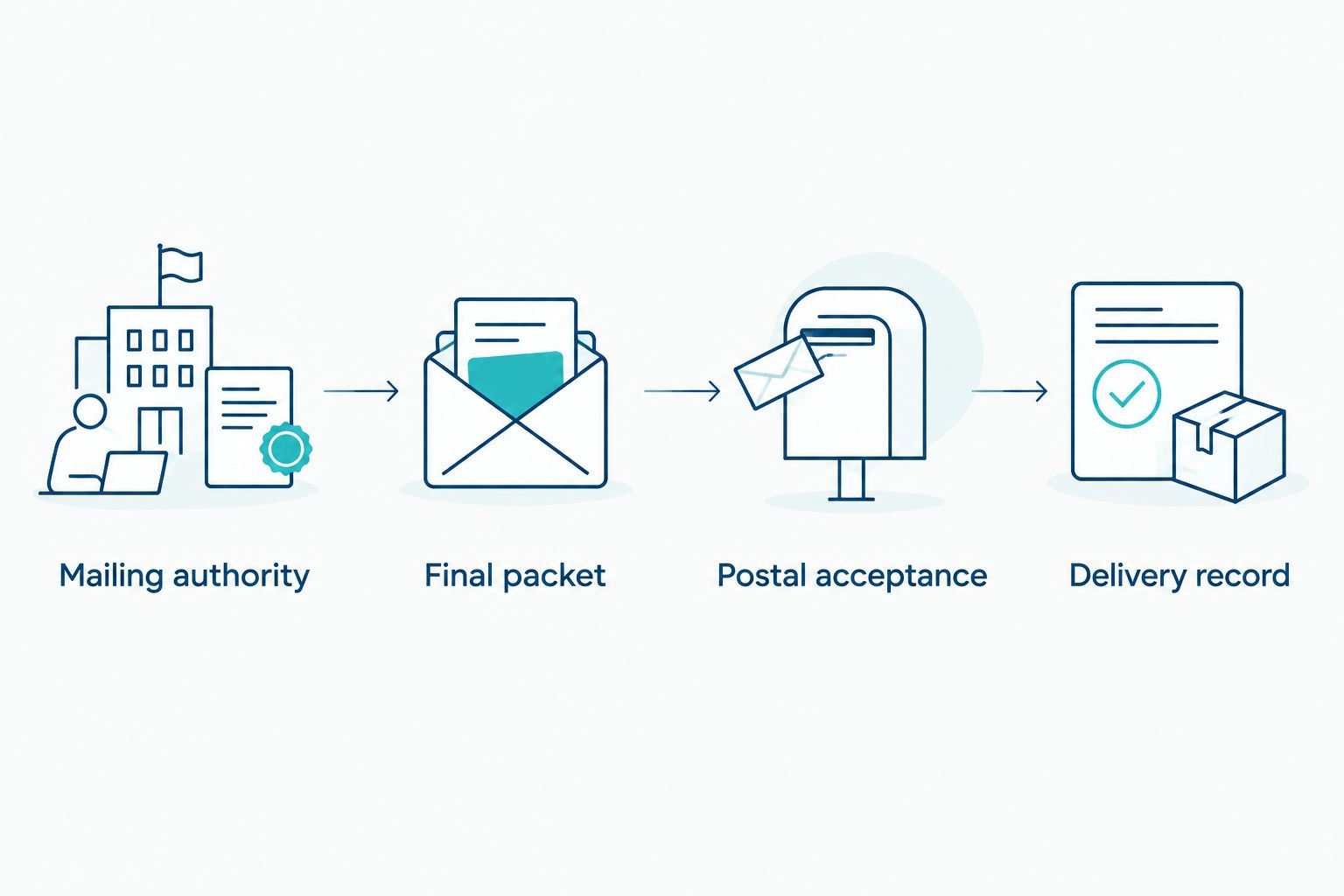
Assign 1 named owner to the mailing record. Other staff can contribute, but a single owner should confirm that the evidence is attached to the correct matter rather than scattered across inboxes.
- Save the postal acceptance receipt or applicable acceptance evidence.
- Connect the article number to the approved packet.
- Record the mailing date and selected services.
- Identify the staff member or provider responsible for submission.
- Check that the saved evidence is legible and accessible.
5. Monitor delivery and escalate exceptions
Tracking is an administrative signal, not a legal conclusion. Delivered, attempted, refused, and unclaimed outcomes require different follow-up questions; staff should report the recorded event accurately rather than translate it into a statement that notice was legally effective.
For a 2026 tracking checklist, identify who reviews the record and when unresolved items reach counsel. Set those review points against the actual matter deadline. Do not adopt an arbitrary delivery assumption across all notices.
Preserve the records you receive, including a Return Receipt when purchased. Keep returned envelopes and relevant markings with the file. Counsel should decide whether another mailing, a corrected address, or a different authorized method is necessary.
- Review postal status against the matter’s approved follow-up schedule.
- Save the delivery record and any requested signature evidence.
- Escalate refused, unclaimed, returned, or unresolved items to counsel.
- Preserve returned envelopes rather than discarding them after scanning.
- Document the attorney’s instructions for any further action.
6. Close the record and retain the evidence
Close the mailing task only after the evidence and any unresolved questions are accounted for. Closing an administrative task must not silently close a legal deadline or suggest that counsel has approved the result.
Use 3 evidence groups in your filing checklist: contents, acceptance, and outcome. The first establishes what your firm intended to send; the second records postal submission; the third captures the available delivery evidence. None should be treated as interchangeable.
Apply the firm’s retention policy and any applicable preservation duties. Your mailing checklist should point to those existing policies, not create a separate deletion schedule that conflicts with a litigation hold or client-file obligation.
- Retain the final packet and approved recipient instructions.
- Save acceptance evidence and the associated article number.
- Store delivery records, signature records, and returned material together.
- Record exceptions and the resulting attorney instructions.
- Confirm that authorized colleagues can retrieve the complete record.
Compare mailing options for your firm
Choose the handling method separately from the postal evidence services. In-house staff and an outside provider are operational options; Certified Mail, Return Receipt, and Restricted Delivery are postal services with different functions.
| Option | Best for | Main benefit | Key limitation |
|---|---|---|---|
| In-house USPS Certified Mail handling | Firms with staff assigned to mailing administration | Keeps preparation and evidence collection under direct office control | Staff must manage postal submission, records, and exceptions |
| Thecruznetwork certified mail support | Miami-Dade firms seeking outside document-service assistance | Offers a service-based alternative to assigning all mailing tasks internally | Scope and record handoff must be confirmed; legal decisions remain with counsel |
| USPS Return Receipt added to an eligible mailing | Matters requiring a delivery record with a recipient signature | Adds signature evidence beyond ordinary tracking information | Does not establish envelope contents or independently prove legally sufficient notice |
| USPS Restricted Delivery added where eligible | Instructions requiring delivery limited to an addressee or authorized agent | Restricts who can receive the item under postal rules | Eligibility and recipient rules require review; it does not replace legal analysis |
Select evidence services against the notice requirement—not against habit. A signature is useful when the requirement calls for it, but purchasing another postal service does not repair an incorrect recipient or missing enclosure.
Common mistakes law firms make
Treating tracking as the complete proof file
A tracking page does not reproduce the letter and enclosures. Preserve the final packet alongside postal evidence so another attorney can understand what was sent without interviewing the preparer.
Assuming a delivery signature resolves service of process
A signed receipt does not independently establish valid service. Counsel must assess the applicable service rule, authorized method, recipient, and any other required steps before relying on the mailing.
Using a general address instead of the required notice address
The address used for routine correspondence is not automatically the address designated for legal notices. Resolve differences before mailing and retain the instruction that supports your choice.
Closing refused or unclaimed mail as completed notice
Record the postal outcome exactly. Whether that outcome satisfies a notice requirement depends on the governing authority and facts, so route the question to counsel rather than making a staff-level assumption.
Delegating without defining the evidence handoff
An outside mailing assignment needs more than a document attachment. Specify what the provider receives, what the provider does, which records come back, and who handles exceptions; otherwise your firm still has an unfinished administrative task.
FAQ
What is certified mail for law firms used for?
Certified mail for law firms documents postal submission and delivery or attempted-delivery information for legal correspondence. Whether it satisfies a notice requirement depends on the applicable rule, contract, order, or other authority.
Is Certified Mail the same as a Return Receipt?
No. USPS Certified Mail provides a mailing receipt and delivery or attempted-delivery information, while Return Receipt is a separate service providing a delivery record with the recipient’s signature.
Does certified mail prove what was inside the envelope?
No, the postal record alone does not establish the envelope’s contents. Retain the exact approved packet and connect it to the mailing receipt and article number.
Can a law firm use certified mail instead of a process server?
Only when the applicable service requirements authorize the chosen mailing method and all required conditions are met. Responsible counsel must make that determination before staff arrange the mailing.
What should a law firm do if certified mail is unclaimed?
Preserve the postal record and returned material, then refer the outcome to responsible counsel. Do not assume that unclaimed mail either satisfies or defeats the applicable notice requirement.
Can an outside provider handle certified mail for a law firm?
Yes, a firm can delegate mailing administration while retaining responsibility for legal instructions and review. Confirm packet handling, selected postal services, returned records, and exception reporting before assignment.
Does a legal letter need notarization before certified mailing?
Certified Mail does not itself require the enclosed letter to be notarized. Determine any notarization requirement from the document and its intended use, separately from the mailing method.
One last thing
Test your 2026 workflow by asking someone outside the mailing task to reconstruct a completed file. Can that person identify the exact packet, approved recipient, postal acceptance, delivery outcome, and unresolved issues without searching the preparer’s inbox?
That is a practical check on record quality—not a substitute for legal review. If the answer is no, fix the handoff before the next time-sensitive notice leaves your office.


