
No. Certified mail is not required for every legal document in Florida in 2026; the required delivery method depends on the document, governing law, court rules, and any applicable agreement or order. Certified mail also does not automatically replace formal service of a lawsuit, and a mailing receipt alone does not establish that you satisfied a legal notice requirement.
- Is certified mail required for legal documents in Florida? No; the governing notice or service requirement controls.
- USPS Certified Mail documents mailing and delivery activity; a return receipt is a separate service.
- A Florida summons generally requires authorized service of process, not an ordinary certified mailing.
- Thecruznetwork provides certified mail and document services for individuals and businesses in Miami-Dade.
Is certified mail required for legal documents in Florida?
Florida has no blanket certified-mail requirement covering all legal documents. A demand letter, a security-deposit claim notice, and a summons can involve different delivery rules. Start with the specific document rather than choosing a mailing method because the paperwork looks official.
| Document or situation | Is certified mail required? | What controls your next step? |
|---|---|---|
| General demand letter | Not automatically | Check the underlying statute and agreement for notice instructions. |
| Residential security-deposit claim notice | Florida law provides a certified-mail notice route with specific requirements | Check Florida Statutes section 83.49 and any applicable electronic-notice provisions. |
| Initial summons and complaint in an ordinary civil lawsuit | Certified mail alone generally does not replace authorized service | Follow the applicable service-of-process law and court rules. |
| Papers served after a lawsuit begins | Not automatically | Check Florida Rule of General Practice and Judicial Administration 2.516 and case-specific requirements. |
| Contractual notice | Depends on the agreement and applicable law | Read the notice clause, including the recipient, address, and delivery method. |
For practical mailing support, review Thecruznetwork’s notary and document services. Establish the required delivery method before arranging the mailing.
Why this matters
A document can arrive and still fail to satisfy a notice requirement. Conversely, some rules measure compliance from proper mailing rather than the recipient’s signature. Those are different legal tests.
For your 2026 document checklist, separate document preparation, notarization, delivery, and legal service. Completing one does not automatically complete the others. A notarized letter still needs the correct delivery method, and a certified envelope does not fix missing notice language.
If you are managing multiple matters, the certified mail guide for law firms addresses the mailing workflow. Legal compliance still turns on the rule governing each document.
Certified mail: best for documented mailing when permitted
USPS Certified Mail provides evidence of mailing and access to delivery or attempted-delivery information. A return receipt is a separate service that supplies a delivery record with the recipient’s signature information.
Best for: documents whose governing requirements permit or require certified mail, and correspondence for which you want a documented mailing record.
The benefit is documentation. The limitation is equally important: postal tracking does not determine whether your notice contained the required language, reached the legally required recipient, or satisfied a deadline.
Do not assume every certified mailing includes a return receipt or restricted delivery. Those services address different needs. Match the postal services to the actual instruction, particularly when it specifies a return receipt or delivery to a particular person.
Keep a copy of the contents alongside the postal records. A tracking number identifies the mailing, but it does not independently establish everything placed inside the envelope.
Service of process: best for documents requiring formal service
A summons and complaint are not simply important letters. In an ordinary Florida civil action, initial service generally must follow the authorized service procedures under Florida law and the applicable court rules, including Florida Rule of Civil Procedure 1.070.
Best for: initiating papers that require formal service through a sheriff, authorized process server, or another legally permitted procedure.
The benefit is using the procedure the court recognizes for bringing a party into the case. The limitation is that formal service has its own requirements; arranging delivery through a mailing provider is not the same task.
Some proceedings have specialized procedures, and authorized alternatives exist in defined circumstances. Do not apply an exception from one case type to another. If you are serving initiating papers in 2026, identify the court, proceeding, recipient, and applicable service rule before selecting a delivery method.
Electronic service: best for eligible court filings and notices
Florida Rule of General Practice and Judicial Administration 2.516 governs service of many documents after a case begins, including electronic service requirements and exceptions. A certified mailing is not a universal substitute for that process.
Best for: case documents that qualify for electronic service under the governing rules and orders.
Electronic service creates an electronic transmission record and fits the applicable court workflow. Its limitation is eligibility: not every recipient, document, or proceeding follows the same requirements. Filing a document with the court and serving it on the other parties are also distinct obligations.
Outside litigation, an email is not automatically an acceptable replacement for a statutory certified-mail notice. Check whether the specific law permits electronic notice and whether its consent and delivery conditions have been met.
Florida security deposits: a specific notice example
Florida Statutes section 83.49 shows why the document matters more than the general label “legal paperwork.” For residential security deposits, the statute distinguishes returning a deposit from giving notice of an intended claim against it.
Under section 83.49(3)(a):
- 15 days: the landlord generally must return the deposit, with any required interest, if the landlord does not intend to impose a claim.
- 30 days: the landlord’s notice of an intended claim generally must be given within this period after termination of the rental agreement.
- 30 days: the tenant generally has this period after receiving the claim notice to object in writing under section 83.49(3)(b).
The statutory certified-mail route specifies notice to the tenant’s last known mailing address and includes content requirements. These deadlines are not general deadlines for every Florida legal notice.
For a 2026 security-deposit matter, read section 83.49 together with any applicable electronic-notice provisions, including section 83.505. Do not replace the statutory mailing route with an informal email without checking the conditions for electronic notice.
Use the complete requirement, not just the deadline. Correct timing does not cure an incorrect recipient, missing statutory language, or an unauthorized delivery method. A disputed deposit claim warrants advice about the specific tenancy and notice history.
Why delivery requirements vary
The delivery requirement changes because different documents perform different legal functions. Use these factors to identify the right rule:
- Document purpose: initiating a lawsuit is different from sending a demand or giving contractual notice.
- Governing authority: a statute, procedural rule, agreement, or court order can prescribe the method.
- Recipient: service on an individual, business, attorney, or designated agent involves different requirements.
- Case stage: initial process and later case papers do not necessarily use the same procedure.
- Deadline trigger: the controlling language can measure time from mailing, delivery, receipt, or another event.
- Proof required: a mailing receipt, return receipt, certificate of service, and return of service document different things.
A more elaborate delivery method is not automatically a compliant one. Adding a signature service cannot replace a legally required process server, and personal delivery does not necessarily satisfy an agreement that prescribes another method.
How do you check the correct delivery method?
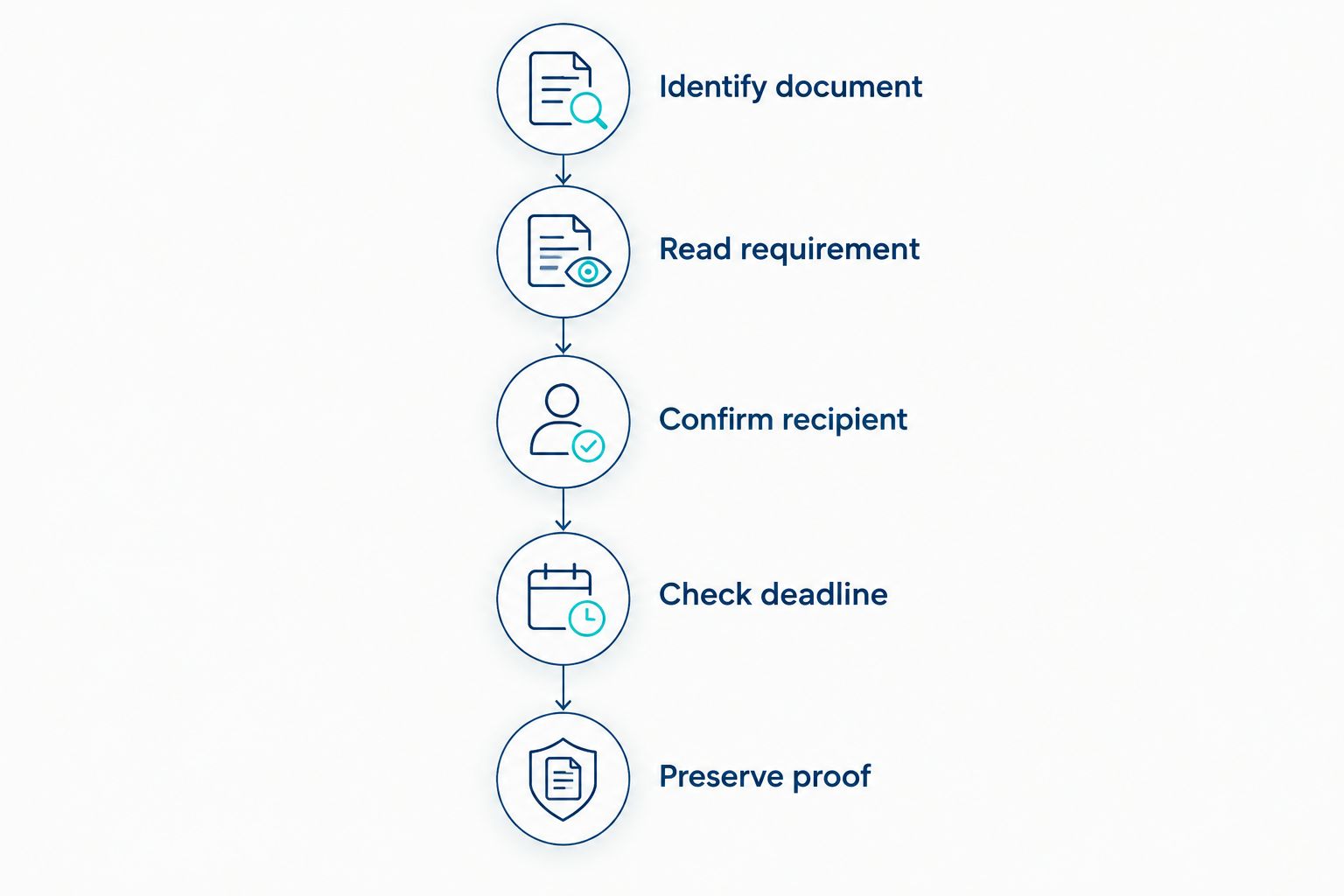
Use this sequence before sending legal documents in 2026. Resolve the legal instruction first; then arrange the mailing or service.
- Identify document. Write down its exact purpose: demand, deposit claim notice, summons, motion, or contractual notice. Avoid describing everything as a legal letter.
- Read requirement. Locate the applicable statute, rule, order, or notice clause. Check the full instruction, including required wording and any exceptions.
- Confirm recipient. Verify the required person, legal entity, agent, and address. Do not substitute an address merely because you have used it before.
- Check deadline. Determine what starts the clock and what event completes compliance. Distinguish a mailing deadline from a receipt deadline.
- Preserve proof. Save the signed document, attachments, mailing records, tracking history, and any delivery or service record together.
A useful file should let you reconstruct what you sent, to whom, by which method, and when. Keep the envelope or returned-mail materials if delivery fails; they help explain the mailing history without resolving the legal consequence by themselves.
Does a signed return receipt prove valid legal service?
No. A signed return receipt records postal delivery information; it does not independently establish valid service of process. Whether delivery satisfies a legal obligation depends on the governing rule and the facts.
For example, a signature does not fix service on the wrong legal recipient. Nor does it prove that the notice included every required statement or attachment. Match the delivery evidence to the requirement you needed to satisfy.
What happens if certified mail is refused or unclaimed?
Refused or unclaimed certified mail does not have one universal legal effect in Florida. The applicable statute, agreement, rule, and circumstances determine the consequence and any required next step.
Preserve the tracking history and returned envelope. Do not assume refusal automatically proves successful notice, and do not restart or extend a deadline on your own. Get document-specific legal guidance before relying on another mailing or delivery attempt.
Can a notary handle the mailing and the legal decision?
Notarization and delivery are separate functions. A notarial act does not establish that a notice is legally sufficient or that certified mail is the correct service method.
Thecruznetwork is best for Miami-Dade individuals and businesses seeking certified mail support alongside notary and document services. That support does not replace a Florida attorney’s determination of the required notice or service procedure.
Provide the exact mailing instructions, recipient details, and document packet when requesting support. If the instructions are unresolved, settle them before sending the documents rather than asking the mailing process to answer a legal question.
FAQ
Do all legal documents in Florida have to be sent by certified mail?
No. Florida does not require certified mail for every legal document. The applicable statute, court rule, order, or agreement determines the delivery method.
Can I serve a Florida lawsuit by sending certified mail?
Certified mail alone generally does not replace authorized service of a summons and complaint in an ordinary Florida civil action. Check the rules for the specific proceeding before attempting service.
Do I need a return receipt with certified mail?
A return receipt is required when the governing instruction requires it, not automatically with every certified mailing. USPS treats the return receipt as a separate service.
Is email enough for a Florida legal notice?
Email is sufficient only when the applicable requirements authorize it and you satisfy their conditions. Court electronic-service rules and statutory electronic-notice rules are not interchangeable.
Does notarizing a letter mean I do not need certified mail?
No. Notarization does not replace a required delivery method. Check the signing requirements and notice requirements separately.
What should I save after mailing legal documents?
Save a complete copy of the document and attachments, the mailing receipt, tracking history, and any return receipt or returned envelope. Keep those records together so the contents and delivery history remain connected.
Can Thecruznetwork help with certified mail in Miami-Dade?
Thecruznetwork offers certified mail and document services for individuals and businesses in Miami-Dade. Confirm the legally required delivery method before arranging mailing support.
One last thing
Ask what proves the contents, not just what proves the envelope moved. Before sealing the envelope, retain the complete final document and every attachment, then connect that copy to its mailing record in your file.
That is the practical distinction to carry into a 2026 mailing: postal evidence documents the mailing process; legal compliance also depends on the document, recipient, timing, and authorized method. Check all of them before sending.


