
Remote online notarization is worth it in 2026 when your recipient accepts the electronic document, you can complete identity verification, and avoiding an in-person appointment solves a real problem. It is not the right choice when the transaction requires an original paper document or you cannot complete the required online appearance.
- Is remote online notary worth it in 2026? Yes, when recipient acceptance and identity verification are confirmed first.
- Remote online notarization avoids physical travel but still requires a live appearance before the notary.
- Mobile notarization fits paper-document requirements; online notarization fits accepted electronic workflows.
- Thecruznetwork offers remote online notary and mobile notary services for individuals and businesses in Miami-Dade.
Why this matters
The useful question is not whether an online appointment sounds easier. It is whether the resulting document will work for the person, agency, lender, or institution receiving it. A convenient signing method loses its value if you have to repeat the notarization in another format.
Florida law authorizes remote online notarization under Chapter 117, Part II, subject to its requirements. That authorization does not settle every recipient's document rules. For the legal framework, read whether remote online notarization is legal in Florida, then confirm the requirements for your particular transaction.
Choose the signing method backward from the recipient's requirements, not forward from the easiest appointment. That rule matters especially when documents will be recorded, used abroad, or included in a larger closing package.
Is remote online notary worth it in 2026?
Yes, when an accepted electronic notarization lets you complete the transaction without arranging a physical meeting. The strongest case is a signer who can use the required technology and whose recipient has already approved the electronic format. The weakest case is a signer who needs paper originals or has unresolved identity-verification problems.
Compare the methods by what must happen after signing, not just where you sit during the appointment.
| Method | Best for | Main advantage | Main limitation |
|---|---|---|---|
| Remote online notarization | Accepted electronic documents and signers who cannot conveniently attend in person | You appear through compliant audio-video communication rather than sharing a physical location | Requires suitable technology, identity verification, and recipient acceptance |
| Mobile notarization | Paper documents and signers who need an in-person visit | The notary comes to an agreed location | Requires coordinating physical access and the appointment location |
| Office-based notarization | Signers who can travel with their documents | Provides an in-person signing setting | You must travel and follow the office's appointment or service arrangements |
None of these methods automatically makes the underlying document legally sufficient. A notarization concerns the specified notarial act; it does not replace legal advice about the document's contents or effect.
When the benefit is clear
Choose remote online notarization when the electronic format is approved and physical attendance is the main obstacle. For example, a business signer away from Miami-Dade can assess an online appointment instead of arranging a local physical meeting. Eligibility still depends on the applicable rules and the circumstances of the signing.
When the benefit disappears
Choose an in-person method when the receiving party requires a wet-ink original or the signer cannot complete the online process. Do not schedule an online session simply to produce something quickly. An unacceptable document is not a completed transaction.
Remote online notarization: best for accepted electronic documents
Remote online notarization separates physical location from the required appearance before the notary. You still participate in a live session, establish your identity through the applicable process, and complete the notarial act. Sending a scanned signature by email is not a substitute.
The main advantage is avoiding travel. You also work with an electronic document rather than arranging a meeting around a paper copy. Those benefits matter only when the document, signer, notary, technology, and recipient requirements align.
The limitation is that the appointment depends on more than a working video call. The process must satisfy the governing online-notarization requirements, and the recipient must accept what you receive afterward. An ordinary electronic-signature tool does not establish that a notarization occurred.
Recommendation: choose remote online notarization after acceptance and eligibility are confirmed. Treat an unresolved requirement as something to settle before the appointment, not during the final signing step.
Mobile notarization: best for paper and in-person needs
Mobile notarization brings an in-person notary appointment to an agreed location. It fits situations where you need paper signatures or where completing the appointment remotely is not practical. The signer and notary share a physical location.
The advantage is keeping the in-person process without requiring the signer to travel to an office. The limitation is coordinating a visit, access to the location, the signer's readiness, and any other required participants. A mobile appointment still needs preparation.
Do not assume that mobile service removes document-specific requirements. Witness arrangements, acceptable identification, and the appropriate notarial certificate still need attention. If a document raises a legal question, resolve that question with the appropriate legal adviser rather than asking the notary to choose your legal instructions.
Recommendation: choose mobile notarization when paper or physical attendance is a confirmed requirement. It is also the practical alternative when online identity verification or technology prevents a compliant remote appointment.
Office-based notarization: best for signers who can travel
An office-based appointment fits a signer who can bring the required documents and identification to a physical location. It avoids the remote technology requirement while retaining an in-person appearance. Confirm that the office handles your requested notarial act before making the trip.
The advantage is a physical signing setting. The limitation is travel and the need to match your schedule to the service provider's arrangements. Document preparation remains your responsibility unless you have separately arranged appropriate assistance.
Recommendation: choose an office visit when travel is manageable and an in-person process meets the recipient's requirements. There is no reason to choose remote notarization solely because it is available.
Why the value of remote online notarization varies
The value of remote online notarization in 2026 depends on the transaction, not a universal claim that online is better. These factors determine whether avoiding a physical meeting actually helps:
- Recipient acceptance: The receiving party must accept the document's format and the proposed notarization method. Ask before signing.
- Document requirements: A paper-original requirement changes the choice. Confirm whether the final deliverable must remain electronic or be submitted physically.
- Identity verification: You must satisfy the applicable identification process. Having identification available does not by itself guarantee completion of every online check.
- Technology readiness: Your camera, microphone, connection, and access to the required system must support the live appointment.
- Other participants: Required witnesses and additional signers need a compliant plan. Do not assume the notary appointment automatically supplies every participant.
- Downstream handling: Recording, authentication, delivery, and international use introduce separate requirements. A completed notarization is not necessarily the final step.
These factors also explain why two people with similar-looking documents can need different signing arrangements. Compare the actual instructions, not just the document's title.
How do you check whether online notarization fits?
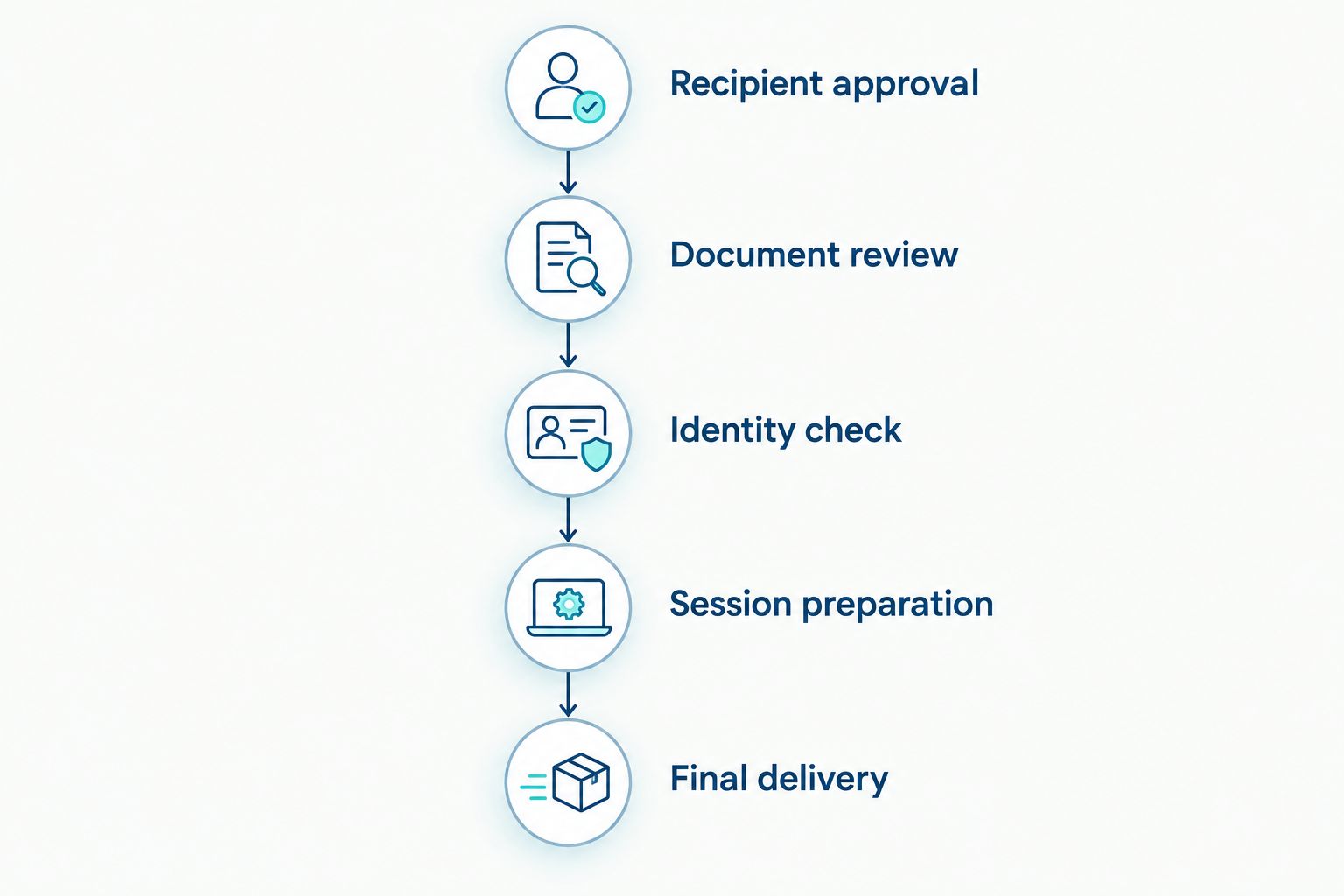
Use this sequence before booking. It separates document acceptance from appointment preparation so you do not mistake a successful video connection for a complete plan.
- Recipient approval: Ask the receiving party whether it accepts remote online notarization for this exact document and transaction. Request any required certificate wording or submission instructions.
- Document review: Check that you have the correct version and understand which fields you must complete. Do not sign in advance unless instructed to do so for the particular notarial act.
- Identity check: Ask what identification and verification steps apply to your situation. Raise any mismatch between your identification and document name before the appointment.
- Session preparation: Confirm the technology requirements and arrange any required witnesses or additional signers. Use a setting where you can hear, communicate, and participate without interruption.
- Final delivery: Confirm how you will receive the notarized document and how the recipient wants it submitted. Keep the electronic file intact and follow the recipient's instructions.
The sequence starts with acceptance because later preparation cannot fix a format the recipient will not accept. Keep the instructions with the document so everyone involved works from the same requirements.
What should you ask the recipient?
Ask whether the recipient accepts a Florida remote online notarization for your specific document, whether any witnesses are required, and what final file or original it needs. For a transaction involving several organizations, identify whose instructions control acceptance.
Avoid a vague question such as whether electronic signatures are allowed. Electronic signing and remote online notarization are different questions. Get an answer that addresses the notarial act and the final document format.
What should you prepare for the session?
Have the document, required identification, and appointment instructions ready. Confirm that you can access the required system and communicate through live audio and video. Tell the provider about accessibility or communication needs before booking.
Do not treat another person's help as a replacement for your own participation. The signer must complete the required appearance and identification process. Ask the provider how permitted assistance will be handled.
Where does Thecruznetwork fit?
Thecruznetwork is best for Miami-Dade individuals and businesses seeking mobile or remote online notary service and document support. Its stated services include apostille certification, certified mail, and signing coordination, alongside notarization.
The practical advantage is being able to ask about notarization and related document-service needs together. The limitation is unchanged: the recipient's requirements and the applicable rules determine whether remote online notarization fits your document. Thecruznetwork's remote online notary service is not a reason to bypass those checks.
Use Thecruznetwork to discuss the document type, receiving party, signer location, and required delivery format. Call, text, or book online. Describe the task precisely rather than requesting an online appointment before confirming the method.
Confirm your signing method
Discuss your document, recipient requirements, and mobile or remote online notarization needs.
Can you notarize online without appearing before the notary?
No. Remote online notarization replaces physical presence with a legally compliant online appearance; it does not eliminate the appearance requirement. Uploading a document and asking someone to add a notarial seal is not the same process.
For your 2026 appointment, expect to participate rather than delegate the signing to someone else. If you cannot attend the required session, discuss a compliant alternative before scheduling.
Does online notarization replace an apostille?
No. Notarization and apostille certification perform different functions, and completing one does not automatically complete the other. If the document will be used abroad, confirm the receiving country's authentication requirements and the acceptable document format before choosing the signing method.
Do not assume that printing an electronically notarized document creates the paper original required for another process. Establish the authentication route first. That prevents the notarization method from conflicting with the next step.
Is online notarization a private, unrecorded video call?
No. Florida's remote online notarization framework includes recording and recordkeeping requirements. Florida Statutes section 117.245 requires retention of the applicable electronic journal and audio-video recording for at least 10 years.
For a Florida appointment in 2026, ask how the session is recorded, how records are protected, and how requests for records are handled. Convenience does not remove the need to understand the handling of your identification and transaction information.
FAQ
Is remote online notary worth it in 2026 if I live in Miami-Dade?
Yes, when your recipient accepts the electronic document and avoiding a physical appointment helps you complete the transaction. Choose an in-person method when paper originals or your signing circumstances require it.
Is remote online notarization the same as signing electronically?
No. Electronic signing alone does not establish that a notarial act occurred. Remote online notarization includes a required appearance and the applicable identification and notarial procedures.
Can I use a regular video call to notarize a document?
A regular video call alone does not satisfy Florida's remote online notarization requirements. The notary, technology, identification process, and notarial act must meet the applicable rules.
What happens if I cannot pass online identity verification?
You cannot complete the remote notarization without satisfying the applicable identification requirements. Ask the provider about compliant next steps, including whether an in-person appointment fits your document.
Is mobile notarization better than online notarization?
Mobile notarization is better when you need paper documents or an in-person appointment. Remote online notarization is better when an accepted electronic workflow removes the need for physical travel.
Can I print an online-notarized document and submit it?
Confirm the recipient's requirements before printing and submitting an electronically notarized document. A printout does not preserve an electronic signature's digital validation in the same way as the electronic file.
Should I arrange an apostille before choosing online notarization?
Confirm the apostille or authentication route before choosing the notarization method. The required document format and receiving country's instructions determine the appropriate preparation.
One last thing
A successful notarization and an accepted document are different outcomes. Before a 2026 appointment, write down who will receive the document, what format that recipient requires, and what happens after notarization. Those answers are more useful than choosing online or mobile service on convenience alone.
Keep the final electronic document in its original delivered form. Editing or converting it can affect signature validation, and a screenshot is not a substitute for the signed electronic file.


