
HOA and condo association mobile notarization is an on-site document-signing service with the aim of completing required notarial acts without sending board members or residents elsewhere. A mobile notary for HOA and condo associations handles notarization; your association remains responsible for document preparation, signing authority, witnesses, and delivery requirements.
- A mobile notary for HOA and condo associations fits signers gathering at the same Miami-Dade property.
- Florida notarization does not establish a board member’s authority or validate an association’s underlying decision.
- Choose mobile notarization for on-site signers and remote online notarization only after confirming document acceptance.
- Confirm the certificate, identification, witnesses, and receiving party’s instructions before scheduling.
Why mobile notarization matters for HOA and condo associations
Association signing involves more than finding someone with a notary stamp. A board officer signs for the association, a resident signs individually, and a property manager coordinates the appointment. Those roles are different. The document must identify the correct signer and capacity before the appointment starts.
For your 2026 procedures, separate notarization from approval. A notary performs the requested notarial act; the notary does not decide whether a board vote, contract, amendment, or enforcement action is legally sufficient. Florida Statutes Chapter 117 governs Florida notaries, while the association’s governing documents and applicable association law address separate questions.
An on-site appointment keeps the signing location under your control. It still requires prepared documents and available signers. Use the Miami-Dade mobile notary services guide to frame your service comparison, then confirm the actual assignment with the provider.
Choose the signing method around the document and signer—not around the board meeting alone. A meeting is a convenient gathering point, but it does not replace identity checks, required personal appearance, or an appropriate notarial certificate.
How to organize association notarization in 2026
1. Confirm which documents actually need notarization
Start with the document’s instructions and the receiving party’s requirements. Do not schedule notarization for an entire board packet simply because one attachment contains a notarial certificate. Routine meeting materials and documents requiring notarization are not interchangeable categories.
Create 1 checklist per document. Record who receives it, who signs it, the capacity in which each person signs, and whether witnesses are required. Treat this as an administrative control, not a substitute for legal review.
An acknowledgment and a jurat serve different purposes. An acknowledgment concerns the signer’s acknowledgment of execution; a jurat includes an oath or affirmation and signing before the notary. If the certificate is absent or unclear, obtain instructions from the document preparer, recipient, or association counsel rather than asking the notary to select the legal form.
- Identify the document’s intended recipient.
- Locate the notarial certificate before booking.
- Confirm whether the act requires an oath or affirmation.
- Resolve missing certificate language with the responsible preparer.
2. Verify signing authority and personal appearance
Check the signer’s authority separately from the signer’s identity. A person’s photo identification establishes neither board office nor permission to execute a particular association document. Review the relevant authorization and have counsel resolve uncertainty about who must sign.
Use the signer’s actual name and the document’s required representative capacity consistently. An officer signing for an association is not the same as an owner signing a personal statement. Do not have a manager substitute for an unavailable officer without confirmed authority.
For an in-person appointment, every person whose signature requires notarization must personally appear before the notary. Remote online notarization uses a different authorized appearance process; an ordinary video call is not a substitute. Ask the provider what identification is acceptable before anyone travels or joins a session.
- Confirm each signer’s name and signing capacity.
- Check the authorization required for the transaction.
- Ask about acceptable, current identification.
- Identify language or communication needs in advance.
3. Assign a coordinator and prepare the appointment
You can organize the appointment manually with a shared checklist, direct calls, and calendar invitations. Assign 1 appointment coordinator so the notary receives consistent instructions. That person should collect administrative details without deciding legal questions for the association.
Thecruznetwork is best for Miami-Dade associations seeking mobile notary and signing coordination support. Its services include mobile and remote online notarization, allowing you to discuss the signing format alongside coordination needs. Confirm the assignment’s scope before booking; coordination does not replace document preparation or counsel’s approval.
Thecruznetwork mobile notary support fits the on-site portion of the process. Your coordinator still needs to confirm building access, signer attendance, document readiness, and any witnesses. For your 2026 scheduling checklist, include a backup contact who can resolve access problems without interrupting the signing.
- Give the provider the property address and access instructions.
- Describe the documents without sending unnecessary sensitive information.
- Confirm signer attendance and any witness arrangements.
- Identify who can answer administrative questions on site.
4. Choose the signing method before circulating documents
Start with the simplest acceptable method: an in-person appointment where the required signers can attend. A mobile visit fits a group gathering at the property; an office visit fits someone who can travel independently. Neither method resolves an unsigned authorization or an incomplete document.
Remote online notarization offers a separate route when physical attendance is impractical. Confirm that the receiving party accepts that format and that the document is eligible for the intended process. Florida’s online notarization requirements include identity and technology procedures beyond opening a video meeting.
Do not distribute competing signing instructions. If some participants sign remotely and others sign on paper, obtain a clear execution plan from the preparer or recipient first. Your 2026 workflow should identify which version becomes the final record and how all required signatures are assembled.
- Ask the recipient which signing formats are accepted.
- Match the method to each signer’s location and needs.
- Confirm remote identity-verification and technology requirements.
- Resolve mixed paper and electronic signing before execution.
5. Check the packet before the notary arrives
Use 2 packet checks: one for document readiness and one for appointment logistics. The first catches inconsistent names, missing pages, and unresolved certificate instructions. The second confirms that the people, identification, witnesses, and location are ready.
Do not instruct everyone to sign in advance. The required sequence depends on the notarial act. A jurat requires signing in the notary’s presence, while an acknowledgment follows different execution rules; the provider should explain the procedure for the act already specified.
Prepare a private, accessible signing area rather than treating an open board meeting as the default workspace. Keep unrelated owner records out of view. Let the notary communicate directly with each signer rather than having a manager answer every question on the signer’s behalf.
- Confirm the packet contains every required page.
- Match names and capacities across the relevant documents.
- Keep signatures blank until the signing sequence is confirmed.
- Provide a suitable area for identification and document review.
6. Close the file and confirm delivery
Notarization is a milestone, not proof that the entire transaction is complete. Review the returned packet for administrative completeness, then follow the recipient’s submission instructions. Ask the notary to address questions about the notarial certificate; do not alter a completed certificate yourself.
Separate the signed document from its delivery record. If the assignment includes mailing, determine who prepares the envelope, sends it, and retains the mailing documentation. Certified mail does not itself establish that every legal notice requirement has been satisfied; the applicable rule controls.
For your 2026 association records, retain the executed version under the association’s recordkeeping procedures. Limit access to sensitive information and document the handoff. A calendar entry saying the appointment happened is not a replacement for the completed instrument or evidence of delivery.
- Check signatures, dates, and certificate completion.
- Confirm who holds the final executed version.
- Assign responsibility for submission or mailing.
- File delivery documentation with the appropriate association record.
Arrange your association signing
Discuss mobile notary, remote online notarization, and signing coordination in Miami-Dade.
Compare signing options for your association
The best option is the method the recipient accepts and your signers can complete correctly. Choose a signing method before reserving a location or circulating signature pages. No method removes the need to establish signing authority.
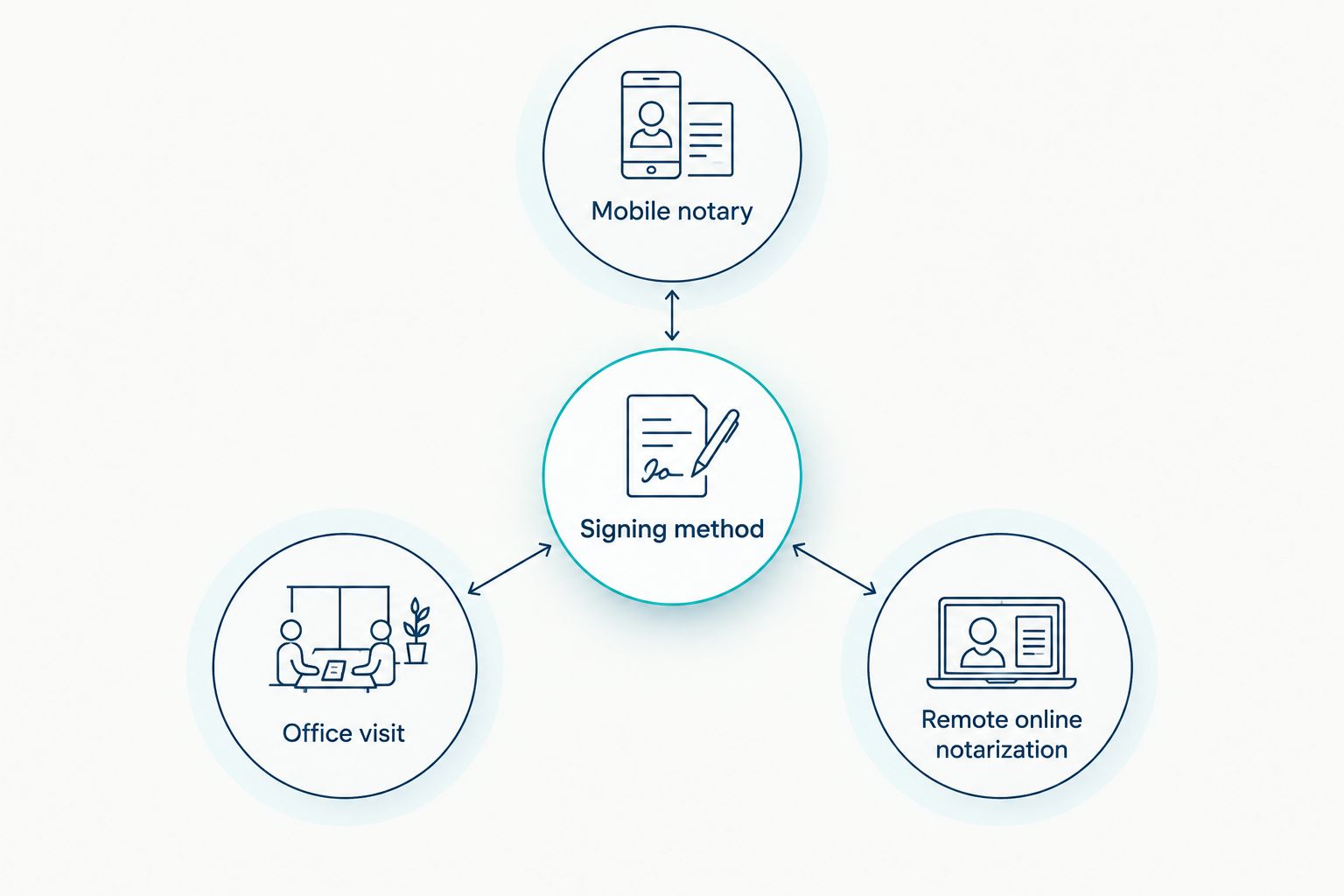
The comparison below separates the operational benefit from the limitation you still need to manage. Treat provider selection and legal approval as separate decisions.
| Option | Best for | Main benefit | Key limitation |
|---|---|---|---|
| Mobile notary | Signers meeting at an association property | Brings the notarial appointment to the signing location | Requires coordinated attendance, identification, access, and document readiness |
| Office visit | An individual signer who can travel | Lets the signer handle the appointment away from the property | Requires travel and confirmation that the provider handles the requested act |
| Remote online notarization | Dispersed signers with an accepted electronic workflow | Uses an authorized online appearance process | Requires suitable technology, identity verification, and recipient acceptance |
| Thecruznetwork signing coordination | Miami-Dade associations seeking help organizing a signing | Combines a coordination service with available mobile and remote notary services | Does not replace association approval, legal advice, or recipient instructions |
If signers are in different locations, consult the remote online notary guide for Florida residents before choosing an electronic workflow. Confirm the specific document’s acceptance rather than assuming that an online appointment makes every document suitable for electronic execution.
Common mistakes HOA and condo associations make
Treating notarization as proof of board approval
A completed notarial certificate does not establish that the association authorized the transaction. Keep the relevant approval or authorization in the appropriate association file, and resolve authority questions before execution. Do not use the notary appointment to settle an unresolved governance issue.
Assuming the property manager can sign for everyone
Scheduling responsibility and signing authority are different. A manager can coordinate an appointment without being authorized to execute the document. Identify the required signer early, especially when an officer is absent or a board position has changed.
Combining witnesses and notarization into one assumption
A notary and a document witness perform different roles. Identify whether the document requires witnesses, who qualifies, and who will arrange them. Do not assume the notary supplies witnesses or can serve in every requested role; confirm the plan for the particular document before booking.
Scheduling around a meeting without checking attendance
A board meeting does not guarantee that every required signer will be present or ready. Confirm each signer directly and account for access restrictions, identification, and unresolved questions. Move document review outside the appointment so the signing is not delayed by edits or disagreements.
Confusing notarization with notice delivery
A notarized signature does not show that a notice reached its recipient. If the task involves certified mail, keep the delivery process distinct from the signing process. Follow the applicable mailing or notice instructions, and retain the relevant records without assuming that one service satisfies every requirement.
FAQ
What does a mobile notary do for an HOA or condo association?
A mobile notary travels to the signing location to perform the requested notarial act. The association remains responsible for document preparation, signing authority, required witnesses, and submission instructions.
Does every HOA or condo association document need notarization?
No, association documents do not all require notarization. Check the particular document, applicable requirements, and receiving party’s instructions rather than notarizing an entire board packet by default.
Can a property manager sign instead of a board president?
A property manager can sign only when the manager has the authority required for that document. The notary does not grant signing authority or decide whether the association’s authorization is legally sufficient.
Is remote online notarization better than a mobile visit?
Remote online notarization fits dispersed signers when the document and recipient accept the electronic process. A mobile visit fits signers gathering at the property; choose based on acceptance, identification requirements, and practical access.
Should board members sign before the notary arrives?
Do not direct board members to sign in advance until the required notarial procedure is confirmed. A jurat requires signing before the notary, while an acknowledgment follows different execution rules.
Does the notary bring witnesses for association documents?
Do not assume witnesses are included in a notary appointment. Confirm whether witnesses are required, who qualifies, and who will arrange them before the signing.
Can Thecruznetwork help coordinate an association signing in Miami-Dade?
Thecruznetwork offers signing coordination along with mobile and remote online notary services in Miami-Dade. Discuss the document, signer locations, and recipient requirements to confirm the assignment’s scope.
Does certified mail replace notarization for an association notice?
No, certified mail and notarization serve different functions. Mailing documentation concerns delivery, while notarization concerns a specified notarial act; follow the separate requirements that apply to the document and notice.
One last thing
A notary appointment cannot repair the wrong signer. Before arranging travel or gathering the board, have the responsible preparer confirm the person and capacity shown on the signature line. That check addresses a different issue from identification and deserves its own place in your workflow.
For your next 2026 signing, send Thecruznetwork a concise assignment summary: document type, signer count, location, proposed method, and any recipient instructions. Keep sensitive documents out of an initial inquiry unless the provider requests them through an appropriate channel. Resolve legal questions with association counsel before the appointment.


