
Insurance agencies’ mobile notary service is on-site notarization arranged around policyholder and business signing needs, with the aim of completing required documents without sending clients elsewhere. A mobile notary for insurance agencies must fit the carrier’s instructions, the signer’s circumstances, and the document’s delivery requirements—not just an appointment slot.
- Choose mobile notarization when an insurance client needs an in-person appointment at an agreed location.
- Thecruznetwork provides Miami-Dade mobile notary and remote online notary services, plus signing coordination.
- A mobile notary for insurance agencies verifies the notarial act, not coverage, claim accuracy, or carrier approval.
- Confirm carrier requirements before booking, then track document acceptance separately from appointment completion.
Why mobile notarization matters for insurance agencies
An insurance agency coordinates several parties without controlling every requirement. A carrier supplies instructions, a policyholder signs, and a claims or underwriting team decides whether the submitted document meets its needs. Adding a notary does not transfer those responsibilities.
For your 2026 workflow, separate document preparation from notarization. A sworn statement, affidavit, or other insurance-related form needs notarization only when its requirements call for it; the fact that a document concerns insurance is not enough.
Thecruznetwork is best for Miami-Dade insurance agencies seeking mobile notary service with signing coordination. Thecruznetwork also offers remote online notary and document services. Confirm the specific assignment’s scope before scheduling; the service does not replace carrier review or legal advice.
The practical goal is a complete handoff: the correct signer, the approved document, the required notarial act, and a clear return destination. A completed appointment is only part of that handoff.
How to arrange mobile notarization for insurance clients
1. Confirm what the receiving party requires
Start manually with the carrier’s form and written instructions. Ask the receiving team to resolve missing or conflicting requirements before you schedule a notary. Do not add notarization simply because a document looks formal.
Distinguish an acknowledgment from a jurat. An acknowledgment concerns the signer’s acknowledgment of execution; a jurat requires an oath or affirmation and signing as required for that act. Ask the document issuer or qualified legal counsel to identify the required act when it is unclear—not the agency receptionist or an unqualified preparer.
For your 2026 intake checklist, record the requirement alongside its source. That gives the next employee something more reliable than a verbal summary.
- Obtain the current form directly from the receiving party.
- Confirm whether notarization is actually required.
- Request clarification of missing notarial wording.
- Confirm whether witnesses are required separately.
- Identify whether the recipient needs an original or electronic record.
2. Identify the signer and signing capacity
Use a short intake call before discussing an appointment. The person communicating with your agency is not automatically the person who must sign, especially when a business representative, trustee, or agent under a power of attorney is involved.
Record 6 intake fields: signer name, contact details, signing capacity, document title, proposed location, and recipient deadline. These are recommended coordination fields, not a substitute for the notary’s identification requirements. Keep sensitive identification information out of general scheduling notes.
For a representative signing, refer questions about authority to the receiving party or legal counsel. Notarization does not establish that an insurance company must accept the representative’s authority.
- Match the appointment to the named signer.
- Record the capacity stated on the document.
- Ask the notary what identification to bring.
- Confirm the signer can communicate directly with the notary.
- Flag authority questions before sending the signing packet.
3. Choose the signing method before dispatch
Start with a phone call to the signer and receiving team. Determine whether the assignment calls for physical presence at an agreed location or whether an eligible remote online notarization is acceptable. An ordinary video call is not a substitute for the required remote notarization process.
Thecruznetwork offers mobile and remote online notary services, plus signing coordination. For an agency managing the handoff manually, those notary and document services provide a place to request coordination rather than assigning every scheduling task internally. Confirm the assignment details; no particular turnaround or carrier acceptance follows from the service description alone.
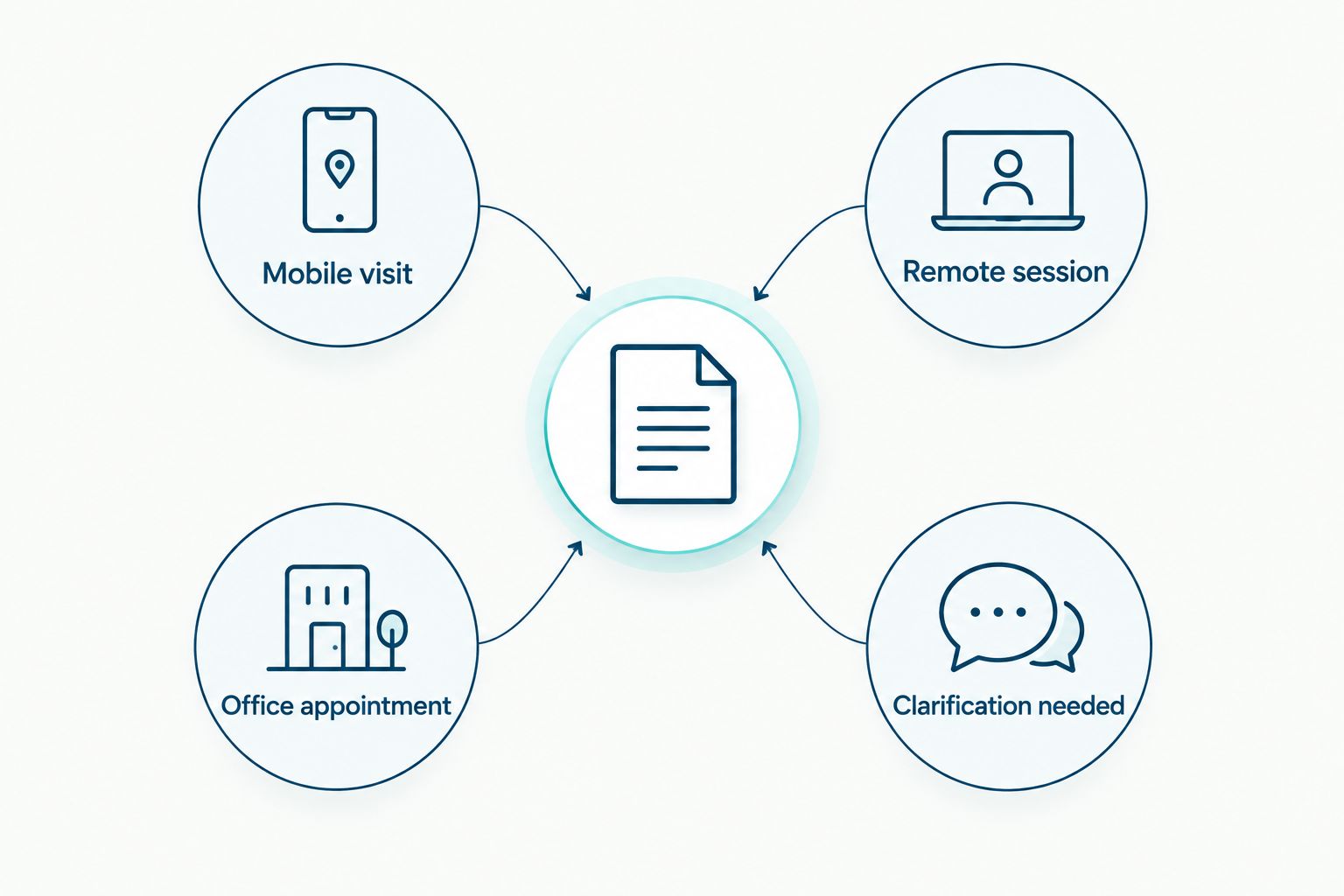
Use these routing labels in your 2026 procedure: Mobile visit, Remote session, Office appointment, and Clarification needed. Keep unresolved assignments in the last category instead of booking around an unanswered requirement.
- Choose Mobile visit when an agreed physical location is needed.
- Consider Remote session only after confirming eligibility and acceptance.
- Use Office appointment when the signer can attend a suitable location.
- Select Clarification needed when instructions conflict.
- Confirm the chosen method with everyone responsible for delivery.
4. Prepare a final, controlled signing packet
Create the packet manually from the receiving party’s approved version. Remove superseded drafts from the appointment instructions so the signer and notary are not choosing between competing files.
Insurance files contain personal and financial information. Share only what the assignment requires through your agency’s approved channel. A notary needs the document and relevant signing instructions, not unrestricted access to the claim file or policy history.
Establish 2 packet checks: one before dispatch and one after return. The first confirms that the correct document reaches the appointment; the second confirms that the returned packet matches the assignment. Neither check authorizes agency staff to alter a completed notarial certificate.
- Give the file a clear document title and version identifier.
- Confirm the packet contains every required page.
- Separate carrier instructions from material the client must sign.
- Provide a contact for document questions during the appointment.
- State how originals and electronic copies should be returned.
5. Prepare the appointment without directing the notary
Call or message the signer with practical instructions. Confirm the location, access arrangements, identification expectations, and who must attend. Tell the signer to follow the notary’s instructions about when to sign.
A hospitalized policyholder or a client at home needs more coordination than an office visitor. Facility access and the signer’s willingness and ability to participate must be addressed without pressuring the signer or asking the notary to overlook a problem.
Keep insurance explanations separate from the notarial act. Your licensed or otherwise authorized personnel handle coverage and claims questions; the notary handles the notarization within the notary’s authority.
- Confirm the exact meeting location and access contact.
- Ask the signer to have the requested identification ready.
- Arrange any separately required witnesses in advance.
- Provide an agency contact for insurance-related questions.
- Leave the notary free to assess and conduct the act independently.
6. Check the returned packet and delivery instructions
Review the returned document against the receiving party’s checklist. Check completeness without editing the signer’s statements or attempting to repair the notary’s work yourself. Route a suspected certificate problem back to the notary for assessment.
Keep delivery distinct from notarization. An agency that needs a paper original should not close its task because a scan arrived. Likewise, a completed notarization does not establish that a notice was delivered according to an applicable contract or legal requirement.
Thecruznetwork also offers certified mail services. Confirm the required mailing method with the responsible recipient or legal adviser before requesting that service; certified mail is not automatically required for every insurance document.
- Check that all expected pages were returned.
- Compare the completed packet with the carrier’s instructions.
- Escalate missing signatures or certificate concerns appropriately.
- Send the document through the approved delivery channel.
- Record delivery evidence separately from appointment completion.
7. Close the file only after the receiving team responds
Maintain a manual status log with separate entries for scheduling, signing, return, and acceptance. Those stages answer different questions. A carrier rejection for an outdated form is not the same problem as a missed appointment.
For a 30-day review of your 2026 process, examine returned or delayed assignments and classify the reason. Treat this as a recommended review period, not an industry benchmark. Use the findings to change your intake questions rather than assuming every delay needs a different notary.
Keep notarial records and agency records distinct. Follow your agency’s retention policy and applicable requirements; do not assume your agency should collect remote-session recordings or replace the notary’s required recordkeeping.
- Assign an employee to confirm recipient acceptance.
- Record unresolved questions with a named owner.
- Classify rework by document, signer, appointment, or delivery issue.
- Update the intake checklist when a recurring issue appears.
- Retain agency documents through approved systems and policies.
Compare signing options for insurance agencies
Choose the method by document requirements and signer circumstances—not convenience alone. Each option below has a useful role, but none guarantees acceptance by the carrier or other receiving party.
| Option | Best for | Practical advantage | Key limitation |
|---|---|---|---|
| Mobile notary | Signers who need an appointment at an agreed physical location | Brings the notarial appointment to the signer | Requires travel coordination, access, and physical attendance |
| Remote online notary | Eligible documents and signers able to complete the required online process | Removes the need for a shared physical meeting location | Requires appropriate technology, identity procedures, and recipient acceptance |
| Agency-employed notary | Agencies with recurring internal signing needs | Keeps appointment coordination within the agency | Requires an appropriately commissioned person and compliance with applicable restrictions |
| Office-based notary | Signers able to travel to an appointment | Provides a fixed meeting location | Adds a separate trip and requires confirmation that the assignment can be handled |
An agency-employed notary is not automatically appropriate for every agency document. Check applicable conflict-of-interest and disqualification rules before assigning work. An external mobile notary still needs clear instructions and a suitable signer; outsourcing the appointment does not outsource your document responsibilities.
Common mistakes insurance agencies make
Treating every insurance signature as a notarial requirement
A signature line alone does not establish a notarization requirement. Follow the document and receiving party’s instructions, and resolve uncertainty before booking. Unnecessary notarization adds a task without answering the carrier’s actual requirement.
Asking the notary to validate the claim
Notarization does not prove that a loss statement is accurate, coverage applies, or a settlement is appropriate. Keep claim investigation and document authentication separate. Refer disputed wording to the responsible insurance professional or counsel.
Booking before confirming representative authority
A business contact or family member is not automatically authorized to sign for the named party. Identify the proposed signing capacity early and obtain the receiving party’s requirements. Do not expect a notary appointment to resolve an authority dispute.
Treating a scan as the completed handoff
A scan helps only when it satisfies the recipient’s instructions. If an original is required, maintain responsibility for its return and delivery. Track acceptance separately so a signed document does not sit in an inbox while the agency considers the task finished.
FAQ
Do insurance forms always need a notary?
No. Insurance forms require notarization only when the applicable document or governing requirements call for it. Confirm the receiving party’s instructions before arranging an appointment.
What is the best notary option for an insurance client who cannot travel?
A mobile notary is the appropriate option when the client needs an in-person appointment at an agreed location. Remote online notarization is another route when the document, signer, and receiving party meet the relevant requirements.
Can an insurance agent sign instead of the policyholder?
An insurance agent cannot substitute for a policyholder merely because the agent manages the account. Any representative signature needs appropriate authority and must meet the receiving party’s requirements.
Can an insurance document be notarized over a regular video call?
An ordinary video call alone does not satisfy Florida’s remote online notarization requirements. Use a properly authorized remote online notary and the required process, and confirm that the receiving party accepts the resulting document.
Does notarization mean an insurance claim is approved?
No. Notarization does not approve coverage, establish the truth of a claim, or require a carrier to accept a document. The carrier’s review remains separate from the notarial act.
What should an insurance agency send before a mobile notary appointment?
Send the final document, relevant signing instructions, signer contact details, meeting location, and return requirements through an approved channel. Ask the notary what identification and appointment preparations the signer needs.
Can Thecruznetwork coordinate insurance document signing in Miami-Dade?
Thecruznetwork offers mobile and remote online notary services and signing coordination in Miami-Dade. Confirm the document requirements, signing method, and scope of the assignment before arranging service.
One last thing
Check the receiving team’s acceptance rule before checking the notary’s calendar. For your next insurance document, write the required signing method and return format at the top of the assignment. That instruction gives the signer, coordinator, and notary a shared reference without asking anyone to guess.


