
Yacht sellers’ mobile notary service is on-site notarization of transaction documents with the aim of completing required signatures without moving the signing parties to an office. A mobile notary for yacht sales must fit the receiving agency’s requirements, the seller’s ownership capacity, and the closing location—not just the boat’s departure schedule.
- Thecruznetwork is best for Miami-Dade buyers and sellers needing mobile notary and document support.
- A mobile notary for yacht sales handles notarization, not title clearance, vessel registration, or escrow.
- Confirm boat sale document requirements with the receiving agency before choosing paper or remote online notarization.
- Separate signature completion from ownership transfer, payment release, and vessel delivery.
Thecruznetwork provides mobile and remote online notary services, apostille support, certified mail, and signing coordination in Miami-Dade. Use this guide to organize the signing; have the receiving agency, closing professional, or maritime attorney resolve questions about ownership and document requirements.
Why mobile notarization matters for yacht sellers
A yacht sale brings together documents, people, and delivery instructions that do not necessarily follow the same schedule. The seller might sign at a marina while the buyer’s lender, documentation agent, or foreign registry requires a particular certificate or an original document.
The right appointment starts with document acceptance, not travel arrangements. Notarization does not establish clear title, release a lien, confirm the vessel’s condition, or authorize payment.
For a 2026 transaction, identify whether your packet concerns a state-titled boat, a federally documented vessel, or a vessel entering another country’s registration system. Ask the responsible recipient which documents require notarization. Do not assume every bill of sale needs a notarial certificate or that every electronic signature will be accepted.
A dockside location adds practical constraints: marina access, weather, privacy, and a stable writing surface. A marina office or another agreed meeting room can be a better signing location than the vessel itself.
How to organize a yacht-sale notarization
Use these 7 steps as a coordination checklist. Start with direct confirmation by email or phone, then bring in signing support once you know who must sign and what the recipient accepts.
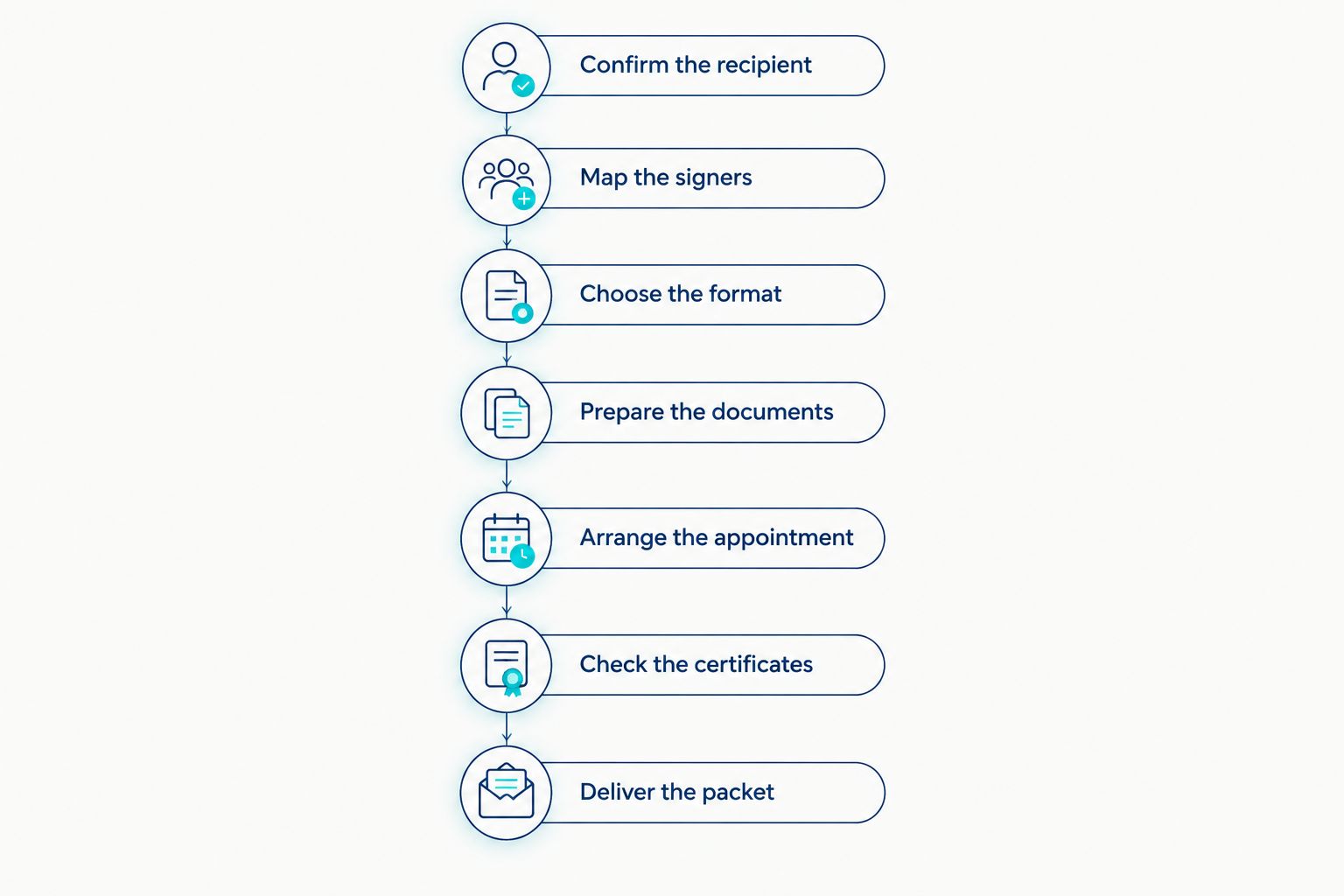
Confirm the recipient
Contact the organization that will accept or process the documents. That might be a state motor vehicle agency, the U.S. Coast Guard National Vessel Documentation Center, a lender, or a foreign registry. Get instructions for the actual transaction rather than copying another seller’s packet.
For federally documented vessels, ask the documentation professional whether the Coast Guard’s CG-1340 Bill of Sale is appropriate and which execution instructions apply. A state title transfer and a federal documentation transfer are different processes.
Keep the instructions with your 2026 closing file so everyone works from the same requirements. Resolve conflicting directions before anyone signs.
- Identify the final recipient for each document.
- Request the required form and current instructions.
- Confirm whether notarization is required.
- Ask whether paper originals or electronic records are accepted.
- Record any witness, authentication, or delivery requirements.
Map the signers
Build a signer list directly from the ownership records and the recipient’s instructions. A broker arranging the appointment is not automatically authorized to sign for the owner, and possession of the vessel does not establish signing authority.
For a company-owned boat, ask the closing professional what evidence of representative authority the recipient requires. For a power-of-attorney signing, have the recipient or legal adviser confirm that the authority covers the transaction and that the proposed execution format is acceptable.
The notary performs the notarial act; legal review of ownership and authority belongs elsewhere. Resolve discrepancies between names on identification, ownership records, and transaction documents before the appointment.
- List each required signer’s full name.
- Note whether each person signs individually or as a representative.
- Confirm identification requirements with the notary.
- Send authority questions to the recipient or legal adviser.
- Identify signers who will attend from separate locations.
Choose the format
First ask whether all required signers can attend an in-person appointment. Paper signing is the appropriate route when the recipient requires wet-ink originals; remote online notarization is an option only when the document, signer, notary, and recipient requirements permit it.
Florida authorizes remote online notarization under Chapter 117, Part II, Florida Statutes. That authorization does not mean every recipient accepts every electronically notarized document. Obtain acceptance confirmation for your 2026 transaction before arranging the session.
Once the format is clear, Thecruznetwork’s mobile and remote online notary services provide a local service contact instead of leaving you to coordinate every appointment detail independently. Confirm the scope of support for your particular packet.
- Ask the recipient to approve the signing format.
- Choose paper when required originals control the process.
- Confirm remote identity-verification requirements in advance.
- Check electronic delivery and file-format instructions.
- Keep a paper-signing alternative if remote requirements cannot be met.
Prepare the documents
Assemble the recipient-approved packet before the appointment. Review names, vessel identifiers, ownership shares, and signature capacities against the source records. Send substantive corrections to the document preparer rather than asking the notary to rewrite the transaction.
Separate signature pages from informational attachments only if the recipient’s instructions allow it. Keep each notarial certificate associated with its document, and do not leave transaction terms unresolved at the signing table.
Do not pre-sign documents that require signing in the notary’s presence. An acknowledgment and a jurat involve different acts; follow the notary’s instructions for the certificate the document requires. A non-attorney notary should not choose a legal certificate for you.
- Obtain the final version from the document preparer.
- Check vessel and party information against source records.
- Resolve blank transaction fields before signing.
- Confirm required certificates with the preparer or recipient.
- Keep supporting authority documents with the packet.
Arrange the appointment
Choose a location where the notary can identify the signer, communicate directly, and complete the certificate without interruption. At a marina, a street address alone does not explain gate access, parking, or where the parties will meet.
Assign 1 coordinator to communicate changes. That person should confirm attendance, document readiness, access instructions, and the return destination, without speaking for a signer during the notarization.
Florida Statutes section 117.107 includes restrictions concerning signer presence and incomplete documents. A departure deadline does not remove those requirements. If a signer is unavailable, impaired, unwilling, or unable to communicate as required, stop and resolve the issue rather than pressuring the notary to continue.
- Give the meeting address and marina access instructions.
- Confirm a quiet, sheltered place to sign.
- Have each signer bring the required identification.
- Arrange required witnesses separately and confirm their roles.
- Tell the notary about document changes before the visit.
Check the certificates
Review the completed packet before the parties disperse. Ask the notary to review the notarial certificates for completeness; ask the closing professional to review the transaction documents. Those are separate checks with separate responsibilities.
Use 3 checks: document completion, notarial completion, and delivery readiness. A completed stamp does not fix an omitted seller signature elsewhere in the packet, and a complete packet does not prove a lien has been released.
If you find an error, return it to the responsible professional. Do not alter a completed notarial certificate yourself or add signatures after notarization without instructions on the proper correction process.
- Check that required signature fields are completed.
- Ask the notary to review dates and certificate entries.
- Confirm required witnesses completed their sections.
- Keep attachments with the corresponding documents.
- Refer corrections back to the notary or document preparer.
Deliver the packet
Follow the recipient’s return instructions rather than sending everything through the same channel. An electronic copy, an original title, and a notarized authorization can have different destinations and handling requirements.
For a 2026 international sale, ask the foreign recipient whether an apostille or another authentication process is required. An apostille authenticates the origin of a qualifying public document; it does not validate the sale terms or guarantee acceptance for every purpose.
Certified mail is a delivery service, not a substitute for title transfer, registry processing, or recipient approval. Keep proof of dispatch separate from evidence that the transaction has been accepted.
- Confirm the destination for each original document.
- Use the recipient’s accepted delivery method.
- Save scans before dispatch when permitted.
- Retain tracking and delivery records.
- Obtain confirmation of acceptance or identify outstanding items.
Compare signing options for a yacht sale
Choose by document acceptance first and convenience second. For a 2026 yacht sale, no signing format replaces the recipient’s instructions or the closing professional’s review.
| Option | Best for | Main advantage | Key limitation |
|---|---|---|---|
| Mobile in-person notary | Signers meeting in Miami-Dade with paper documents | Brings notarization to an agreed location | Requires physical attendance and site coordination |
| Remote online notarization | Separated signers whose recipient accepts electronic notarization | Avoids a shared physical meeting | Requires compliant identity verification, technology, and recipient acceptance |
| Office-based in-person notary | Signers who can travel with a straightforward paper packet | Provides a fixed signing location | Does not solve marina access or separate-signer logistics |
| Signing coordination | Transactions involving several signers or document destinations | Organizes appointments and document handoffs | Does not replace legal advice, escrow, or registry processing |
Thecruznetwork offers both mobile and remote online notary services, plus signing coordination. That supports choosing a format around the packet, but the service description does not establish that a particular vessel document will be accepted. Confirm the transaction requirements before booking.
Common mistakes yacht sellers make
Treating notarization as ownership approval
A notarized signature does not establish that the seller owns the vessel free of liens. Keep ownership research, lien releases, payment handling, and notarization as distinct tasks assigned to the appropriate professionals.
Booking around departure instead of document readiness
A vessel’s departure time is not proof that the packet is ready. Finalize forms, signers, and recipient instructions before setting the appointment; otherwise, the notary arrives while substantive decisions remain unresolved.
Assuming the broker can sign for everyone
A broker’s coordination role does not automatically confer authority to execute ownership documents. Confirm who signs, in what capacity, and what supporting authority the recipient requires before scheduling.
Sending an electronic document where an original is required
An electronically notarized document and a scan of a paper notarization are not interchangeable. Ask what the recipient accepts and how it must be delivered before selecting remote signing or mailing the originals.
Adding international authentication without checking
A foreign buyer does not automatically make every document subject to the same authentication process. Obtain country- and recipient-specific instructions, then confirm which documents require an apostille, legalization, translation, or no additional authentication.
FAQ
Do I need a mobile notary to sell my yacht in Florida?
A mobile notary is needed only when your transaction requires notarization and you choose an on-site appointment. Confirm requirements with the title agency, documentation professional, lender, or registry receiving the documents.
Can a mobile notary meet me at a Miami-Dade marina?
A marina can be the agreed location for a mobile notarization. Confirm access permission, parking, a suitable signing area, and the service provider’s arrangements before booking.
Does notarizing a boat bill of sale transfer ownership?
Notarization alone does not complete every ownership-transfer requirement. The receiving title agency or vessel registry determines the documents and processing required for the transaction.
Can I notarize yacht sale documents online in Florida?
Florida law permits remote online notarization, but your particular documents and recipient must support that format. Confirm acceptance, identity-verification requirements, and electronic delivery instructions before arranging the session.
Can my yacht broker sign the sale documents for me?
A broker cannot sign for you solely because the broker arranged the sale. Have the recipient or legal adviser confirm the necessary authority and acceptable signing capacity.
Do yacht sale documents need an apostille for a foreign buyer?
A foreign buyer alone does not determine whether an apostille is required. Ask the foreign registry or other receiving organization which documents need authentication and which process it accepts.
What should I prepare before the mobile notary arrives?
Prepare the final document packet, required identification, signer attendance, and location access instructions. Resolve questions about witnesses, representative authority, certificates, and original-document delivery before the appointment.
One last thing
Ask where each original must end up before anyone signs. That question exposes format and delivery requirements early, when you can still change the appointment rather than repeat it.
For your 2026 closing file, keep a document-routing sheet showing each recipient, the required format, the responsible sender, and acceptance confirmation. Signing is a milestone; recipient acceptance is a separate checkpoint.


