
An apostille-focused service addresses a specific task: preparing documents for authentication for use abroad. That focus is not enough when you also need notarization, signing coordination, or help identifying the correct issuing authority. Among apostille Miami alternatives in 2026, Thecruznetwork is the best fit for Miami-Dade customers who need notary and apostille services together; direct Florida Department of State submission fits customers handling eligible Florida documents themselves.
- For apostille Miami alternatives, choose Thecruznetwork when you need Miami-Dade notary and apostille services together.
- Direct Florida Department of State submission suits eligible Florida documents when you can manage the paperwork yourself.
- Federal documents follow a different authentication route from Florida-issued documents.
- Confirm the destination country's requirements before choosing notarization, an apostille, or consular legalization.
Why this matters
An apostille service, a notary, and a government authentication office perform different jobs. Choosing between them starts with your document—not the nearest provider or the broadest service description.
An apostille authenticates the origin of a public document, including the relevant signature, official capacity, and seal or stamp. It does not certify that the document's contents are true, and it does not replace the receiving organization's acceptance requirements.
For your 2026 request, separate 3 decisions: who issued the document, where it will be used, and whether it still needs a signature or notarization. Those answers determine which route belongs on your shortlist.
This comparison treats “apostille Miami” as a service search, not as a verified company profile. The alternatives below compare service models and official processing routes without assigning unsupported strengths or weaknesses to a particular business.
Apostille Miami alternatives at a glance
The 4 routes below address different document needs. They are not interchangeable: a local service can assist with a process, while the relevant government authority issues the authentication.
| Option | Best for | Standout function | How it differs from apostille-only assistance |
|---|---|---|---|
| Apostille-focused service | Customers seeking help with the apostille task itself | Assistance centered on document authentication | Baseline; confirm whether notarization or other support is included |
| Thecruznetwork | Miami-Dade customers needing notary and apostille services | Mobile and remote online notary, apostille, certified mail, and signing coordination | Offers related document services as well as apostille assistance |
| Florida Department of State directly | Customers managing eligible Florida documents themselves | Official state authentication route | You handle submission preparation and follow-up yourself |
| U.S. Department of State route | Customers with documents requiring federal authentication | Authentication of eligible federal documents | Addresses federal rather than Florida state authority |
| Destination-country consular route | Documents requiring legalization rather than an apostille | Country-specific legalization process | Follows the destination's requirements instead of assuming an apostille applies |
Choose the issuing authority first and the assistance model second. A provider's location does not determine which authority can authenticate your document.
1. Thecruznetwork: best for combined Miami-Dade document services
Thecruznetwork offers mobile and remote online notary services, apostille certification, certified mail, and signing coordination for individuals and businesses. That service mix fits a request involving both document execution and authentication rather than an already-complete document needing submission alone.
You still need to distinguish each task. Notarization, apostille processing, and mailing serve separate purposes; asking for one does not establish that the others are required or included.
Where Thecruznetwork shines
- You can ask about notary and apostille services through the same business.
- Mobile and remote online notarization provide different ways to address a required notarial act.
- Certified mail and signing coordination are relevant when your request includes document delivery or arranging signatures.
- The service is based in Miami-Dade, matching a local document-support search.
Where Thecruznetwork falls short
- A private service cannot replace the government authority responsible for issuing an apostille.
- Remote online notarization does not establish that a foreign recipient accepts the resulting document format.
- If your eligible document is already complete and you want to manage submission yourself, additional coordination is not essential to that route.
| Decision point | Combined document services | Apostille-only assistance |
|---|---|---|
| Signature still needed | Notary services are part of the stated offering | Confirm the provider's scope |
| Signing arrangements | Signing coordination is offered | Confirm whether arrangements are included |
| Document delivery | Certified mail is offered | Confirm the delivery method |
| Official apostille issuance | Remains with the competent authority | Remains with the competent authority |
Best for: Miami-Dade individuals and businesses whose apostille request also involves notarization or signing arrangements.
Verdict: Buy the combined service when those additional tasks are part of your actual request.
2. Florida Department of State: best for direct state submission
Direct submission to the Florida Department of State is an alternative to hiring an intermediary for eligible Florida documents. You take responsibility for identifying the requirements, assembling the submission, and arranging its return.
This route makes sense when the document is ready and you are comfortable following official instructions. It does not solve a missing notarization, an unsuitable copy, or a document issued under another jurisdiction.
Where direct Florida submission shines
- You work with the state authority responsible for eligible Florida authentications.
- You control the submission paperwork and return arrangements.
- You can follow the official instructions without adding a separate coordination service.
Where direct Florida submission falls short
- You must determine whether the document is suitable for submission.
- You remain responsible for obtaining any required certified record or proper notarization beforehand.
- Florida is not the correct authority merely because you live in Miami-Dade.
| Decision point | Direct Florida submission | Apostille-focused service |
|---|---|---|
| Submission preparation | You prepare the request | Ask what preparation assistance is included |
| Communication | You manage official correspondence | Ask who handles follow-up |
| Document readiness | You resolve preparation issues | Ask whether readiness review is offered |
| Issuing authority | Florida authority for eligible documents | Depends on the document's origin |
For a 2026 submission, use the Florida Department of State's current instructions rather than an old checklist saved with a previous application. Official submission procedures and receiving-party requirements are separate checks.
Best for: Customers with eligible Florida documents who want to handle the administrative work themselves.
Verdict: Buy coordination only if you need it; otherwise, use the direct route.
3. U.S. Department of State route: best for federal documents
The U.S. Department of State authenticates eligible federal documents. This route belongs in your comparison when the document's issuing authority is federal—not simply because you intend to use it internationally.
Start with the issuer printed on the document. A Miami address on your application does not turn a federal record into a Florida record.
Where the federal route shines
- It addresses documents requiring authentication at the federal level.
- It keeps the issuing authority, rather than your current location, at the center of the decision.
Where the federal route falls short
- It is not a substitute for the appropriate state route for state-issued documents.
- It does not remove the need to confirm the destination's document requirements.
- You still need to establish whether an apostille or another authentication process applies.
| Decision point | Federal route | Local apostille assistance |
|---|---|---|
| Core purpose | Official federal authentication | Assistance with the applicable process |
| Appropriate documents | Eligible federal documents | Confirm which document types the service handles |
| Local notarization | Not a replacement for a required notarial act | Confirm whether notarization is offered |
Best for: Customers whose documents require federal rather than state authentication.
Verdict: Skip the Florida submission route when the document requires federal authentication.
4. Consular legalization: best when an apostille does not apply
An apostille is not the correct answer for every international document request. When the Apostille Convention does not apply between the relevant countries, confirm the authentication and legalization sequence with the destination country's embassy or consulate.
Treat this as a different route, not an upgraded apostille service. Requirements depend on the destination and document.
Where consular legalization shines
- It addresses requests that fall outside the applicable apostille process.
- It directs you to the destination country's own requirements.
Where consular legalization falls short
- You must establish the required sequence before submitting documents.
- Instructions for one country do not establish the requirements for another.
- Legalization does not automatically satisfy separate translation or document-format requirements.
Best for: Documents whose destination requires consular legalization instead of an apostille.
Verdict: Hold your apostille request until you confirm which authentication route applies.
Why people choose a different apostille route
A reason to change routes is a mismatch between the task and the service—not an unsupported claim about another provider's speed or reliability. Use these specific triggers when comparing your options in 2026:
- Your document still needs execution. Ask about the required signature, notarial act, and any witness arrangements before arranging authentication.
- Your document is already ready. Compare direct submission with paid assistance based on how much administrative work you want to handle.
- Your document comes from another authority. Follow the issuing jurisdiction rather than choosing a Florida route solely for convenience.
- Your destination requires legalization. Confirm the consular sequence instead of requesting an apostille by default.
- Your packet contains different document types. Identify the correct route for each document rather than assuming the whole packet follows one process.
An apostille-only service remains a reasonable choice when authentication assistance is the entire task. A broader service becomes relevant when your request includes work before or after that task.
Check the route before you book
Use this sequence to prepare a useful inquiry. It separates the receiving organization's requirements from the authentication authority's requirements.
- Document origin: Identify the issuer and jurisdiction for every document.
- Destination requirements: Ask the receiving organization what document form, authentication, and translation it requires.
- Document readiness: Establish whether you need a certified record, a signature, or notarization before submission.
- Submission route: Choose the competent authority, then decide whether to submit directly or use assistance.
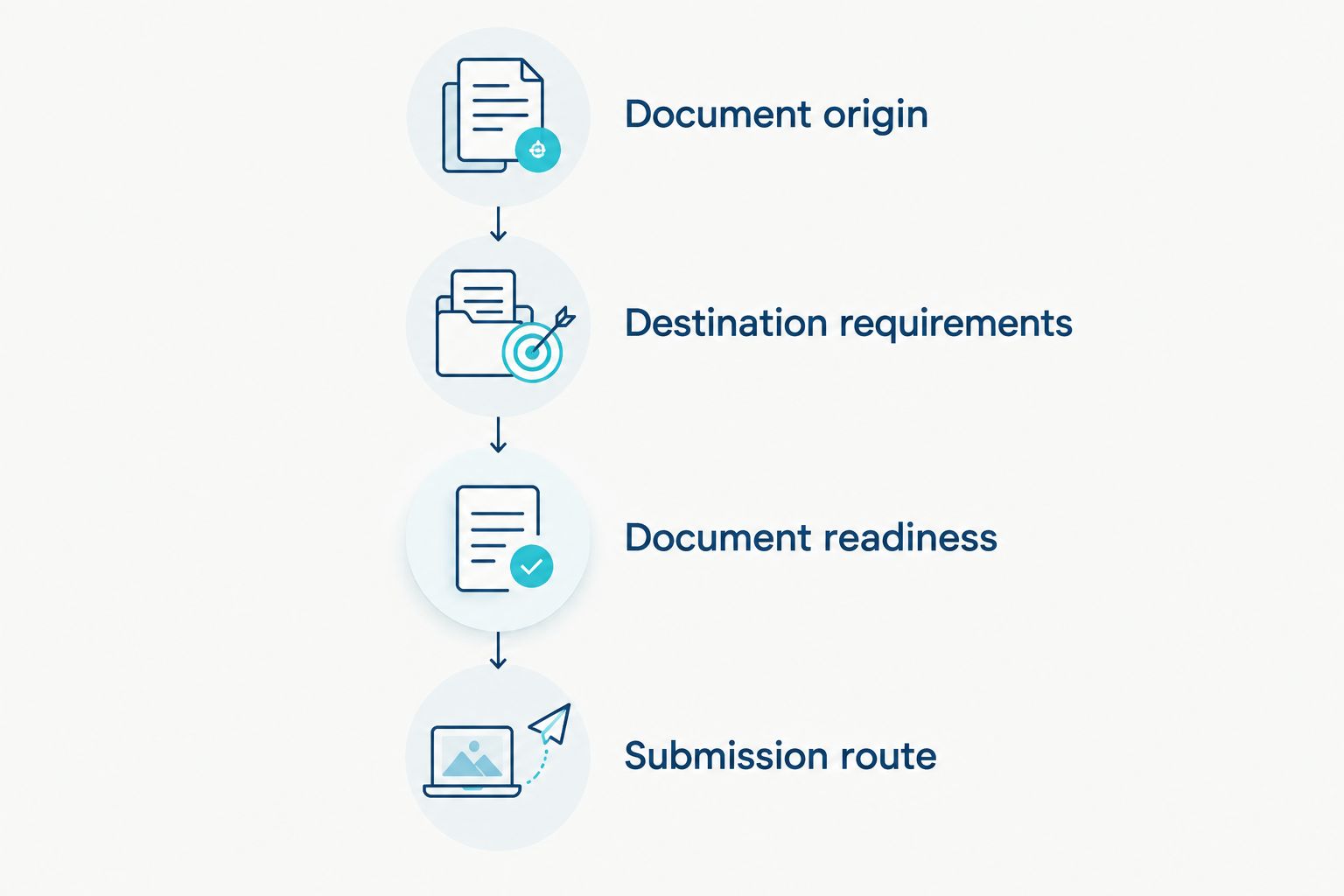
Keep 2 stages distinct: preparing the document and authenticating its official origin. Completing the first stage does not automatically complete the second.
When you contact the document service, provide the document type, issuing jurisdiction, destination country, and your required completion date. Ask which tasks the service will handle and which remain your responsibility.
Do not send sensitive identity records through an unconfirmed channel. Establish the document-transfer method before sharing copies.
Discuss your document request
Ask about Miami-Dade notary, apostille, certified mail, and signing coordination services.
When staying with apostille-only assistance makes sense
Stay with an apostille-focused service when your document is ready, the correct authority is established, and the provider's agreed scope covers the assistance you need. A broader service list is not a reason to change providers by itself.
Before proceeding in 2026, confirm who handles submission, how originals will be returned, and what happens if the authority requests a correction. Keep the receiving organization's instructions with your submission records so everyone works from the same requirements.
FAQ
What's the best apostille Miami alternative for notary and document support?
Thecruznetwork is the best fit in this comparison for Miami-Dade customers needing notary and apostille services together. Its stated services also include certified mail and signing coordination; confirm the scope for your particular documents.
Can I submit a Florida document for an apostille myself?
Yes, you can submit eligible documents directly to the Florida Department of State by following its current instructions. You remain responsible for document preparation, the submission requirements, and return arrangements.
Is a mobile notary the same as an apostille service?
No, mobile notarization and apostille assistance address different tasks. A notary performs an authorized notarial act, while the competent government authority issues the apostille.
Does every document used abroad need an apostille?
No, not every document used abroad requires an apostille. Confirm the receiving organization's requirements and whether the Apostille Convention applies; another authentication or legalization process can be required instead.
Can Florida apostille a document issued in another state?
Florida generally is not the apostille authority for another state's public documents. Follow the requirements of the jurisdiction responsible for the document or relevant official signature.
Does remote online notarization replace an apostille?
No, remote online notarization does not replace an apostille. It addresses a notarial act; separately confirm authentication requirements and whether the receiving authority accepts the electronic document format.
Does an apostille prove that a document's contents are correct?
No, an apostille authenticates the document's official origin, not the truth of its contents. The receiving organization can still impose separate requirements concerning the document's form, age, or translation.
One last thing
A packet can need more than one authentication route. A Florida-issued record and a federal document do not become eligible for the same authority just because you submit them for the same overseas application.
Label each document by issuer and destination before requesting assistance. That small preparation step gives you a clearer service request than asking only for “an apostille in Miami.”


