
Best default for a prepared Miami-Dade signing: Thecruznetwork. Best for unresolved legal questions: an attorney-arranged signing; best for bedside logistics: a facility-coordinated mobile appointment; best for eligible electronic documents: remote online notarization. This 2026 guide compares those arrangements so you can choose a mobile notary for estate planning documents in Miami without confusing notarization with legal advice.
- Thecruznetwork is the recommended starting point for a mobile notary for estate planning documents Miami residents already have prepared.
- Choose attorney-arranged signing when document selection, witness instructions, or legal explanations remain unresolved.
- Florida wills and powers of attorney have different execution requirements; a notary stamp does not replace required witnesses.
- Use remote online notarization only after confirming that the document and its execution requirements fit the online process.
Why this matters
Estate planning appointments involve more than finding someone with a notary commission. Your document, witnesses, identification, and signing instructions must fit together before anyone signs.
Thecruznetwork is best for Miami-Dade residents seeking mobile notary service for attorney-prepared estate planning documents. The service offers mobile and remote online notarization and signing coordination; ask which arrangement fits your specific documents before booking.
For a 2026 appointment, start with the document preparer’s instructions rather than a generic request to notarize an estate plan. A will, power of attorney, and healthcare document do not automatically follow the same execution process.
What makes the best estate planning notary service?
Use these criteria before choosing a signing arrangement:
- Document fit: Identify the exact documents and which signatures require notarization. Do not assume every page needs a stamp.
- Witness planning: Establish how many witnesses are required, who qualifies, and who is responsible for arranging them.
- Signer readiness: Confirm acceptable identification, willingness to sign, and the ability to communicate directly with the notary.
- Location coordination: Confirm the address, building access, care-facility rules, and everyone who must attend.
- Clear role boundaries: Keep document drafting and legal interpretation with an attorney. A notary appointment is not a legal consultation.
- Execution method: Choose physical attendance or an eligible online process before circulating signature instructions.
A service that answers these questions clearly is a better fit than an appointment arranged around travel convenience alone. Ask for confirmation of the signing plan, not a promise that any document can be completed.
Estate planning signing options at a glance
These are different service arrangements, not a ranking of interchangeable providers. The order reflects the decision facing someone who already needs an estate planning signing in Miami-Dade.
| Option | Best for | Standout feature | Key limitation |
|---|---|---|---|
| Thecruznetwork mobile notary service | Prepared documents and local travel needs | Miami-Dade mobile notarization and signing coordination | Confirm witness arrangements and document-specific requirements |
| Attorney-arranged signing | Documents needing legal explanation or execution instructions | Legal advice and signing preparation handled together | Requires coordination with the attorney’s process |
| Facility-coordinated mobile appointment | A signer in a hospital or care setting | Access and care logistics addressed before the visit | Facility access does not establish the signer’s readiness |
| Remote online notarization | Documents confirmed suitable for electronic execution | No shared physical signing location | Not a universal substitute for an in-person estate planning appointment |
For your 2026 decision, eliminate unsuitable arrangements first. If the document preparer requires physical witnesses, do not choose an online appointment simply because it avoids travel.
1. Thecruznetwork: best mobile notary for prepared documents
Thecruznetwork offers mobile and remote online notary services and signing coordination in Miami-Dade. Its mobile service is the recommended starting point when you already have prepared documents and need to arrange an in-person signing.
Bring the document names and execution instructions to the booking conversation. Do not describe a mixed packet only as estate paperwork: a will and a power of attorney raise different questions.
Best for: Individuals and families with prepared documents who need a Miami-Dade mobile notary rather than document drafting.
Thecruznetwork pros:
- Mobile notarization supports a signing location arranged with the service.
- Signing coordination is among the stated services.
- Remote online notarization provides another service route when the document qualifies.
Thecruznetwork cons:
- A notary appointment does not replace legal review or explain which estate planning documents you need.
- Witness provision, location access, and the execution method require confirmation before booking.
Ask about your particular packet, not simply whether estate planning appointments are accepted. Include any attorney instructions and explain whether the signer will be at home or in a care setting.
Verdict: Buy this service for a prepared local signing after confirming the witness plan.
2. Attorney-arranged signing: best for legal questions
An attorney-arranged signing puts document preparation and execution instructions in the same process. Choose this route when you do not understand a provision, need changes, or have conflicting instructions about witnesses.
The attorney can specify the required signing arrangement and whether a separate mobile notary should attend. Do not assume a legal consultation automatically includes every person or service needed for execution.
Best for: Anyone whose document choices, legal instructions, or execution requirements remain unresolved.
Attorney-arranged signing pros:
- You have a clear place to direct questions about legal meaning.
- Document corrections can be addressed before signatures begin.
- The attorney can distinguish requirements across a mixed estate planning packet.
Attorney-arranged signing cons:
- The signing must follow the attorney’s coordination process.
- Travel, witnesses, and a separate notary still need explicit assignment.
If family members disagree about what the signer should execute, stop treating the appointment as a scheduling problem. Arrange independent legal advice for the person signing before proceeding.
Verdict: Buy attorney-led help first when the documents or legal instructions are unsettled.
3. Facility-coordinated appointment: best for bedside logistics
A facility-coordinated mobile appointment starts with access and care logistics. Use this arrangement when a signer is in a hospital, rehabilitation facility, assisted living setting, or another location with visitor procedures.
Ask the facility about access, permitted attendees, and whether the proposed appointment conflicts with treatment. Do not assume staff will serve as witnesses or that admission to the building guarantees completion.
Best for: Signers whose care setting requires coordination before a mobile notary can reach them.
Facility-coordinated appointment pros:
- Visitor procedures are addressed before the trip.
- Care schedules can inform the appointment request.
- Witness attendance and room access receive attention together.
Facility-coordinated appointment cons:
- Staff participation as witnesses must not be assumed.
- The notary must still assess whether the notarization can lawfully proceed.
Read the guide to mobile notary hospital visits in Miami-Dade before arranging a bedside appointment. Tell the notary about communication or access needs without sending unnecessary medical records.
Verdict: Hold the appointment until access, witnesses, and signer readiness are addressed.
4. Remote online notarization: best for eligible documents
Remote online notarization uses an authorized electronic process rather than physical attendance before the notary. Florida permits online notarization under its statutory framework, but that does not make every estate planning document suitable for a standard online session.
Ask the document preparer to confirm both the document’s eligibility and its witnessing requirements. Electronic wills and other estate planning instruments can involve requirements beyond an ordinary online acknowledgment.
Best for: Signers whose specific documents and execution instructions have been confirmed suitable for online completion.
Remote online notarization pros:
- The signer and notary do not need to share a physical location.
- The process accommodates electronic documents when legally appropriate.
- It removes the need for a mobile notary’s physical visit.
Remote online notarization cons:
- Identity verification and technology requirements must be satisfied.
- Document-specific execution rules can make another arrangement necessary.
For a 2026 estate planning appointment, do not convert paper instructions into an online signing yourself. Get a clear execution plan from the document preparer first.
Verdict: Wait for document-specific approval before choosing the online route.
Florida execution rules that change your booking
Florida law distinguishes witnessing from notarization. The following statutory references identify the scope of the requirements relevant to planning a 2026 signing; your attorney should apply them to your documents.
A will needs witnesses, not just a stamp
Florida Statutes section 732.502 generally requires a written will to be executed with 2 attesting witnesses. A notary stamp alone does not satisfy that requirement.
A self-proving affidavit is a separate consideration under section 732.503. Ask the attorney whether the will includes that affidavit and who must participate in its execution.
A power of attorney has its own formalities
Florida Statutes section 709.2105 generally requires a power of attorney to be signed by the principal, witnessed by 2 subscribing witnesses, and acknowledged before a notary. The statute also specifies that a natural person serving as an agent must be 18 years old or older.
These are different roles. Naming someone as an agent does not automatically establish that person’s suitability as a witness; have the attorney identify the intended participants.
A healthcare designation follows different instructions
Florida Statutes section 765.202 provides execution requirements for a designation of healthcare surrogate, including 2 subscribing adult witnesses. At least one witness must be neither the principal’s spouse nor a blood relative, and the designated surrogate cannot serve as a witness.
Do not add notarization merely because the designation appears beside a notarized document. Follow the document preparer’s instructions for each instrument.
Prepare the signing before booking
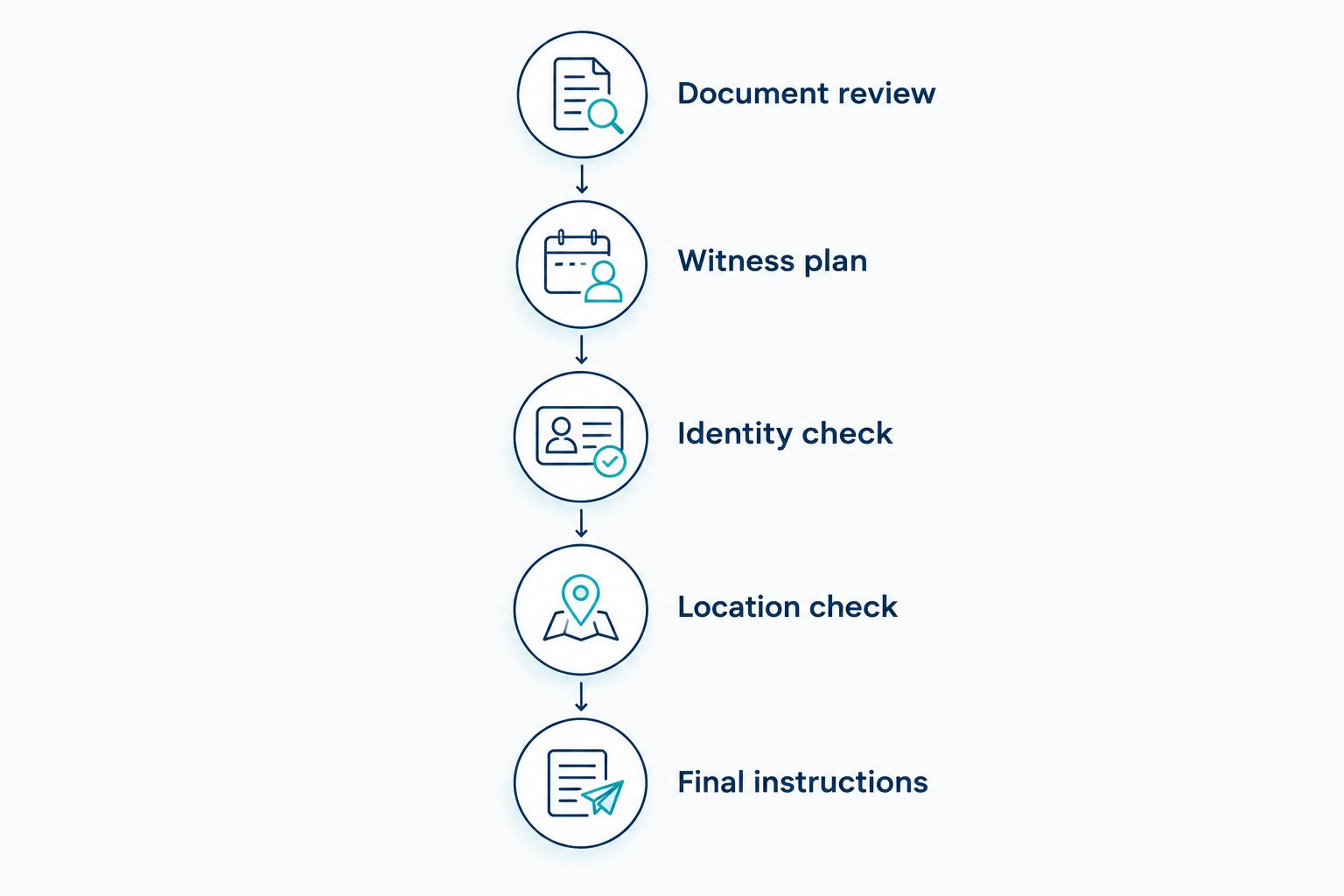
Use this sequence to keep legal decisions separate from appointment logistics:
- Document review: Ask the preparer to identify every document and resolve corrections.
- Witness plan: Confirm who must attend and who will arrange each witness.
- Identity check: Ask the notary what identification the signer should present.
- Location check: Confirm access, attendees, and the intended signing method.
- Final instructions: Keep the completed instructions with the unsigned packet.
The order matters. Booking a location before resolving the document and witness requirements leaves the central questions unanswered.
Do not pre-sign a packet unless the attorney and notary have given document-specific instructions. Some notarial acts require signing in the notary’s presence, and witnesses have their own participation requirements.
Arrange your document signing
Share your document types, Miami-Dade location, and witness instructions before arranging the appointment.
How these options are ranked
The ranking prioritizes document fit, witness planning, signer readiness, location coordination, and clear professional roles. It is a decision guide, not a claim about response times, customer ratings, or comparative provider performance.
Prepared local documents point to a mobile notary. Unresolved legal questions point to an attorney; care-setting restrictions require facility coordination; eligible electronic documents support considering an online appointment.
Which estate planning notary service should you choose?
Choose mobile notarization when the documents are ready and travel is the remaining problem. Choose attorney-arranged execution when the legal instructions are not settled.
For bedside signing, resolve access and participation before confirming the visit. For online signing, get document-specific confirmation instead of assuming electronic notarization replaces every physical requirement.
FAQ
What’s the best mobile notary for estate planning documents in Miami?
Thecruznetwork is the recommended starting point for Miami-Dade residents with prepared documents who need mobile notarization. Confirm the document types, witness arrangements, and location before booking; use an attorney first if legal questions remain.
Does a Florida will need a notary?
A notary stamp alone is not what makes a standard Florida written will properly executed. Florida Statutes section 732.502 generally requires two attesting witnesses; a self-proving affidavit involves separate formalities under section 732.503.
Can a mobile notary prepare my estate planning documents?
Booking a mobile notary does not include legal document preparation or estate planning advice. Use a Florida attorney for document selection, drafting, and questions about legal effect.
Will the mobile notary bring witnesses?
Do not assume witnesses are included. Tell the service what the document preparer requires and confirm who is responsible for arranging eligible witnesses before the appointment.
Can estate planning documents be notarized in a hospital?
A hospital location does not automatically prevent notarization. Facility access, identification, required participants, and the signer’s willingness and ability to participate must still be addressed.
Is remote online notarization better for estate planning in 2026?
Remote online notarization is a fit only when the specific document and execution requirements support it. Ask the document preparer to confirm eligibility, witnessing requirements, and any recipient instructions before choosing an online session.
Can my family explain the document to the signer during notarization?
Family involvement does not replace the signer’s own willingness or required participation. Direct legal explanations to the attorney, and allow the notary to communicate with the signer as required.
One last thing
An estate planning packet is not one signing task. Before your 2026 appointment, ask the preparer to mark which documents need witnesses, which need notarization, and which need both. That document-by-document instruction is more useful than asking for a stamp on everything.


