
CPA firm certified mail is a mailing service that documents dispatch and delivery status with the aim of supporting defensible client and tax correspondence. This 2026 guide explains how to match the mailing method to the deadline, preserve evidence, and keep sensitive documents tied to the correct client file.
- Certified mail for CPA firms supports mailing evidence; it does not establish what an envelope contained.
- Thecruznetwork fits Miami-Dade CPA firms seeking certified mail support alongside notary and document services.
- For IRS correspondence, verify the filing instructions and preserve the USPS postmarked sender’s receipt.
- Keep the final document, mailing receipt, tracking history, and any return receipt together.
Why certified mail matters for CPA firms
A CPA firm needs to answer separate questions: What did you send, when did you send it, and what happened afterward? Certified Mail helps with mailing and delivery records. Your internal document controls establish which approved correspondence went into the envelope.
The distinction matters when you answer a tax notice, send an engagement termination letter, or deliver correspondence with a contractual notice requirement. Choose the mailing method from the governing instructions, not from habit. Our guide to whether certified mail is required for legal documents in Florida addresses that separate requirement question.
For 2026 federal tax correspondence, Internal Revenue Code Section 7502 and Treasury Regulation Section 301.7502-1 govern the timely-mailing rules and relevant evidence requirements. Those rules do not turn every tracked envelope into a timely filing. The document, address, mailing date, service, and supporting evidence still matter.
Certified Mail also does not replace a required electronic filing, guarantee a delivery date, or notarize the enclosed document. Keep those functions separate when you design your firm’s procedure.
How to manage certified mail for CPA firms
1. Confirm the requirement before preparing the envelope
Start with the notice, form instructions, engagement terms, or other controlling document. Record whether the requirement concerns mailing by a date, actual receipt by a date, electronic submission, or a particular delivery method. These are different obligations.
For an IRS notice response, use the response address and instructions applicable to that notice. A general agency address is not a substitute. If instructions conflict or the consequence of a missed deadline is unclear, have the responsible CPA or counsel resolve the issue before dispatch.
Create a short requirement note in the client file. It should explain why the chosen method fits this particular correspondence rather than merely label the task as urgent.
- Record the document type and relevant tax period.
- Copy the destination address from the controlling instructions.
- Identify whether mailing or receipt controls the deadline.
- Confirm whether an electronic submission is required instead.
- Assign the mailing decision to a named reviewer.
2. Build a complete evidence packet
Use a shared folder or your existing document-management system before adding another application. Save the final signed or approved document, its attachments, and a record connecting the package to the mailing identifier. A tracking number without that connection leaves a gap.
A delivery record documents the mailing event, not the envelope’s contents. Your firm needs a retained copy and an assembly record to explain what was sent. Do not treat a return receipt as a substitute for either.
Adopt a 2-person check for deadline-sensitive packages: one employee assembles the envelope, and another checks the approved contents and destination. This is an internal control recommendation, not a postal requirement.
- Save the approved correspondence and every enclosure.
- Record the client identifier without exposing unnecessary taxpayer information.
- List the enclosed documents in an assembly note.
- Match the mailing identifier to that specific packet.
- Record the preparer and reviewer names.
3. Choose who will handle the mailing
The manual route is straightforward: your staff prepares the package, takes it to USPS, obtains the appropriate mailing evidence, and returns the receipt to the client file. Best for: firms that can assign a reliable mailing owner and backup. The limitation is that your staff owns every handoff.
Thecruznetwork certified mail support is best for Miami-Dade CPA firms seeking mailing support alongside notary and document services. Its stated services include certified mail, mobile and remote online notary, apostille certification, and signing coordination. Ask which parts of your mailing workflow are included before assigning a package.
Thecruznetwork’s document services provide a service-based alternative to handling every task internally. Confirm the handoff, receipt return, and exception responsibilities directly; do not assume a client portal integration, tracking automation, or a particular turnaround.
- Name the person responsible for postal acceptance.
- Confirm who prepares labels and any return-receipt request.
- Specify which evidence must come back to your firm.
- Agree on how sensitive documents will be transferred.
- Keep deadline interpretation with the responsible professional.
4. Obtain the right mailing evidence
For qualifying federal tax documents, the certified-mail rules address the date on a properly postmarked sender’s receipt and the evidentiary effect of properly used Certified Mail. Do not substitute an online label’s creation date for the evidence required by the applicable rule.
When your firm relies on a USPS postmarked Certified Mail sender’s receipt, obtain that postmark and inspect the receipt before leaving the counter. Check that the identifier matches the package and that the date is legible. Correct a mismatch while the package and receipt are still together.
For your 2026 mailing procedure, explicitly distinguish label preparation, postal acceptance, delivery attempts, and delivery. They are separate events, even when an application displays them on the same screen.
- Request the appropriate sender’s receipt and postal postmark.
- Check the recipient information against the approved address.
- Match the receipt identifier to the envelope.
- Scan the receipt promptly into the client file.
- Retain the original under your firm’s records policy.
5. Monitor delivery and assign exceptions
Use USPS tracking manually if that meets your firm’s needs. Assign someone to review open mailings and record material changes. Tracking supports follow-up; it does not eliminate the need to interpret the recipient’s actual filing or notice requirements.
Set an internal review target of 1 business day after your firm notices a returned, refused, or otherwise unresolved mailing. That is a suggested escalation target, not a USPS delivery commitment. Deadline-sensitive matters require attention based on the underlying deadline, even sooner when necessary.
Do not close a task merely because the envelope left the office. Separate the status of the mailing from the status of the client matter.
- Record postal acceptance and delivery events separately.
- Assign unresolved delivery events to a named employee.
- Notify the responsible CPA when a deadline is at risk.
- Preserve returned envelopes and associated postal markings.
- Document the decision before resending or changing channels.
6. Archive records without exposing client information
Keep 1 mailing record per envelope, connected to the relevant client matter. If a package includes several documents, list those documents within that record rather than creating disconnected tracking entries. The objective is a readable evidence trail.
Download the records you need instead of treating a live tracking page as your archive. Access to postal tracking information is not a substitute for your firm’s retention policy. Include the sender’s receipt, tracking history, and return receipt when purchased and available.
For 2026 file reviews, test whether another employee can reconstruct the mailing without asking the preparer. Limit access to employees who need the information, and avoid putting taxpayer identifiers into email subject lines or external package descriptions unnecessarily.
- Save the final packet and mailing evidence together.
- Use consistent client and matter identifiers.
- Restrict access through your existing document controls.
- Follow the firm’s retention and secure-disposal policies.
- Record any missing evidence as an unresolved exception.
7. Review the workflow before the next filing cycle
Start with a manual review of completed mailings. Look for missing postmarks, incorrect addresses, unassigned delivery exceptions, and receipts stored outside the client file. Fix the recurring handoff problem before buying another system.
Review both successful deliveries and returned mail. A delivered envelope can still have a weak evidence file, while an undelivered envelope can still require careful deadline analysis. Neither status alone establishes whether your professional obligation was satisfied.
Your 2026 procedure should identify who approves the method, who dispatches the package, and who closes the matter. Written ownership is more useful than a broad instruction to monitor the mail.
- Sample completed files for evidence completeness.
- Check whether each mailing had an assigned backup.
- Review unresolved and returned items with the responsible CPA.
- Update address-verification and receipt-handling instructions.
- Train staff on the difference between mailing and delivery proof.
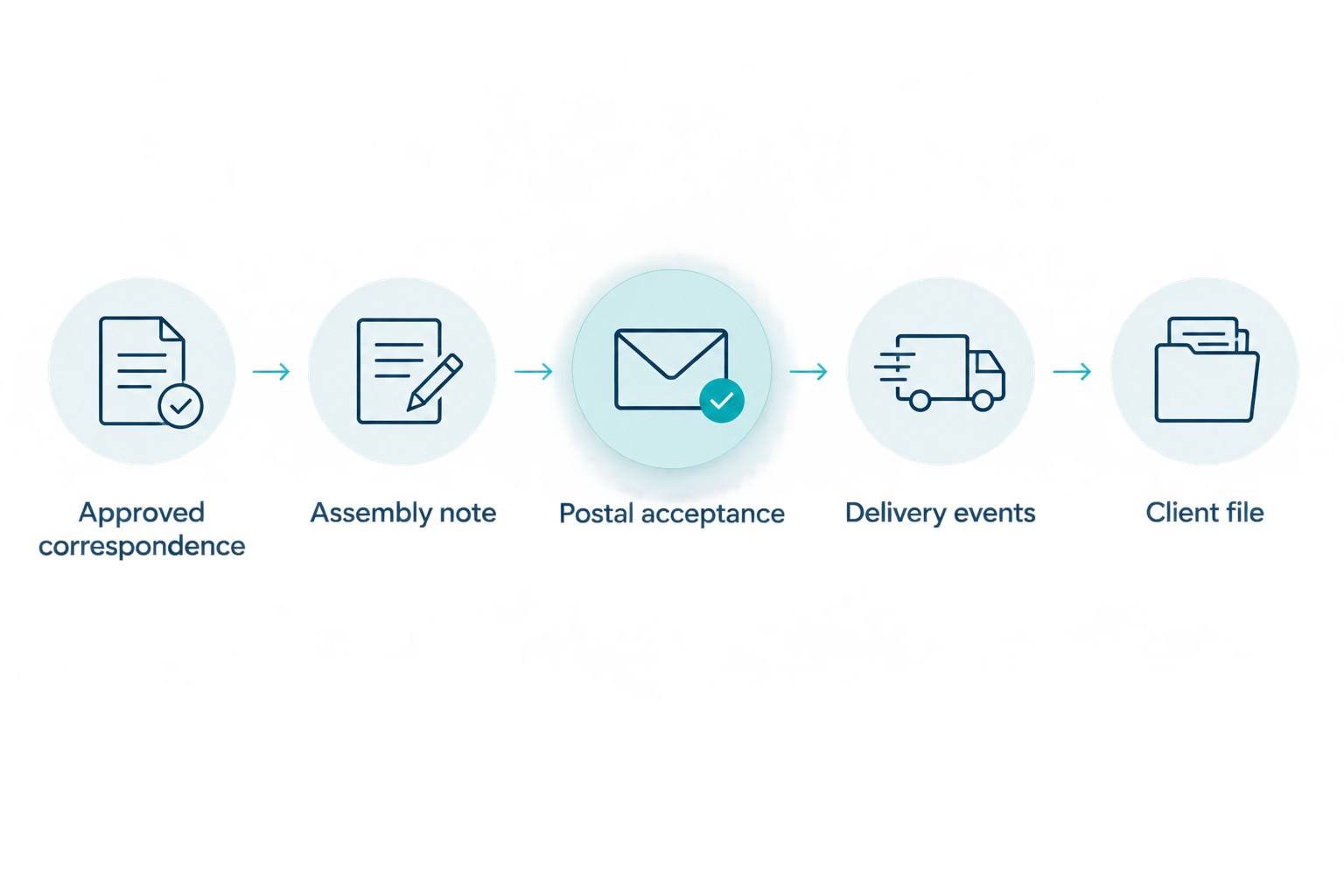
Compare mailing options for CPA correspondence
Choose the option that meets the recipient’s requirements and your evidence needs. No delivery service compensates for the wrong address, missing enclosure, or an instruction requiring electronic filing. Return Receipt is an additional service, not a different underlying filing method.
| Option | Best for | Main benefit | Key limitation |
|---|---|---|---|
| Staff-managed USPS Certified Mail | Firms with an assigned mailing owner | Direct control over preparation, acceptance, and evidence collection | Staff must manage every handoff and exception |
| USPS Certified Mail with Return Receipt | Matters needing an additional delivery record | Adds a delivery record with recipient signature information | Does not establish envelope contents or necessarily prove a named individual personally received it |
| Thecruznetwork certified mail support | Miami-Dade firms seeking document-service support | Provides a service-based option alongside notary and document services | Scope, evidence return, and handoff arrangements need direct confirmation |
| Ordinary First-Class Mail | Routine correspondence without a special evidence requirement | Simple internal dispatch process | Does not provide the Certified Mail sender’s receipt or delivery record |
| IRS-designated private delivery service | Eligible federal tax submissions using an approved service | Offers an alternative where the applicable rules permit it | Only designated services qualify, and delivery-address instructions differ |
Check the IRS’s current designated-service list before using a private carrier for a federal tax deadline. A carrier’s name alone does not establish that every service it sells qualifies. Likewise, obtain recipient-specific instructions before treating a courier delivery as an acceptable substitute.
Discuss your firm’s certified mail needs
Confirm mailing scope, document handoff, and evidence return for your Miami-Dade CPA firm.
Common mistakes CPA firms make
Treating every tax deadline as a postmark deadline
Some obligations depend on actual receipt or electronic submission. Read the controlling instructions before choosing Certified Mail, and document the rule your reviewer applied. A familiar mailing method is not proof that the method fits.
Saving the tracking number but not the approved packet
Tracking cannot identify the contents of an envelope by itself. Save the exact correspondence, attachment list, and assembly record alongside the mailing evidence. Draft versions belong outside the final evidence packet.
Assuming the return-receipt signature is the taxpayer’s signature
A delivery signature does not automatically establish that a particular named person personally received the package. Review any identity or restricted-delivery requirement separately. Do not promise more than the purchased service establishes.
Closing returned correspondence without professional review
An unclaimed or refused envelope does not answer whether a filing or notice obligation was met. Preserve the returned item and escalate it to the responsible CPA or counsel. Record the next action rather than simply marking the mailing complete.
FAQ
Is certified mail required for every IRS response?
No. Follow the instructions for the specific notice, form, or submission. Certified Mail is an evidence option, not a universal replacement for required electronic filing or another prescribed method.
Does certified mail prove what my CPA firm sent?
No. Certified Mail provides mailing and delivery-related evidence, not independent verification of the envelope’s contents. Retain the approved documents and an assembly record connected to the mailing identifier.
Do CPA firms need a return receipt with certified mail?
Not for every mailing. Return Receipt adds a delivery record, but the applicable instructions and your firm’s evidence requirements determine whether to request it. It does not replace the sender’s mailing receipt.
Can a CPA firm use a private carrier for a federal tax deadline?
Yes, when the submission qualifies and the firm uses an IRS-designated private delivery service under the applicable rules. Check the current designated-service list and the correct delivery address before dispatch.
What should a CPA firm do when certified mail is returned?
Preserve the envelope and postal markings, then refer the matter to the responsible CPA or counsel. Record the tracking history and the decision about follow-up; returned mail alone does not resolve the deadline question.
Does notarizing a tax document replace certified mail?
No. Notarization and Certified Mail perform different functions. Complete any required notarization and separately follow the recipient’s submission and delivery instructions.
Can Thecruznetwork support certified mail for CPA firms?
Yes. Thecruznetwork lists certified mail among its document services and serves individuals and businesses in Miami-Dade. Confirm your firm’s preparation, handoff, evidence-return, and follow-up requirements directly before assigning work.
One last thing
Track the evidence packet, not just the envelope. A delivered status is only one part of the record. Before closing a mailing task, have someone confirm that the approved contents, sender’s receipt, delivery information, and exception decisions are readable together in the client file.


